
Issue 001
From the Editors
Every era has its fashionable shortcut. Today it is the overnight success story: the founder who launched on a Tuesday and retired by Friday, the product that "went viral," the trend that promises to make everything easy. These stories are entertaining. They are also a poor guide to building anything that lasts.
The businesses worth admiring rarely begin with a breakthrough. They begin with a decision: to take one real problem seriously and to keep working on it after the excitement fades. They grow through hundreds of smaller decisions, most of them unglamorous. Who exactly is this for? What will they pay? What should we stop doing? Which week did we waste, and why?
Every one of those decisions starts in the same place: understanding customers. What do they struggle with? What do they already pay to fix? What would make their day measurably better? Founders who answer those questions honestly, and then act on the answers week after week, build something that lasts. Founders who skip them build on guesswork.
That is the subject of this first issue of Hustle Mag. The Startup Playbook follows the path from a first idea to a business built to last, one practical step at a time. We look at how to find an idea worth pursuing, how to test it before you spend real money, how to choose a business model that fits, and how to win your first customers without pretending to be bigger than you are. We end where every business eventually ends up: with the founder's own discipline.
You will not find promises of easy money in these pages. You will find methods, examples and questions you can use this week. Read it in order, or start with the article closest to where you are today. Then do the most valuable thing a reader can do with a magazine like this: close it, and act.
Our motto is Hustle in Silence. It is not a call for secrecy. It is a reminder that the work matters more than the announcement. Build quietly, measure honestly, improve steadily, and let the results speak.
Welcome to the first issue.
The Editors, Hustle Mag
In This Issue
The Startup Playbook
From First Idea to a Business Built to Last
Most new businesses do not fail because their founders lacked ambition. They fail because ambition was never turned into a sequence of good decisions: the right problem, the right customer, a fair price, a sensible budget and a plan simple enough to follow on a difficult Monday.
This issue is organised as that sequence. We begin with the full playbook, from problem to first sale. We then step back to the question underneath it all, which idea deserves your time, and forward again through budget, business model, planning, brand, marketing and the personal habits that hold everything together.
Each article stands on its own, and each ends with something to do. Together, they form a single route from first idea to a business built to last.
Cover Story · 01 of 08
The Startup Playbook: How to Turn an Idea Into a Real Business
From problem to first sale, the six decisions that separate a business from a hobby.
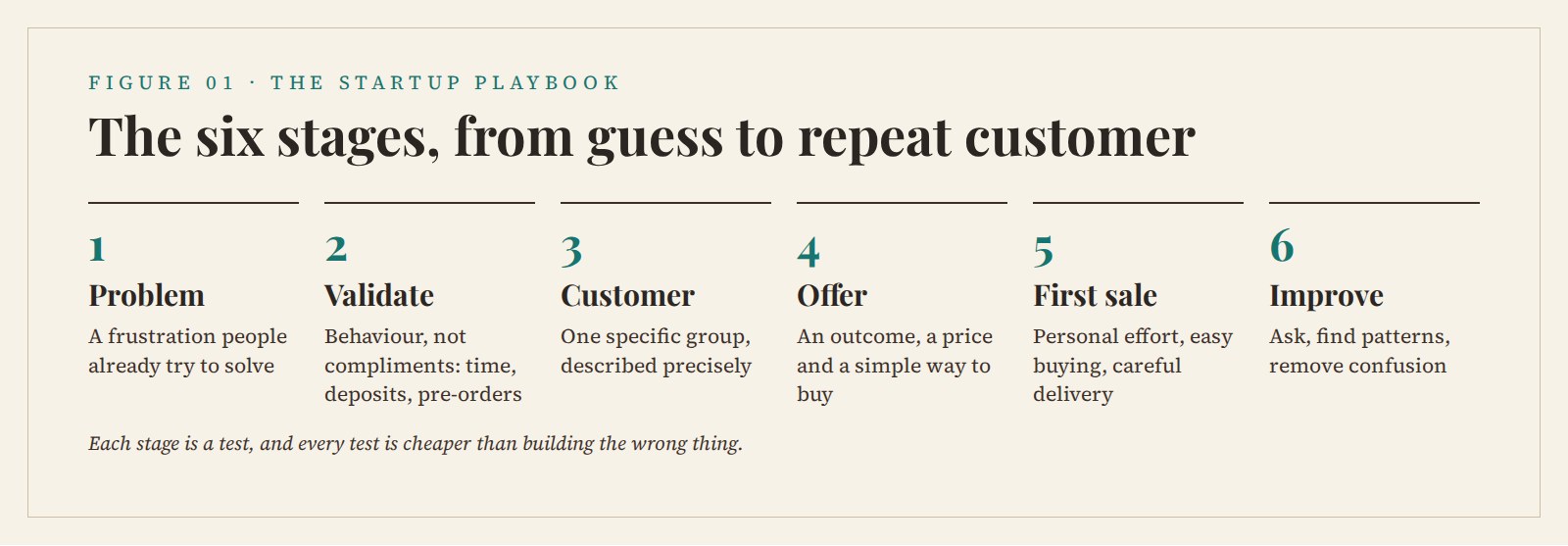
An idea is not a business. It is a guess. A business begins when that guess meets a real customer who is willing to exchange money for what you offer, and then does it again. Everything between the first thought and that repeated exchange is the work of turning a guess into evidence.
This playbook covers that work in six stages. None of them requires a large budget. All of them require honesty.
1. Start with a problem, not a product
The most common mistake new founders make is falling in love with a solution. They imagine an app, a product or a brand and then search for people who might want it. The order should be reversed. Begin with a problem that people already experience, already find frustrating and already try to solve.
A useful test is to ask: What are people doing about this today? If the answer is "nothing," the problem may not be painful enough. If the answer is "they use a clumsy workaround, pay for something they dislike or spend hours doing it by hand," you may have found something worth pursuing.
Consider a freelance bookkeeper who noticed that small restaurant owners kept their receipts in shoeboxes and paid accountants extra at year-end to sort them. The problem was obvious, frequent and already costing money. The business was a simple monthly service: collect receipts weekly, keep the books tidy and send a one-page summary. The idea was modest. The problem was real.
2. Validate demand before you build
Validation means collecting evidence that people want what you plan to offer. Compliments are not evidence. Friends who say "great idea" are being kind. Evidence is behaviour: people who give you time, information, a deposit or a pre-order.
Begin with conversations. Speak with ten to fifteen people who have the problem and ask about their recent experience. "Tell me about the last time this happened" produces far better answers than "Would you use a service that…?" Listen for how often the problem occurs, what it costs them and what they have already tried.
Then look for stronger signals. Would they join a waiting list? Pay a small deposit? Book a paid trial? Each step up the ladder of commitment tells you more than any survey.
3. Define a specific customer
"Everyone" is not a customer. A business that tries to serve everyone usually speaks to no one. Choose a specific group whose problem you understand well, and describe them precisely: who they are, what situation they are in, what they want and what stops them.
A precise description might read: independent café owners with one or two locations who post on social media inconsistently because they have no time. That sentence tells you where to find customers, what language to use and which offer will appeal. You can widen your market later. At the beginning, narrow is an advantage.
4. Test a simple offer
An offer is more than a product. It is a promise of an outcome, presented at a price, with a clear way to buy. Write it down in plain language before you build anything substantial:
- Who it is for: the specific customer.
- What it achieves: the result they care about.
- What is included: the concrete deliverables.
- The price and terms: what it costs and how they pay.
Then test it with the smallest possible version. A service can be sold before it is perfected. A product can be pre-sold with a clear delivery date. A course can begin as a live workshop. The goal is not to impress; it is to learn whether people will pay.
5. Make the first sale
The first sale changes everything because it proves that the exchange works. It rarely arrives through advertising. It usually comes from direct, personal effort: a conversation, a referral, a message to someone who told you about their problem two weeks ago.
Make buying easy. One clear price, one simple payment method and a prompt follow-up. Deliver more care than the customer expects, and pay close attention to everything that happens during delivery. Your first customers are also your best teachers.
6. Improve with feedback
After each sale, ask three questions: What nearly stopped you from buying? What was most valuable? What would you change? Write the answers down and look for patterns rather than reacting to every comment.
Improvement is not the same as adding features. Often the best change is removing confusion: a clearer description, a simpler onboarding step, a faster first result. Small, steady improvements based on real feedback compound into a business that customers recommend.
The takeaway
The path from idea to business is a series of tests, each one cheaper than building the wrong thing. This week, write down one problem you could solve, name the specific customer who has it and arrange three conversations with people in that group. Do not pitch. Listen. The business begins there.
Opportunity · 02 of 08
Finding a Business Idea Worth Pursuing
Where good opportunities actually come from, and a simple way to judge them before you commit.
Good business ideas are rarely invented in a flash of inspiration. They are noticed. They hide in complaints, in clumsy workarounds, in skills people take for granted and in the small changes that reshape how customers live and buy. The founder's job is to look carefully and then judge honestly.
This article covers both halves of that job: where to look, and how to decide whether an idea deserves your time and money.
Listen for frustration
Every frustration is a potential market. Pay attention to what people complain about, especially when they complain repeatedly and with specifics. "I can never find a reliable plumber who answers the phone" is more useful than "plumbers are bad." The first sentence points to a service gap: reliability and responsiveness.
Online reviews are a rich source. Read the three-star reviews of popular products and services in a field that interests you. One-star reviews are often emotional; five-star reviews are often vague. Three-star reviews tend to say, "It's good, but…" and the sentence after "but" is frequently a business idea.
Start from your skills
Many durable businesses begin with a skill the founder already has. A graphic designer becomes a branding studio for local trades. A former retail manager becomes a consultant who helps small shops organise their stock. A fluent bilingual speaker becomes a specialist translator for a particular industry.
List the things people already ask you to help with, the problems you solve easily that others find difficult, and the work you have been paid for before. Skills reduce the cost of starting and improve the quality of what you deliver from the first day.
Look for gaps in existing markets
A market gap is a group of customers that existing businesses serve poorly. It might be a segment that is too small for large companies to notice, a location without a good option, or a price point between "cheap and unreliable" and "excellent but expensive."
Gaps often appear when you combine two things: a familiar service with an underserved audience. Fitness coaching is common. Fitness coaching for people returning to exercise after an injury is narrower, more specific and easier to market. Accounting is everywhere. Accounting for freelance creatives who are paid through several platforms solves a particular headache.
Notice changing needs
Customer needs change with technology, regulation, work patterns and habits. When many people start working from home, they need better home offices, new routines and different services. When a new platform becomes popular, businesses need help using it. When rules change, people need guidance to comply.
Ask: What has recently become easier, harder, cheaper or more important for a particular group? Change creates new problems, and new problems create openings for businesses that respond quickly and clearly.
Evaluate before you commit
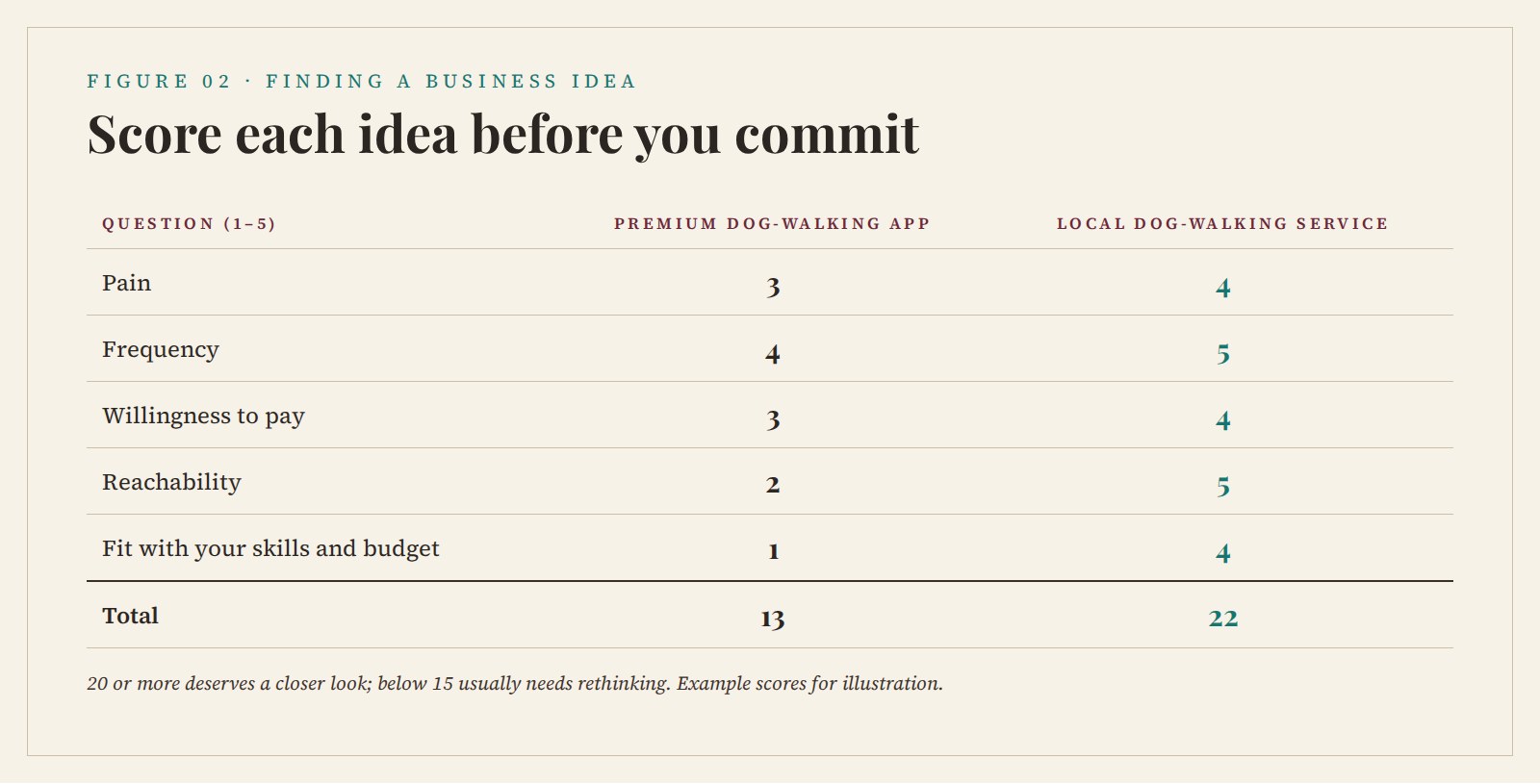
Once you have a few candidate ideas, resist the temptation to start building the most exciting one. Instead, score each idea on five questions, from 1 (weak) to 5 (strong):
- Pain: How much does this problem cost or frustrate the customer?
- Frequency: How often does it happen?
- Willingness to pay: Are people already spending money on solutions?
- Reachability: Can you easily find and contact these customers?
- Fit: Do your skills, budget and time suit this business?
An idea scoring 20 or more deserves a closer look. An idea scoring below 15 usually needs rethinking, however appealing it seems.
Consider two ideas. A premium dog-walking app scores high on excitement but low on reachability and fit for a founder with no technical skills and a small budget. A local dog-walking service with reliable scheduling and photo updates scores well on pain, frequency, willingness to pay and reachability. The second idea is less glamorous and far more likely to become a real business.
Warning signs
Some ideas look promising but carry hidden weaknesses. Be cautious when the main appeal is that a market is "hot" rather than that a specific problem is painful; when you cannot name ten real people who have the problem; when success depends entirely on a single platform, supplier or trend outside your control; or when the idea only works if large numbers of customers arrive immediately.
None of these signs automatically rules an idea out. Each one, however, is a question to answer with evidence before you invest serious time or money.
Run small tests
Scoring is a starting point, not a verdict. The next step is a small test that costs little and teaches a lot. Speak with potential customers, create a simple page that describes the offer and collects interest, or sell a limited version by hand. Set a clear goal before you begin, such as ten conversations, five people asking for a price or two paid trials.
If the test succeeds, you have earned the right to invest more. If it fails, you have saved months of effort. Both outcomes are progress.
The takeaway
Opportunities come from frustration, skill, market gaps and change, but only evidence tells you which ones are worth pursuing. Write down three ideas, score each on pain, frequency, willingness to pay, reachability and fit, and design one small test for the highest-scoring idea this week.
Money · 03 of 08
Start Small: Building a Business on a Limited Budget
Lean thinking, honest priorities and the expenses that can wait.
A small budget is not a disadvantage to be overcome. Handled well, it is a discipline that protects founders from their most expensive mistakes: building too much, too early, for customers who have not yet proved they exist.
Starting lean does not mean starting cheaply in every respect. It means spending deliberately, in the right order, on the things that create evidence and revenue.
Think in experiments, not launches
The traditional picture of starting a business involves a grand launch: a finished website, a full product line, printed materials and an advertising budget. The lean approach replaces that picture with a series of experiments. Each experiment answers one question as cheaply and quickly as possible.
Will people in this neighbourhood pay for weekly meal preparation? You do not need a commercial kitchen to find out. You need a simple menu, a few willing customers and a clear price. Will small businesses pay for monthly social media content? You need a short offer document and a handful of conversations, not a full agency brand.
Every experiment should have a defined cost, a time limit and a clear measure of success.
Separate essential from optional
Before spending money, place each expense into one of three categories:
- Essential now: Without it, you cannot deliver or legally operate. Examples include basic tools of the trade, required registrations and a way to take payments.
- Useful soon: It would make work easier once you have customers. Examples include better software, a professionally designed logo or a nicer workspace.
- Optional: It feels like progress but does not create customers. Examples include elaborate branding packages, premium office space and stock you have not tested.
In the beginning, spend almost exclusively on the first category. Move items from "useful soon" into the budget only when revenue or a clear bottleneck justifies them.
Validate before you invest
The cheapest research is a conversation. The next cheapest is a pre-sale. Before you buy stock, sign a lease or commission a website, look for proof that customers want what you plan to offer.
A small clothing brand might sell a limited pre-order run before committing to a full production order. A consultant might sell three projects at an introductory rate before investing in a polished website. A course creator might run a live online workshop before recording a complete programme. In each case, the customer funds the next step.
Use simple tools
Many early businesses run perfectly well on simple, inexpensive tools: a spreadsheet for customers and finances, a free or low-cost website builder, a shared document for processes and a basic payment provider. Complex software can come later, when you understand your workflow well enough to know what you need.
A useful rule is to adopt a new tool only when you can name the specific problem it solves and the time or money it will save. Tools that promise to transform everything rarely fix a business that has not yet found its customers.
Prioritise spending that creates revenue
When money is limited, rank possible expenses by how directly they lead to sales. Improving your offer, reaching potential customers and delivering excellent work come first. Decoration comes later.
A bakery owner with a modest budget might choose better ovens over a premium shopfront design, because the ovens improve the product customers taste every day. A freelancer might invest in a professional microphone for client calls before a custom logo, because clear communication wins work.
Keep a simple monthly budget with three lines: money in, money out and what you learned. If an expense does not support delivery, sales or learning, question it.
Know your break-even point
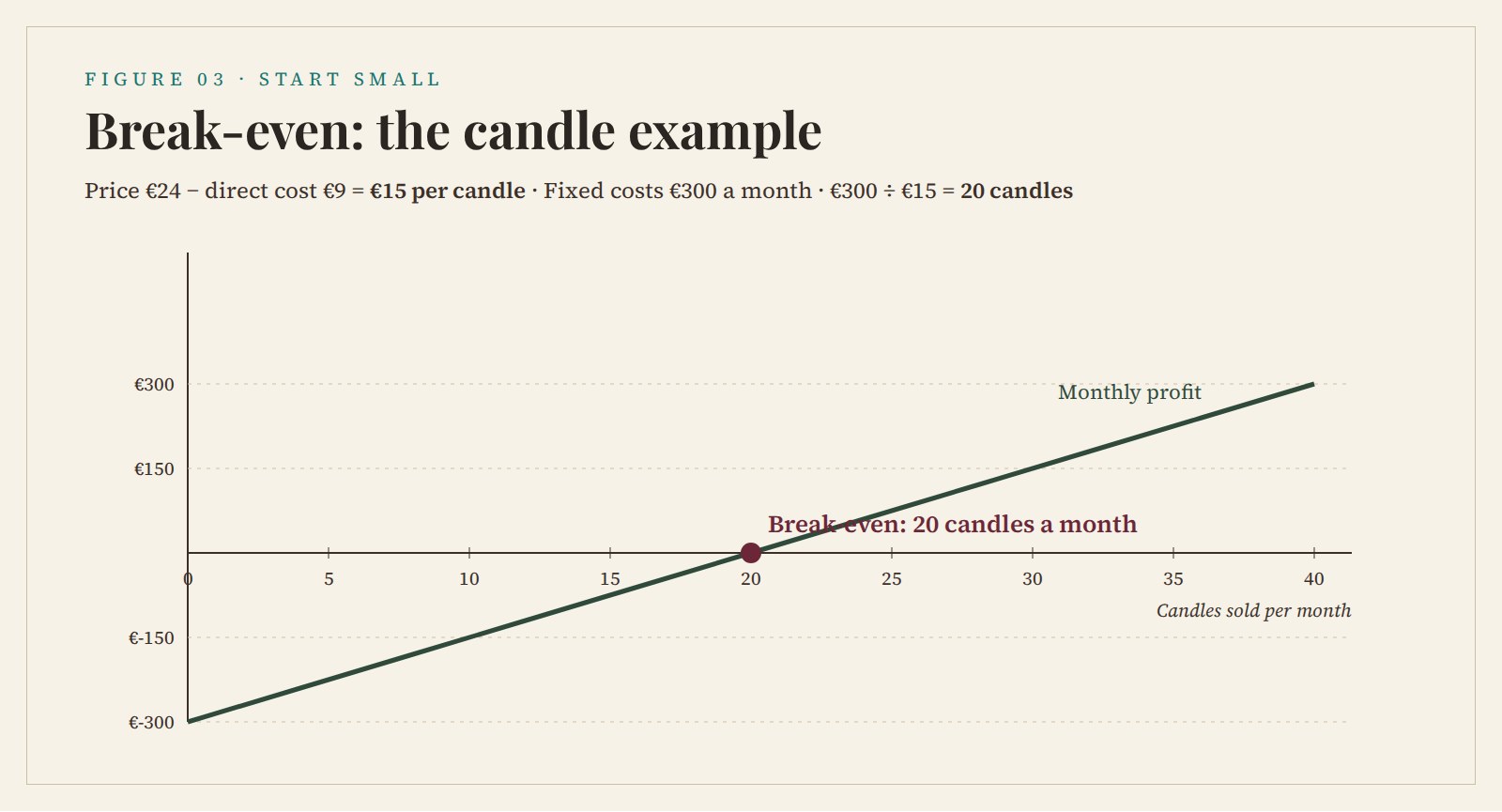
Every founder on a budget should know one number: how many sales it takes to cover monthly costs. The calculation is simple. Subtract the direct cost of each sale from its price to find what each sale contributes. Then divide your fixed monthly costs by that contribution.
Imagine a handmade candle business. Each candle sells for €24 and costs €9 in wax, jars, wicks and packaging, so each sale contributes €15. Fixed costs, including website, tools and a small market-stall fee, come to €300 a month. The business breaks even at 20 candles a month. Anything beyond that is profit; anything below it is a loss to be fixed.
Knowing this number turns vague worry into a clear target, and it shows instantly whether a new expense is worth the extra sales it requires.
Protect your runway
Your runway is the time you can keep going before money runs out. Protect it by keeping fixed costs low, avoiding long contracts early on and holding back a cash reserve for surprises. Monthly commitments are more dangerous than one-off purchases, because they continue whether or not customers arrive.
If possible, keep another income source while you test your business. Starting part-time is slower, but it allows you to make decisions based on evidence rather than fear.
The takeaway
A limited budget rewards clear thinking. List every expense you are planning, mark each as essential now, useful soon or optional, and delay everything that is not essential until a customer or a clear bottleneck justifies it.
Strategy · 04 of 08
Business Models Explained: How Your Business Will Make Money
Six common models, what each demands of you, and how to choose the one that fits.
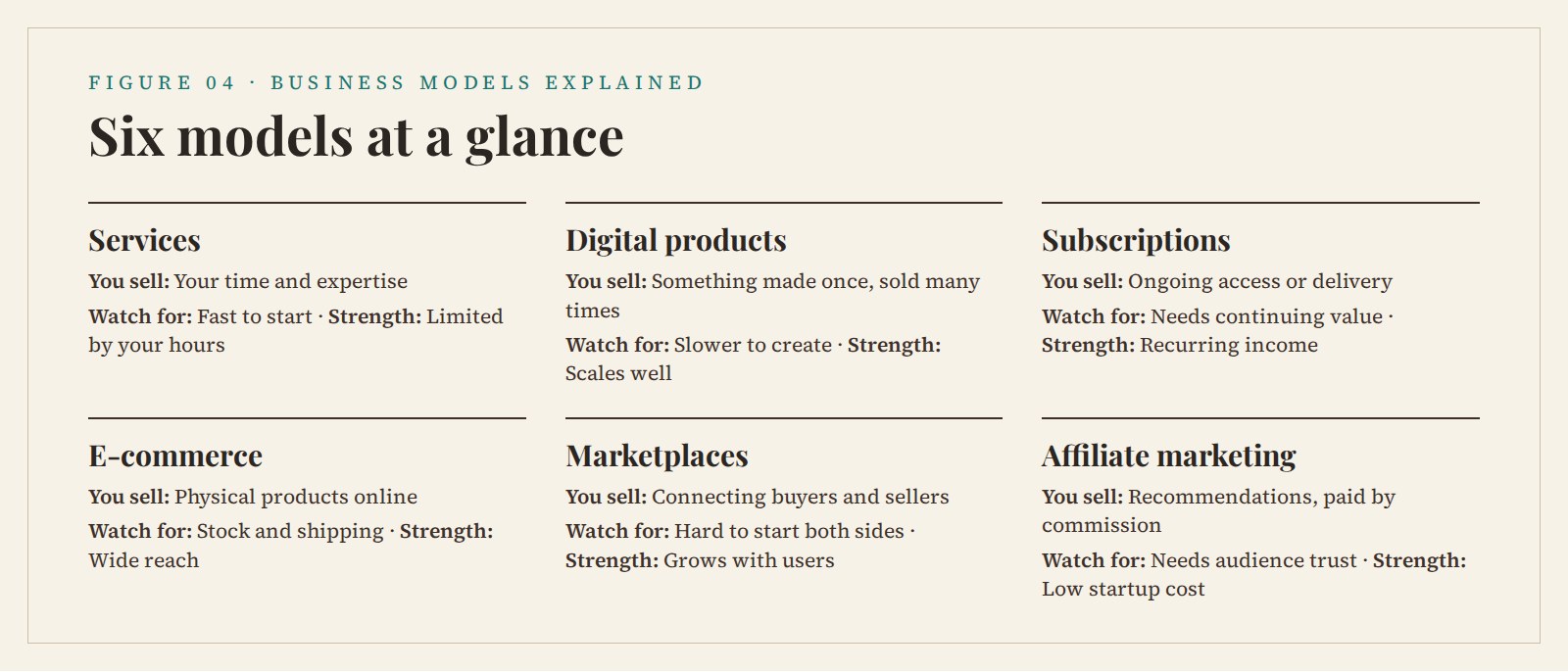
A business model is the logic of how a business creates value and earns money from it. Two businesses can serve the same customer with the same skills and still look entirely different because they choose different models. Choosing well early saves years of friction.
Here are six common models, what makes each work and what each asks of the founder.
Services
You sell your time, expertise or labour: design, consulting, cleaning, bookkeeping, coaching, marketing. Services are usually the fastest way to begin earning, because you can start with skills you already have and little upfront investment.
Strengths: quick to start, close contact with customers, high margins on skilled work. Challenges: income is limited by your hours, and growth often requires hiring.
A service business suits founders who want early revenue and deep customer knowledge. Many successful product companies began as services, learning exactly what customers needed before turning that knowledge into something scalable.
Digital products
You create something once and sell it many times: templates, guides, courses, software tools, design assets or music. Digital products can be delivered instantly and have very low costs per sale.
Strengths: scalable, no inventory, sales are not tied to your hours. Challenges: significant upfront creation time, and marketing becomes the main constraint.
Digital products work best when you understand a specific audience's problem well enough to package a clear solution.
Subscriptions
Customers pay regularly for ongoing access or delivery: software, memberships, boxes of products or recurring services. The attraction is predictable revenue that builds month after month.
Strengths: recurring income, easier planning, higher lifetime value per customer. Challenges: you must deliver continuing value, or customers cancel.
The key number in a subscription business is retention. Attracting new subscribers matters, but keeping them is what creates a stable business.
E-commerce
You sell physical products online, either products you make, buy wholesale, source from manufacturers or ship through third-party suppliers. E-commerce can reach customers far beyond your location.
Strengths: large potential market, tangible products, opportunities to build a brand. Challenges: inventory risk, shipping, returns, thinner margins and advertising costs.
Success depends on careful product selection, honest pricing that accounts for every cost, and excellent customer service.
Marketplaces
You connect buyers and sellers and earn a commission or fee on transactions: platforms for local tutors, freelance designers, rental equipment or handmade goods. Marketplaces can become very valuable once they reach scale.
Strengths: you do not hold inventory, and value grows as more people join. Challenges: you must attract both buyers and sellers at the same time, which is difficult at the start.
Marketplaces often begin by focusing on one narrow niche or location, where it is easier to build both sides.
Affiliate marketing
You recommend products or services made by others and earn a commission when people buy through your links. Affiliate businesses are usually built on content: reviews, comparisons, tutorials, newsletters or videos.
Strengths: no product creation, low startup costs, flexible schedule. Challenges: income depends on audience trust and traffic, and programmes can change their terms.
Honesty is the foundation. Clear disclosure, genuine recommendations and helpful content build the trust that affiliate income depends on.
One skill, three models
To see how much the model matters, consider a food photographer. As a service, she photographs menus for local restaurants and charges per shoot. As a digital product, she sells a pack of lighting presets and a short guide to phone food photography. As a subscription, she offers restaurants a monthly package: fresh photos of seasonal dishes, delivered every four weeks.
The skill is identical in each case. The customers, the marketing, the workload and the income pattern are completely different. The service brings cash quickly. The digital product earns while she sleeps but needs an audience first. The subscription offers stability but demands reliable monthly delivery. None is "best"; each suits a different founder at a different stage.
How to choose
Choose a model by answering four questions:
- What does the customer prefer? Some customers want a done-for-you service; others want to learn and do it themselves.
- What can you offer well today? Your skills and resources should match the model's demands.
- How much capital and time do you have? Services need little money; e-commerce and marketplaces often need more.
- What kind of business do you want to run? A service means client work; a digital product means creation and marketing; a subscription means continuous delivery.
Models can also be combined over time. A marketing consultant might start with services, create a template pack for clients who cannot afford a full engagement, and later launch a membership with monthly guidance. Each step builds on what came before.
The takeaway
The right model fits the customer, the offer and the founder at the same time. Write down two models that could suit your idea, list what each would require from you in time, money and skills, and choose the one you could start testing within thirty days.
Planning · 05 of 08
The First Business Plan: A Practical Roadmap for Founders
Forget the forty-page document. Nine questions and a 90-day plan you will actually use.
The traditional business plan has an image problem. Many founders picture a long document full of projections, written to impress a bank and then forgotten in a drawer. That kind of plan has its place, but it is not what a new business needs first.
What a new business needs is a working roadmap: short enough to read in five minutes, specific enough to guide decisions and honest enough to change when evidence arrives. Here is a framework built around nine questions, followed by a 90-day execution plan.
The one-page plan
Answer each question in two or three sentences. If you cannot, that is useful information: it shows where your thinking needs work.
1. Target customer. Who exactly are you serving? Describe their situation, not just their demographics. "Freelance designers who struggle to find steady clients" is more useful than "people aged 25 to 40."
2. Problem. What specific problem do they have, and what does it cost them in time, money or stress?
3. Offer. What will you provide, and what outcome will the customer get? Name the concrete deliverables.
4. Positioning. Why should customers choose you instead of an alternative, including the option of doing nothing? State one clear reason.
5. Pricing. What will you charge, and why? Base the price on the value of the outcome and the cost of delivery, not only on what competitors charge.
6. Marketing channels. Where will you find your first customers? Choose one or two channels you can work on consistently.
7. Expenses. What will it cost to deliver and to operate each month? Separate one-off costs from recurring ones.
8. Revenue assumptions. How many customers do you expect, at what price, over what period? Write these as assumptions to test, not facts.
9. Key risks. What could stop this from working, and how will you find out early?
A one-page plan in practice
Here is how the first five answers might read for a small social media service. Customer: owners of independent cafés with one or two locations. Problem: they know they should post regularly but have no time, so their accounts look abandoned. Offer: twelve professionally written and designed posts a month, scheduled in advance, with one short monthly report. Positioning: specialised in cafés, with menu-based content ideas ready every season. Pricing: a fixed monthly fee, with a three-month minimum.
Five sentences, and the founder already knows where to find customers, what to say to them and what to deliver. That is the purpose of a first plan.
Writing realistic assumptions
The weakest part of most first plans is the revenue section. It is tempting to start with a target, such as €5,000 a month, and work backwards to whatever numbers make it possible. Reverse the process. Start with what you can actually do.
How many conversations can you hold each week? What share of them might reasonably turn into sales? How long does each delivery take? A consultant who can hold eight sales conversations a week and closes one in four will win about two clients a week, if each client can be served in the time available. Assumptions built from activity are easier to test and harder to fool yourself with.
Mark every assumption with the date by which you expect to know whether it holds. Your plan then becomes a list of questions with deadlines.
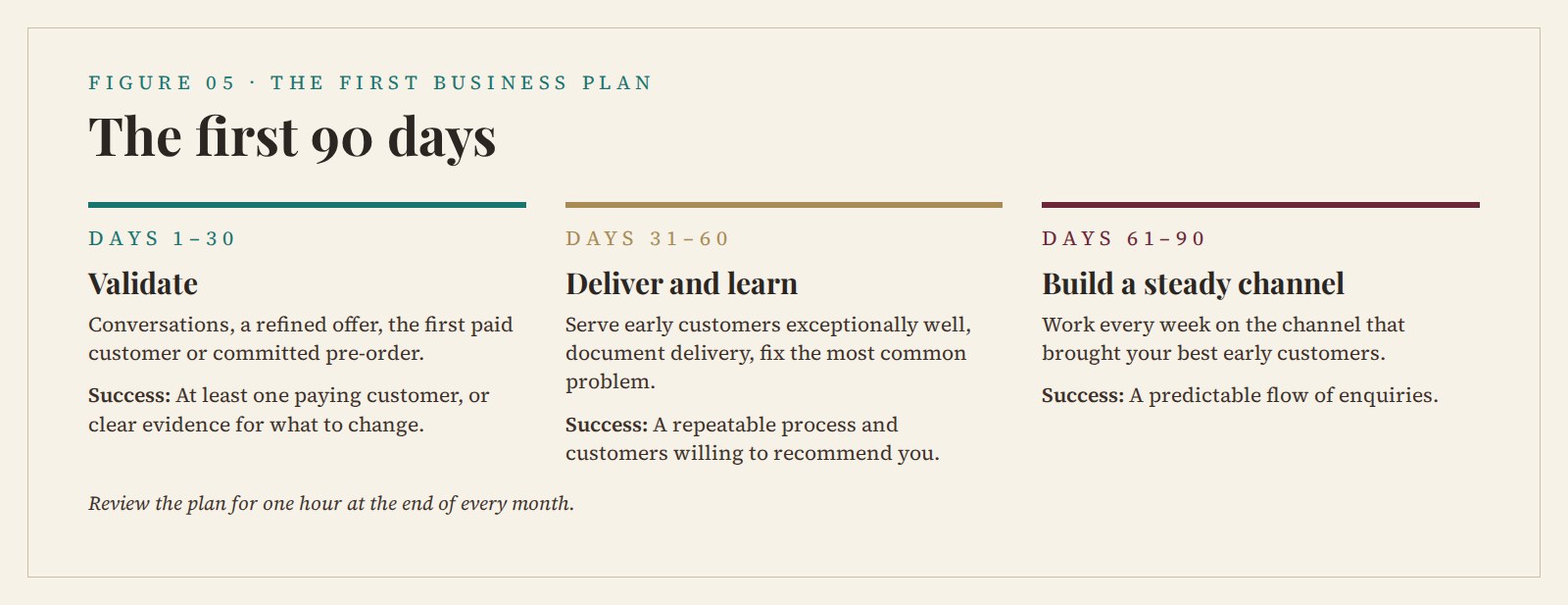
The first 90 days
A plan is only useful if it turns into action. Divide the first three months into three focused phases.
Days 1–30: Validate. Hold conversations with potential customers, refine the problem and the offer, and aim for your first paid customer or committed pre-order. Success measure: at least one paying customer, or clear evidence for what to change.
Days 31–60: Deliver and learn. Serve your first customers exceptionally well. Document how you deliver the work so it can be repeated. Collect feedback and testimonials, and fix the most common problem. Success measure: a repeatable delivery process and satisfied customers willing to recommend you.
Days 61–90: Build a steady channel. Choose the marketing channel that produced your best early customers and work on it every week. Set a weekly activity target, such as a number of posts, outreach messages or partner conversations. Success measure: a predictable flow of enquiries.
Review the plan monthly
Set aside an hour at the end of each month. Compare what happened with what you assumed. Which assumptions held? Which were wrong? What will you change next month?
The plan is not a promise you failed to keep when reality differs. It is a tool for noticing the difference early. Founders who review their plans regularly make smaller mistakes and correct them faster.
When you need a longer plan
If you seek a bank loan, investment or a significant partnership, you may need a fuller document with financial statements, market analysis and detailed projections. The one-page plan is still the right foundation. A longer plan built on tested assumptions is far more convincing than one built on hope.
The takeaway
A good first plan is short, specific and constantly tested. This week, answer the nine questions on a single page, write your three most important assumptions with a deadline for each, and set one measurable goal for your first 30 days.
Brand · 06 of 08
Branding Before Promotion: Building a Business People Remember
A brand is not a logo. It is the promise customers believe you will keep.
Many founders treat branding as decoration: a logo, a colour palette and a clever name, arranged before launch and admired on a screen. These elements matter, but they are the visible surface of something deeper. A brand is what people believe about your business, and what they expect when they choose you.
Promotion amplifies that belief. If the belief is unclear or weak, promotion simply spreads confusion faster. That is why branding comes first.
Start with positioning
Positioning is the place your business occupies in the customer's mind compared with the alternatives. It answers a simple question: Why this, rather than something else?
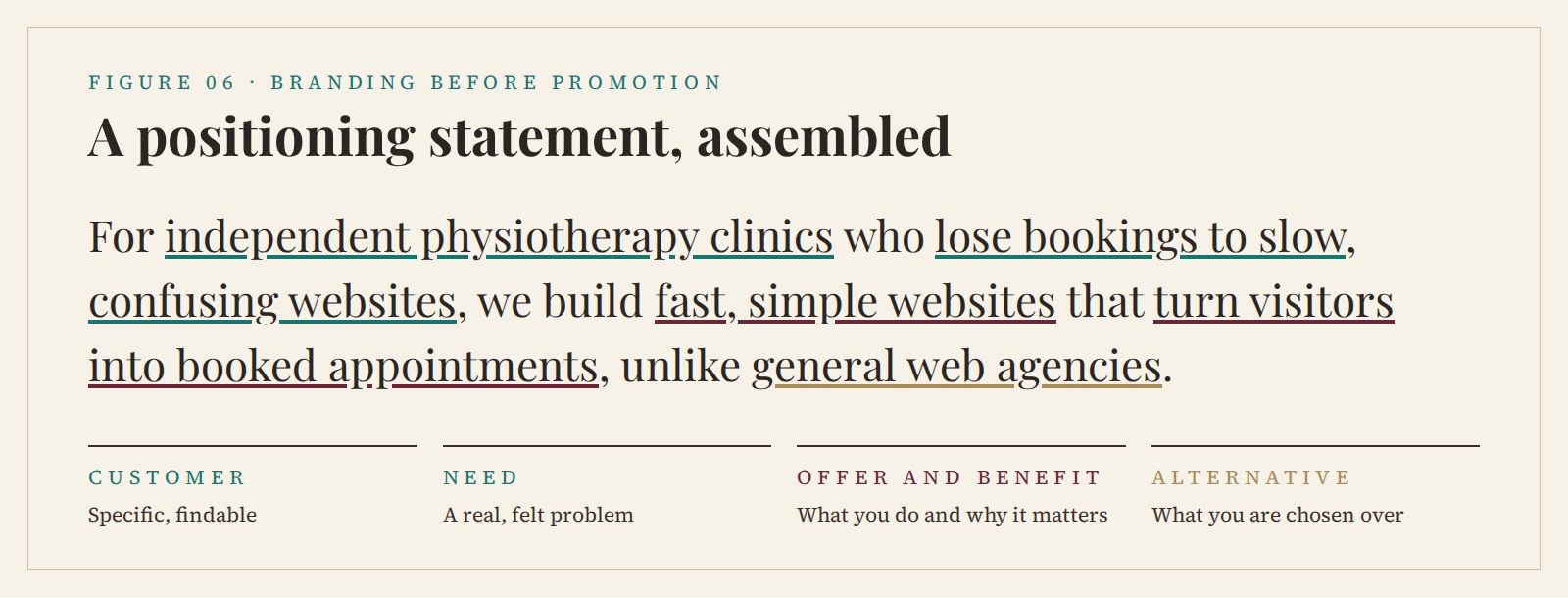
Strong positioning is specific. "A web designer" competes with thousands of others. "A web designer who builds fast, simple websites for independent physiotherapy clinics" stands apart instantly. The narrower statement makes marketing easier, referrals more natural and prices easier to defend.
A useful formula: For [specific customer] who [need or problem], we provide [offer] that [distinct benefit], unlike [alternative]. Write it plainly, even if you never publish the sentence. It will guide every decision that follows.
Make a brand promise you can keep
A brand promise is the experience customers can rely on every time. It might be speed, reliability, craftsmanship, clarity, warmth or expertise. It must be true, and it must be delivered consistently.
A small removals company might promise "on time, every time, with nothing broken." That promise shapes hiring, scheduling, packing materials and how complaints are handled. The promise is not a slogan to print on a van. It is a standard the whole business lives by.
Be careful not to promise everything. "Cheapest, fastest and highest quality" convinces no one. Choose what you will be known for, and accept what you will not.
Differentiate with substance
Differentiation means giving customers a real reason to choose you. The strongest reasons are rarely cosmetic. They come from a better process, deeper specialisation, a clearer guarantee, a more convenient experience or a particular point of view.
Ask your first customers why they chose you. Their answers often reveal your genuine differentiation more accurately than any brainstorming session. One accountant discovered that clients valued her plain-English monthly summaries more than anything else. She made those summaries the centre of her brand.
Stay consistent
Consistency builds recognition and trust. Customers should have a similar experience whether they visit your website, read an email, speak with you on the phone or receive your product.
Consistency covers your name and visual style, but also your tone of voice, response times, quality standards and the way you handle problems. A beautifully designed website followed by slow, careless replies damages a brand more than a plain website followed by excellent service.
Write down a few simple rules: how you describe what you do, how you sound, which colours and fonts you use, and how quickly you respond. Share them with anyone who helps you.
Visual identity: clear before clever
Your logo, colours and typography should be clear, appropriate for your customers and easy to use across your materials. A financial advisory firm and a children's party business should not look alike, because their customers expect different things.
At the beginning, a simple, well-executed identity is enough. A clean wordmark, two or three colours and one or two fonts used consistently will serve you better than an elaborate design you cannot maintain. Invest more once you understand your customers and your positioning.
Build credibility
New businesses lack history, so they must earn trust in other ways. Show real work and real results. Share specific testimonials with permission. Explain your process openly. Display clear contact details, honest prices and fair policies. Write useful content that demonstrates your expertise.
Every claim should be true and verifiable. Credibility built honestly grows over time. Credibility borrowed through exaggeration collapses at the first disappointed customer.
A brand in practice
Consider a small cleaning company that described itself as "professional cleaning services for homes and offices." Its website looked like dozens of others, and customers chose mainly on price.
After asking its best clients why they stayed, the owner noticed a pattern: busy parents valued the fact that the same trusted cleaner came every week and left a short note about anything unusual. The company repositioned itself as "the same trusted cleaner, every week, for busy families." It introduced the weekly note as a standard, featured its cleaners by first name and replaced generic stock photos with real ones.
Nothing about the cleaning changed. What changed was clarity. Enquiries became more relevant, cancellations fell and price discussions became shorter, because customers understood exactly what they were paying for.
The takeaway
Branding is the work of deciding what you stand for and then proving it consistently. Write your positioning statement and a one-sentence brand promise, ask three customers why they chose you, and adjust your website and messages so they communicate that real value clearly.
Growth · 07 of 08
Your First Customers: Practical Marketing for a New Business
Before advertising, there is a simpler path: be useful, be direct and be easy to recommend.
The first customers are the hardest to win. You have no reviews, no case studies and no reputation to lean on. Yet these early customers matter more than any others, because they prove your offer works and teach you how to improve it.
The good news is that winning them rarely requires a large budget. It requires clarity, persistence and a willingness to do things that do not scale.
Start with the people closest to you
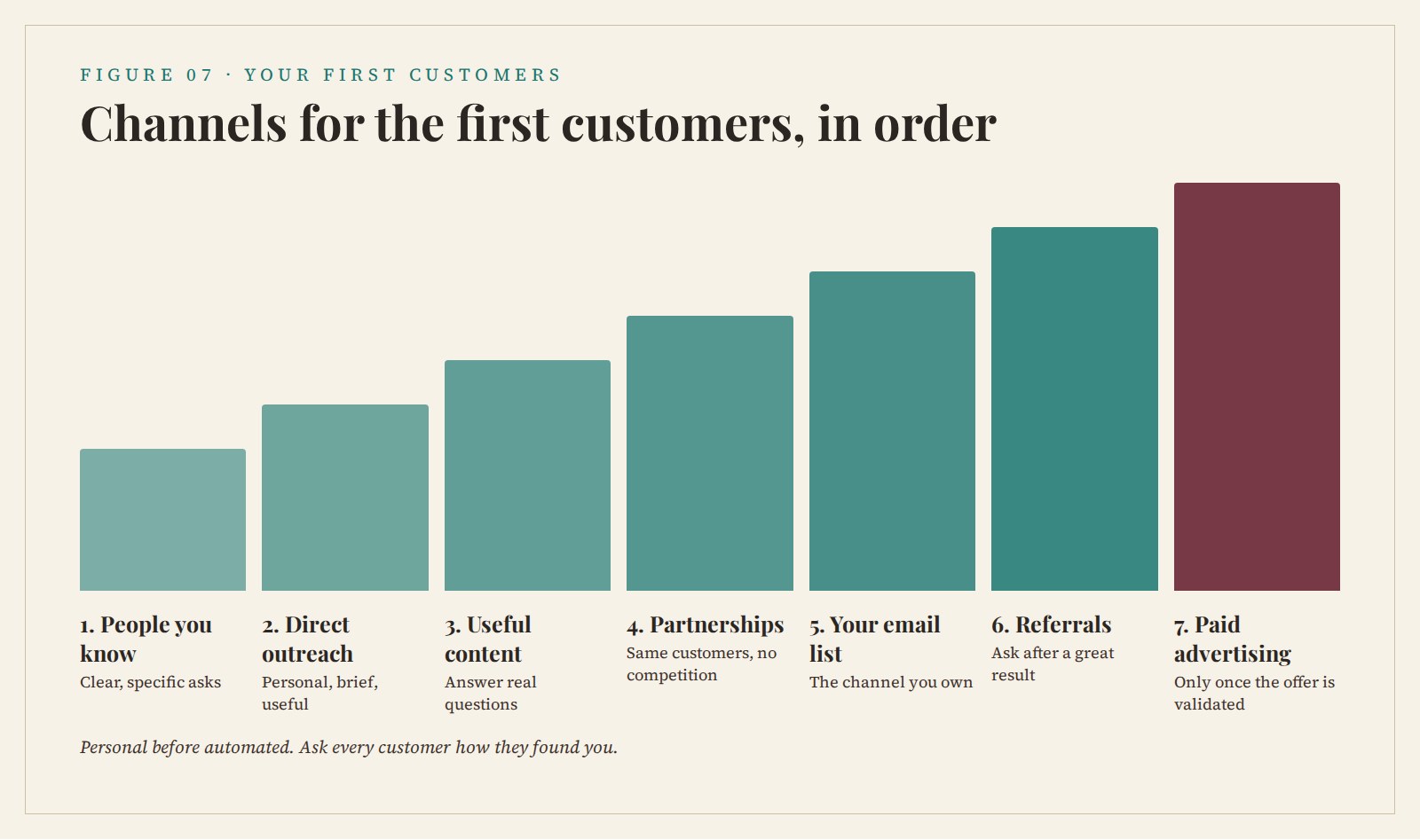
Your first customers are often one or two steps away: former colleagues, acquaintances, members of communities you already belong to and people who have mentioned the problem you solve. Tell them clearly what you now offer and who it is for. Ask not only whether they need it, but whether they know someone who does.
Be specific. "I've started a business, let me know if I can help" produces polite silence. "I'm helping small restaurants post consistently on Instagram without spending their evenings on it. Do you know any owners who struggle with that?" gives people something to act on.
Direct outreach, done respectfully
Direct outreach means contacting potential customers personally: a message, an email or a visit. It is uncomfortable for many founders, but it is one of the most reliable ways to win early business.
Good outreach is personal, brief and useful. Show that you understand the recipient's situation, offer something of value and make it easy to reply. A web designer might send a local business a short note pointing out one specific improvement to its booking page, with no obligation. Many will ignore it. Some will reply, and those conversations become customers.
Keep a simple record of who you contacted, when and what happened. Follow up once or twice, politely, and respect anyone who is not interested. Always follow the rules on unsolicited messages in your country.
Organic content
Content means sharing useful information where your customers already spend time: social media, a blog, a newsletter or videos. Its purpose is to demonstrate expertise and build trust before people are ready to buy.
The most effective early content answers real questions your customers ask. A personal trainer might explain how to exercise safely with lower back pain. An accountant might explain which expenses freelancers often forget to claim. Each piece should be practical enough that someone could act on it immediately.
Consistency matters more than volume. One helpful post a week for six months will usually outperform a burst of daily posts that stops after three weeks.
Partnerships
Partnerships connect you with customers who already trust someone else. Look for businesses that serve the same customers without competing with you. A wedding photographer might partner with florists and venues. A bookkeeper might partner with a business lawyer. A dog trainer might partner with local pet shops.
Offer partners something genuinely useful: referrals in return, a resource for their customers or a joint workshop. The best partnerships make both businesses look good.
Email: the channel you own
Social platforms change their rules; your email list belongs to you. From the beginning, invite interested people to join a simple newsletter, perhaps by offering a short guide or checklist related to your service.
Send useful emails regularly, not just announcements and offers. A list of two hundred engaged readers who trust you is far more valuable than thousands of followers who barely notice your posts. Always include an easy way to unsubscribe.
Referrals
Delighted customers are your best marketing. Make referrals easy by asking at the right moment, usually right after you have delivered a great result. Be specific: "If you know another café owner who'd find this useful, I'd be grateful for an introduction."
Some businesses offer a small thank-you for referrals. Whether or not you do, the foundation is the same: work good enough that people want to talk about it.
Track where customers come from
Ask every new customer one simple question: How did you hear about us? Record the answer alongside the sale. After a few months, patterns appear. Perhaps most of your best clients came from partner referrals, while social media brought many enquiries but few sales.
This simple habit tells you where to spend your limited time. Double down on the channels that bring good customers, and stop investing in those that only bring attention.
When to use paid advertising
Paid advertising can accelerate growth, but it magnifies whatever is already true about your offer. If people do not yet understand or want what you sell, ads will spend your money proving it.
Advertise once you have validated your offer: you know who buys, why they buy and roughly how much a customer is worth to you. Start with a small, controlled budget, test one clear message and measure the cost of each customer you win. Scale only what works.
The takeaway
Early marketing is personal before it is automated. This week, write a one-sentence description of who you help and how, send it to ten people who could buy or refer, and publish one piece of genuinely useful content for your target customer.
Execution · 08 of 08
The Founder's Discipline: Turning Ambition Into Consistent Execution
Motivation starts the work. Systems, focus and honest reviews finish it.
Ambition is common. Execution is rare. Most people who dream of building a business have enough intelligence and energy to succeed. What separates those who do from those who drift is usually not talent but discipline: the ability to choose what matters, do it consistently and learn from what happens.
Discipline is often misunderstood as relentless willpower. In practice, it is better described as good design. Disciplined founders build simple systems that make the right work easier and the wrong work harder.
Choose fewer priorities
A new business offers endless possible tasks: improving the website, posting on every platform, refining the logo, researching tools, networking, learning new skills. Doing a little of everything feels productive and achieves little.
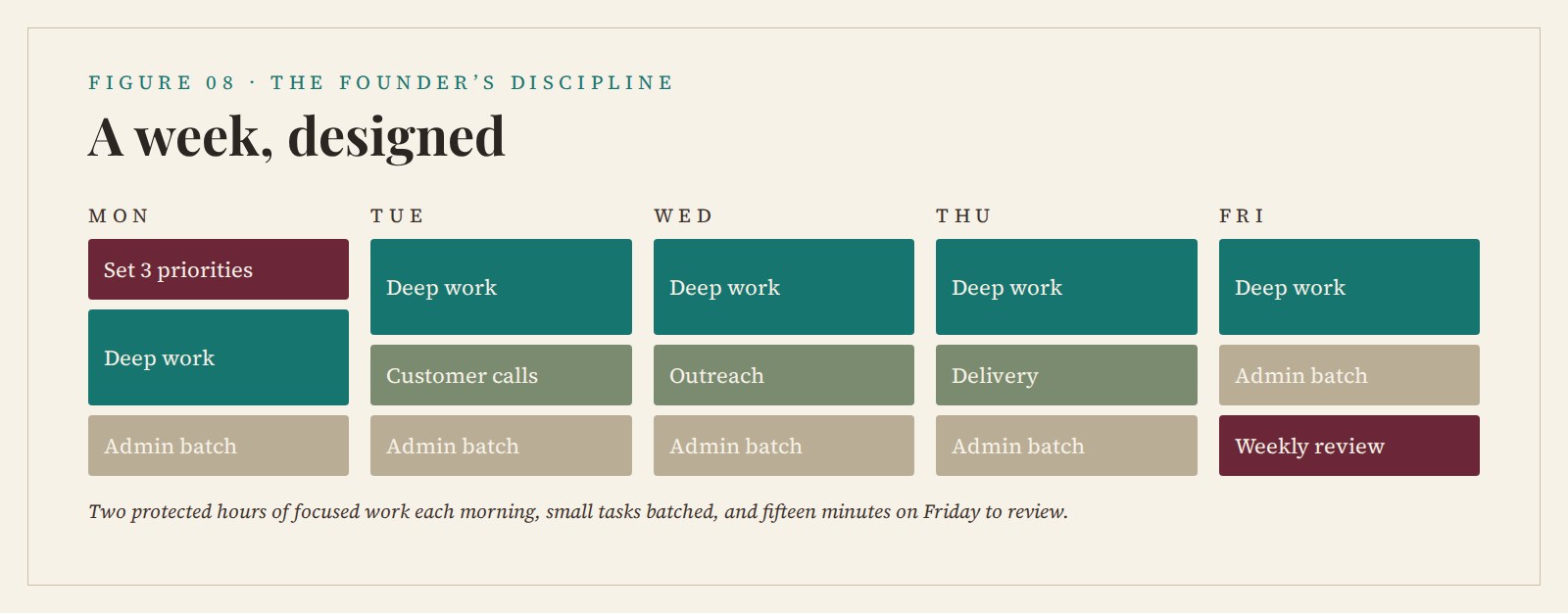
Each week, choose no more than three priorities that move the business forward. Early on, almost all of them should relate to customers: speaking with them, selling to them, delivering for them or improving what you offer. A useful question when choosing is: If I only achieved this one thing this week, would the business be meaningfully better?
Write your three priorities somewhere visible. When a new idea appears, write it on a separate list rather than starting it immediately. Most ideas look less urgent a week later.
Protect your focus
Deep, focused work is where most valuable progress happens: writing an offer, building a product, solving a difficult customer problem. It is also the work most easily interrupted.
Reserve blocks of time for focused work and protect them. Turn off notifications, close unrelated tabs and tell others when you are unavailable. Many founders find that two uninterrupted hours in the morning produce more than an entire day of scattered effort.
Group small administrative tasks, such as emails, invoices and messages, into one or two set times each day instead of handling them the moment they arrive.
Manage time realistically
Founders consistently overestimate what they can do in a day and underestimate what they can do in a year. Plan with this in mind. Leave space in your schedule for the unexpected, and break large goals into small, concrete next actions.
"Grow the business" is not a task. "Send five outreach messages to café owners" is. When your next action is clear and small, starting becomes easier, and starting is often the hardest part.
If you are building alongside a job or other responsibilities, be honest about your available hours. Five focused hours a week, used consistently on the right priorities, can build a real business over time.
Learn to say no
Every yes is also a no to something else. Opportunities will arrive that look attractive: a side project, a partnership outside your focus, a customer who wants something you do not really offer. Saying yes to all of them spreads your time thin and slows the core business.
Before accepting a new commitment, ask whether it supports your current priorities. If it does not, decline politely, or write it on your idea list for a later review. Founders who protect their focus often move faster precisely because they do fewer things.
Make decisions and move
Indecision is expensive. Founders often delay decisions while waiting for perfect information that never arrives. Most early decisions are reversible: a price can be changed, a message rewritten, a channel abandoned.
For reversible decisions, set a short deadline, gather the information you reasonably can and decide. Save extended deliberation for decisions that are costly or difficult to undo, such as long contracts, large purchases or partnerships. Then judge decisions by the quality of your reasoning at the time, not only by the outcome.
Track progress honestly
What gets measured gets attention. Choose a small number of indicators that reflect real progress: conversations held, offers sent, sales made, customers retained, revenue and costs. Record them weekly in a simple spreadsheet.
Track activities as well as results. Results often lag behind effort, especially at the start. If you held twenty sales conversations and made no sales, that is valuable information about your offer. If you held two conversations, the problem is activity, not the offer.
Learn from setbacks
Every founder faces rejection, mistakes and disappointing weeks. The difference lies in what happens next. Treat setbacks as information. After a lost sale or a failed experiment, ask: What happened? What did I learn? What will I do differently? Write the answers down.
Avoid two traps: blaming yourself entirely, and blaming circumstances entirely. The useful answer usually lies in between and points to something specific you can improve.
Build sustainable habits
A business is a long project. Habits that depend on exhaustion eventually fail. Protect sleep, take regular breaks and make time for people and interests outside work. Sustainable effort over years beats heroic effort over months.
End each week with a short review: what you achieved, what you learned, and your three priorities for the following week. This simple ritual turns scattered effort into steady direction.
The takeaway
Discipline is not a personality trait. It is a set of simple practices repeated until they become normal. Tonight, write your three priorities for the coming week, block two hours of focused time in your calendar, and schedule a fifteen-minute review at the end of the week.
Before you close this issue
Your Action Plan
Your next 30 days
Week 1: Choose the problem. Write down five frustrations you have seen people pay to solve. Pick one, and describe the customer in a single sentence.
Week 2: Test the demand. Speak with ten people who have that problem. Ask about the last time it happened and what they did about it. Do not pitch.
Week 3: Make an offer. Write a one-page offer with a clear outcome, a price and a simple way to buy. Show it to the people you spoke with.
Week 4: Make the first sale, then improve. Deliver the work, collect feedback, fix the biggest problem and ask for a referral.
Keep a short weekly log: what you did, what you learned, what you will change. Progress you write down is progress you can repeat.
Keep learning
Hustle Influence offers practical online courses on faceless content, marketing agencies, Amazon, affiliate marketing, e-commerce and trading education, plus AI tools that help you turn ideas into action.
hustleinfluence.com
HUSTLE MAGHustle in Silence.