
Contents · Edition 005
Edition 005
From the Editors
Most failed businesses were built carefully. The product worked, the website was attractive and the founder worked hard. What was missing was not effort but evidence: proof, gathered early, that enough people wanted the thing badly enough to pay for it.
This issue is about gathering that proof before you spend serious time or money. Validation is not a single test or a box to tick. It is a way of thinking that treats every important belief about your business as an assumption until customers confirm it with their behaviour.
The methods here are deliberately modest. A simple page, a handful of honest conversations, a pre-order, a service delivered by hand. None requires a large budget. All of them answer the same question faster and more cheaply than building first and hoping later.
Validation also requires a particular kind of courage: the willingness to hear an answer you did not want. A test that disproves your idea in three weeks is not a failure. It is three months, or three years, returned to you.
Read this issue with your current idea in mind, and choose the one assumption you will test first.
The Editors, Hustle Mag
In This Edition
Validate Before You Build
Test Demand Before You Commit Time and Money
Every new product or business rests on assumptions: that a problem is real, that customers will pay, that you can reach them and that you can deliver profitably. Validation is the practice of testing those assumptions cheaply, in order of risk, before committing to them.
This issue follows that practice step by step. We begin with why evidence beats opinion and how to find your riskiest assumptions. We then cover smoke tests, pre-sales, manual delivery and price tests. We finish with reading results honestly and making the hardest decision of all: whether to pivot, persevere or stop.
Each article ends with a test you can run this week.
Cover Story · 01 of 08
The Case for Evidence
Opinions are free and plentiful. Evidence costs a little effort, and it is worth far more.
When founders share a new idea, they usually receive encouragement. Friends say it sounds great. Family members say they would definitely buy it. Colleagues suggest features. This feedback feels like validation, but it is not. It is opinion, offered kindly, by people who are not being asked to pay.
Validation means replacing opinions with evidence: observable behaviour that shows real people want what you plan to offer. The difference between the two is often the difference between a business that grows and one that quietly runs out of money.
Why building first is so tempting
Building feels productive. Designing a logo, creating a website, developing a product or ordering stock all produce something visible. Testing demand, by contrast, can feel uncomfortable. It involves asking strangers for their time, presenting something unfinished and risking rejection.
That discomfort is precisely why validation is valuable. The questions you avoid by building first do not disappear. They wait until launch, when the cost of the answer is much higher.
What counts as evidence
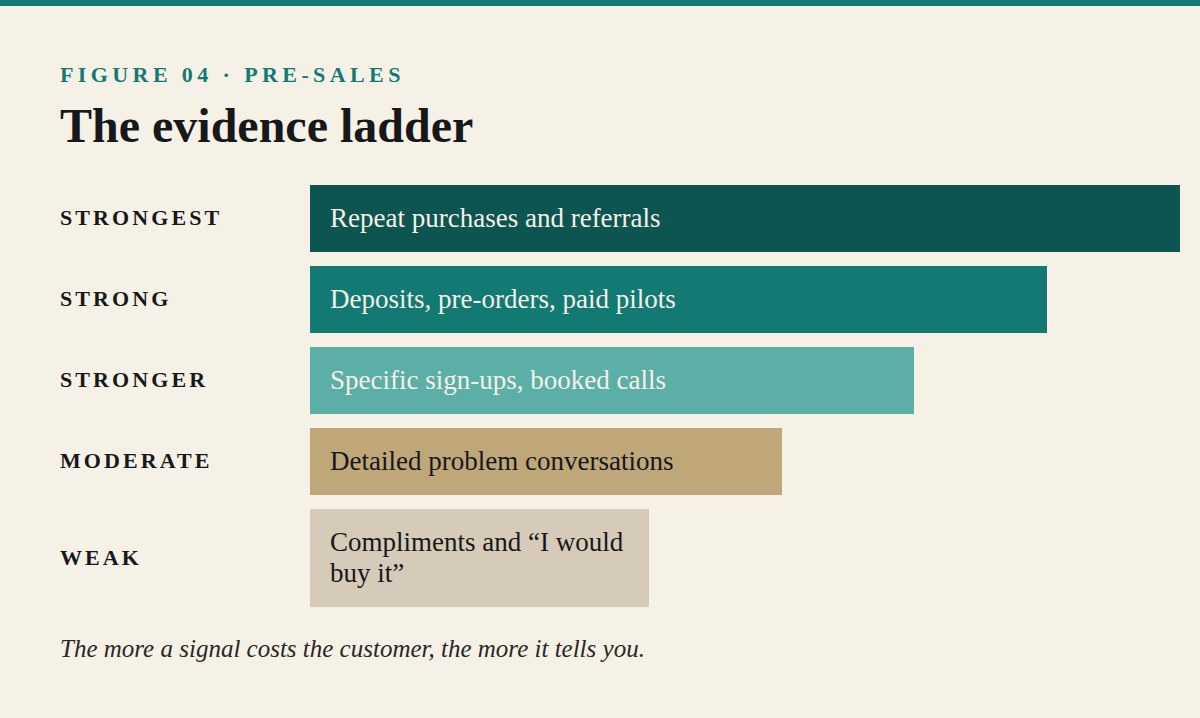
Evidence is behaviour that costs the customer something: time, effort, reputation or money. The more it costs, the stronger the evidence. A rough order of strength might look like this:
- Weak: compliments, likes and statements that people would probably buy.
- Moderate: detailed conversations about the problem and the time people already spend on it.
- Stronger: email sign-ups for a specific offer, requests for a call or introductions to colleagues.
- Strong: deposits, pre-orders, signed letters of intent or paid pilots.
- Strongest: repeat purchases and referrals from paying customers.
A single paying customer is often more informative than a hundred enthusiastic comments.
A single paying customer is often more informative than a hundred enthusiastic comments.
Validation is not a single test
Founders sometimes treat validation as one experiment: launch a page, count sign-ups, declare success. In reality, a business depends on several assumptions, and each may need its own test. Customers may genuinely have the problem but refuse your price. They may want your product but be impossible to reach affordably. Delivery may cost more than expected.
Good validation works through these assumptions in order of risk, starting with the beliefs that would end the business if they proved false.
Cheap tests before expensive ones
The guiding principle is simple: learn as much as possible for as little as possible. A conversation costs nothing. A simple landing page costs a few hours. A manual pilot costs some effort. Building a full product, hiring staff or ordering inventory costs far more.
Use cheap tests to decide whether more expensive tests are justified. Each successful step earns the right to invest a little more.
Decide what success looks like in advance
Before running a test, write down what result would count as success and what would count as failure. Without this, it is too easy to interpret any result as encouraging. Ten sign-ups can be described as promising or disappointing depending on what you hoped for.
A clear criterion, such as "at least five deposits from thirty conversations within two weeks", turns a vague experiment into a decision tool.
An example in practice
A founder planned to open a children's coding club and was ready to lease a room and buy laptops. Instead, she ran a single four-week course in a borrowed community space, advertised through local parent groups, with a modest fee paid in advance. Twelve places sold within a week, and eight parents asked about the next course. Only then did she sign a lease, with evidence that demand existed and a waiting list to start from.
Method · 02 of 08
Finding Your Riskiest Assumptions
Every idea rests on beliefs. Test the ones that would sink you first.
Every business idea is built on assumptions. Some are obvious: people have this problem, they will pay this price. Others are hidden: customers can be reached through a particular channel, suppliers can deliver on time, the founder can produce the work fast enough. If an important assumption is wrong, the business fails, however good the execution.
The purpose of this step is to make assumptions visible, rank them and decide which to test first.
Write every assumption down
Start by listing everything that must be true for your idea to work. Ask a series of questions:
- Problem: Do customers really have this problem, and is it important to them?
- Customer: Who exactly has it, and how many of them are there?
- Solution: Does your offer solve the problem better than their current alternatives?
- Price: Will customers pay enough to make the business viable?
- Reach: Can you find and reach these customers affordably?
- Delivery: Can you deliver reliably, at a cost that leaves a profit?
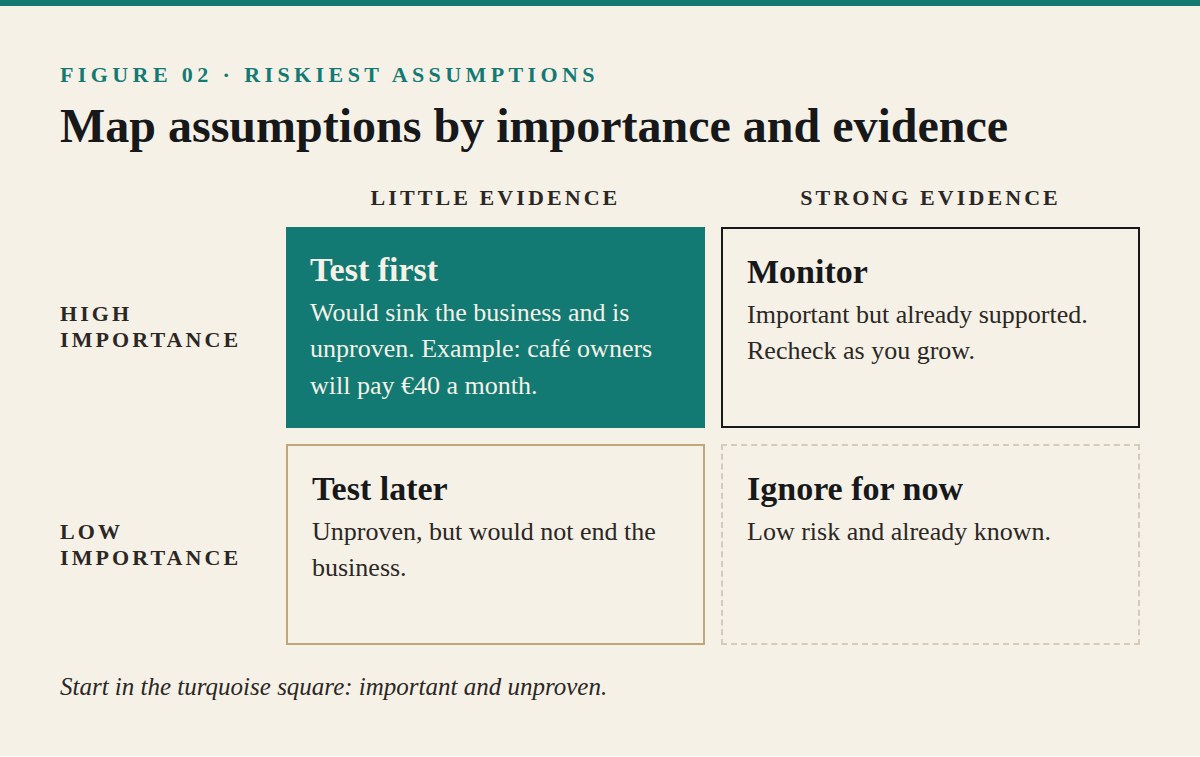
Write each assumption as a clear statement, for example: "Independent café owners will pay €40 a month for a simple stock-tracking app."
Rank by importance and evidence
Not all assumptions carry equal risk. For each one, ask two questions. How important is it: would the business fail if it were false? How much evidence do you already have: is it proven, partly supported or pure guesswork?
Assumptions that are both highly important and poorly supported are your riskiest. These should be tested first. An assumption that is important but already well supported, such as the existence of a well-known problem, needs less immediate attention.
The usual suspects
In many early-stage ideas, the riskiest assumptions are similar. Founders often overestimate how urgently customers feel a problem, how much they will pay and how easily they can be reached. Technical feasibility, by contrast, is frequently less risky than founders fear.
Pay particular attention to willingness to pay and customer acquisition. Many products solve real problems but fail because customers will not pay enough, or because finding each customer costs more than they are worth.
Founders often overestimate how urgently customers feel a problem, how much they will pay and how easily they can be reached.
Turn assumptions into testable questions
An assumption becomes useful when it can be tested. Rewrite each risky assumption as a question with a measurable answer. "People want healthy office lunches" becomes "Will at least ten local offices agree to a paid two-week trial?"
The more specific the question, the clearer the result. Vague questions invite vague answers and comfortable interpretations.
Choose the cheapest reliable test
For each risky assumption, consider the cheapest test that would produce trustworthy evidence. Conversations can test whether a problem is real. A landing page can test interest in a specific offer. A pre-order can test willingness to pay. A manual service can test delivery and satisfaction.
Avoid tests that are cheap but unreliable, such as asking friends whether they like the idea. A slightly more demanding test that produces real evidence is better value.
Revisit the list regularly
As you test, your list changes. Some assumptions are confirmed and can be set aside. Others are disproved and force changes to the idea. New assumptions appear. Review the list after every significant test and choose the next riskiest assumption to examine.
An example in practice
A founder planning a subscription box for home bakers listed fourteen assumptions. Ranking them showed that the riskiest were not product quality or packaging, but whether bakers would pay €30 a month and whether she could reach them affordably through baking communities. She tested those two first with a pre-order page shared in three online groups, before designing a single box.
Testing · 03 of 08
Smoke Tests and Landing Pages
Describe the offer clearly, invite a real action and measure who takes it.
A smoke test measures interest in an offer before the offer fully exists. The name comes from engineering, where a basic test checks whether a system works at all before more detailed testing begins. In business, a smoke test checks whether anyone cares enough to take action.
The most common smoke test is a simple landing page that describes a specific offer and asks visitors to do something: join a waiting list, request early access, book a call or place a pre-order.
What a good test page contains
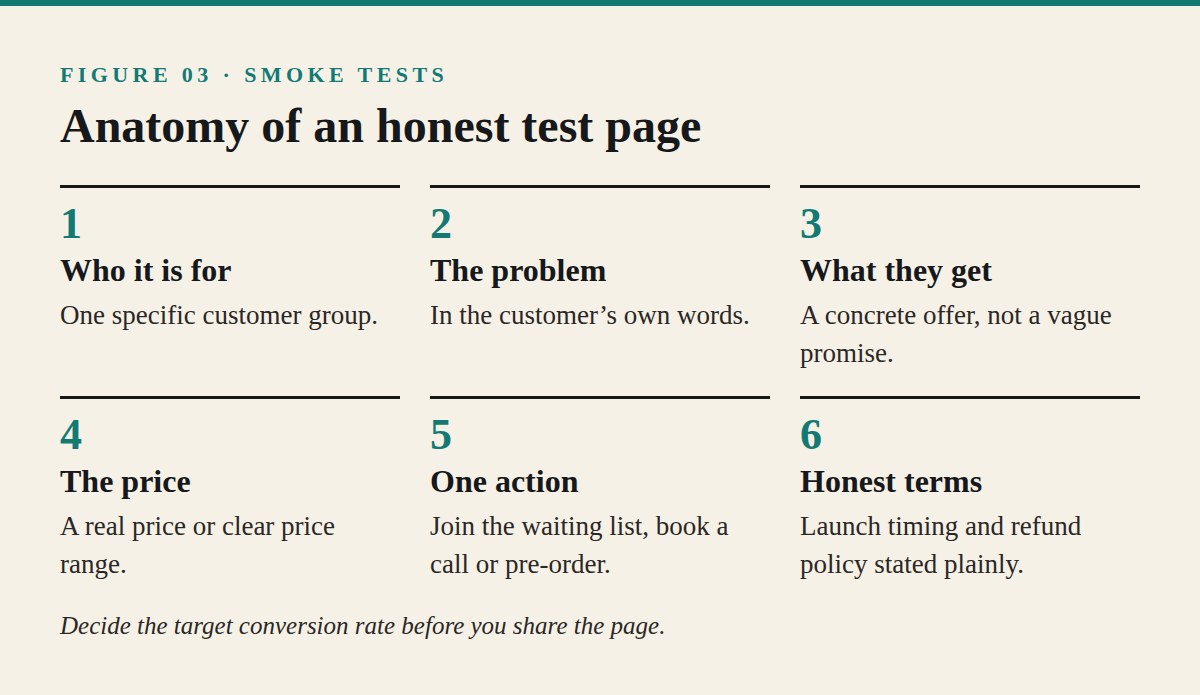
A useful test page is short and specific. It should state who the offer is for, the problem it solves, what the customer will receive, the price or price range and a single clear action. It does not need elaborate design. It needs clarity.
Vague pages produce vague results. "A smarter way to manage your finances" attracts curiosity but tells you little. "Monthly bookkeeping for freelance photographers, €49 a month, starting in March" tests a real offer.
Ask for a meaningful action
The action you ask for determines the strength of the evidence. An email sign-up is easy and therefore weak evidence. Booking a call requires more commitment. A refundable deposit or pre-order is much stronger.
Where possible, ask for the strongest action that is fair and honest at your stage. If you collect money, be clear about what customers are paying for, when they will receive it and how refunds work if the offer does not proceed.
Be honest with visitors
A smoke test must never deceive people. Do not claim that a product exists if it does not, invent customer reviews or take payments without a clear delivery plan and refund policy. Phrases such as "join the waiting list", "launching in spring" or "founding members" set honest expectations.
Honesty protects your reputation and keeps you on the right side of consumer protection rules. It also produces better data, because people respond to the real offer.
A landing page means little without visitors who match your target customer.
Send the right people
A landing page means little without visitors who match your target customer. Share it where those customers already gather: relevant online communities, industry groups, your existing network, partner newsletters or small, carefully targeted advertisements.
Traffic from friends and family is not useful evidence. Their interest reflects their relationship with you rather than the strength of the offer.
Measure the right numbers
Track how many people visited the page and how many took the requested action. The conversion rate, the percentage of visitors who acted, is more informative than the total number of sign-ups. Record where visitors came from, because different channels often perform very differently.
Decide your success threshold before launching the test. Without a predefined target, every result can be explained away.
Follow up personally
The people who respond to a smoke test are valuable. Contact them personally, thank them and ask a few questions about their situation and why the offer appealed to them. These conversations often reveal more than the numbers, and some respondents become your first customers.
Interpret results carefully
A smoke test shows interest, not certainty. People who join a waiting list may not buy when the product launches. Treat strong results as permission to run a stronger test, such as pre-sales, rather than as final proof.
Weak results are also informative. They may indicate low demand, the wrong audience, an unclear message or a price that is too high. Change one element at a time and test again before abandoning the idea entirely.
Signals · 04 of 08
Pre-Sales and Deposits: The Strongest Signal
When customers pay before the product is finished, you have evidence that no survey can provide.
Interest is encouraging. Payment is evidence. A customer who pays in advance, or leaves a deposit, has demonstrated that the problem matters, the offer is credible and the price is acceptable. Pre-sales also provide early cash and a group of committed customers to learn from.
Pre-selling is one of the most powerful validation methods available to small businesses. It also carries responsibilities, because customers are trusting you with their money before you deliver.
Why payment changes everything
People are generous with opinions and careful with money. Many will say they would buy a product, but far fewer actually pay when given the opportunity. The gap between what people say and what they do is the main reason surveys and casual conversations often mislead founders.
A pre-sale removes that gap. If customers pay, demand is real at that price. If they hesitate, you learn what stops them: price, trust, timing or a mismatch between the offer and the need.
Forms of pre-selling
Pre-selling can take several forms, depending on your business:
- Pre-orders: customers pay in full for a product delivered later.
- Deposits: customers pay part of the price to reserve a place or product.
- Founding memberships: early customers receive special terms in exchange for joining before launch.
- Paid pilots: a business customer pays for a limited trial of a service.
- Letters of intent: for some business services, a signed commitment to buy if certain conditions are met.
Choose the form that matches your offer and customers. Deposits often work well when customers want reassurance; founding offers suit communities and subscriptions.
Make the offer clear and honest
A pre-sale must explain exactly what the customer is buying, the expected delivery date, what happens if delivery is delayed and how refunds work. Ambiguity damages trust and can create legal problems.
Only pre-sell what you can realistically deliver. Set conservative timelines and communicate regularly with customers about progress. Early buyers who are kept informed often become your most loyal advocates.
Deposits often work well when customers want reassurance; founding offers suit communities and subscriptions.
Set a threshold
Decide in advance how many pre-sales would justify proceeding. Base the number on the minimum viable scale of the business: enough customers to cover your initial costs or to show a strong signal of demand.
If you reach the threshold, proceed with confidence. If you fall short, refund customers promptly, thank them and use what you learned to adjust the offer.
Offer early buyers something fair
Early customers take a risk by paying before delivery. Recognise that with something genuinely valuable: a lower founding price, additional features, personal support or the chance to influence the final product. Avoid artificial pressure such as fake countdowns or false scarcity, which undermine trust.
Learn from those who do not buy
Every person who considers the offer but does not pay is a source of insight. Ask them politely what held them back. Common answers include price, timing, uncertainty about results and lack of trust. Each answer suggests a specific improvement to the offer or the way it is presented.
An example in practice
A furniture maker wanted to launch a range of compact desks for small apartments but could not afford to build stock. He photographed a single prototype, described the specifications and offered thirty pre-orders with a 30% deposit and an eight-week delivery date. Twenty-four were reserved within three weeks. The deposits funded materials for the first batch, and buyer questions led him to add a narrower size option before production.
Method · 05 of 08
The Concierge Approach: Deliver Manually First
Before you build the machine, do the work by hand and learn what the machine must really do.
Many founders want to automate everything from the start: an app instead of a spreadsheet, a platform instead of personal emails, software instead of phone calls. Automation is valuable, but building it too early often means automating the wrong process. The concierge approach reverses the order. You deliver the service manually to a small number of customers first, learn exactly what they need and only then decide what to build.
The name comes from hotel concierges, who personally arrange whatever guests need. In validation, it means serving early customers with care and attention, even when the process is slow and unscalable.
Why manual delivery teaches so much
When you deliver a service by hand, you see every step from the customer's side. You notice which questions they ask, where they become confused, what they value most and what they ignore completely. This knowledge is very difficult to obtain from surveys or landing pages.
Manual delivery also tests whether customers are satisfied with the result, not just interested in the promise. A customer who renews, pays again or refers a friend after a manual service provides strong evidence that the offer works.
How it works in practice
Suppose you plan an app that creates personalised weekly meal plans. Instead of building the app, you could recruit ten paying customers, interview each about their preferences and send their meal plans by email every Sunday. You would learn what information you really need, how long planning takes, which recipes people actually cook and whether they stay subscribed.
Only after several weeks would you know which parts of the process deserve automation and which features customers truly value.
Charge for the service
Wherever possible, charge customers for the manual service, even if the price is modest. Payment confirms that the value is real and attracts customers who are genuinely committed. Free services can produce misleading enthusiasm and feedback from people who would never buy.
Be transparent about the nature of the service. Customers do not need to know every internal detail, but you should not mislead them about what they are receiving.
Only after several weeks would you know which parts of the process deserve automation and which features customers truly value.
Document everything
As you deliver the service, record each step: what you do, how long it takes, which tools you use, what questions customers ask and where problems occur. This documentation becomes the blueprint for any future system, whether that is software, templates, checklists or hired help.
Note also the moments that delight customers. These are often small human touches that should be preserved even after automation.
Know when to stop doing it by hand
Manual delivery is not meant to last forever. Signs that it is time to systematise include consistent demand, a stable process that rarely changes and a workload that limits growth. At that point, automate the most repetitive and time-consuming steps first, keeping human contact where it adds the most value.
The "behind the curtain" variation
A related approach presents customers with a simple front end, such as a form or basic website, while the work behind it is done manually. Customers experience the intended product, and you learn whether it works before investing in technology. This approach must still be honest: customers should receive exactly the service you describe, delivered reliably.
An example in practice
A founder wanted to build software that matched small shops with local delivery couriers. Instead of writing code, she created a simple form and a shared spreadsheet, and personally phoned couriers for each request. After six weeks and about two hundred deliveries, she knew which shops ordered repeatedly, which delivery times mattered and what prices both sides accepted. The software she eventually built was far simpler than her original plan, and it matched how customers actually behaved.
Pricing · 06 of 08
Testing Prices Without Guesswork
The right price is discovered through offers customers can accept or decline, not through asking what they would pay.
Pricing is one of the riskiest assumptions in any new business. Set prices too low and the business may never become sustainable, even with many customers. Set them too high without enough perceived value and few people will buy. Many founders choose a price by copying competitors or guessing, then never test it properly.
Price testing replaces guesswork with evidence. The key principle is simple: observe what customers do when presented with real prices, rather than asking what they would hypothetically pay.
Why asking does not work
When asked "How much would you pay for this?", people tend to give unreliable answers. Some name low prices because they hope for a bargain. Others name high prices to be polite or because they have not considered the decision seriously. Neither answer reliably predicts purchasing behaviour.
Real price discovery happens when a customer faces an actual decision: buy at this price, or do not.
Start from value, not cost
Before testing, estimate the value your offer creates for customers. How much time does it save? How much money does it help them earn or avoid losing? What does their current alternative cost? These questions help you choose a sensible starting range.
Costs set the minimum price you can accept. Value sets the maximum customers might pay. Your price should sit somewhere between the two, ideally closer to value than cost.
Ways to test prices
Several practical methods allow you to test prices honestly:
- Sequential tests: offer the same product at one price for a period, then a different price, and compare conversion rates.
- Packages: present two or three clearly different options and observe which ones customers choose.
- Pre-sale offers: test price points with deposits or pre-orders before launch.
- Proposals: in service businesses, gradually raise quoted prices for new prospects and track acceptance.
Keep other variables as constant as possible, so differences in behaviour can reasonably be linked to price.
Your price should sit somewhere between the two, ideally closer to value than cost.
Watch more than conversion
The highest conversion rate does not always produce the best business. A lower price may attract more buyers but generate less profit, more demanding customers or less perceived value. Compare total revenue, profit, customer satisfaction and retention at each price level.
Often, a modest price increase loses only a few customers while improving profits significantly.
Use packages to learn preferences
Packages reveal what customers value. If most buyers choose a premium option with personal support, support may be more valuable than you assumed. If nearly everyone chooses the cheapest option, the higher packages may not offer enough additional value.
Each package should be genuinely useful. Avoid options designed only to manipulate choices, as customers recognise and resent them.
Treat existing customers fairly
When testing prices, be careful with existing customers. Sudden changes can damage trust. It is usually better to test new prices with new customers first and give existing customers clear notice of any future change.
Listen to price objections
When customers say a price is too high, ask what they are comparing it with and what result they need. The answer may reveal a value communication problem, a missing smaller option or simply a customer outside your target market.
An example in practice
A consultant offering website audits charged €150 and was busy but barely profitable. Over three months, she quoted €250 to new prospects, then €350. Acceptance fell only slightly at €250 and more noticeably at €350, where prospects requested a smaller option. She settled on €290 for the full audit and added a €140 express review, increasing her monthly income while serving a similar number of clients.
Judgement · 07 of 08
Reading the Results Honestly
A test is only as useful as the honesty with which you interpret it.
Running a validation test is the easy part. Interpreting the result honestly is harder. Founders care deeply about their ideas, and that care makes it tempting to see encouragement in ambiguous numbers, explain away disappointing results or keep testing until something looks positive.
Honest interpretation protects you from spending months or years on an idea that the evidence did not support. It also gives you confidence to invest when the evidence genuinely is strong.
Beware of confirmation bias
Confirmation bias is the tendency to notice information that supports what we already believe and overlook information that contradicts it. In validation, it appears as remembering the three enthusiastic customers and forgetting the twenty who were indifferent, or treating a few sign-ups as proof of strong demand.
The most effective protection is to define success criteria before the test begins and to compare results against them without changing the target afterwards.
Compare against your criteria
Before each test, you should have written down what result would count as success. Afterwards, compare the outcome directly. If you aimed for at least eight pre-orders from fifty conversations and received three, the result does not meet the criterion, however friendly the conversations were.
Sometimes results fall between clear success and clear failure. In that case, identify what additional evidence would resolve the uncertainty and design the next test accordingly.
Consider the size of the sample
Small samples can be misleading. Two sales from five visitors look impressive as a percentage but provide little certainty. Early validation often relies on small numbers, which is acceptable, but interpret them cautiously and look for consistent patterns across several tests or sources.
Qualitative evidence matters too. Detailed interviews with ten well-chosen customers can reveal more about motivations than hundreds of anonymous clicks.
The problem may be the audience, the message, the channel or the price.
Ask the right questions of every result
For each result, ask:
- Who responded? Were they genuine target customers or friends and casual visitors?
- What did they actually do? Did they pay, sign up, ask questions or only express interest?
- What alternative explanations exist? Could the result be due to timing, the channel or a special offer?
- Is it repeatable? Would a similar test produce a similar result?
- What did we learn that we did not know before?
Separate the idea from its presentation
A weak result does not always mean the idea is poor. The problem may be the audience, the message, the channel or the price. Change one variable at a time and test again before abandoning the entire concept.
However, repeated weak results across several variations are an important signal. At some point, persistence becomes avoidance of an uncomfortable conclusion.
Involve someone outside the idea
Ask a trusted adviser, mentor or fellow founder to review your results. Someone without emotional attachment to the idea will often notice what you overlook. Present the original success criteria, the method and the results, and ask for their honest interpretation.
Record what you learned
Write a short summary after every test: the assumption tested, the method, the success criterion, the result and the decision taken. This record prevents memory from reshaping the past and helps you see how your understanding has developed.
An example in practice
A founder testing a paid newsletter for small landlords set a target of forty paid subscribers from a month of promotion. She reached twenty-six. Her first instinct was to call the test a success, because readers wrote enthusiastic replies. Reviewing the results with a mentor, she noticed that almost all subscribers came from one landlord forum, while two other channels produced almost nothing.
The honest conclusion was not "demand is strong" but "demand exists in one specific community". Her next test focused on landlords in similar forums, with a clearer target, rather than a broad launch.
Decisions · 08 of 08
Pivot, Persevere or Stop
Every round of evidence ends with a decision. Making it clearly is a founder's most valuable skill.
Validation is not an endless process of testing. Its purpose is to support decisions. After each meaningful round of evidence, a founder faces three options: persevere with the current direction, pivot to a different approach or stop and redirect time and money elsewhere.
None of these decisions is a failure. The real failure is avoiding the decision and continuing out of habit, hope or fear of admitting that the evidence points elsewhere.
Persevere when the evidence is strong
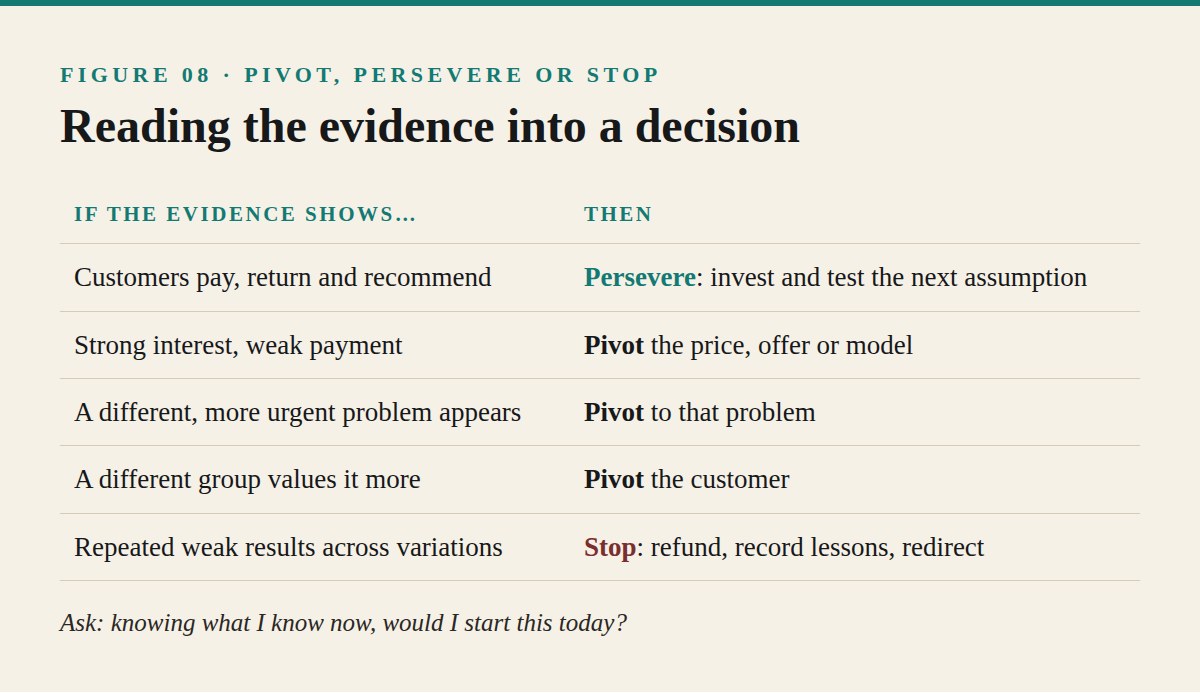
Persevering makes sense when your riskiest assumptions are being confirmed: customers pay, return and recommend, and the economics look viable. In this case, the next step is to invest more deliberately: improve delivery, strengthen marketing and test the next assumption, such as whether growth can be achieved affordably.
Perseverance should still be evidence-based. Continue testing as you grow, because new assumptions emerge at every stage.
Pivot when part of the idea works
A pivot is a significant change to one part of the idea while keeping what has been validated. Common pivots include:
- Customer pivot: the same solution for a different customer group that values it more.
- Problem pivot: the same customers, but a more important problem they need solved.
- Offer pivot: a different format, such as a service instead of software.
- Pricing pivot: a different business model or price structure.
- Channel pivot: a different way of reaching and selling to customers.
Pivots are most effective when based on specific evidence. If interviews repeatedly reveal a different, more urgent problem, that is a strong reason to change direction.
Stop when the evidence is clear
Stopping is the hardest decision, especially after investing time, money and emotion. Yet stopping an idea that the evidence does not support frees resources for something better. Many successful founders abandoned several ideas before finding one that worked.
Consider stopping if repeated tests across different audiences, messages and prices consistently fail to produce meaningful commitment, or if the economics cannot work even under optimistic assumptions.
The sunk cost trap is the tendency to continue investing because of what has already been spent.
Avoid the sunk cost trap
The sunk cost trap is the tendency to continue investing because of what has already been spent. Past investment cannot be recovered, and it should not determine future decisions. Ask instead: knowing what I know now, would I start this project today? If the answer is no, continuing is difficult to justify.
Set decision points in advance
Before starting a validation phase, define when you will make a decision and what evidence will guide it. For example: "After six weeks and fifty conversations, we will persevere if we have at least ten paying customers, pivot if interest is strong but conversion is weak, and stop if neither condition is met."
Predefined decision points reduce emotional pressure and prevent indefinite testing.
Stop well
If you decide to stop, do so responsibly. Refund any customers who paid for undelivered products, thank people who helped, document what you learned and share the lessons with others where appropriate. A well-managed ending protects your reputation and leaves relationships intact for your next venture.
Keep what you learned
Every validation effort produces valuable knowledge: customer insights, marketing skills, supplier contacts and a better understanding of what makes a business work. These assets carry forward into the next idea, which is often stronger because of the experience.
An example in practice
A team built a scheduling app for hair salons. After two months of tests, salon owners showed polite interest but few paid. In interviews, however, several mentioned the same frustration: clients who failed to turn up. The team pivoted to a simpler product focused on deposits and reminder messages for appointments. The same salon owners began paying within weeks, because the new offer solved a problem that cost them money every day.
Before you close this edition
Your Action Plan
Your next 30 days
Week 1: List and rank. Write every assumption your idea depends on. Mark the three that are most important and least proven.
Week 2: Run one test. Choose the cheapest test for your riskiest assumption: conversations, a landing page or a pre-order offer. Decide in advance what result counts as success.
Week 3: Deliver by hand. Serve your first customers manually, even if the process is slow, and record every step and question.
Week 4: Decide. Compare the results with your success criteria. Write down your decision to pivot, persevere or stop, and the reason.
Keep learning
Hustle Influence offers practical online courses and AI tools that help you turn ideas into action.
hustleinfluence.com
HUSTLE MAGHustle in Silence.