
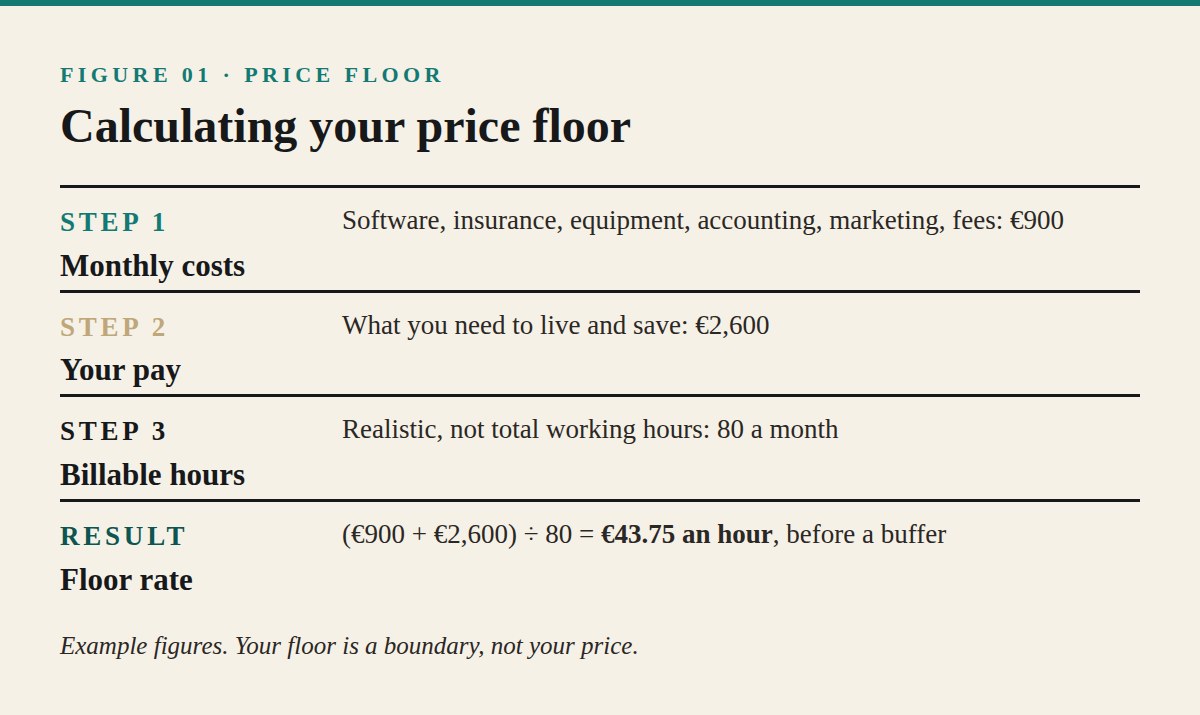
Every business has a price floor: the lowest price at which it can sell without losing money or underpaying its owner. Many small businesses have never calculated theirs. They set prices by instinct or comparison, then discover months later that busy periods somehow fail to produce profit.
Knowing your floor does not mean charging it. It means you can recognise a bad deal immediately, negotiate without anxiety and build every other pricing decision on solid ground.
Count every cost
Start with direct costs: the materials, products, software, subcontractors or delivery expenses tied to each sale. Then add overheads: the costs of running the business regardless of sales, such as software subscriptions, insurance, equipment, accounting, marketing, workspace and payment fees.
Founders often forget smaller recurring costs, but together they add up. Review a few months of bank statements to capture everything, then calculate a monthly total.
Pay yourself properly
The most commonly omitted cost is the founder's own pay. If your prices only cover expenses, the business is not truly profitable; it is simply using your time for free. Decide what you need to earn each month to live, save and contribute to a pension or emergency fund where relevant, and include it as a cost.
A business that cannot pay its owner a fair income at its current prices has a pricing problem, not a motivation problem.
Account for non-billable time
If you sell time, remember that not every working hour can be charged. Marketing, sales conversations, administration, learning and finance all take time. Many independent professionals find that only half to two-thirds of their working hours are billable.
Divide your total monthly costs, including your pay, by your realistic billable hours, not your total working hours. The result is often surprisingly high, and it explains why so many freelancers feel busy but underpaid.
Marketing, sales conversations, administration, learning and finance all take time.
Calculate the floor
For product businesses, your floor per sale is the direct cost of each unit plus its share of overheads and your pay. For service businesses, it is the minimum hourly or project rate that covers all costs at realistic billable hours.
Add a margin for unexpected costs, quieter months and taxes. A floor without any buffer leaves no room for the inevitable surprises of running a business.
Use the floor as a boundary
Once you know your floor, treat it as a firm boundary. If a customer asks for a price below it, the answer should usually be no, or an offer with reduced scope that still respects the floor. Selling below your floor means paying to work.
This boundary also makes negotiation calmer. You no longer need to guess whether a discount is acceptable. You know exactly where the line is.
Review it regularly
Costs change. Software subscriptions rise, suppliers adjust prices and your personal needs evolve. Recalculate your floor at least twice a year and whenever a significant cost changes. Many businesses lose profitability slowly because prices stay fixed while costs creep upwards.
An example in practice
A freelance designer charged €35 an hour because it felt competitive. When she calculated her real costs, including software, equipment, insurance, a modest salary and the fact that only twenty of her forty weekly hours were billable, her floor came to €48 an hour. She had been losing money on every project without realising it. She raised her rates for new clients to €65 and introduced fixed-price packages based on that figure.