
Contents · Edition 009
Edition 009
From the Editors
A good offer is one of the most underrated assets in business. Many founders have real skill and a genuine product, yet struggle to sell because what they offer is vague. Customers cannot quite tell what they will receive, what will change for them or why they should act now rather than later.
This issue is about turning ability into an offer: a clear promise, a defined set of components, a fair price, a guarantee that removes doubt and a page that explains it all in plain words. None of this requires exaggeration. In fact, the strongest offers are the most honest ones, because clarity is persuasive on its own.
We finish with the practical work of making your first ten sales. Those early customers are not only revenue. They are evidence, feedback and the beginning of a reputation.
If you have been circling an idea for months, waiting for it to feel ready, this is the issue to act on. Write the offer. Show it to real people. Learn from what they do.
The Editors, Hustle Mag
In This Edition
Your First Offer
Designing an Offer People Understand, Trust and Buy
An offer is the complete package a customer is asked to say yes to: the result promised, what is included, the price, the terms and the reasons to trust it. A strong offer makes buying easy. A weak one makes even good products difficult to sell.
This issue builds an offer step by step. We define what makes an offer and the promise at its centre, then decide what goes inside, how guarantees work and how to name and describe it. We write the offer page, prepare for objections and finish with a plan for your first ten sales.
Each article ends with a step that moves your offer closer to launch.
Cover Story · 01 of 08
What Makes an Offer
A product is what you make. An offer is the complete reason a customer says yes.
Founders often describe their business in terms of what they do: "I'm a designer", "We make candles", "I coach small business owners". Customers, however, do not buy activities. They buy offers: a specific result, delivered in a specific way, at a specific price, with terms that make the decision feel safe.
The difference matters. Two designers with equal skill can achieve very different results if one sells "design services" and the other sells "a complete brand identity for new cafés, delivered in three weeks for €1,800, with two rounds of revisions and a satisfaction guarantee".
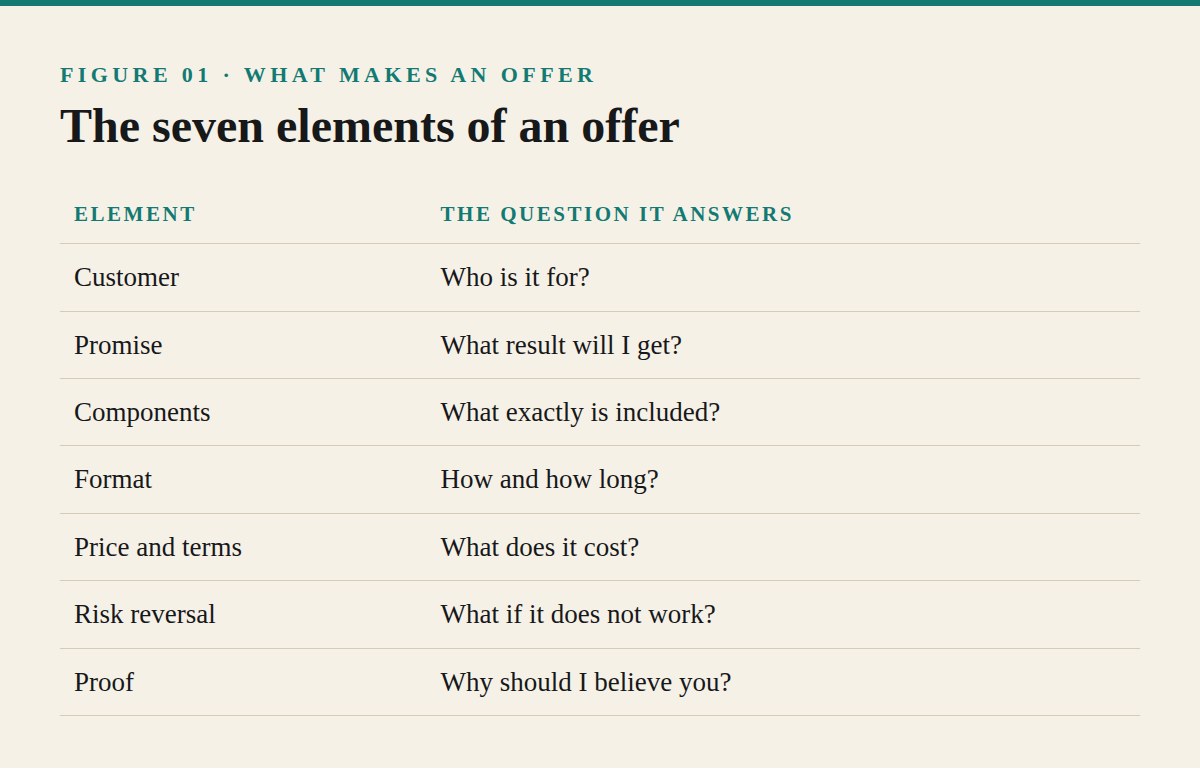
The parts of an offer
Most strong offers contain the same elements:
- A clear customer: who the offer is designed for.
- A promise: the result the customer can expect.
- The components: what exactly is included.
- The format: how it is delivered and how long it takes.
- The price and terms: what it costs and how payment works.
- Risk reversal: a guarantee, trial or clear refund policy.
- Reasons to trust: proof that you can deliver.
When one of these elements is missing or unclear, customers hesitate.
Clarity beats cleverness
An offer does not need dramatic language or clever wordplay. It needs clarity. A customer should be able to understand within seconds who the offer is for, what it achieves and what happens after they buy.
A useful test is to show your offer to someone who matches your customer description and ask them to explain it back to you. If they cannot describe it accurately in one or two sentences, the offer needs simplifying.
Specific offers sell better than general ones
General offers feel safer to founders because they seem to appeal to more people. In practice, specific offers usually sell better. "Website design" competes with thousands of providers. "A five-page booking website for physiotherapy clinics" speaks directly to a particular customer and solves a particular problem.
Specificity also makes delivery easier. When you know exactly what you are selling, you can build a repeatable process and improve it with every customer.
General offers feel safer to founders because they seem to appeal to more people.
Your first offer should be simple
A first offer does not need multiple tiers, bonuses and complex options. One clear offer, sold to the right customers, teaches you more than a complicated menu sold to no one. You can add packages and variations once you understand what customers value most.
Offers can be tested
An offer is not a permanent decision. Treat your first version as a hypothesis. Present it to real customers, observe their reactions, listen to their questions and adjust. Price, components, guarantees and wording can all improve with evidence.
Before and after
Compare two descriptions of the same work. Before: "I offer social media services for businesses. Contact me for prices." After: "Social media management for independent restaurants: twelve posts a month, written and designed for you, scheduled at the best times and reviewed in a monthly report. €450 a month, cancel with thirty days' notice."
The second version names the customer, the result, the components, the price and the terms. A restaurant owner can decide within a minute whether it suits them, which is exactly what a good offer should allow.
An example in practice
A fitness coach advertised "personal training sessions" and struggled to fill her schedule. She redesigned her work as a twelve-week strength programme for women returning to exercise after having children: two sessions a week, a written plan, monthly progress check-ins and a clear price. The new offer attracted a specific group of clients who immediately understood whether it was for them, and her schedule filled within two months.
Offer Design · 02 of 08
The Promise: One Clear Result
The centre of every offer is a result the customer wants and believes you can deliver.
Every offer is built around a promise: the change the customer can expect after buying. The promise answers the customer's most important question: what will this do for me? A strong promise is specific, desirable and believable. A weak promise is vague, exaggerated or focused on features rather than results.
Getting the promise right shapes everything else: the components you include, the price you charge, the words you use and the customers you attract.
Results, not features
Features describe what the offer contains. Results describe what the customer gains. "Twelve video lessons" is a feature. "Confidently edit your own short videos in two weeks" is a result. Customers buy results; features explain how those results are achieved.
When writing your promise, start with the outcome and only then mention the method.
Make it specific
Specific promises are more persuasive than general ones. "Grow your business" is vague. "Get your first ten paying clients" is concrete. Specificity may include a measurable outcome, a timeframe or a clear deliverable, such as "a finished, published website" or "a written financial plan for the next twelve months".
Be careful, however, not to promise outcomes that depend largely on factors outside your control.
Keep it believable
A promise must be credible to the customer and honest from your side. Exaggerated claims, such as guaranteed income or dramatic overnight results, damage trust and may breach advertising rules. A modest, believable promise backed by evidence is far more effective than a dramatic one customers doubt.
Ask yourself whether you could deliver the promised result for most customers who follow the process. If not, adjust the promise.
Exaggerated claims, such as guaranteed income or dramatic overnight results, damage trust and may breach advertising rules.
A simple formula
A useful structure for an offer promise is: We help [specific customer] achieve [specific result] through [method] within [timeframe]. For example: We help independent cafés create a recognisable brand identity through a guided three-week design process.
The formula is a starting point, not a slogan. Refine the wording until it sounds natural and clear.
Test the promise with customers
Share your promise with several people who match your customer description. Ask whether the result matters to them, whether they believe it is achievable and what concerns they would have. Their reactions reveal whether the promise is compelling or needs adjustment.
Pay attention to the language they use. Customers often describe the desired result more vividly than you do.
Connect every part of the offer to the promise
Once the promise is clear, every component should support it. If a feature does not help the customer achieve the promised result, consider removing it. Focused offers are easier to understand, easier to deliver and often more valuable than bloated ones.
Promises to avoid
Some promises consistently backfire. Income guarantees ("earn €10,000 a month") are rarely within your control and attract scepticism. Vague transformations ("change your life") say nothing concrete. Promises built on comparisons with unnamed competitors ("better than the rest") cannot be checked. And promises that depend entirely on the customer's effort, without acknowledging it, lead to disappointment.
Strong promises describe a result you can reliably help most suitable customers achieve, and they are honest about what the customer must contribute.
An example in practice
A bookkeeping freelancer described her service as "accounting and administrative support". Few prospects understood what she offered. She rewrote her promise: "Monthly bookkeeping that keeps your records ready for tax time, so you never face a year-end panic again." Prospects immediately understood the result, and conversations moved more quickly from interest to agreement.
Offer Design · 03 of 08
What Goes Inside the Offer
Include everything needed to deliver the promise, and nothing that distracts from it.
Once the promise is clear, the next step is deciding what the offer contains. The components are the deliverables, support and resources that help the customer achieve the promised result. Too few components and the promise feels unsupported. Too many and the offer becomes confusing, harder to deliver and less profitable.
The right components are those that most directly remove obstacles between the customer and the result.
Work backwards from the result
Start with the promised outcome and ask what the customer needs to reach it. What must be created, taught, delivered or supported? What usually stops customers achieving this result on their own? Each obstacle suggests a component.
For example, a promise to help small businesses publish a professional website might require a planning session, design, written content, technical setup, a short training session and a period of support after launch.
Core components and supporting components
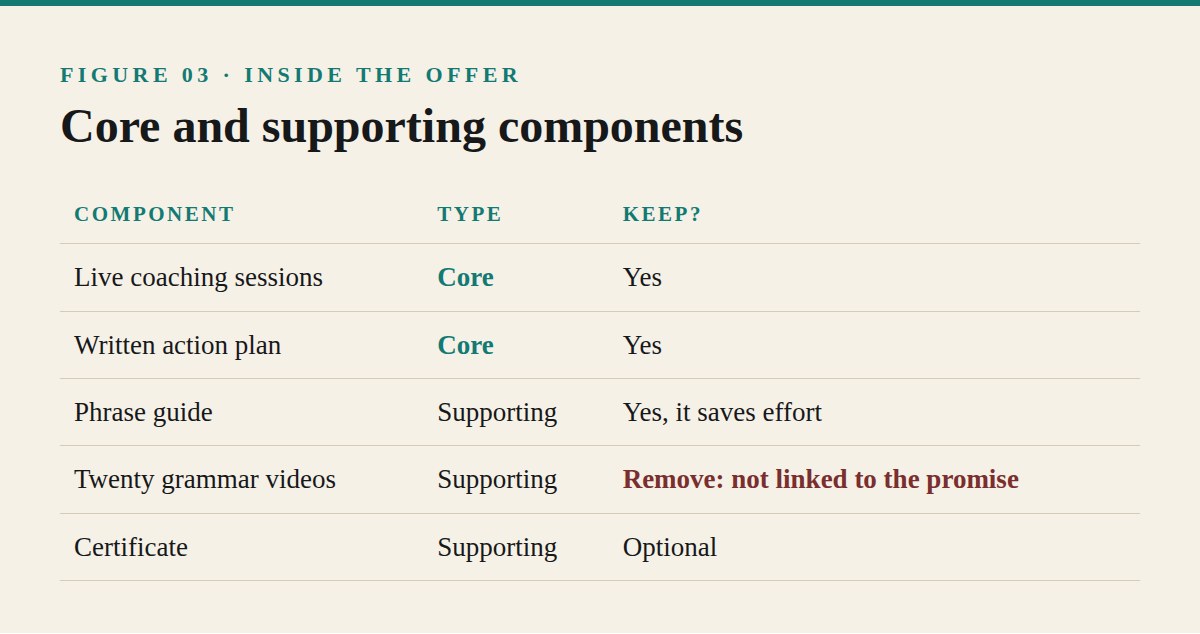
Separate essential components from helpful extras. Core components deliver the promise directly. Supporting components make the experience easier, faster or more reassuring, such as templates, checklists, progress updates or a short follow-up call.
Keep supporting components focused. A few useful extras improve the experience; a long list of bonuses can make an offer feel cluttered or less credible.
Define each component clearly
Customers should understand exactly what they will receive. Describe each component in practical terms: how many sessions, how long each lasts, what formats are included, how many revisions are allowed and how support works. Vague descriptions create misunderstandings and scope creep.
The best offers reduce the work required from the customer.
Consider the customer's effort
The best offers reduce the work required from the customer. Ask which tasks customers find difficult, confusing or time-consuming, and consider whether your offer can take those tasks off their hands. Done-for-you or guided components are often valued more highly than information alone.
At the same time, be clear about what the customer must contribute, such as providing materials, attending sessions or making decisions on time.
Check delivery and profitability
For each component, estimate the time and cost required to deliver it. Make sure the total offer remains profitable at your intended price and can be delivered consistently. Components that consume large amounts of time but add little value should be simplified or removed.
Remove what does not serve the promise
Review the final list and ask of each component: does this help the customer achieve the promised result? If the answer is unclear, consider removing it. A focused offer is easier to explain, easier to sell and easier to deliver well.
Document the delivery process
Write down how each component is delivered, step by step. This process becomes your checklist, ensures consistency and makes the offer easier to improve or delegate in future.
Name the deliverables clearly
Customers find it easier to value what they can picture. Instead of "support and resources", name the deliverables: "a sixty-minute planning call", "a written action plan", "three design concepts", "thirty days of email support". Concrete names make the offer feel substantial without exaggeration, and they make it easier for customers to compare your offer with alternatives.
Clear names also help delivery. When everyone knows what "the launch checklist" or "the monthly report" contains, quality becomes more consistent.
An example in practice
A language tutor offered a "business English course" with twenty lessons, workbooks, grammar videos, vocabulary lists, monthly webinars and a certificate. Few people bought, and those who did rarely finished. She rebuilt the offer around one promise: confidently leading meetings in English within eight weeks. The new offer included eight live sessions, meeting role-play practice, a phrase guide and short written feedback after each session. It was simpler, more focused and sold far better.
Trust · 04 of 08
Guarantees That Remove Doubt
A fair guarantee transfers risk from the customer to you, and signals confidence in your work.
Every purchase involves risk for the customer. They may worry that the product will not work for them, that the service will disappoint or that they will regret spending the money. This perceived risk is one of the main reasons interested customers hesitate. A well-designed guarantee reduces that risk and makes the decision easier.
A guarantee is not a marketing trick. It is a commitment, and it must be one you can honour.
Why guarantees work
A guarantee shifts some of the risk from the customer to the business. It says, in effect, "If this does not deliver what we promised, you will not be left worse off." This reassurance can be especially powerful for new businesses without a long track record.
Guarantees also signal confidence. Customers reason that a business willing to stand behind its work probably believes in its quality.
Types of guarantees
Common guarantees include:
- Satisfaction guarantees: a refund if the customer is not satisfied within a set period.
- Results guarantees: a refund or additional work if specific, measurable results are not achieved.
- Service guarantees: a commitment to deadlines, response times or standards, with a remedy if missed.
- Redo guarantees: further revisions or work at no extra cost until the agreed standard is met.
- Trial periods: customers can try the product before committing fully.
Choose the type that addresses your customers' main worry.
Match the guarantee to the risk
Think about what customers fear most. If they worry about wasting money, a refund period may help. If they worry about quality, a redo guarantee may be more appropriate. If they worry about delays, a deadline guarantee may be most reassuring.
A guarantee that addresses the wrong concern adds complexity without reducing hesitation.
Explain the guarantee simply: what is covered, for how long, what the customer must do and how claims are handled.
Set clear conditions
Explain the guarantee simply: what is covered, for how long, what the customer must do and how claims are handled. Fair conditions protect both sides. For results guarantees, customers may reasonably need to complete certain steps, such as attending sessions or implementing advice.
Avoid conditions so complicated that the guarantee is meaningless. Customers recognise and resent hollow promises.
Respect consumer rights
In many countries, consumers have legal rights to refunds, cancellations or repairs regardless of what a business offers. A guarantee should add to these rights, not replace or contradict them. Check the rules where you sell and describe your guarantee accurately.
Honour claims gracefully
When a customer uses the guarantee, honour it promptly and politely. Ask for feedback to understand what went wrong, but do not make the process difficult. A smooth refund can preserve goodwill and protect your reputation, even if the sale is lost.
Track claims. Frequent claims may reveal problems with the offer, the customer fit or the expectations created in your marketing.
Make guarantees affordable
Before offering a guarantee, estimate how many customers might use it and what it would cost. In many cases, the increase in sales outweighs the cost of occasional refunds. If refunds would threaten the business, choose a more limited guarantee or improve the offer first.
An example in practice
A web design studio struggled to convince small businesses to commit to new websites. It introduced a clear guarantee: if the client was not happy with the initial design concept, the studio would produce a second concept free of charge, and if the client was still unhappy, it would refund the deposit. Few clients used the guarantee, but enquiries converted more often because the main risk had been removed.
Words · 05 of 08
Naming and Describing Your Offer
A clear name and a plain description help customers understand the offer before they read the details.
The name and description of an offer are often the first things a customer encounters. Within seconds, they shape whether the customer understands what is being offered and whether it seems relevant. Clever names can be memorable, but if they hide the meaning, they create friction. Clear names and plain descriptions usually perform better.
The goal is not to sound impressive. It is to be understood immediately.
Choose clarity over cleverness
A name such as "Phoenix Programme" may sound interesting, but it tells the customer nothing about the result. "The 90-Day Bookkeeping Clean-Up" or "Website in a Week" communicates the offer instantly. If you prefer a distinctive name, pair it with a clear descriptive subtitle.
Ask yourself whether a stranger could guess what the offer does from its name alone. If not, add clarity.
Include the result or format
Effective offer names often include the result, the format or the timeframe:
- Result: "First Clients Programme", "Brand Identity Package".
- Format: "Strategy Session", "Monthly Content Plan".
- Timeframe: "Website in Two Weeks", "30-Day Marketing Reset".
Combining two of these often works well, for example "Two-Week Website Launch".
Write a one-sentence description
Beneath the name, write one sentence that explains who the offer is for and what it achieves. For example: "A guided two-week programme that helps independent cafés launch a professional website ready to take bookings."
This sentence should be clear enough to stand alone on social media, in an email or in a conversation.
Use the customer's language
Describe the offer using words your customers use, not industry jargon. Customers may not search for "conversion optimisation", but they understand "turn more website visitors into bookings". Review customer conversations, reviews and questions to identify the phrases they naturally use.
Customers may not search for "conversion optimisation", but they understand "turn more website visitors into bookings".
Show what is included simply
After the description, list the main components in plain language. Use short lines and concrete details: number of sessions, deliverables, support period and timeframe. Avoid lengthy paragraphs or vague promises such as "comprehensive support".
Keep names consistent
Once you choose a name, use it consistently across your website, proposals, invoices, emails and conversations. Consistency helps customers remember the offer and recommend it to others.
Test names with real people
If you are choosing between several names, ask potential customers which one they understand most easily and which makes them most interested. Their answers are more useful than your own preferences.
Avoid misleading descriptions
Names and descriptions should reflect the offer accurately. Avoid implying results, credentials or features you cannot deliver. Misleading wording may attract initial interest but leads to disappointment, refunds and damaged trust.
Weak and strong names
A few comparisons show the difference. "Momentum" becomes "Momentum: A 60-Day Sales Plan for Freelancers". "Premium Package" becomes "Complete Launch Package: Website, Copy and Training". "Clarity Call" becomes "Pricing Clarity Call: One Hour to Set Your Rates". In each case, the stronger version keeps any memorable word but adds the result, the format or the customer, so nobody has to guess.
Check the name works everywhere
Before settling on a name, check how it appears in every place customers will see it: a social media bio, an invoice line, an email subject and a spoken sentence. A name that is clear on a web page may become awkward when abbreviated or read aloud. Also confirm it does not conflict with a well-known product or brand in your field.
An example in practice
A marketing consultant sold a programme called "Ignite". Prospects frequently asked what it was. She renamed it "Your First 100 Email Subscribers: A Four-Week Guided Programme" and added a one-sentence description explaining who it was for. Questions about the offer decreased, and prospects who enquired already understood what they were buying.
Selling · 06 of 08
The Offer Page
One clear page can explain your offer, answer questions and invite the next step.

Whether it is a page on your website, a document attached to an email or a section of a proposal, every offer needs a clear written explanation. An offer page allows customers to understand the offer in their own time, share it with others involved in the decision and return to it when they are ready to buy.
A good offer page is not long for the sake of length. It is complete: it answers the questions a customer needs answered to make a confident decision.
Lead with the promise
Start with the result the customer wants. The headline should communicate the promise clearly, followed by a sentence explaining who the offer is for. Customers should understand within seconds whether the page is relevant to them.
Avoid opening with your biography or a long introduction. Customers care first about their problem and the result.
Describe the problem honestly
Briefly describe the situation your customer is in and the problems they face. When customers recognise their own experience, they are more likely to trust that you understand them. Keep this section specific and honest; avoid exaggerating pain to create urgency.
Explain what is included
List the components clearly: what the customer receives, how it is delivered and over what timeframe. Use short lines and concrete details. If there is a process, show the main steps so customers can picture the experience.
Show proof
Include evidence that you can deliver the result: testimonials, case studies, examples of work, relevant experience or qualifications. Choose proof that relates closely to the customer's situation. One specific, relevant example is often more persuasive than many general compliments.
Include evidence that you can deliver the result: testimonials, case studies, examples of work, relevant experience or qualifications.
State the price and terms
Show the price clearly, along with payment options, what the price includes and any additional costs. Hidden or unclear prices create doubt. If prices vary, explain the factors and give typical ranges.
Present the guarantee
If you offer a guarantee, explain it simply near the price or the call to action. Customers often look for reassurance at the moment they consider buying.
Answer common questions
Include a short section answering frequent questions: who the offer is not for, how long it takes, what the customer must do, what happens after purchase and how refunds work. These answers remove obstacles before they become reasons to delay.
End with one clear action
Finish with a single next step: buy now, book a call, request a proposal or join the waiting list. Make the action obvious and easy. Multiple competing calls to action can create hesitation.
A simple order for the page
A practical structure is:
- Headline with the promise.
- Who it is for and the problem it solves.
- What is included and how it works.
- Proof.
- Price, terms and guarantee.
- Frequently asked questions.
- One clear call to action.
Writing tips for each section
Write as if speaking to one person who matches your customer. Use "you" more than "we". Keep paragraphs short and put the most important information first in each section. Replace adjectives with specifics: instead of "fast delivery", write "delivered within ten working days". Read the page aloud; anywhere you stumble, a customer will too. Finally, ask whether every sentence helps the customer decide. If not, cut it.
An example in practice
A coach sent prospects long emails explaining her coaching programme, and many did not reply. She created a one-page offer document following the structure above, including two short client stories, a clear price and a brief list of frequently asked questions. Prospects began replying with questions about start dates rather than what the programme involved, a sign that the page had answered the essential questions.
Selling · 07 of 08
Answering Objections Before They Are Asked
Every hesitation has a reason. Address the common ones openly and buying becomes easier.
When interested customers do not buy, there is usually a specific reason: the price feels high, the timing is wrong, they doubt the result, they do not understand the process or they worry that the offer is not right for them. These reasons are objections. Some customers voice them; many do not, and simply leave.
Answering objections is not about pressure or clever arguments. It is about providing the information and reassurance customers need to make a confident decision, whether that decision is yes or no.
Collect the objections you hear
Start by listing the objections you encounter in conversations, emails and messages. Ask people who decided not to buy what held them back. Review questions customers ask before purchasing. Patterns will appear quickly.
Most offers face a small number of recurring objections, often five or fewer.
The common categories
Objections usually fall into a few categories:
- Price: "It costs more than I expected."
- Value: "I'm not sure it will work for me."
- Timing: "Now isn't the right time."
- Trust: "I don't know enough about you yet."
- Effort: "I don't have time to do this properly."
- Fit: "This might not suit my situation."
Identifying the category helps you respond appropriately.
Answer objections in your materials
Once you know the common objections, address them on your offer page, in proposals and in follow-up emails. A frequently asked questions section, relevant testimonials, a clear guarantee and a description of the time commitment can resolve many objections before customers raise them.
For example, if customers worry about time, explain exactly how many hours the offer requires each week and how you make the process manageable.
They may need a different service, have a smaller budget or face circumstances that make timing difficult.
Respond with understanding in conversations
When a customer raises an objection directly, listen carefully and acknowledge it. Ask a question to understand the concern: "What would you need to feel confident about the timing?" Then respond honestly with relevant information, examples or options.
Avoid dismissing concerns or arguing. The goal is clarity, not winning a debate.
Accept valid objections
Sometimes an objection reveals that the offer is genuinely not right for the customer. They may need a different service, have a smaller budget or face circumstances that make timing difficult. In these cases, saying so honestly builds trust and protects your reputation.
Not every prospect should become a customer.
Use objections to improve the offer
Recurring objections are valuable feedback. If many customers find the price too high, the value may not be clear, or a smaller option may be needed. If customers doubt results, stronger proof or a guarantee may help. If many say they lack time, the offer may need simplifying.
Prepare written responses
Write short, honest responses to your most common objections. Practise them until they feel natural. Preparation helps you respond calmly and consistently, rather than becoming defensive or offering discounts automatically.
Three example answers
"It's more than I expected." "That's fair to raise. Most clients compare it with hiring a part-time assistant, which costs considerably more each month. If the full package doesn't fit, the starter option covers the essentials."
"I'm not sure it will work for me." "Here is a client in a similar situation and what changed for them. And if the first concept doesn't suit you, the guarantee covers a second one or a refund of your deposit."
"Now isn't the right time." "Understood. What would need to change for the timing to work? I can hold a start date for next month if that helps."
An example in practice
An online course creator noticed that many visitors left her sales page without buying. Interviews revealed three main concerns: uncertainty about whether beginners could follow the course, the time required each week and the lack of support. She added a beginner-friendly preview lesson, a clear weekly time estimate and a small private discussion group. Conversion improved because the page answered the questions visitors had been silently asking.
Launch · 08 of 08
Your First Ten Sales
Early sales are rarely won by advertising. They come from conversations, follow-up and careful delivery.

The first ten sales of a new offer are among the most important a business will ever make. They prove that people will pay, generate the first testimonials and reveal how the offer can be improved. They are also usually the hardest to win, because you have little proof, no reputation for the offer and no established marketing channel.
Early sales rarely come from large campaigns. They come from personal outreach, existing relationships and careful attention to every potential customer.
Start with people who already know you
Your existing network is often the fastest route to early customers: past clients, colleagues, professional contacts and people who have followed your work. Some may buy themselves; others may introduce you to people who need your offer.
Contact people personally rather than sending a generic announcement. A short, specific message explaining the offer and asking whether they know someone who might benefit is often more effective than a broad promotion.
Reach out directly to ideal customers
Identify people or businesses that clearly match your customer description and contact them personally. Explain briefly why you are contacting them, what problem your offer solves and what the next step would be. Keep messages short, respectful and relevant.
Expect many people not to respond. Early sales are partly a numbers game, but each message should still be personal and useful.
Offer a founding position
Early customers take a risk by buying something new. Recognise this honestly by offering a founding price, additional support or the chance to help shape the offer. Explain why the terms are available: you are building early case studies and want detailed feedback.
Avoid artificial urgency. Genuine reasons are more persuasive and maintain trust.
Genuine reasons are more persuasive and maintain trust.
Track every conversation
Keep a simple record of everyone you contact: who they are, when you contacted them, their response, any objections and the next step. Follow up politely after a few days if there is no reply. Many sales happen after the second or third contact, not the first.
A simple spreadsheet is enough.
Deliver exceptionally
Your first customers deserve exceptional attention. Deliver carefully, communicate often and solve problems quickly. Their experience determines whether they recommend you, provide testimonials and buy again.
At this stage, quality matters far more than efficiency.
Ask for feedback and testimonials
After delivering, ask customers what worked well, what could be improved and whether they would recommend the offer. With permission, collect testimonials and short case studies. These become valuable proof for future sales.
Improve after every sale
Treat each early sale as a learning opportunity. Review the questions customers asked, the objections they raised and the parts of delivery that took longer than expected. Adjust the offer, the page and your process continuously.
By the tenth sale, your offer should be noticeably clearer, easier to deliver and easier to sell than it was at the first.
A first outreach message
A short, personal message works best. For example: "Hi Marta, I noticed your café recently started taking online orders. I've just launched a monthly bookkeeping package designed for independent cafés, built to keep records ready for tax time without year-end stress. I'm taking ten founding clients at a reduced rate in return for feedback. Would a fifteen-minute call next week be useful?" Adapt the details to each person; a message that could be sent to anyone is easily ignored.
An example in practice
A freelance bookkeeper launched a new monthly package for small cafés. Instead of advertising, she contacted twenty café owners she knew or could reach through local business groups, offering a founding price for the first ten clients in exchange for feedback and a testimonial. She tracked every conversation, followed up twice and visited interested owners in person. Within six weeks, she had eight clients, three testimonials and a much clearer offer.
Before you close this edition
Your Action Plan
Your next 30 days
Week 1: Write the promise. Complete one sentence: we help [customer] achieve [result] through [method], within [timeframe].
Week 2: Build the offer. List the components, price and guarantee. Remove anything that does not support the promise.
Week 3: Write the page. Create a one-page description with the promise, who it is for, what is included, price, guarantee and answers to common questions.
Week 4: Sell to ten people. Contact people who match your customer description personally. Record every response and improve the offer after each conversation.
Keep learning
Hustle Influence offers practical online courses and AI tools that help you turn ideas into action.
hustleinfluence.com
HUSTLE MAGHustle in Silence.