
Founders often describe their business in terms of what they do: "I'm a designer", "We make candles", "I coach small business owners". Customers, however, do not buy activities. They buy offers: a specific result, delivered in a specific way, at a specific price, with terms that make the decision feel safe.
The difference matters. Two designers with equal skill can achieve very different results if one sells "design services" and the other sells "a complete brand identity for new cafés, delivered in three weeks for €1,800, with two rounds of revisions and a satisfaction guarantee".
The parts of an offer
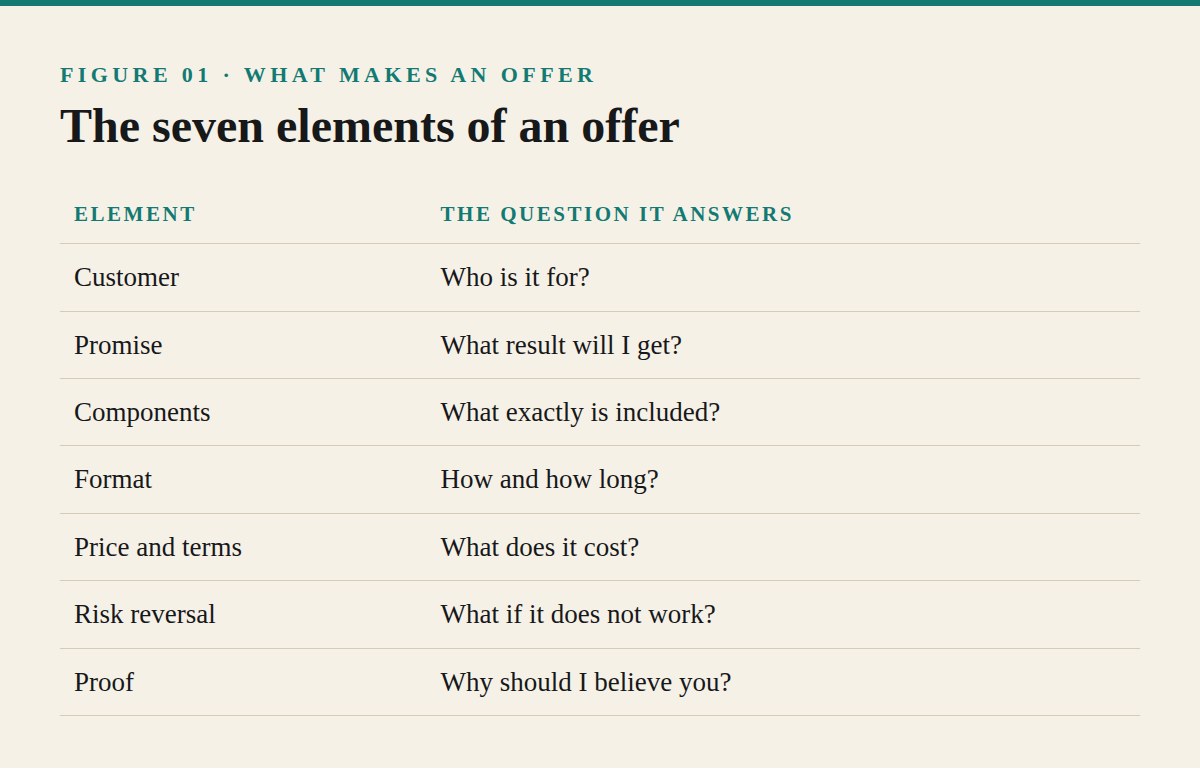
Most strong offers contain the same elements:
- A clear customer: who the offer is designed for.
- A promise: the result the customer can expect.
- The components: what exactly is included.
- The format: how it is delivered and how long it takes.
- The price and terms: what it costs and how payment works.
- Risk reversal: a guarantee, trial or clear refund policy.
- Reasons to trust: proof that you can deliver.
When one of these elements is missing or unclear, customers hesitate.
Clarity beats cleverness
An offer does not need dramatic language or clever wordplay. It needs clarity. A customer should be able to understand within seconds who the offer is for, what it achieves and what happens after they buy.
A useful test is to show your offer to someone who matches your customer description and ask them to explain it back to you. If they cannot describe it accurately in one or two sentences, the offer needs simplifying.
Specific offers sell better than general ones
General offers feel safer to founders because they seem to appeal to more people. In practice, specific offers usually sell better. "Website design" competes with thousands of providers. "A five-page booking website for physiotherapy clinics" speaks directly to a particular customer and solves a particular problem.
Specificity also makes delivery easier. When you know exactly what you are selling, you can build a repeatable process and improve it with every customer.
General offers feel safer to founders because they seem to appeal to more people.
Your first offer should be simple
A first offer does not need multiple tiers, bonuses and complex options. One clear offer, sold to the right customers, teaches you more than a complicated menu sold to no one. You can add packages and variations once you understand what customers value most.
Offers can be tested
An offer is not a permanent decision. Treat your first version as a hypothesis. Present it to real customers, observe their reactions, listen to their questions and adjust. Price, components, guarantees and wording can all improve with evidence.
Before and after
Compare two descriptions of the same work. Before: "I offer social media services for businesses. Contact me for prices." After: "Social media management for independent restaurants: twelve posts a month, written and designed for you, scheduled at the best times and reviewed in a monthly report. €450 a month, cancel with thirty days' notice."
The second version names the customer, the result, the components, the price and the terms. A restaurant owner can decide within a minute whether it suits them, which is exactly what a good offer should allow.
An example in practice
A fitness coach advertised "personal training sessions" and struggled to fill her schedule. She redesigned her work as a twelve-week strength programme for women returning to exercise after having children: two sessions a week, a written plan, monthly progress check-ins and a clear price. The new offer attracted a specific group of clients who immediately understood whether it was for them, and her schedule filled within two months.