
Contents · Edition 010
Edition 010
From the Editors
The internet has made it possible to sell almost anything to almost anyone. It has also made it harder to choose. Services, digital products, subscriptions, content, marketplaces, online shops and affiliate income all promise flexibility and growth. Each works. Each also has demands that its enthusiasts rarely mention.
This issue examines the main digital business models one at a time. For each, we look at how the money is actually made, what the model demands from the founder, where it typically struggles and who it suits. We avoid the language of "passive income", because no model runs itself, and the businesses that last are those whose founders understood the work before they began.
A business model is not a personality test or a trend to follow. It is a practical arrangement between what you can deliver, what customers will pay for and how you will reach them. The best model is the one that fits those three realities.
Use this issue to choose deliberately, or to check that the model you already have is the right one.
The Editors, Hustle Mag
In This Edition
Digital Business Models
How Online Businesses Really Make Money
A business model describes how a business creates value, delivers it and earns money from it. Online, the main models are well established, but they differ greatly in startup speed, scalability, cash flow and the skills they demand.
This issue gives each model its own article: online services, digital products, subscriptions, content and media, marketplaces and platforms, online shops and affiliate income. We finish with hybrid models, which combine several sources of revenue into a more resilient business.
Each article ends with a question to test whether the model fits you.
Cover Story · 01 of 08
Online Services
The fastest route to revenue, and the model that teaches you most about customers.
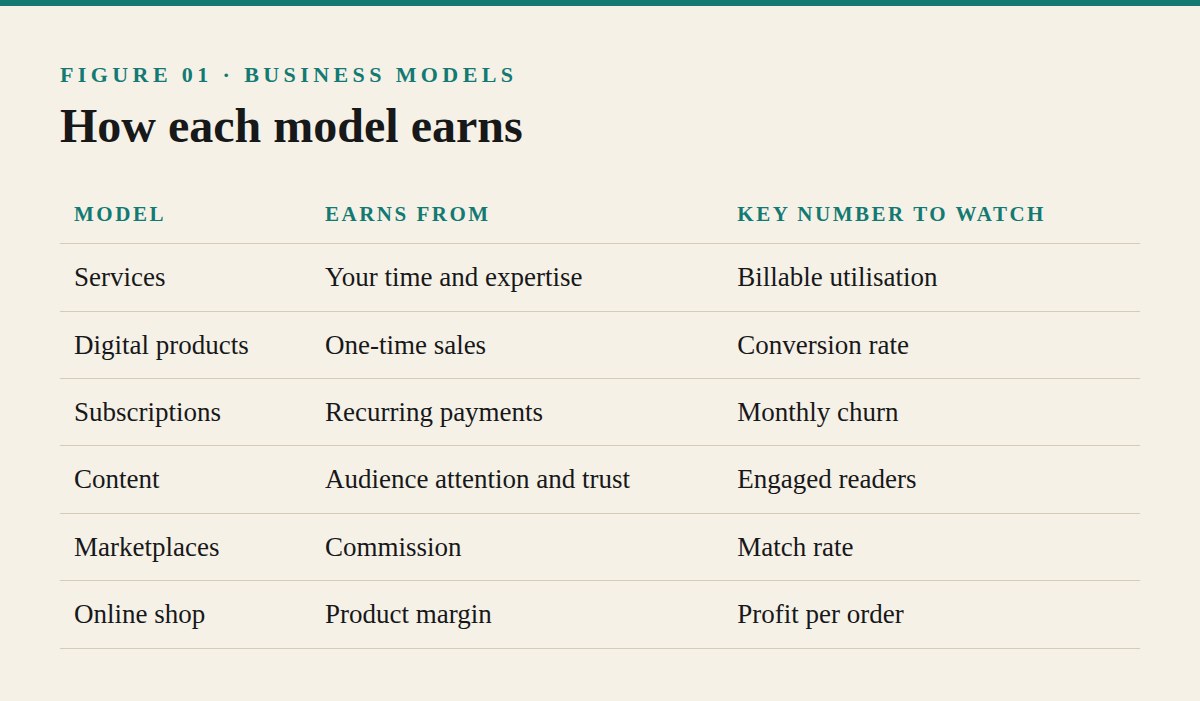
Selling a service online means customers pay for your expertise and time: design, writing, development, consulting, coaching, bookkeeping, editing, marketing and many other skills delivered remotely. It is the most common starting point for independent businesses, and for good reason.
Services require little upfront investment, generate revenue quickly and put the founder in direct contact with customers. They also have a natural limit: income grows only as fast as the hours available to deliver the work.
How the money is made
Service businesses earn through hourly rates, fixed project prices, retainers or packaged services. Revenue depends on the number of clients, the price of each engagement and the founder's capacity. Margins can be high because costs are often low, but income stops when work stops.
What the model demands
Services demand strong skills in the craft itself, but also in communication, sales, project management and client relationships. Founders must find clients continuously, manage expectations and deliver reliably. The work can be rewarding, yet demanding, especially when several clients need attention at once.
Strengths
Services are quick to start: a founder with a valuable skill can find a first client within weeks. They require little capital, provide immediate feedback and build a deep understanding of customer problems. Many successful product businesses began as service businesses, using client work to discover what customers really needed.
Weaknesses
The main limitation is scalability. Each additional client requires more of the founder's time. Income can be irregular, with busy months followed by quiet ones. Dependence on a few large clients creates risk if one leaves.
Many successful product businesses began as service businesses, using client work to discover what customers really needed.
Making services scale better
Several strategies help service businesses grow beyond the founder's hours:
- Raise prices as skills and results improve.
- Productise services into fixed packages with standard processes.
- Specialise to deliver faster and justify higher fees.
- Work with freelancers for parts of the delivery.
- Introduce retainers for predictable recurring revenue.
Who services suit
Services suit people with a valuable, marketable skill who enjoy working with clients and want revenue quickly. They also suit founders who plan to build products later and want to learn their market first.
How to start
Begin with one service for one customer group, priced as a defined package rather than open-ended hours. Show three relevant examples of your work, even if some come from practice projects, and contact potential clients directly. Your first three clients matter more for what they teach you than for the revenue they bring: note which tasks take longest, which questions they ask and what they value most.
Common mistakes
Service founders frequently underprice to win early work and then struggle to raise rates. Many accept every type of request and never build a repeatable process. Others rely on a single large client, which leaves the business exposed if that relationship ends. A clear offer, a firm price floor and a pipeline of several prospects prevent most of these problems.
An example in practice
A data analyst started offering monthly reporting services to small online shops. Within a year, she had twelve retainer clients and noticed that most asked similar questions. She turned her reports into a standard dashboard package, reducing delivery time by half, and later sold a self-service version for smaller shops that could not afford her full service.
A useful question
Before choosing services, ask: which problem could I solve for a specific customer this month, and what would they pay for the result? If the answer is clear, a service may be the fastest way to start.
Models · 02 of 08
Digital Products
Created once and sold many times, but only if people can find and trust them.
Digital products are made once and delivered electronically to many customers: templates, guides, courses, design assets, software tools, presets, printables, music, stock photography and more. Because each additional sale costs little to deliver, digital products can separate income from the founder's hours in a way services cannot.
That potential is real, but it is often oversold. Digital products require significant effort to create, market and maintain, and many never sell because nobody knows they exist.
How the money is made
Digital products are usually sold as one-time purchases, sometimes with optional upgrades, bundles or licences for different uses. Revenue depends on the number of buyers, the price and the cost of attracting each customer. Delivery costs are low, but marketing costs can be substantial.
What the model demands
Creating a good digital product requires deep understanding of a customer problem and the skill to package a solution clearly. Selling it requires an audience, search visibility, partnerships, advertising or a marketplace. Ongoing work includes customer support, updates, refunds and improvements.
Strengths
Digital products can be sold repeatedly without additional production effort. They allow sales across time zones and can complement services by serving customers who cannot afford one-to-one work. A library of good products can generate steady income over years.
Weaknesses
Most digital products face intense competition and low barriers to entry. Without an audience or reliable traffic, sales may be minimal. Prices are often lower than services, so many sales are needed. Products can become outdated, and piracy or copying can occur.
Prices are often lower than services, so many sales are needed.
Choosing the right product
The best digital products solve a specific, recurring problem for a defined customer group. Many successful products grow from service work: a consultant turns a frequently used process into a template; a designer packages common design assets; a teacher turns a popular workshop into a course.
Validate demand before creating a large product. Pre-sales, waiting lists or a small first version can show whether customers will pay.
Pricing digital products
Price according to value, not production cost. A template that saves a business owner several hours may justify a higher price than its size suggests. Offering tiers, such as a basic version and a version with support or additional resources, can serve different customers.
Who digital products suit
Digital products suit founders with specialised knowledge, an existing audience or a reliable way to reach customers, and the patience to build sales over time.
How to start
Start small. A focused template, checklist or short guide that solves one problem well teaches you more than a large course that takes months to build. Sell it first to people who already know you, then improve it from their feedback. Choose a reliable sales platform that handles payments, delivery and taxes appropriately for your markets.
Common mistakes
The most common mistake is building in isolation, spending months on a product before confirming anyone will buy it. Others price too low, assuming digital means cheap, or neglect marketing after launch. Many creators also forget maintenance: outdated screenshots, broken links and old information quietly erode trust.
An example in practice
A freelance accountant noticed that many small business clients struggled with the same monthly cash flow planning. She created a spreadsheet template with a short video guide and sold it to her newsletter subscribers. The first version sold modestly, but feedback led to improvements and a second version. After two years, the template provided a steady additional income and introduced new clients to her services.
A useful question
Ask: do I have a reliable way to reach the people who need this product? If not, building that audience or channel should come before, or alongside, creating the product.
Models · 03 of 08
Subscriptions and Memberships
Recurring revenue brings stability, and a permanent obligation to keep delivering value.
Subscriptions charge customers regularly for continued access: software, content, communities, coaching groups, regular deliveries, support plans or exclusive resources. For businesses, recurring revenue is attractive because it makes income more predictable and allows long-term planning.
The model has one essential requirement. Customers must continue to see value every billing period, or they will leave.
How the money is made
Subscription businesses earn recurring monthly or annual payments. Revenue depends on how many subscribers join, how much each pays and how long they stay. Retention is often more important than acquisition: a business that keeps customers for years can grow steadily even with modest numbers of new sign-ups.
Key numbers to understand
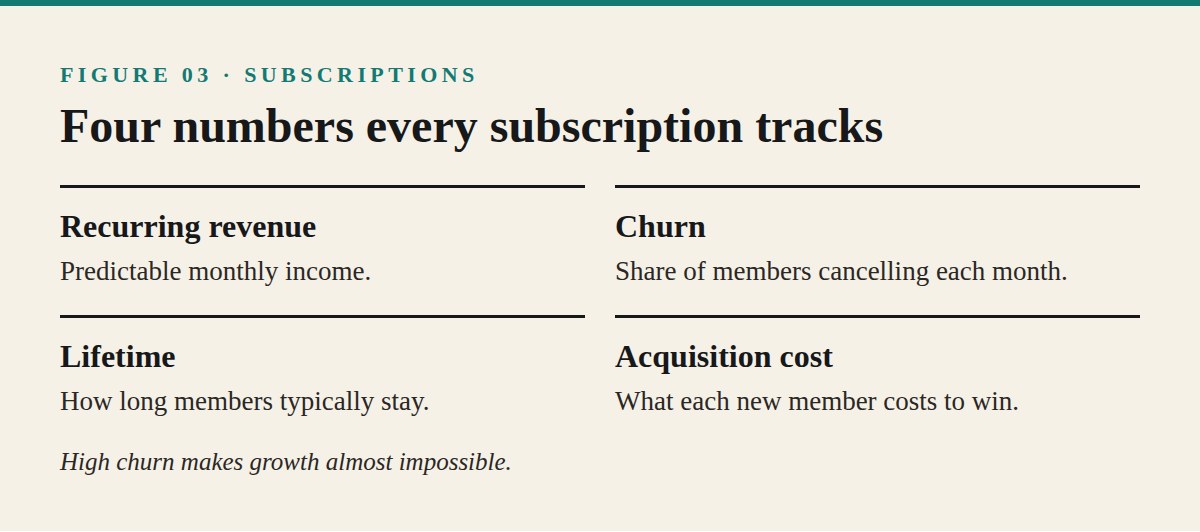
Subscription businesses usually track several simple measures:
- Monthly recurring revenue: the total predictable income each month.
- Churn rate: the percentage of subscribers who cancel each month.
- Average customer lifetime: how long subscribers typically stay.
- Customer acquisition cost: what it costs to win each new subscriber.
High churn can make growth almost impossible, because the business must constantly replace customers who leave.
What the model demands
Subscriptions require continuous delivery: new content, ongoing software improvements, regular community activity or reliable service. They also require attention to onboarding, because subscribers who do not experience value early are likely to cancel.
Strengths
Recurring revenue improves cash flow predictability and can increase a business's long-term value. Subscribers who stay for many months may generate far more revenue than one-time buyers. Communities and memberships can build strong relationships and loyalty.
Communities and memberships can build strong relationships and loyalty.
Weaknesses
Subscription fatigue is real: customers increasingly review and cancel subscriptions. The pressure to deliver ongoing value can be exhausting, particularly for solo founders running content or community memberships. Early growth may be slow, and revenue can decline quickly if churn rises.
Reducing churn
Several practices help keep subscribers:
- Strong onboarding that helps new members achieve an early result.
- Regular, visible value delivered on a predictable schedule.
- Listening to members and improving based on their feedback.
- Annual plans with a fair discount for committed customers.
- Easy cancellation, which builds trust and reduces resentment.
Who subscriptions suit
Subscriptions suit businesses that solve an ongoing need rather than a one-time problem, and founders who can deliver consistent value over long periods.
How to start
Begin with a small group of founding members at a fair price, and deliver value on a clear schedule, such as a weekly session or a monthly resource pack. Ask members regularly what helps them most and adjust. It is better to delight thirty members than to disappoint three hundred.
Common mistakes
Many subscription founders promise too much content and burn out trying to deliver it. Others focus entirely on attracting new members while ignoring why existing members leave. Some make cancellation difficult, which damages reputation and can breach consumer rules. Sustainable subscriptions promise a manageable rhythm and measure retention from the first month.
An example in practice
A fitness instructor launched a monthly online membership with weekly workouts and a private community. Many members cancelled after one or two months. She added a structured first-month programme, a short weekly check-in email and member progress challenges. Average membership length increased significantly, and the business became stable enough for her to reduce in-person classes.
A useful question
Ask: does my customer have a need that continues every month? If the need is solved once, a subscription may feel like poor value.
Models · 04 of 08
Content and Media Businesses
An audience can become a durable asset, but it is built slowly and must be earned continuously.
Content businesses create articles, newsletters, videos, podcasts or social media content that attract an audience, then earn money from that attention and trust. Revenue may come from advertising, sponsorships, paid subscriptions, affiliate commissions, products or services sold to the audience.
Content can build one of the most valuable assets a business can own: a loyal audience that trusts the creator. It also takes time, consistency and patience before it pays.
How the money is made
Content businesses often combine several revenue sources:
- Advertising: payments based on views or impressions.
- Sponsorships: brands pay to be featured.
- Paid subscriptions: readers or viewers pay for premium content.
- Affiliate commissions: earnings from recommended products.
- Own products and services: courses, coaching, books or consulting sold to the audience.
Advertising alone usually requires very large audiences. Smaller, specialised audiences often earn more through sponsorships, products and services.
What the model demands
Content businesses require consistent creation, a clear focus and genuine expertise or perspective. Growth depends on understanding the audience, distributing content effectively and building trust over time. Founders must be comfortable creating regularly, often for months before significant income appears.
Strengths
An engaged audience reduces dependence on paid advertising and provides a direct channel for launching products and services. Content can continue attracting readers or viewers long after publication. A specialised audience can make a small creator highly valuable to relevant sponsors.
Weaknesses
Growth is often slow and unpredictable. Dependence on social media platforms creates risk, because algorithm changes can reduce reach overnight. Burnout is common among creators who feel pressure to publish constantly. Advertising income may be low unless the audience is very large.
Burnout is common among creators who feel pressure to publish constantly.
Owning the relationship
Content creators should build channels they control, especially an email list. Social platforms are useful for discovery, but a business that relies entirely on one platform is vulnerable. Encourage followers to subscribe to a newsletter or join a community you manage directly.
Choose a clear niche
Specialised content attracts more loyal audiences than general content. A newsletter about bookkeeping for freelance creatives may grow slower than a general business publication, but it can attract readers with clear needs and sponsors seeking that exact audience.
Who content businesses suit
Content suits people with deep knowledge, a distinctive perspective and the discipline to publish consistently for a long time. It works especially well for founders who plan to sell products or services to the audience they build.
How to start
Choose one main format you enjoy and can sustain, such as a weekly newsletter or video, and one discovery channel where your audience already spends time. Publish consistently for several months before judging results. From the start, invite people to join your email list, and note which topics produce replies and shares.
Common mistakes
Creators often spread themselves across too many platforms, publish without a clear audience in mind or wait for a large following before offering anything for sale. Others copy popular formats without a distinctive perspective. The creators who last usually go deep on a narrow topic and offer something useful to their audience early.
An example in practice
A landscape gardener began publishing short weekly videos about small garden design. Growth was slow for the first year. As her audience grew, she added a newsletter, then a paid seasonal planting guide and occasional design consultations. Within three years, content-driven work accounted for most of her income, and she chose clients more selectively.
A useful question
Ask: could I publish useful content on this topic every week for two years? If the answer is no, a content business may become exhausting.
Models · 05 of 08
Marketplaces and Platforms
Connecting buyers and sellers can create powerful businesses, but the first customers are the hardest to win.
Marketplaces connect people who want something with people who provide it: buyers and sellers, clients and freelancers, guests and hosts, students and tutors. The marketplace earns money by facilitating these connections, usually through commissions, listing fees or subscriptions.
When marketplaces work, they can become extremely valuable because each new participant makes the platform more useful for everyone else. Getting to that point, however, is one of the most difficult challenges in business.
How the money is made
Marketplaces typically earn through one or more of these methods:
- Commission: a percentage of each transaction.
- Listing fees: sellers pay to list products or services.
- Subscriptions: sellers or buyers pay for premium access or features.
- Advertising: sellers pay for greater visibility.
- Additional services: payments, insurance, delivery or verification.
The chicken-and-egg problem
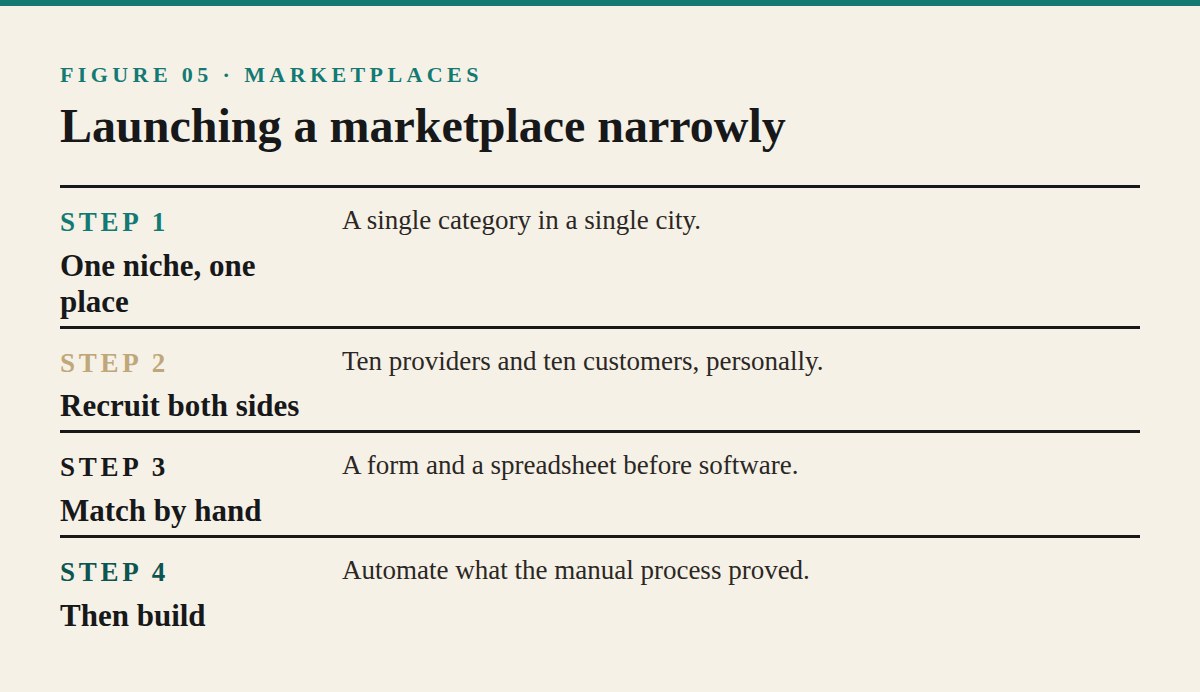
Buyers want a marketplace with plenty of sellers. Sellers want a marketplace with plenty of buyers. At the beginning, there are neither. Successful marketplaces usually solve this by starting extremely narrow: one city, one category or one specific customer group, where they can personally recruit enough participants on both sides to make the marketplace useful.
What the model demands
Marketplaces demand trust, quality control and active management. Founders must attract both sides, ensure listings meet standards, handle disputes and prevent people from bypassing the platform once they have connected.
Strengths
Successful marketplaces benefit from network effects: more buyers attract more sellers, which attract more buyers. Commission-based revenue grows with transaction volume, and the platform may not need to hold inventory or deliver services directly.
Large marketplaces already dominate many categories, making it difficult for new platforms to compete broadly.
Weaknesses
Early growth is slow and expensive. Trust problems, such as poor sellers, fraud or unreliable buyers, can quickly damage reputation. Large marketplaces already dominate many categories, making it difficult for new platforms to compete broadly.
How to start
Begin manually. Recruit a small group of trusted providers personally, then match them with customers yourself, perhaps using a simple form and spreadsheet. This approach tests whether the marketplace solves a real problem before you invest in technology. Focus on one location or niche until both sides are active and satisfied.
Common mistakes
Founders often build complex software before proving demand, launch across too many categories at once or neglect quality control. Others charge commissions so high that participants leave the platform to transact directly. A narrow focus, fair fees and visible value for both sides are essential.
Who marketplaces suit
Marketplaces suit founders who understand both sides of a market deeply, enjoy community building and have the patience for slow early growth.
The numbers to watch
Marketplace founders usually track a few measures closely: the number of active providers and customers, the percentage of searches or requests that result in a match, repeat transactions, average transaction value and the share of transactions that happen on the platform rather than around it. A healthy marketplace shows rising match rates and repeat use on both sides, not only growing sign-up numbers.
An example in practice
A founder noticed that local restaurants struggled to find reliable short-term kitchen staff. Instead of building a large platform, she personally recruited thirty experienced cooks and contacted restaurants in one neighbourhood, matching shifts through messaging. Once both sides trusted the service, she introduced a simple booking system and expanded to nearby areas.
A useful question
Ask: can I personally recruit enough providers and customers in one narrow niche to make the marketplace useful from the start? If not, the model may be difficult to launch.
Models · 06 of 08
Online Shops
Selling physical products online combines broad reach with the realities of stock, shipping and margins.
Online shops sell physical products directly to customers through a website, a marketplace or social commerce. Products may be handmade, manufactured, sourced from suppliers or shipped directly by a third party. E-commerce offers access to customers far beyond a local area, but it involves practical challenges that digital businesses often avoid.
Success depends on choosing products carefully, managing margins and delivering a reliable customer experience.
How the money is made
Revenue comes from product sales, sometimes supplemented by subscriptions, bundles or repeat orders. Profit is the difference between the selling price and all costs: product cost, packaging, shipping, payment fees, platform fees, returns, advertising and overheads. Margins can disappear quickly if these costs are underestimated.
Fulfilment options
Online shops can deliver products in several ways:
- Self-fulfilment: storing, packing and shipping products yourself.
- Third-party fulfilment: a logistics provider stores and ships products.
- Dropshipping: suppliers ship products directly to customers.
- Print-on-demand: products are produced only when ordered.
Each option involves trade-offs between control, cost, speed and risk.
What the model demands
Online shops require product research, supplier management, inventory planning, photography, customer service, returns handling and marketing. Cash flow is particularly important because inventory often must be paid for before it sells.
Strengths
Physical products are easy for customers to understand. Successful products can generate repeat purchases, and brands can build loyal communities. E-commerce platforms make it relatively easy to launch an online store.
Weaknesses
Competition can be intense, especially for products available from many sellers. Advertising costs can be high. Inventory ties up cash, and unsold stock creates losses. Shipping delays, damaged products and returns affect customer satisfaction.
E-commerce platforms make it relatively easy to launch an online store.
How to start
Start with a small product range, validated through pre-orders, small batches or test listings. Calculate the full cost per order before setting prices. Choose a fulfilment method that matches your volume and cash position. Focus on excellent product pages, clear delivery information and responsive customer service.
Common mistakes
New shop owners often order large quantities before demand is proven, price products without accounting for all fees and shipping costs, or rely entirely on paid advertising. Others choose generic products with no clear advantage. Specialised products, careful margin calculations and a distinctive brand help avoid these traps.
Who online shops suit
Online shops suit founders who enjoy products, logistics and branding, and who can manage stock and cash flow carefully.
The numbers to watch
Online shop owners should know their average order value, gross margin per order after all costs, conversion rate, return rate, repeat purchase rate and the cost of acquiring each customer through advertising. If acquiring a customer costs more than the profit from their first order, the business depends on repeat purchases to survive, so retention becomes critical.
Product page essentials
Strong product pages answer questions before customers ask them: clear photographs from several angles, dimensions and materials, what is included, delivery times and costs, the returns policy and genuine reviews. Many abandoned purchases come from a single missing detail, such as whether an item fits a particular space or how long delivery takes.
An example in practice
A founder wanted to sell handmade ceramic planters. Instead of producing a large collection, she made twenty pieces and offered them through her website and local social media groups, with clear delivery costs. They sold within two weeks. She used customer feedback to refine sizes and glazes, increased production gradually and added a waiting list for popular designs.
A useful question
Ask: after every cost, including shipping, fees, returns and advertising, how much profit remains on each order? If the answer is unclear, calculate it before launching.
Models · 07 of 08
Affiliate and Partnership Income
Recommending products you trust can earn commissions, if your audience trusts your recommendations.
Affiliate marketing pays commissions for recommending products or services. When a reader, viewer or customer buys through a tracked link or code, the recommender receives a share of the sale. Partnerships work similarly: businesses refer clients to each other in exchange for a fee or reciprocal referrals.
Affiliate income can be a useful revenue stream, particularly for content creators and businesses with trusted audiences. It depends entirely on credibility.
How the money is made
Affiliate programmes typically pay a percentage of each sale or a fixed amount per customer. Some pay recurring commissions for subscription products. Partnership arrangements may involve referral fees, revenue sharing or reciprocal introductions.
Income depends on audience size, trust, relevance of recommendations and the commission rates offered by partners.
What the model demands
Affiliate income requires an audience that values your recommendations and content that helps people make decisions, such as reviews, comparisons, tutorials and guides. It also requires careful selection of products you genuinely trust.
Strengths
Affiliate income requires no product creation, inventory or customer support for the products themselves. It can complement content businesses, newsletters and services by recommending tools and resources customers already need.
Weaknesses
Commission rates can change or programmes may close. Income is often modest unless the audience is substantial and highly relevant. Overpromotion can damage trust quickly, and dependence on search traffic or a single platform creates risk.
Honesty and disclosure
Trust is the foundation of affiliate income. Disclose clearly when links are affiliate links or when you receive payment, in line with the advertising rules where you operate and the requirements of the platforms you use. Recommend only products you have evaluated honestly and explain both strengths and limitations.
Readers who feel misled rarely return.
Income is often modest unless the audience is substantial and highly relevant.
How to start
List tools, products or services you already use and recommend to customers. Check whether they offer affiliate or partner programmes. Create genuinely useful content, such as an honest comparison or a tutorial, and include disclosed links where relevant. Track which recommendations your audience finds most valuable.
Common mistakes
Affiliate beginners often promote products they have not used, choose programmes based only on high commissions or fill content with links. Others hide affiliate relationships. These approaches may produce short-term income but erode credibility, which is the asset the model depends on.
Who affiliate income suits
Affiliate income suits content creators, educators and advisers with a trusted audience and a habit of recommending useful tools.
The numbers to watch
Track clicks, conversion rates and earnings for each recommendation, but also watch audience trust signals: unsubscribe rates, replies and comments questioning recommendations. Note which partners pay reliably and which change terms often. A small number of honest, well-matched recommendations usually outperforms a long list of loosely relevant links.
Choosing partners
Choose partners as carefully as you would choose suppliers. Check the product's quality, the company's customer service reputation, how reliably the programme pays and whether its terms allow honest, balanced reviews. A slightly lower commission from a product your audience loves is worth far more than a high commission from one that generates complaints.
An example in practice
A photography educator often answered questions about cameras, lenses and editing software. She created an honest guide to beginner equipment, clearly disclosing affiliate links and explaining when cheaper options were sufficient. Readers appreciated the balanced advice, and the guide became a steady source of commissions while also attracting students to her paid courses.
A useful question
Ask: would I recommend this product even if I earned nothing from it? If not, it does not belong in your recommendations.
Strategy · 08 of 08
Hybrid Models That Last
Many durable online businesses combine several revenue streams that support one another.
Few successful online businesses rely on a single source of revenue forever. Many combine models: services with digital products, content with affiliate income, subscriptions with consulting or an online shop with workshops. A hybrid model can make income more stable, serve customers at different price points and reduce dependence on any one channel or platform.
The key is that each stream must support the others. A random collection of unrelated offers creates complexity without resilience.
Why hybrid models work
Different customers have different needs and budgets. Some want personal service; others prefer a lower-cost product or a recurring membership. A hybrid model allows a business to serve these customers without diluting its focus. It also spreads risk: if one revenue stream slows, others can continue.
Common combinations
Several combinations appear frequently:
- Services and digital products: consulting for high-value clients, templates or courses for others.
- Content and products: free content builds an audience that buys products or services.
- Subscriptions and one-time offers: a membership supported by occasional workshops or advanced programmes.
- Online shop and education: selling products alongside tutorials, workshops or memberships.
- Content, affiliate and services: recommendations support income while expertise leads to client work.
Build in sequence, not all at once
The most successful hybrid businesses usually add revenue streams gradually. They begin with one model, establish demand and processes, then add a second stream that serves the same customers or builds on existing assets. Launching several models simultaneously often divides attention and slows progress.
Connect the streams
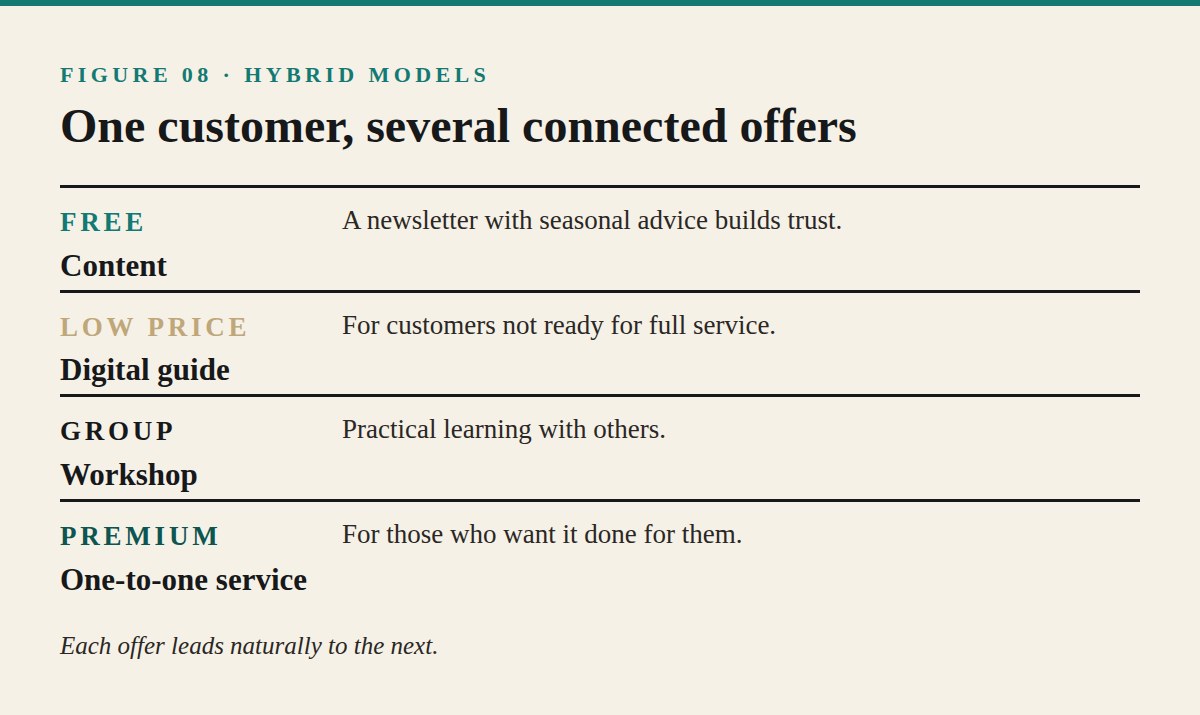
Each revenue stream should lead naturally to another. Free content might introduce a low-cost product; product buyers may later choose premium services; service clients may join a membership for ongoing support. Map how customers move between offers and make those paths clear.
Every additional stream adds work: marketing, delivery, support, administration and decision-making.
Watch complexity
Every additional stream adds work: marketing, delivery, support, administration and decision-making. Review the profitability and time required for each stream regularly. A stream that generates little profit but consumes significant time may need simplifying or removing.
Protect your focus
Hybrid models work best when all streams serve the same core customer and reinforce the same brand. A financial planner offering advice, budgeting templates and a newsletter for small business owners has a coherent hybrid model. Adding unrelated products would weaken it.
How to start
Review your current business and identify one asset you already have, such as expertise, an audience, a process or customer relationships. Ask what second offer could serve existing customers at a different price point or in a different format. Test it with a small group before expanding.
Common mistakes
Founders sometimes add new streams because they look attractive rather than because customers need them. Others create too many offers, confusing customers and spreading effort thinly. Each new stream should have a clear customer, purpose and connection to existing offers.
When to drop a stream
Not every revenue stream deserves to continue. Consider dropping or pausing one when it produces little profit for the time it consumes, serves customers outside your core audience, requires skills you do not want to develop or distracts from a stronger stream that could grow with more attention. Removing a weak stream is often the fastest way to improve a hybrid business.
An example in practice
A garden designer began with one-to-one design services. She later added a newsletter with seasonal advice, then digital planting guides for customers who could not afford full designs, and finally small group workshops. Each stream served people interested in beautiful small gardens. When client demand slowed one winter, guide sales and workshops kept income steady.
Before you close this edition
Your Action Plan
Your next 30 days
Week 1: Map your model. Write down how your business makes money today: who pays, for what, how often and how much.
Week 2: Compare alternatives. Choose one other model from this issue and sketch how your skills could fit it.
Week 3: Test a second stream. Create one small, related offer, such as a template, a workshop or a monthly plan, and offer it to existing customers.
Week 4: Review the numbers. Compare revenue, time required and profit for each stream. Decide where to focus next quarter.
Keep learning
Hustle Influence offers practical online courses and AI tools that help you turn ideas into action.
hustleinfluence.com
HUSTLE MAGHustle in Silence.