
Contents · Edition 011
Edition 011
From the Editors
Our motto is Hustle in Silence. It is often misunderstood as a call for secrecy. It is closer to a philosophy of credibility: let the work speak, let results accumulate and let others do the talking on your behalf.
In a world crowded with promotion, noise has become cheap. Anyone can post daily, claim expertise and announce success. What remains rare is proof: work that stands up to scrutiny, clients who return, peers who recommend you without being asked. Credibility built this way is slower, but it compounds, and it is very difficult for competitors to copy.
This issue examines how that kind of reputation is built. We look at proof, visible expertise, case studies and a personal brand that avoids hype. We consider earned media, partnerships, the multiplying power of consistency and how to protect a reputation once you have it.
None of this means staying invisible. It means being visible for the right reasons. Speak when you have something useful to say. Show your work. Keep your promises. Over time, people notice.
The Editors, Hustle Mag
In This Edition
Credibility Without Noise
Building Reputation Through Proof, Not Promotion
Credibility is the belief that you can do what you say. Customers look for it before they buy, partners look for it before they collaborate and journalists look for it before they quote. It cannot be declared. It has to be demonstrated.
This issue follows the quiet route to credibility. We begin with the case for quiet authority and the power of proof over promotion, then turn to visible expertise, case studies and a personal brand without hype. We look at earned media and partnerships, the role of consistency and finally how to protect the reputation you build.
Each article ends with one step that adds to your credibility this week.
Cover Story · 01 of 08
The Case for Quiet Authority
In a noisy market, the most trusted voices are often the ones that speak only when they have something useful to say.

Many founders believe that visibility requires constant promotion: daily posts, frequent announcements, bold claims and a steady stream of self-congratulation. Some attention does come this way. Yet customers have grown sceptical of noise. They have seen too many confident claims followed by disappointing results.
Quiet authority takes a different path. It builds trust through useful work, demonstrated results and a reputation that spreads through other people. It is slower to start and far more durable.
Why noise is losing value
When everyone promotes constantly, promotion becomes background. Customers learn to filter out claims such as "industry-leading", "life-changing" or "best-in-class", because anyone can make them. Exaggeration also creates risk: once customers discover a gap between claims and reality, trust is difficult to rebuild.
Noise can attract attention. It rarely builds confidence.
What quiet authority looks like
Quiet authority shows itself in specific ways. A consultant who answers questions generously and precisely. A designer whose portfolio speaks clearly about results. A small brand whose customers recommend it without being asked. An expert who writes rarely but always usefully. Their visibility comes from substance.
These businesses still market themselves, but their marketing is built on evidence rather than adjectives.
Substance first
The foundation of quiet authority is excellent work. Marketing can amplify a good reputation, but it cannot create one that the work does not support. Invest first in the quality of your product or service, in understanding your customers and in delivering results consistently.
When the work is strong, every satisfied customer becomes a source of credibility.
Invest first in the quality of your product or service, in understanding your customers and in delivering results consistently.
Visibility with purpose
Quiet does not mean invisible. People cannot trust what they cannot find. The difference is purpose: share when you have something useful to contribute, such as an insight, a lesson, a result or an answer to a common question. Avoid posting simply to stay in front of people.
A small number of valuable contributions usually builds more credibility than a large volume of forgettable content.
Let others speak for you
The most powerful credibility comes from other people: clients, peers, partners and independent sources. Testimonials, referrals, case studies, reviews and mentions by respected figures in your field carry far more weight than your own claims.
Make it easy for satisfied customers to recommend you, and ask for testimonials and referrals when the work has gone well.
Patience as strategy
Quiet authority compounds over time. Each satisfied client, useful article and kept promise adds to your reputation. Progress can feel slow at first, but credibility built this way is difficult for competitors to replicate and resilient when markets change.
Common mistakes
Founders who adopt this approach sometimes go too far, becoming so quiet that potential customers cannot find them at all. Others wait for perfect work before sharing anything. Quiet authority still requires a clear website, accessible examples of work and regular, purposeful communication.
A weekly credibility habit
A simple routine builds quiet authority steadily. Each week, capture one result or lesson from your work, answer one real customer question in public or in a newsletter, and thank or recommend one person whose work you respect. Ten minutes a day is enough. After a year, you will have a substantial body of useful work and a network that knows what you do well.
An example in practice
An architect who designed small residential extensions rarely posted on social media. Instead, she photographed every completed project, wrote a short explanation of the problem and solution, and asked each client for a testimonial. Over five years, her website became a library of real projects. Most new clients arrived through referrals or after reading several case studies, already confident in her work.
Trust · 02 of 08
Proof Over Promotion
Adjectives are easy to write. Evidence is what customers believe.
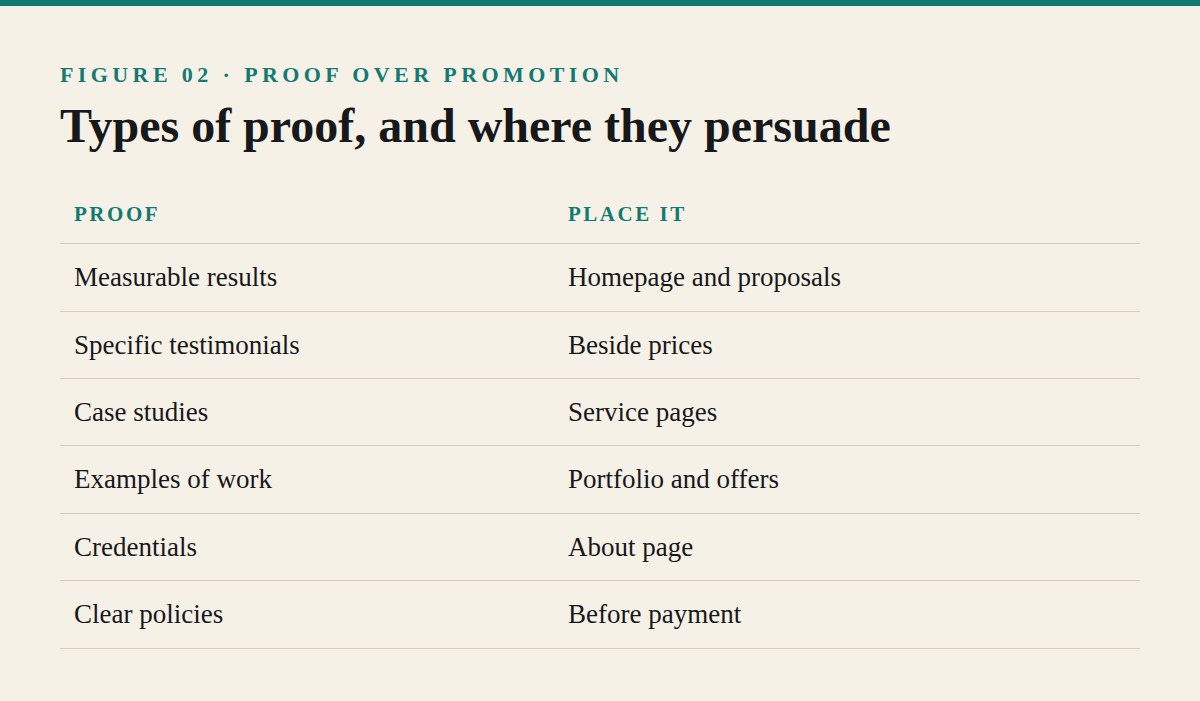
Most marketing is full of adjectives: excellent, innovative, trusted, premium, expert. Customers have read them so often that they barely register. What they do notice is evidence: a specific result, a recognisable client, a detailed example, a measurable improvement, a guarantee that shows confidence.
Replacing promotion with proof is one of the simplest ways to make a small business more credible.
Types of proof
Proof comes in several forms:
- Results: measurable outcomes customers achieved.
- Testimonials: specific comments from real customers.
- Case studies: detailed accounts of problems solved.
- Examples of work: portfolios, samples or demonstrations.
- Credentials: relevant qualifications, memberships or certifications.
- Third-party recognition: reviews, awards or mentions by respected sources.
- Transparency: clear prices, policies and processes.
The most persuasive proof is specific and relevant to the customer's situation.
Specific beats general
General statements such as "clients love our work" are weak evidence. Specific statements such as "We helped a local dental practice reduce missed appointments from twelve to four each week" are strong. Specificity makes proof believable because it can, in principle, be checked.
Wherever possible, include numbers, timeframes, named clients with permission and concrete details.
Collect proof systematically
Many businesses have excellent results but no record of them. Make collecting proof part of your process. At the end of each project or purchase, ask for feedback and permission to share it. Record results, take photographs of finished work and note interesting stories.
Over time, this habit creates a rich library of evidence for your website, proposals and conversations.
A customer worried about results needs case studies and measurable outcomes.
Match proof to objections
Different customers need different reassurance. A customer worried about quality needs examples of work. A customer worried about results needs case studies and measurable outcomes. A customer worried about reliability needs testimonials about communication and deadlines.
Place relevant proof close to the decisions it supports, such as beside prices, service descriptions and calls to action.
Be honest with evidence
Proof must be accurate. Never invent testimonials, exaggerate results or use client names without permission. Present typical results honestly and avoid implying that exceptional outcomes are guaranteed. Advertising rules in many places restrict misleading claims and fake reviews.
Honest proof is more valuable than impressive but questionable claims.
Turn claims into evidence
Review your website and marketing materials. For every claim you make, ask: what evidence supports this? If you claim to be fast, show delivery times. If you claim expertise, show relevant work or credentials. If you cannot support a claim, remove it or replace it with something you can prove.
Common mistakes
Businesses often bury their best proof on a separate testimonials page few visitors read. Others collect only generic praise, or present results without context, making them seem unbelievable. The most effective proof is specific, honest and placed where customers make decisions.
How to ask for a testimonial
Customers often agree to give testimonials but write vague praise. Make it easier by asking specific questions: What was happening before you worked with us? What changed? What would you tell someone considering us? Offer to draft a short testimonial from their answers for them to approve. Ask soon after a successful result, when the experience is fresh.
An example in practice
A software company's homepage described its product as "powerful, intuitive and trusted by businesses". It replaced these words with three short customer stories, each showing a measurable improvement, along with logos of clients who agreed to be featured. Visitors spent more time on the page, and sales conversations began with questions about specific results rather than whether the product worked.
Authority · 03 of 08
Expertise People Can See
Knowledge becomes credibility only when others can see it, test it and benefit from it.
Many skilled professionals are less visible than they deserve to be. Their knowledge is real, but potential customers cannot see it before they buy. Meanwhile, less experienced competitors who share their thinking publicly appear more expert. Expertise that remains private does little to build a business.
Making expertise visible does not require self-promotion. It requires sharing useful knowledge in ways that help people and demonstrate how you think.
Answer real questions
The simplest way to show expertise is to answer the questions customers actually ask. Collect questions from sales conversations, emails, support requests and social media. Each question can become an article, a short video, a newsletter section or a page on your website.
Useful answers do two things at once: they help people immediately and they demonstrate that you understand their problems.
Show your thinking
Customers trust experts whose reasoning they can follow. Explain not only what you recommend, but why. Describe the trade-offs, the common mistakes and how you would decide in different situations. Thoughtful explanations are more convincing than confident conclusions alone.
Teach generously
Some founders worry that sharing knowledge freely will reduce demand for their services. In practice, the opposite usually happens. People who learn from you begin to trust you, and many realise they would rather pay an expert than do the work themselves. Those who do it themselves often recommend you to others.
Teach the principles generously. Customers pay for application, judgement and execution.
Choose formats that suit you
Expertise can be shared in many formats: written articles, newsletters, short videos, podcasts, workshops, talks, templates or detailed social media posts. Choose formats that suit your strengths and your audience's preferences. Consistency in one format is better than occasional efforts across many.
Some founders worry that sharing knowledge freely will reduce demand for their services.
Be specific to your field
General advice is everywhere. Specific advice for a particular audience is rare and valuable. A bookkeeper writing about tax deadlines for freelance photographers will stand out more than one writing generally about accounting.
Specificity also attracts the customers most likely to value your expertise.
Engage where your audience gathers
Share knowledge in places where your customers already look for answers: industry forums, professional groups, local business networks or relevant online communities. Answer questions thoughtfully without immediately promoting your services. Over time, people notice who consistently provides useful help.
A simple routine
Each month, choose one common customer question and create one thorough, useful answer. Publish it on your website, share it with your email list and adapt it for one social platform. Over a year, twelve strong pieces can form a valuable library that demonstrates your expertise continuously.
Common mistakes
Experts often write for other experts, using jargon customers do not understand. Others share only conclusions without explanation, or publish sporadically and then disappear. The most credible expert content is clear, practical, specific to the audience and published steadily over time.
Turning one answer into several pieces
A single thorough answer can serve many purposes. Publish the full version on your website, send a shorter summary to your email list, share one key point on a professional network and keep the answer ready to send when a prospect asks the same question. Over time, these answers form a body of work that demonstrates expertise every day, without constant new effort.
An example in practice
A commercial lawyer noticed that small business clients repeatedly asked similar questions about contracts with freelancers. She wrote a clear, practical guide explaining the key issues in plain language, with a reminder that readers should seek advice for their situation. The guide was shared widely in local business groups, and several companies contacted her specifically because they had found it useful.
Proof · 04 of 08
Case Studies That Build Trust
A well-told case study shows customers what working with you is actually like, and what it can achieve.

A testimonial tells customers that someone was satisfied. A case study shows them why. It describes the client's situation, the problem, the approach, the work and the result, giving future customers a detailed picture of what working with you involves. For many service businesses, case studies are the most persuasive marketing material available.
Good case studies are honest, specific and focused on the client's journey rather than on the provider's brilliance.
Choose the right projects
Select projects that represent the work you want more of and the customers you serve best. A strong case study features a recognisable problem, a clear approach and a meaningful result. It does not need to be your largest project; it needs to be relevant to the customers you want to attract.
Follow a clear structure
A simple structure keeps case studies readable:
- The client: who they are and their situation.
- The challenge: the problem they faced and why it mattered.
- The approach: how you worked together and key decisions.
- The result: what changed, with specific details where possible.
- The client's words: a short quotation describing the experience.
This structure mirrors how customers think about their own problems.
Make the client the hero
The client's progress should be the focus. Describe their goals, constraints and achievements. Your role is to guide and support them. Customers reading the case study will imagine themselves in the client's position, so make the story relatable.
Use specific details
Specific details make case studies credible: timeframes, numbers, before-and-after comparisons, photographs, screenshots or examples of deliverables. If exact numbers cannot be shared, describe the result honestly in qualitative terms.
Always obtain the client's permission before publishing identifying details, numbers or images.
Briefly mentioning a challenge and how it was solved can make a case study more believable and show how you handle problems.
Include the difficult parts
Real projects rarely go perfectly. Briefly mentioning a challenge and how it was solved can make a case study more believable and show how you handle problems. Avoid overly polished stories that sound like advertisements.
Keep it concise
Most readers want the essential story, not every detail. A clear headline, a short summary and a few well-organised sections are usually enough. Offer more detail for those who want it, such as images or a longer explanation.
Use case studies throughout your marketing
Place relevant case studies on service pages, in proposals, in sales conversations and in follow-up emails. When a prospect describes a problem, sharing a case study about a similar client can be more persuasive than any explanation.
Common mistakes
Case studies often focus too much on the provider's process and too little on the client's result. Others lack specifics, read like advertisements or are published without the client's permission. Some businesses write one case study and never update it. A small, current library of honest, specific stories works best.
A short interview guide
Case studies are easier to write after a brief conversation with the client. Useful questions include: What was happening before we started? What had you tried already? What made you decide to work with us? What changed, and how do you measure it? What would you tell someone in your position? Record the answers with permission, and use the client's own words where possible.
An example in practice
A small branding studio replaced its gallery of logos with five short case studies. Each explained the client's business, the problem with its previous brand, the design process and what changed after the new identity launched. Prospective clients began referencing specific case studies in their enquiries, and proposals were accepted more quickly because expectations were already clear.
Identity · 05 of 08
A Personal Brand Without Hype
Your reputation is already your personal brand. The aim is to make it clear, honest and consistent.
For many small businesses, especially service businesses, the founder is the brand. Customers choose a consultant, designer, coach or craftsperson partly because of who they are: their expertise, values, style and way of working. A personal brand is simply how people understand and remember you professionally.
Personal branding has acquired an unfortunate reputation for self-promotion, staged success and exaggerated authority. It does not need to be like that. A credible personal brand is an honest, consistent expression of what you do well and how you work.
Clarify what you want to be known for
Start by defining a clear professional focus. What problems do you solve? For whom? What makes your approach distinctive? A personal brand without focus becomes a collection of unrelated opinions and activities.
Write a short statement such as: I help independent restaurants simplify their finances and make better decisions. This statement guides what you share and how you present yourself.
Show your values through action
Values become credible when people see them in your behaviour. If you value honesty, explain trade-offs openly. If you value craftsmanship, show the care in your work. If you value clients' time, communicate clearly and keep commitments.
Avoid listing values without evidence. Customers learn more from what you do than from what you say about yourself.
Share work and lessons, not image
A credible personal brand shares useful content: lessons learned, client stories with permission, behind-the-scenes explanations of your process and practical advice. It avoids presenting a carefully staged image of constant success.
Occasional honesty about mistakes and lessons can increase trust, provided it remains professional and constructive.
Keep a consistent presence
Use consistent information across your website, professional profiles, social media and email signatures: the same professional photograph, description, focus and contact details. Consistency makes you easier to recognise and recommend.
Consistency makes you easier to recognise and recommend.
Be visible in the right places
Choose a small number of places where your audience spends time and contribute there regularly. For some professionals, this may be a professional network or newsletter. For others, it may be local events, industry associations or speaking opportunities.
Protect your privacy
A personal brand does not require sharing your private life. Decide what you are comfortable making public and keep boundaries around family, location and personal matters. Professional credibility depends on expertise and reliability, not on constant personal disclosure.
Avoid hype
Avoid exaggerated titles, inflated claims, misleading income screenshots or implied expertise you do not have. These tactics may attract attention briefly but often damage credibility when scrutinised. Let qualifications, experience and results speak for themselves.
Common mistakes
Personal brands often suffer from inconsistency: a polished website alongside neglected or contradictory profiles. Others try to appeal to everyone, share opinions on every topic or post frequently without saying anything useful. A narrow focus and useful contributions build stronger recognition than constant visibility.
Profile essentials
Every professional profile should answer four questions within seconds: what you do, who you help, the result you deliver and how to contact you. Use the same headline, photograph and short description everywhere. Remove outdated roles and unrelated activities that confuse your focus. A clear, current profile often does more for credibility than months of posting.
An example in practice
An independent HR consultant felt uncomfortable with self-promotion. Instead of posting about her achievements, she began writing a monthly newsletter answering practical HR questions from small business owners, sharing anonymised lessons from her work. Her profile clearly stated her focus on small growing companies. Within a year, she was invited to speak at local business events, and most new clients arrived already familiar with her advice.
Reach · 06 of 08
Earned Media and Partnerships
Being recommended by others carries more weight than anything you say about yourself.
Earned media is attention you do not pay for directly: a journalist quoting your expertise, a podcast inviting you as a guest, a respected newsletter recommending your work or a partner introducing you to their clients. Because someone else has chosen to feature or recommend you, earned media carries a credibility that advertising rarely achieves.
For small businesses, earned media and partnerships are among the most effective ways to reach new audiences without loud self-promotion.
Be genuinely useful to others
Journalists, editors, podcast hosts and partners are looking for value: insight, expertise, good stories or services that benefit their own audience. Approach them with something useful rather than a request for publicity. Offer a clear perspective, practical advice or a relevant example.
Ask yourself what the other person needs and how you can help them succeed.
Start with smaller, relevant outlets
Large publications are difficult to reach and may not reach your ideal customers anyway. Niche newsletters, industry blogs, local media, trade associations and specialist podcasts often have smaller but highly relevant audiences. A mention in the right specialist publication can be more valuable than a brief appearance in a large one.
Prepare your expertise
Make it easy for others to understand what you can contribute. Prepare a short biography, a clear statement of your expertise, a list of topics you can discuss and examples of previous articles or talks. Keep a professional photograph available.
When opportunities arise, you can respond quickly and professionally.
Pitch briefly and specifically
When contacting a journalist or host, keep your message short. Explain why the topic matters to their audience, what insight you can provide and why you are qualified. Reference their previous work to show you understand their focus.
Generic mass pitches are usually ignored. Personal, relevant pitches have a much better chance.
Reference their previous work to show you understand their focus.
Build partnerships with complementary businesses
Partnerships work best between businesses that serve the same customers without competing directly. A web designer might partner with a copywriter, a wedding photographer with a florist, an accountant with a business lawyer. Partners can refer clients, collaborate on workshops, share content or create combined offers.
Start by referring clients to trusted partners yourself. Generosity often leads to reciprocal referrals.
Protect your reputation in partnerships
Your partners' behaviour reflects on you. Choose partners whose quality, reliability and values match your own. Agree clearly on expectations, referral arrangements and communication. Review partnerships periodically to ensure they still benefit both sides and their customers.
Make earned media work harder
When you receive coverage, share it thoughtfully on your website and with your audience. Thank the journalist or host and stay in touch. A single positive relationship can lead to repeated opportunities over many years.
Common mistakes
Businesses often pitch large outlets with generic messages, treat partnerships as one-sided requests for referrals or neglect relationships after a single collaboration. Others agree to partner with anyone, risking their reputation. Relevance, generosity and careful selection produce better results.
A sample pitch
A short pitch might read: "Hello Anna, I enjoyed your recent piece on small retailers and rising costs. I run a bookkeeping practice for independent shops and have seen three practical ways owners protect margins without raising prices. I would be happy to share examples for a future article or newsletter. Here are two short pieces I have written on the topic." It is brief, relevant, specific and useful.
An example in practice
A small interior design studio wanted more clients but disliked heavy advertising. The founder contacted a local property newsletter offering a short monthly column with practical advice for small homes. She also partnered with two estate agents, offering their clients a free consultation guide. The column built recognition, the agents referred clients regularly and enquiries grew steadily without paid campaigns.
Discipline · 07 of 08
Consistency: The Quiet Multiplier
Reputation is not built in a single moment. It is built by doing the right things repeatedly.
Many businesses invest heavily in occasional bursts of activity: a major launch, a brand redesign, a campaign or a flurry of social media posts. These moments can create attention, but reputation is rarely built that way. It is built through consistency: reliable work, regular communication, predictable quality and promises kept month after month.
Consistency is less exciting than a launch. It is also far more powerful over time.
Why consistency builds trust
Trust grows when expectations are met repeatedly. A customer who receives excellent service once may be pleased. A customer who receives excellent service every time becomes loyal and recommends you. The same applies to content, communication and brand experience.
Consistency reduces uncertainty, and reducing uncertainty is at the heart of credibility.
Consistency in quality
Customers judge your business by the experience they receive, not your best day. Define clear standards for your products or services and create checklists or processes that help you meet them every time. Review work regularly to identify where quality varies.
Reliable quality is often more valuable to customers than occasional brilliance.
Consistency in communication
Respond to messages within predictable timeframes. Keep clients informed about progress. Use a consistent tone and clear language across emails, proposals and support. Customers feel more confident when they know what to expect.
Consistency in visibility
If you publish content, choose a schedule you can sustain, such as one article a month or one newsletter every two weeks, and keep it. A steady rhythm builds familiarity and trust. Erratic bursts followed by silence can make a business appear unreliable.
It is better to publish less often consistently than to promise a frequency you cannot maintain.
Erratic bursts followed by silence can make a business appear unreliable.
Consistency in brand
Use the same name, visual identity, voice and core message across your website, social media, documents and conversations. Repetition helps people remember who you are and what you stand for.
Systems support consistency
Consistency depends less on motivation than on systems: templates, checklists, calendars, routines and clear processes. Plan content in advance, schedule regular client updates and document how important tasks are performed. Systems allow quality to continue even during busy periods.
Track your promises
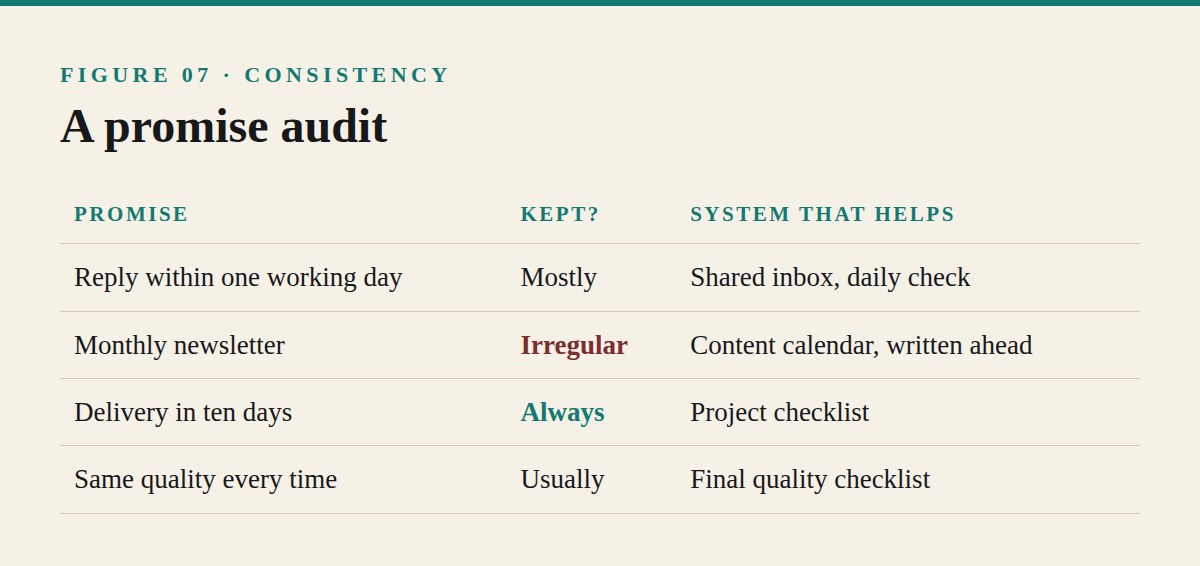
Make a list of the promises your business makes: response times, delivery dates, quality standards and publishing schedules. Review them periodically. Are you keeping them? Where you are not, either improve your systems or adjust the promise.
Common mistakes
Businesses often start ambitious routines they cannot sustain, such as daily posting or same-day replies, then abandon them. Others allow standards to slip quietly during busy periods. Choosing realistic commitments and supporting them with systems prevents both problems.
A quick consistency audit
Once a quarter, look at your business as a customer would. Read your last ten client emails, your last five published pieces and your website, profiles and documents together. Are the tone, quality and promises consistent? Note any gaps between what you say and what customers experience, then choose the most visible one to fix first.
An example in practice
A small accounting practice noticed that clients complained about slow responses, even though the work itself was accurate. It introduced a simple standard: every client message would receive a reply within one working day, even if the full answer took longer. A shared inbox, templates and a daily check made this possible. Complaints fell sharply, and client reviews began mentioning reliability as a key reason for recommending the practice.
Resilience · 08 of 08
Protecting Your Reputation
Reputation takes years to build and moments to damage. Protect it in how you handle problems.
A strong reputation is one of the most valuable assets a small business can have. It brings referrals, supports higher prices, attracts partners and gives customers confidence before they have even spoken to you. Yet reputation can be damaged quickly by a poorly handled complaint, a public mistake, an unreliable partner or careless communication.
Protecting your reputation does not mean avoiding every problem. It means handling problems well and behaving consistently with the values you claim.
Prevention starts with standards
Most reputation problems begin with ordinary failures: missed deadlines, poor communication, inconsistent quality or broken promises. Clear standards, reliable processes and honest commitments prevent many issues before they arise.
Only promise what you can consistently deliver.
Handle mistakes openly
When something goes wrong, acknowledge it quickly. Explain what happened in plain terms, apologise sincerely where appropriate and focus on fixing the problem. Customers are often forgiving when businesses take responsibility. They are far less forgiving of excuses, silence or blame.
After resolving the issue, identify the cause and improve your process to prevent it happening again.
Respond to criticism calmly
Negative reviews and public criticism can feel personal. Respond calmly, professionally and promptly. Thank the person for the feedback, acknowledge their experience, explain what you will do and offer to continue the conversation privately where appropriate.
Remember that future customers are reading your response. A thoughtful reply can demonstrate professionalism and care.
Address false claims carefully
Occasionally, businesses face criticism that is inaccurate or unfair. Respond factually and politely without becoming defensive or aggressive. Provide relevant information and avoid public arguments. If statements are seriously false or damaging, consider seeking professional advice before taking further action.
Respond factually and politely without becoming defensive or aggressive.
Monitor what is said about you
Check reviews, social media mentions and search results regularly. Early awareness allows you to respond quickly to problems and thank people for positive feedback. Simple alerts and periodic searches are often sufficient for small businesses.
Protect your reputation through partners
Your reputation can be affected by suppliers, contractors and partners. Choose them carefully, set clear expectations and monitor quality. If a partner's behaviour conflicts with your standards, address it promptly.
Be careful online
Public comments, social media posts and emails can be shared widely and remain visible for years. Communicate professionally, avoid public disputes and think before posting about controversial topics, clients or competitors.
Prepare for difficult situations
Write a short plan for responding to serious issues: a data breach, a product problem, a major complaint or public criticism. Decide who responds, how quickly and what information is shared. Preparation helps you act calmly under pressure.
Common mistakes
Businesses often respond defensively to criticism, ignore early warning signs or try to hide mistakes. Some delete negative reviews where possible or post fake positive ones, which can make problems far worse and may breach platform rules or the law. Openness, speed and genuine improvement are the most effective protections.
Review response templates
Prepare short templates for common situations, then personalise each reply. For a positive review: thank the customer specifically for what they mentioned. For a mixed review: thank them, acknowledge the issue and explain what you are doing about it. For a negative review: apologise for their experience, avoid arguing in public and invite them to continue the conversation directly. Templates help you respond quickly and calmly, even on difficult days.
An example in practice
A small catering company delivered an order late to a corporate event because of a vehicle breakdown. The owner called the client immediately, explained the situation, provided a partial refund and later sent a written summary of new backup arrangements. The client posted a review praising the honest handling of the problem and continued booking the company for future events.
Before you close this edition
Your Action Plan
Your next 30 days
Week 1: Gather proof. Collect three specific results, testimonials or examples of your best work.
Week 2: Show your expertise. Publish one genuinely useful piece answering a question your customers often ask.
Week 3: Write a case study. Document one client success with situation, approach, result and the client's own words.
Week 4: Build one relationship. Contact one complementary business or relevant publication with a useful idea, not a request.
Keep learning
Hustle Influence offers practical online courses and AI tools that help you turn ideas into action.
hustleinfluence.com
HUSTLE MAGHustle in Silence.