
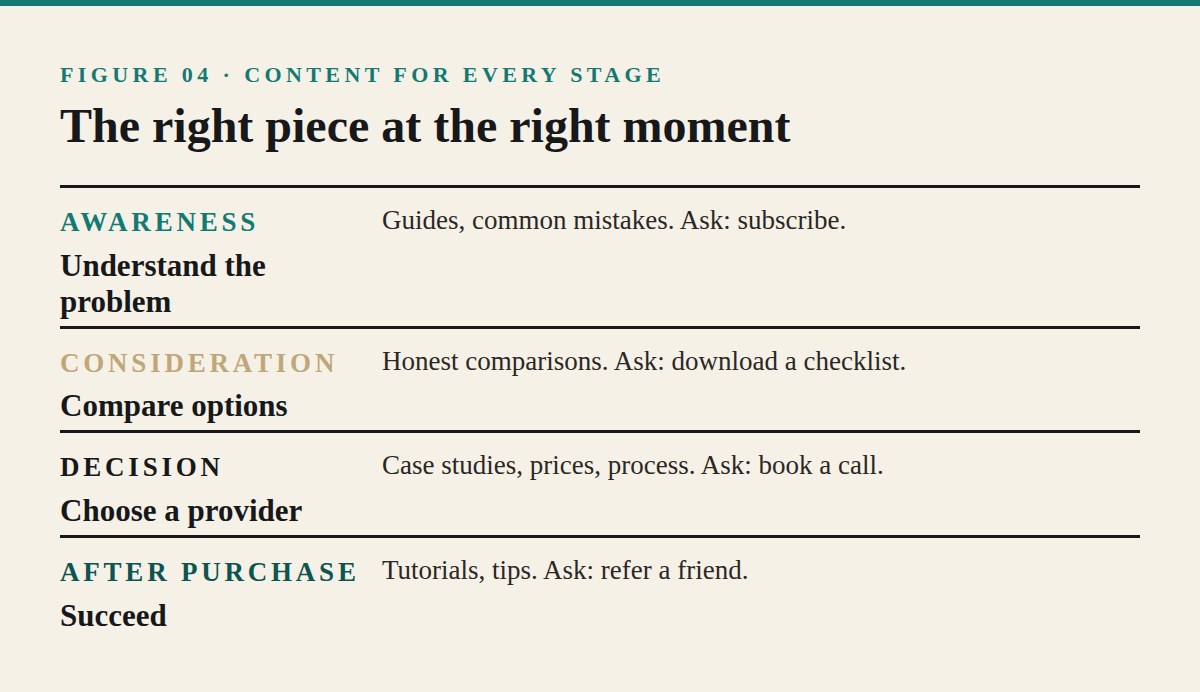
Customers need different information at different points in their decision. Early on, they want to understand a problem. Later, they compare solutions and look for proof. Finally, they need reassurance and practical details before committing. Content that serves only one stage leaves gaps where potential customers lose interest or turn to competitors.
A complete content library supports buyers from first curiosity to confident purchase, and beyond.
Awareness: understanding the problem
At the earliest stage, people may not know what solution they need. They are trying to understand a problem or opportunity. Content at this stage explains causes, symptoms, consequences and options in a neutral, helpful way.
Examples include beginner guides, explanations of common problems and articles about mistakes to avoid. This content builds familiarity and positions you as a helpful source.
Consideration: comparing options
Once people understand the problem, they explore ways to solve it. They compare approaches, products and providers. Content here helps them evaluate options honestly: comparisons, pros and cons, guides to choosing a provider and explanations of different methods.
Being fair and balanced at this stage builds trust, even when you explain that your solution is not right for everyone.
Decision: choosing a provider
At the decision stage, prospects want proof and practical details. Case studies, testimonials, pricing information, process explanations, guarantees and answers to frequently asked questions help them decide confidently.
This content often has the greatest direct effect on sales, yet many businesses neglect it in favour of general articles.
After purchase: success and loyalty
Content continues to matter after purchase. Onboarding guides, tutorials, tips for getting the best results and answers to common questions help customers succeed. Successful customers are more likely to buy again and recommend you.
Onboarding guides, tutorials, tips for getting the best results and answers to common questions help customers succeed.
Audit your existing content
List your existing content and assign each piece to a stage. Many businesses discover they have plenty of awareness content but very little decision-stage material, or vice versa. Identify the gaps and plan new pieces to fill them.
Link content between stages
Guide readers from one stage to the next. An awareness article can link to a comparison guide. A comparison guide can link to case studies and pricing. A case study can invite readers to book a call. These connections create a path through your content.
Use decision content in sales
Decision-stage content is valuable in direct sales conversations. Send relevant case studies, process guides or answers to common objections to prospects at the right moment. This saves time and provides consistent, well-considered information.
Common mistakes
Many businesses publish only awareness content because it attracts the most readers, then wonder why few become customers. Others jump straight to decision content and struggle to attract an audience. Some never create post-purchase content, missing an opportunity to increase loyalty. A balanced library serves every stage.
A content map example
A web design studio might map its content like this. Awareness: "Why your website is not bringing enquiries". Consideration: "Website builder or custom site? An honest comparison". Decision: three case studies, a page explaining the process and typical prices, and a frequently asked questions page. After purchase: a guide to updating your own website and a checklist for the first month after launch. Every stage now has at least one clear piece.
Match the call to action to the stage
Each stage calls for a different next step. Awareness content might invite readers to subscribe to a newsletter. Consideration content might offer a comparison checklist. Decision content should invite a call, a quote or a purchase. Asking an early-stage reader to buy immediately rarely works, while asking a ready buyer only to subscribe can lose a sale.
An example in practice
A software company published dozens of general productivity articles that attracted visitors but few trials. An audit showed almost no decision-stage content. The team added comparison pages, three detailed customer case studies, a clear pricing explanation and a guide to switching from spreadsheets. Trial sign-ups increased significantly, while traffic stayed roughly the same.