
Contents · Edition 014
Edition 014
From the Editors
Every week, millions of businesses publish content that nobody needs. Articles that repeat what others have said, posts that exist only to fill a schedule, videos that promote without helping. It is no surprise that many founders conclude content marketing does not work.
Content does work, but only a particular kind: content that genuinely helps the people you want to serve, at the moment they need help, and leads naturally towards what you sell. That kind of content earns trust before the first conversation. It answers objections before they are raised. It keeps working for years.
This issue is about creating that kind of content with limited time. We start with why useful content sells, then build content pillars, search-led topics and material for every stage of the buying decision. We look at writing articles people finish, choosing formats, repurposing work across channels and measuring what content actually earns.
Write less. Help more. Connect it to what you offer. That is the whole strategy.
The Editors, Hustle Mag
In This Edition
Content That Sells
Useful Content That Builds Trust and Leads to Sales
Content that sells is not content that pushes. It is content that helps a specific customer understand a problem, make a decision or get a result, and that makes the next step towards your offer obvious.
This issue moves from strategy to execution. We begin with why useful content sells and how content pillars keep it focused. We turn to search, to content for each stage of the buying decision and to writing articles people actually finish. We then cover formats, repurposing and measurement.
Each article ends with a step that makes your content more useful and more profitable.
Cover Story · 01 of 08
Why Useful Content Sells
People buy from those who have already helped them. Content lets you help before the sale.
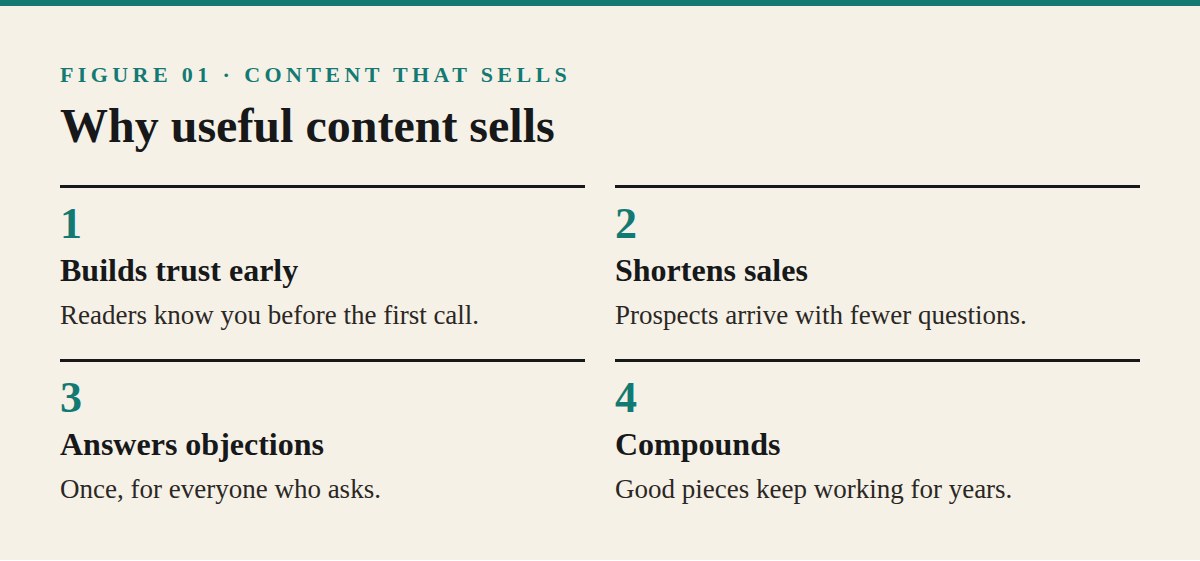
Before most people buy, especially when the purchase matters, they research. They search for answers, compare options, read reviews and look for someone who seems to understand their situation. Content allows a business to be present during that research, helping people before they are ready to buy.
When content genuinely helps, it builds trust, demonstrates expertise and creates a sense of familiarity. By the time a reader becomes a prospect, they already know how you think and whether they trust you.
Help first, sell second
The most effective content focuses on the reader's problem, not the business. It explains, teaches, compares or guides. Promotion has a place, but usually as a natural next step at the end: "If you would like help with this, here is how we work."
Content that constantly promotes tends to be ignored. Content that consistently helps tends to be shared and remembered.
Content shortens the sales process
Prospects who have read your content arrive with fewer questions and more confidence. They understand your approach, your prices if you publish them and the results you aim for. Sales conversations become easier because much of the explanation has already happened.
Some businesses find that prospects mention specific articles in their first conversation, a clear sign that content is doing part of the selling.
Content answers objections at scale
Every business hears the same questions and objections repeatedly: Is this right for me? How long does it take? What does it cost? What if it does not work? Content can answer these questions once, thoroughly, for everyone who asks them.
An article that addresses a common objection can be read by hundreds of prospects and sent directly to those who raise it in conversation.
An article that addresses a common objection can be read by hundreds of prospects and sent directly to those who raise it in conversation.
Content compounds
Unlike an advertisement that stops when spending stops, useful content can continue working for years. A strong article that ranks in search results or is shared regularly keeps bringing new readers long after publication. Over time, a library of useful content becomes a significant business asset.
Specific beats general
The internet is full of general advice. Content that serves a specific audience with specific problems stands out. "How to price your services" competes with thousands of articles. "How freelance translators can move from per-word to project pricing" speaks directly to a defined reader and is far more likely to attract the right customers.
Connect content to your offers
Content sells only when it connects to something you offer. Choose topics close to the problems your products or services solve. A garden designer writing about plant care for small gardens attracts people who may later want a garden designed. Writing about unrelated topics may attract readers, but not customers.
Common mistakes
Businesses often publish content because they feel they should, without a clear audience or connection to their offers. Others create thin, generic material to fill a schedule. Many forget to include any next step, leaving interested readers with nowhere to go. Useful, specific, connected content works; volume alone does not.
How much content is enough
Small businesses rarely need large volumes of content. One genuinely useful piece a month, connected to an offer and shared consistently, often outperforms weekly posts written in a hurry. Quality, relevance and consistency matter more than quantity. A library of twelve strong articles after a year can serve prospects for many years afterwards.
An example in practice
A small accounting firm began publishing one practical article a month for restaurant owners, covering topics such as food cost percentages, tips and staff payroll. Each article ended with an invitation to book a short review call. Within a year, restaurant owners made up most of the firm's new clients, and many mentioned an article they had read before getting in touch.
Strategy · 02 of 08
Content Pillars
Three or four focused themes keep content coherent, efficient and connected to what you sell.
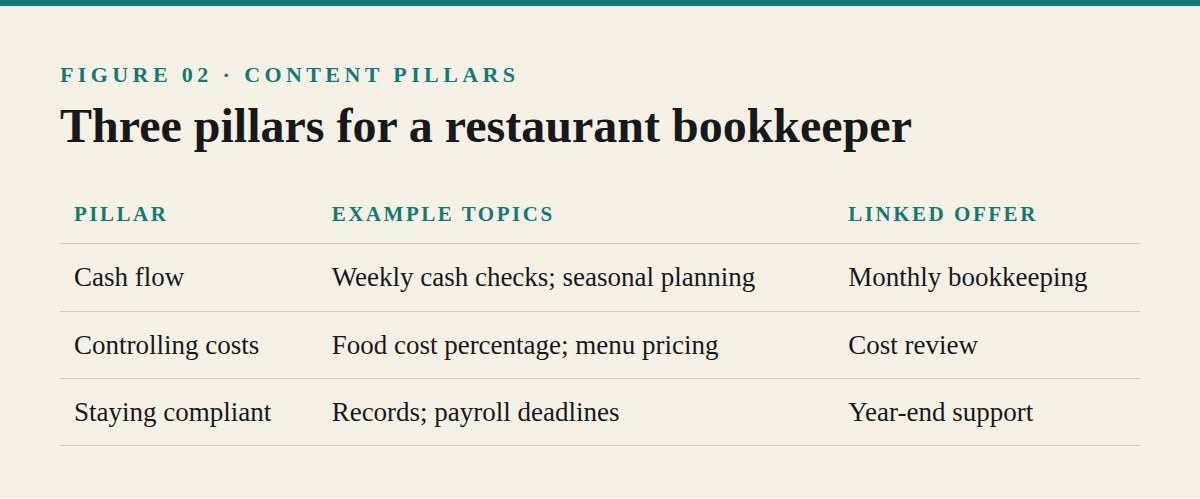
Without a clear focus, content wanders. One week it covers industry news, the next a personal story, then a product announcement, then general advice. Each piece may be fine, but together they fail to establish what the business stands for, and they rarely lead readers towards an offer.
Content pillars solve this. They are a small set of themes, usually three or four, that all content returns to. Each pillar connects to a customer problem and to something the business offers.
What makes a good pillar
A strong content pillar has three qualities. It addresses a real, recurring problem or interest of your customers. It connects to one of your products or services. And it is broad enough to generate many specific topics over time.
For a fitness coach serving busy professionals, pillars might be efficient training, simple nutrition and building consistent habits. Each connects to coaching and contains dozens of possible topics.
Derive pillars from your offers
Start with what you sell. For each main product or service, ask what problems it solves and what customers need to understand before buying. These problems become natural pillars. A web design studio might choose pillars such as converting visitors into enquiries, choosing the right website platform and maintaining a website after launch.
Check pillars against customer questions
Collect questions customers ask in sales conversations, emails, reviews and support requests. Group them by theme. If your proposed pillars contain many genuine questions, they are well chosen. If not, adjust them to reflect what customers actually want to know.
Build topic lists under each pillar
Under each pillar, list specific topics: questions, comparisons, mistakes, step-by-step guides, examples and case studies. Aim for at least ten topics per pillar. These lists become your content backlog, removing the weekly struggle of deciding what to create.
These lists become your content backlog, removing the weekly struggle of deciding what to create.
Balance the pillars
Rotate between pillars so that each receives regular attention. A monthly theme from your marketing calendar can draw on one pillar at a time, or each week can feature a different pillar. Balance ensures that you build authority across all the areas connected to your offers.
Create cornerstone pieces
For each pillar, consider creating one comprehensive cornerstone piece: a thorough guide covering the topic in depth. Smaller pieces can then link to it, and it can serve as a valuable resource to send to prospects. Cornerstone pieces often become the most visited and most useful content a business owns.
Review pillars annually
As your business evolves, your pillars may need to change. New services, new customer groups or changes in your market may require adjustments. Review your pillars once a year and ensure they still reflect what you sell and what customers need.
Common mistakes
Businesses often choose pillars based on what they find interesting rather than what customers need. Others choose too many pillars, diluting focus. Some create pillars unconnected to any offer, attracting readers who will never buy. Three or four customer-centred, offer-connected pillars are usually enough.
A pillar planning example
A bookkeeper serving restaurants might plan like this. Pillar one, managing cash flow: weekly cash checks, seasonal planning, supplier payment terms. Pillar two, controlling costs: food cost percentages, waste tracking, menu pricing. Pillar three, staying compliant: record-keeping basics, payroll deadlines, preparing for an accountant. Each pillar connects directly to a paid service and contains years of possible topics.
An example in practice
A small interior design studio published content on a wide variety of topics, from celebrity homes to design history. Readers enjoyed it, but few became clients. The studio defined three pillars: making small homes feel larger, choosing durable materials for family homes and planning renovations on a budget. Each aligned with a service. Within months, enquiries increasingly came from readers who had followed content in one of these pillars.
Search · 03 of 08
Answering What Buyers Search For
When someone searches for a problem you solve, your content should be the clearest answer they find.
Search engines remain one of the most important ways customers find businesses. When people have a problem, they search for answers, explanations, comparisons and providers. Content that answers those searches clearly can bring a steady flow of interested visitors for years, without paying for each click.
Search-led content does not require technical tricks. It requires understanding what customers search for and creating the most helpful answer you can.
Think in questions
Customers search in questions and phrases: "how much does a small business website cost", "best way to price freelance photography", "what to look for in a bookkeeper". Each search reveals a need. Your task is to identify the searches connected to your offers and answer them thoroughly.
Collect questions from customer conversations, support emails, review sites, forums and the suggestions search engines display as you type.
Prioritise buying-stage searches
Some searches indicate early curiosity; others indicate readiness to buy. "What is bookkeeping" is early. "Bookkeeping services for restaurants price" is much closer to a purchase. Content that answers buying-stage searches often brings fewer visitors but more customers.
A balanced content library includes both, with particular attention to searches close to purchase decisions.
Create the best answer
For each chosen topic, look at the content that currently appears in search results. Ask how you could make your answer clearer, more complete, more specific or more practical. Include examples, steps, prices or ranges where appropriate, and information drawn from your own experience.
Helpful, original content tends to perform better over time than content written mainly to repeat keywords.
Structure for readers and search engines
Clear structure helps both readers and search engines understand content. Use a descriptive title that reflects the search, an introduction that answers the main question quickly, headings that break the topic into sections and short paragraphs. Include the main phrase naturally, without forcing it.
Ask how you could make your answer clearer, more complete, more specific or more practical.
Show experience and trust
Search engines and readers increasingly value content that demonstrates real experience. Include details from your work, examples, case studies, photographs of real projects and clear information about who wrote the content and why they are qualified.
Keep content updated
Information changes. Prices, regulations, tools and best practices evolve. Review important articles regularly and update them with current information. Updated content remains useful to readers and often performs better in search results.
Connect to the next step
Every search-led article should help the reader take a next step: a related article, a free resource, a newsletter sign-up or an enquiry. A reader who finds a helpful answer should know exactly how you can help further.
Be patient
Search results take time to change. New content may take weeks or months to attract consistent traffic. Publish steadily, focus on quality and judge results over months rather than days.
Common mistakes
Businesses often target broad, highly competitive topics where they have little chance of standing out, or write content stuffed with keywords that reads poorly. Others publish and forget, letting articles become outdated. Specific, buying-stage topics answered thoroughly and kept current are usually the best investment for a small business.
Finding the right questions
Simple sources reveal what buyers search for: the questions customers ask you, the "people also ask" suggestions in search results, comments on competitors' content, industry forums and your own website's search box if you have one. Write each question down exactly as a customer would phrase it. Those phrases often make the best article titles.
An example in practice
A small company installing solar panels noticed that prospects repeatedly asked about costs, payback periods and maintenance. It published detailed guides answering each question for homes in its region, with real examples and price ranges, and updated them every year. These guides became the main source of website enquiries, and visitors arrived with realistic expectations about prices.
Strategy · 04 of 08
Content for Every Stage
Different content serves different moments in a buyer's decision. Make sure each stage is covered.
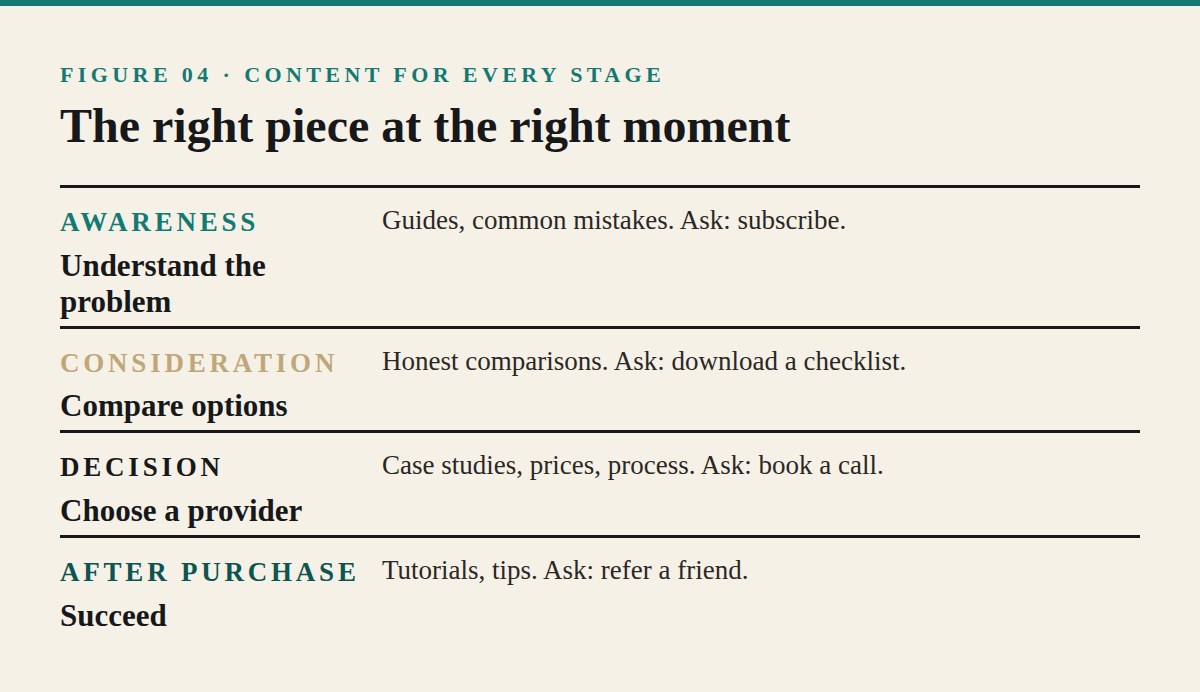
Customers need different information at different points in their decision. Early on, they want to understand a problem. Later, they compare solutions and look for proof. Finally, they need reassurance and practical details before committing. Content that serves only one stage leaves gaps where potential customers lose interest or turn to competitors.
A complete content library supports buyers from first curiosity to confident purchase, and beyond.
Awareness: understanding the problem
At the earliest stage, people may not know what solution they need. They are trying to understand a problem or opportunity. Content at this stage explains causes, symptoms, consequences and options in a neutral, helpful way.
Examples include beginner guides, explanations of common problems and articles about mistakes to avoid. This content builds familiarity and positions you as a helpful source.
Consideration: comparing options
Once people understand the problem, they explore ways to solve it. They compare approaches, products and providers. Content here helps them evaluate options honestly: comparisons, pros and cons, guides to choosing a provider and explanations of different methods.
Being fair and balanced at this stage builds trust, even when you explain that your solution is not right for everyone.
Decision: choosing a provider
At the decision stage, prospects want proof and practical details. Case studies, testimonials, pricing information, process explanations, guarantees and answers to frequently asked questions help them decide confidently.
This content often has the greatest direct effect on sales, yet many businesses neglect it in favour of general articles.
After purchase: success and loyalty
Content continues to matter after purchase. Onboarding guides, tutorials, tips for getting the best results and answers to common questions help customers succeed. Successful customers are more likely to buy again and recommend you.
Onboarding guides, tutorials, tips for getting the best results and answers to common questions help customers succeed.
Audit your existing content
List your existing content and assign each piece to a stage. Many businesses discover they have plenty of awareness content but very little decision-stage material, or vice versa. Identify the gaps and plan new pieces to fill them.
Link content between stages
Guide readers from one stage to the next. An awareness article can link to a comparison guide. A comparison guide can link to case studies and pricing. A case study can invite readers to book a call. These connections create a path through your content.
Use decision content in sales
Decision-stage content is valuable in direct sales conversations. Send relevant case studies, process guides or answers to common objections to prospects at the right moment. This saves time and provides consistent, well-considered information.
Common mistakes
Many businesses publish only awareness content because it attracts the most readers, then wonder why few become customers. Others jump straight to decision content and struggle to attract an audience. Some never create post-purchase content, missing an opportunity to increase loyalty. A balanced library serves every stage.
A content map example
A web design studio might map its content like this. Awareness: "Why your website is not bringing enquiries". Consideration: "Website builder or custom site? An honest comparison". Decision: three case studies, a page explaining the process and typical prices, and a frequently asked questions page. After purchase: a guide to updating your own website and a checklist for the first month after launch. Every stage now has at least one clear piece.
Match the call to action to the stage
Each stage calls for a different next step. Awareness content might invite readers to subscribe to a newsletter. Consideration content might offer a comparison checklist. Decision content should invite a call, a quote or a purchase. Asking an early-stage reader to buy immediately rarely works, while asking a ready buyer only to subscribe can lose a sale.
An example in practice
A software company published dozens of general productivity articles that attracted visitors but few trials. An audit showed almost no decision-stage content. The team added comparison pages, three detailed customer case studies, a clear pricing explanation and a guide to switching from spreadsheets. Trial sign-ups increased significantly, while traffic stayed roughly the same.
Writing · 05 of 08
Writing Articles People Finish
Clear structure, plain language and genuine usefulness keep readers reading until the end.
Many articles are opened and abandoned within seconds. Readers scan the first lines, find a slow introduction or dense paragraphs and leave. An article that is never finished cannot build trust or lead to a sale, however valuable the information buried inside it.
Writing articles people finish is less about talent and more about structure, clarity and respect for the reader's time.
Start with the reader's question
Before writing, define the single question the article answers and the reader who is asking it. Every paragraph should help answer that question. Material that does not serve it belongs in a different article or nowhere at all.
A clear purpose makes writing easier and reading more satisfying.
Answer quickly
Readers want to know immediately whether the article will help them. Open with a short statement of the problem and a preview of the answer. Avoid long introductions, background history or general statements such as "In today's fast-moving world". Get to the point within the first few sentences.
Use a clear structure
Organise the article into sections with descriptive headings. Headings allow readers to scan, understand the shape of the article and jump to the parts most relevant to them. A logical sequence, such as problem, explanation, steps, example and next action, keeps readers oriented.
Write in plain language
Use short sentences, everyday words and active verbs. Explain technical terms the first time you use them. Write as if you were explaining the topic to an intelligent friend who is not an expert in your field. Plain language is not simplistic; it is respectful of the reader's time.
A logical sequence, such as problem, explanation, steps, example and next action, keeps readers oriented.
Be specific and practical
Generic advice is easy to find and quickly forgotten. Specific advice is valuable: actual steps, numbers, examples, templates and common mistakes. Instead of "price your services correctly", explain how to calculate a price floor and show an example. Practical detail is what makes readers trust and remember an article.
Use examples and stories
Examples turn abstract advice into something readers can picture. A short story about a customer, a before-and-after comparison or a worked calculation helps readers understand how the advice applies to their own situation.
Format for easy reading
Use short paragraphs, occasional lists for steps or options and white space. Highlight key points sparingly. Include images, diagrams or tables where they genuinely clarify ideas. A wall of text discourages even motivated readers.
End with a clear next step
Finish with a brief summary and a natural next action: a related article, a downloadable resource, a newsletter sign-up or an invitation to get in touch. Readers who have found the article helpful are more likely to take the next step if it is clear and relevant.
Edit ruthlessly
The first draft is rarely the best version. Remove repetition, cut unnecessary words, shorten long sentences and check that every section serves the main question. Reading the article aloud helps identify awkward phrasing. Ask someone who matches your target reader to review important pieces.
Common mistakes
Writers often begin with long introductions, use jargon, cover too many topics in one article or end abruptly without any next step. Others publish first drafts without editing. Focus, structure, specificity and careful editing solve most of these problems.
An example in practice
A financial planner's articles were long, technical and rarely read beyond the opening paragraph. She restructured them around a single question each, opened with a direct answer, added clear headings, a worked example and a short checklist, and ended with an invitation to book a review. Readers began spending far longer on the articles, and several clients mentioned that the clarity of her writing convinced them to get in touch.
Formats · 06 of 08
Choosing the Right Format
Articles, videos, newsletters, guides and podcasts each have strengths. Choose by audience, message and capacity.
Content can take many forms: written articles, email newsletters, short videos, long videos, podcasts, downloadable guides, checklists, templates, case studies, webinars and social media posts. Each format suits certain audiences, topics and goals. Choosing well makes content more effective and easier to sustain.
There is no universally best format. The right choice depends on your customers, your message and your own strengths.
Written articles
Articles work well for search visibility, detailed explanations and content that readers want to reference later. They are easy to update, easy to share and accessible to many readers. They suit topics that require careful explanation, steps or comparisons.
Email newsletters
Newsletters build an ongoing relationship with people who have chosen to hear from you. They are an owned channel, unaffected by platform algorithms. Newsletters suit regular insights, curated advice, updates and gentle reminders of your offers.
Video
Video can demonstrate processes, show products, convey personality and build familiarity quickly. Short videos suit discovery on social platforms. Longer videos suit tutorials, explanations and detailed demonstrations. Video requires comfort on camera and some production effort, though simple, clear videos often perform well.
Podcasts and audio
Audio suits audiences who prefer listening while commuting, exercising or working. Podcasts can build deep familiarity because listeners spend long periods with the host. They require consistency and can take time to grow an audience.
Downloadable resources
Guides, checklists, templates and calculators provide practical value and are often offered in exchange for an email address. They work well for engagement and decision-stage content, helping readers act on advice.
They require consistency and can take time to grow an audience.
Case studies
Case studies are particularly powerful at the decision stage. They show real results and give prospects confidence that you can solve problems similar to their own.
Match format to purpose
Consider what each piece of content needs to achieve. Explaining a complex process may suit a written guide with diagrams. Demonstrating a product may suit video. Building a weekly relationship may suit a newsletter. Proving results may suit a case study.
Match format to your audience
Ask customers how they prefer to learn. Some audiences read detailed articles; others prefer short videos or podcasts. Busy professionals may prefer concise newsletters. Choosing formats your audience already enjoys increases engagement.
Match format to your capacity
Choose formats you can produce consistently and well. A founder who writes easily may build an excellent library of articles and newsletters. A founder who speaks naturally may prefer video or audio. It is better to excel in one format than to struggle across several.
Start with one core format
Many effective content strategies begin with one core format, such as a monthly article or weekly newsletter, and adapt that content into other formats later. This approach keeps production manageable while reaching people on several channels.
Common mistakes
Businesses often choose formats because they are popular rather than suitable, or try to produce every format at once and burn out. Others ignore accessibility, for example publishing videos without captions or audio without written summaries. Choose one core format that fits your audience and capacity, then expand gradually.
Test a format before committing
Before investing heavily in a new format, run a small trial: four videos, three podcast episodes or two downloadable guides over a month or two. Track engagement and the actions each produces, and notice how sustainable the production felt. A format that performs reasonably and feels manageable is often a better long-term choice than one that performs slightly better but exhausts you.
An example in practice
A home renovation contractor tried writing long blog posts but found it difficult and time-consuming. He began recording short videos on site explaining common renovation decisions, adding captions and a written summary beneath each video. The videos attracted far more engagement, and prospects said they appreciated seeing his work and hearing his explanations before inviting him to quote.
Efficiency · 07 of 08
Create Once, Use Many Times
One strong piece of content can become a dozen smaller ones across every channel you use.

Creating high-quality content takes time. Many small businesses publish a piece once, share it briefly and move on to the next, leaving most of its value unused. Repurposing changes that. It turns one substantial piece of content into many smaller pieces adapted for different channels, audiences and moments.
Repurposing is not lazy repetition. It is a practical way to reach more people with your best ideas while saving time.
Start with a substantial core piece
Repurposing works best when the original piece is substantial: a detailed article, a recorded talk, a webinar, a long video or an in-depth guide. Rich content contains multiple ideas, examples and insights that can be extracted and adapted.
Plan each core piece with repurposing in mind. Identify its main points, examples, statistics and practical steps.
Turn one piece into many
A single detailed article might become:
- An email newsletter summarising the key idea.
- Several social media posts, each highlighting one point.
- A short video explaining the main concept.
- A checklist or template based on the practical steps.
- A slide or talk for an event or webinar.
- A sales resource to send prospects who ask related questions.
Each version reaches different people through different channels.
Adapt, do not copy
Each format and platform has different expectations. A newsletter can be personal and reflective. A social post should be concise and focused on one idea. A video needs spoken language rather than written paragraphs. Adapt the content to suit the channel instead of copying the same text everywhere.
Spread content over time
Repurposed content does not need to appear all at once. Share different elements over several weeks or months. Most followers will not see every piece, and repeated exposure helps reinforce key ideas. Evergreen content can be shared again whenever it is relevant.
Most followers will not see every piece, and repeated exposure helps reinforce key ideas.
Refresh older content
Older articles, videos and guides often remain valuable. Update them with new information, examples or insights, then share them again. A refreshed piece can perform as well as, or better than, something entirely new.
Build a repurposing routine
Create a simple process: after publishing each core piece, list the derived pieces you will create, assign dates in your calendar and prepare them in one session. A routine makes repurposing consistent rather than occasional.
Keep a library of reusable assets
Store quotes, examples, statistics, diagrams, images and short explanations from your content in an organised library. These assets make it easy to create new posts, presentations or sales materials quickly.
Use repurposed content in sales
Content can support sales conversations directly. Send a relevant article, checklist or video to prospects who ask specific questions. This provides thoughtful answers, saves time and reinforces your expertise.
Common mistakes
Businesses often repost identical text across every platform, ignoring each channel's style, or repurpose weak content that was not worth reusing in the first place. Others forget older content entirely. Start with strong pieces, adapt them carefully and revisit your library regularly.
A repurposing checklist
After each core piece, work through a short checklist. What is the single main idea, for a newsletter? Which three points could stand alone as social posts? Is there a process worth turning into a checklist? Could the key explanation work as a short video? Which prospect questions does it answer, so it can be sent in sales conversations? Five minutes with this list turns one piece into a plan for the month.
An example in practice
A business coach recorded a monthly forty-minute workshop for clients. Afterwards, her assistant turned each recording into a written article, a newsletter, five short video clips with captions, a one-page worksheet and several social posts. One workshop now supported a month of marketing, and her content output increased significantly without additional recording time.
Measurement · 08 of 08
Measuring What Content Earns
Content is worth the effort only if you can see what it contributes to subscribers, enquiries and sales.
Content takes time and effort, so it is reasonable to ask what it returns. Many businesses measure content by views, likes or shares. These numbers indicate reach, but they do not show whether content is building relationships, generating enquiries or contributing to sales.
Measuring what content earns means connecting content to business outcomes, even when that connection is indirect.
Define the purpose of each piece
Different content serves different purposes. Awareness content aims to attract new readers. Consideration content aims to build engagement and subscribers. Decision content aims to generate enquiries and sales. Measure each piece against its purpose rather than applying the same standard to everything.
Track meaningful actions
Useful content metrics include:
- Email sign-ups from content.
- Enquiries or booked calls after reading.
- Downloads of resources linked to content.
- Visits to offer or pricing pages from content.
- Sales from readers, where tracking allows.
- Time spent reading and return visits.
These actions show whether content moves people forward.
Use simple tracking
Website analytics can show which pages lead to sign-ups and enquiries. Unique links, codes or simple form questions such as "Which article brought you here?" can help attribute results. Perfect attribution is rarely possible, but reasonable evidence is enough to guide decisions.
Ask customers directly
Ask new customers which content they read before getting in touch. Their answers often reveal valuable articles, videos or case studies that analytics alone miss. Record these responses alongside your other marketing data.
Identify your best performers
Review content regularly to find the pieces that generate the most subscribers, enquiries or sales. These top performers deserve more attention: update them, promote them more widely, link to them from related content and create similar pieces.
Many businesses find that a small number of pieces produce most of their results.
Review content regularly to find the pieces that generate the most subscribers, enquiries or sales.
Consider long-term value
Content can continue producing results long after publication. An article published two years ago may still bring visitors and enquiries every month. When evaluating content, consider its total contribution over time, not just the first few weeks.
Compare effort with results
Estimate the time and cost of creating each type of content and compare it with the results it produces. If detailed guides bring many enquiries while frequent short posts bring few, shift effort towards guides. Measurement should influence where you invest your time.
Review monthly and quarterly
Check key content numbers monthly and conduct a deeper review every quarter. Ask which topics, formats and channels perform best and adjust your content plan accordingly.
Common mistakes
Businesses often celebrate high view counts while ignoring whether content produces subscribers or enquiries. Others judge content too quickly, before it has had time to attract search traffic. Some never ask customers what they read. Connect content to actions, allow time and gather direct feedback.
A simple content scorecard
Keep a sheet listing each significant piece of content with its purpose, publication date, time invested and three numbers: visitors, sign-ups and enquiries or sales attributed. Update it monthly. Sorting the sheet by enquiries or sign-ups quickly shows which topics and formats deserve more investment, and which can be updated, combined or retired.
Know what content cannot show
Some of content's value is difficult to measure directly. A prospect may read several articles over months, then contact you after a referral, crediting only the referral. Combine numbers with qualitative evidence, such as prospects mentioning your content, to form a fair picture.
An example in practice
A small software company published several articles each month and measured success by page views. When it began tracking which articles led to trial sign-ups, it discovered that three detailed comparison guides produced most trials, while many popular general articles produced almost none. The company focused on more comparison and decision-stage content, and trial sign-ups grew while total publishing decreased.
Before you close this edition
Your Action Plan
Your next 30 days
Week 1: Choose pillars. Define three content pillars connected to your offers and list ten customer questions under each.
Week 2: Create one strong piece. Write one thorough, useful article answering a question buyers ask before purchasing.
Week 3: Repurpose and distribute. Turn that article into an email, three social posts and a short answer you can send to prospects.
Week 4: Connect and measure. Add a clear next step to your best content and track enquiries and subscribers it produces.
Keep learning
Hustle Influence offers practical online courses and AI tools that help you turn ideas into action.
hustleinfluence.com
HUSTLE MAGHustle in Silence.