
Contents · Edition 017
Edition 017
From the Editors
Many founders say they hate selling. What they usually hate is a particular kind of selling: pushy scripts, false urgency, talking over people and pressuring them into decisions they will regret. That kind of selling deserves its reputation. It is also unnecessary.
There is another way to sell, practised quietly by the most trusted professionals in every field. It begins with curiosity rather than persuasion. It asks careful questions, listens to the answers and recommends a solution only when one genuinely fits. It is honest about price, limits and alternatives. And it treats "no" as a perfectly acceptable outcome.
This issue describes that approach in practical detail: the mindset, the discovery conversation, qualifying, presenting a recommendation, writing proposals, handling objections, following up and asking for a decision. None of it requires an extrovert's personality. It requires preparation, attention and integrity.
Selling well is a form of service. When you help someone make a good decision, even a decision not to buy from you, you build the trust that sustains a business for years.
The Editors, Hustle Mag
In This Edition
Selling Without Pressure
Honest Selling: Discovery, Proposals, Objections and Follow-Up
Selling without pressure is not selling less. It is selling more honestly: understanding the customer's situation, recommending what genuinely helps and making it easy to decide. Customers notice the difference, and they reward it with trust, loyalty and referrals.
This issue follows a sale from first conversation to decision. We begin with the mindset of selling as service, then move through discovery, qualifying and presenting a recommendation. We cover proposals, objections and follow-up, and finish with asking for the decision clearly and respectfully.
Each article ends with a step you can use in your next sales conversation.
Cover Story · 01 of 08
Selling as Service
The best salespeople do not push. They help people make good decisions.

Many people associate selling with pressure: persuasive scripts, aggressive closing techniques and the feeling of being manipulated. Not surprisingly, many founders avoid selling, hoping their work will speak for itself. Yet without conversations that help customers decide, even excellent products and services struggle to grow.
A healthier approach treats selling as a form of service. Your role is not to convince everyone to buy, but to help the right people understand whether your offer can solve their problem.
Selling is helping people decide
Customers often arrive with uncertainty. They know they have a problem but may not know the best solution, the risks involved or what a reasonable investment looks like. A helpful salesperson clarifies the situation, explains options and supports a well-informed decision.
When selling is approached this way, it becomes less about persuasion and more about guidance.
Curiosity before recommendations
Pressure-based selling often begins by pitching. Service-based selling begins with questions. Understand the customer's goals, challenges, constraints and priorities before suggesting anything. Recommendations based on understanding are far more relevant and persuasive than generic presentations.
Honesty builds trust
Be honest about what your product or service can and cannot do. Explain limitations, realistic timelines and the commitment required. If another option would suit the customer better, say so. Honesty may occasionally lose a sale, but it builds a reputation that wins many more.
Respect the customer's decision
A customer saying "no" is not necessarily failure. It may mean the timing is wrong, the budget does not fit or the offer is not right for them. Respecting that decision preserves the relationship and leaves the door open for future opportunities or referrals.
Pressure may secure short-term sales, but it often leads to regret, refunds and poor reviews.
Honesty may occasionally lose a sale, but it builds a reputation that wins many more.
Confidence comes from preparation
Many founders feel uncomfortable selling because they fear being pushy or not knowing what to say. Confidence grows from preparation: understanding your offer deeply, knowing common questions and objections, having clear prices and terms, and practising conversations.
Prepared salespeople sound calm and helpful rather than anxious or forceful.
Focus on outcomes
Customers buy results, not features. Throughout the sales process, connect your offer to the outcomes the customer wants: saving time, increasing revenue, reducing risk or achieving a personal goal. Outcome-focused conversations help customers evaluate value more clearly.
Selling continues after the sale
Service-based selling does not end at payment. Deliver what you promised, communicate clearly and check that the customer is achieving the expected results. Satisfied customers become repeat buyers and referral sources, which makes future selling easier.
Common mistakes
Founders often avoid sales conversations altogether, talk too much about features, pitch before understanding the customer or feel guilty about discussing price. Others swing to the opposite extreme and pressure people to decide immediately. A curious, honest and prepared approach creates better results for both sides.
An example in practice
A freelance designer disliked sales calls and usually rushed into presenting her portfolio and prices. She changed her approach, spending the first half of each call asking about the client's business, customers and goals. She then recommended a specific package or, when appropriate, suggested a simpler option elsewhere. Her conversion rate improved, and several prospects she redirected later referred other clients to her.
Reframing sales anxiety
If selling still feels uncomfortable, try reframing the conversation in your mind. You are not asking for a favour; you are offering to solve a problem the customer has already described. If your offer genuinely helps, staying silent about it is not modesty. It is withholding something useful from someone who came looking for help.
Conversations · 02 of 08
The Discovery Conversation
Understanding the customer's situation is the most important part of a sale.

The discovery conversation is the stage where you learn about a prospect's situation, goals, challenges and decision-making process. Many salespeople rush through it to reach their presentation. Yet discovery is where trust is built and where the information needed for a strong recommendation is gathered.
A good discovery conversation leaves the customer feeling understood, often before you have said anything about your offer.
Prepare beforehand
Before the conversation, learn what you can about the prospect: their business, role, previous enquiries or public information. Preparation allows you to ask more relevant questions and shows respect for their time.
Set the agenda
Begin by explaining the purpose and structure of the conversation. For example: "I'd like to understand your situation and goals first, then I can share whether and how we might help. If it isn't a good fit, I'll say so." A clear agenda reduces pressure and helps the conversation flow naturally.
Ask open questions
Open questions encourage prospects to explain their situation in their own words. Useful areas to explore include:
- Current situation: What is happening now?
- Goals: What would success look like?
- Challenges: What is getting in the way?
- Impact: How is the problem affecting the business or their life?
- Previous attempts: What have they already tried?
- Timing: Why is this important now?
- Decision process: Who else is involved, and how will they decide?
Listen carefully
Listening is more important than talking during discovery. Let prospects finish their thoughts, take notes and ask follow-up questions. Phrases such as "Can you tell me more about that?" often reveal the most valuable information.
If it isn't a good fit, I'll say so." A clear agenda reduces pressure and helps the conversation flow naturally.
Clarify priorities
Customers may mention many problems. Ask which matter most and why. Understanding priorities allows you to focus your recommendation on what truly matters to them.
Understand the cost of the problem
Explore the consequences of not solving the problem: lost revenue, wasted time, missed opportunities, stress or risk. When customers recognise the cost of inaction, they can evaluate the value of a solution more clearly.
Summarise what you heard
Before discussing solutions, summarise the main points: "So your main goal is to increase bookings, the biggest obstacle is that visitors leave the website without enquiring, and you want a solution before the summer season. Is that right?" A summary confirms understanding and shows that you listened.
Decide whether there is a fit
Discovery is also your opportunity to determine whether you can genuinely help. If the customer's needs, budget, timeline or expectations do not match your offer, it is better to say so early and, where possible, suggest alternatives.
Common mistakes
Discovery conversations often fail because salespeople ask too few questions, interrupt, talk about their offer too early or skip the decision process entirely. Others ask a long list of questions mechanically without listening to the answers. Curiosity, focus and genuine attention matter more than any script.
An example in practice
A marketing consultant used to begin calls by presenting her services. Many prospects seemed interested but rarely signed. She restructured her calls to spend the first twenty minutes on discovery questions about goals, current marketing and challenges, then summarised what she heard before recommending a tailored plan. Prospects frequently commented that she understood their business better than other consultants, and her proposals were accepted far more often.
A discovery question bank
Keep a short bank of questions you can draw on: "What prompted you to look into this now?", "What would make this a success in six months?", "What have you tried so far, and how did it go?", "What happens if nothing changes?", "Who else will be involved in the decision?" You will not ask every question in every conversation, but having them ready keeps the discussion focused and natural.
Focus · 03 of 08
Knowing Who to Help
Not every prospect should become a customer. Qualifying protects your time and their outcome.
Not every enquiry represents a good opportunity. Some prospects need a different solution, have unrealistic expectations, lack the budget or are not ready to act. Spending time on poorly matched prospects consumes energy and can lead to difficult projects or dissatisfied customers.
Qualifying is the process of determining whether a prospect is a good fit for your offer. It helps you focus on the customers you can genuinely help.
Define your ideal customer
Start by describing the customers you serve best. Consider their industry, size, situation, goals, budget and values. Look at your most successful past customers and identify what they had in common.
A clear profile makes qualifying easier and more consistent.
Identify qualifying criteria
Most qualifying criteria fall into a few areas:
- Need: Do they have a problem your offer solves?
- Fit: Does your approach suit their situation?
- Budget: Can they invest at your price level?
- Timing: Is solving the problem a current priority?
- Authority: Are they able to make the decision or involve those who can?
- Expectations: Are their goals and timeline realistic?
Not every criterion must be perfect, but significant mismatches usually signal a poor fit.
Qualify early
Ask qualifying questions early in the conversation, ideally during discovery. Some businesses also use short enquiry forms that ask about budget, timeline or project type. Early qualification saves time for both sides.
Discuss budget openly
Many founders avoid discussing budget, fearing it will seem pushy. In practice, open discussion of investment helps customers and businesses avoid wasted effort. You can share typical price ranges or ask what budget they have considered.
Transparent pricing on your website can also help prospects qualify themselves before contacting you.
In practice, open discussion of investment helps customers and businesses avoid wasted effort.
Look for red flags
Some warning signs suggest a project may be difficult: unrealistic deadlines, unwillingness to discuss budget, repeated requests for free work, dismissive attitudes towards previous providers or expectations that do not match the offer. Trust your experience when these signs appear.
Refer when appropriate
If a prospect is not a good fit, help them where you can. Recommend another provider, a different product or a resource that might suit them better. Referrals build goodwill and strengthen relationships with partners.
Qualification is two-way
Customers are also evaluating whether you are right for them. Being clear about your process, expectations and ideal customers helps them make an informed decision.
Review your qualifying process
After projects end, consider which customers were most successful and which were difficult. Use these insights to refine your ideal customer profile and qualifying questions.
Common mistakes
Businesses often accept every enquiry, avoid discussing budget, ignore warning signs or qualify too late after investing significant time. Others become overly restrictive and reject prospects who could have been good customers with clearer communication. Balanced, early and honest qualification works best.
An example in practice
A web development studio spent many hours preparing proposals for prospects who later revealed budgets far below its minimum project size. It added a short enquiry form asking about project goals, timeline and budget range, and published typical project prices on its website. Fewer enquiries arrived, but a much higher proportion became clients, and the team spent far less time on unsuitable proposals.
A short qualifying checklist
After discovery, score the opportunity quickly against six questions: Is the need clear? Does our approach fit? Is the budget realistic? Is the timing right? Is the decision-maker involved? Are expectations achievable? Three or more uncertain answers suggest clarifying further before writing a proposal, or politely recommending another route.
Conversations · 04 of 08
Presenting a Recommendation
Present a clear recommendation tied to what the customer told you, not a list of everything you do.
After discovery, many salespeople present everything they offer: every service, every feature, every option. Customers are left to work out what applies to them, which creates confusion and delays decisions. A stronger approach is to make a clear recommendation based on what you learned, explain why it fits and outline the next steps.
Customers value expert guidance. A confident, well-reasoned recommendation is part of the service you provide.
Connect to their goals
Begin your recommendation by restating the customer's goals and challenges in their own words. Then explain how your proposed solution addresses those specific points. This connection shows that the recommendation is tailored rather than generic.
For example: "You mentioned that most enquiries come in during spring and that your current website makes it hard for visitors to book. I'd recommend a redesign focused on a simple booking process, completed before March."
Recommend one primary option
Offer one recommended solution and explain why it is the best fit. You may also present one or two alternatives, such as a smaller or more comprehensive option, but make your recommendation clear. Too many choices can overwhelm customers and slow decisions.
Explain how it works
Describe the process in simple steps: what happens first, what the customer needs to provide, how long each stage takes and what the final result will be. A clear process reduces uncertainty and helps customers imagine working with you.
Address the important details
Include the main information customers need to decide: price, timeline, what is included, responsibilities, guarantees and expected outcomes. Avoid technical detail unless it helps the decision.
Use relevant examples
Share examples or case studies from similar customers. Explain what they needed, what you did and what happened. Relevant proof helps customers trust that your recommendation can work for them.
You may also present one or two alternatives, such as a smaller or more comprehensive option, but make your recommendation clear.
Invite questions
After presenting your recommendation, invite questions and listen carefully. Questions show where customers need clarification or reassurance. Answer honestly, including when something is outside your scope.
Confirm fit
Ask whether the recommendation matches what they need. Questions such as "Does this approach fit what you were hoping to achieve?" help identify concerns before the customer leaves the conversation.
Agree next steps
End by agreeing on the next step: sending a proposal, scheduling another conversation, involving another decision-maker or starting the project. Clear next steps prevent opportunities from stalling.
Common mistakes
Recommendations often fail because they are generic, overloaded with options, filled with technical jargon or disconnected from the customer's goals. Others are delivered without confidence, leaving customers unsure what the seller actually recommends. Clarity, relevance and a clear next step make recommendations effective.
An example in practice
A bookkeeping consultant used to describe all her services in every sales call. Prospects often asked for time to think and rarely returned. She began recommending one tailored package based on each prospect's goals, explaining why it fitted, sharing a similar client example and agreeing a next step. Decisions became quicker and clients felt more confident that the service had been designed for them.
A recommendation structure
A clear structure helps: restate the goal ("You want to..."); name the recommendation ("I'd recommend..."); explain why it fits ("Because you mentioned..."); outline how it works in three or four steps; share one relevant example; state the investment and timeline; then ask, "Does this match what you were hoping for?" Practising this structure makes recommendations feel natural rather than rehearsed.
When to recommend against yourself
Sometimes the right recommendation is a smaller option, a different provider or waiting. Saying so builds remarkable trust. A prospect who hears "You don't need the full package yet; start with the review and see whether the rest is necessary" is far more likely to return, and to recommend you, than one who feels pushed into more than they need.
Proposals · 05 of 08
Proposals That Win
A good proposal confirms the customer's goals, presents a clear solution and makes saying yes easy.
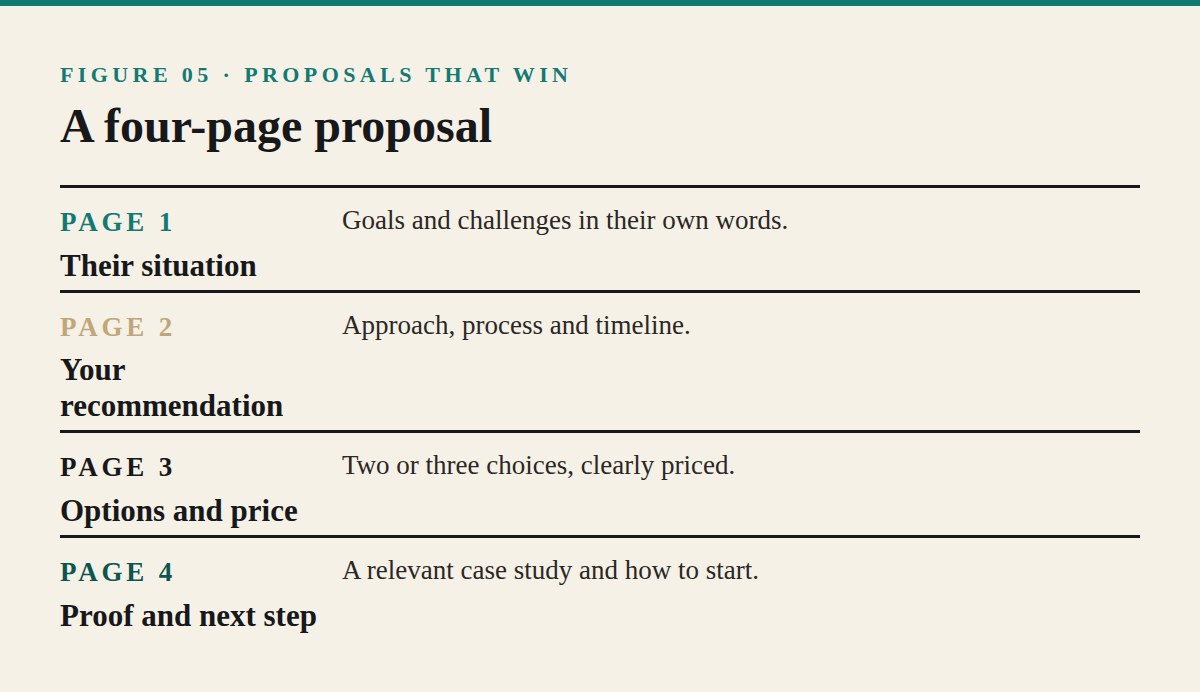
For many service businesses, the proposal is the document that turns interest into a decision. Yet many proposals are long, generic documents filled with company history, technical detail and unclear prices. Customers struggle to understand what they are buying and why it matters.
A winning proposal is focused, clear and tailored. It reflects the conversation you had and helps the customer decide confidently.
Start with the customer
Open the proposal with the customer's situation and goals, not your company profile. Summarise what you learned during discovery: their challenges, priorities and desired outcomes. This shows that the proposal is designed for them.
Present the recommended solution
Describe your recommended approach clearly. Explain what you will do, how it addresses the customer's goals and what results they can expect. Focus on outcomes and benefits rather than long lists of tasks.
Show the process
Outline the main stages of the project: discovery, planning, delivery, review and completion. Include timelines and explain what the customer needs to provide at each stage. A visible process reduces uncertainty.
Define the scope
State exactly what is included and what is not. Clear scope prevents misunderstandings and protects both parties. Include details such as deliverables, number of revisions, communication methods and support periods.
Offer clear options
Where appropriate, present two or three options with different levels of service. Explain who each option suits and highlight your recommendation. Options give customers flexibility while keeping the decision simple.
Explain who each option suits and highlight your recommendation.
Present price clearly
Show prices clearly for each option, along with payment terms, deposits and any additional costs. Hidden or unclear pricing creates hesitation. If relevant, explain the value or return the customer can expect from the investment.
Include proof
Add a short case study, testimonial or examples of similar work. Choose proof that relates directly to the customer's situation. One relevant example is often more persuasive than many unrelated ones.
Make the next step obvious
End with a clear next step: approve the proposal, sign the agreement, pay the deposit or schedule a kickoff call. Include an expiry date if prices or availability are time-sensitive, and explain why.
Keep it concise
Proposals do not need to be long. Many effective proposals are only a few pages. Use headings, short paragraphs and simple language. Customers should be able to understand the essentials quickly.
Review the proposal together
Where possible, present the proposal in a short meeting rather than simply emailing it. Walking through the proposal allows you to answer questions immediately and address concerns before they become reasons to delay.
Common mistakes
Proposals often begin with long company introductions, use generic templates without personalisation, hide prices, omit scope details or end without a clear next step. Others are sent without discussion, leaving customers to interpret them alone. Tailored, concise and clearly structured proposals perform better.
An example in practice
A small branding agency sent detailed twenty-page proposals that took days to prepare and often received no response. It replaced them with a four-page template: client goals, recommended approach, project stages, three package options, a short case study and next steps. The agency presented each proposal in a thirty-minute call. Proposal preparation time fell sharply and more proposals were accepted.
A proposal template outline
A reusable template might contain: a title page with the client's name and goal; one page summarising their situation and objectives; one page describing the recommended approach and process; one page with options, prices and terms; a short case study; and a final page with next steps and an acceptance section. Personalise the first two pages carefully every time; the rest can be adapted quickly.
Conversations · 06 of 08
Handling Objections in the Moment
An objection is a question in disguise. Stay curious, stay calm and address what really matters.
Objections are a normal part of selling. Customers may worry about price, timing, results, trust or whether the solution fits their needs. Many founders fear objections and respond defensively, offering discounts or abandoning the conversation. Yet objections often indicate genuine interest: the customer is considering the decision seriously.
Handled well, objections become opportunities to clarify value and build trust.
Listen fully
When a customer raises an objection, let them finish speaking. Avoid interrupting or responding immediately with a prepared argument. Listening shows respect and helps you understand the real concern.
Acknowledge the concern
Acknowledge the objection before responding. For example: "That's a reasonable concern," or "I understand why that matters." Acknowledgement reduces tension and shows that you are not dismissing the customer's view.
Ask a clarifying question
Many objections are not what they first appear. "It's too expensive" might mean the value is unclear, the budget is limited or the customer is comparing with a different solution. Ask a question such as "What are you comparing it with?" or "What would make this feel like a good investment?"
Understanding the real concern allows you to respond appropriately.
Respond honestly and specifically
Once you understand the concern, respond with relevant information: an explanation, example, case study, guarantee, adjusted option or practical solution. Keep the response clear and focused on the customer's situation.
Common objections and approaches
- Price: clarify value, compare with the cost of the problem or offer a smaller option.
- Timing: understand constraints and discuss a suitable start date.
- Trust: share proof, explain your process or offer a guarantee.
- Fit: clarify how the offer applies, or acknowledge if it is not suitable.
- Effort: explain what is required and how you reduce the customer's workload.
Offering a discount immediately after a price objection can suggest that your original price was inflated.
Avoid automatic discounts
Offering a discount immediately after a price objection can suggest that your original price was inflated. Explore the concern first. If budget is genuinely limited, consider adjusting scope rather than lowering the price for the same work.
Accept valid objections
Sometimes an objection reveals a real mismatch. The customer may need a different solution, have a smaller budget or face timing that makes the project impractical. In these cases, acknowledge the issue honestly and help them find a better option if possible.
Check before moving on
After responding, confirm whether the concern has been addressed: "Does that answer your question?" or "How do you feel about that now?" This prevents unresolved doubts from lingering.
Common mistakes
Salespeople often become defensive, argue with customers, respond with generic scripts, offer discounts too quickly or move on without checking whether the concern was resolved. Others treat every objection as resistance rather than useful information. Calm curiosity and honest responses create better outcomes.
An example in practice
A wedding photographer often heard that her packages were more expensive than others. She used to respond by offering discounts. Instead, she began asking what couples were comparing her packages with and what mattered most to them. Many were comparing shorter coverage without edited albums. Once she explained the differences and showed complete wedding galleries, many chose her standard package without discounts.
The pause and the question
Two simple habits transform objection handling. First, pause for a breath before responding; it signals that you are considering the concern rather than reacting. Second, answer the objection with a question before answering it with information. "What makes you say that?" often reveals a concern you could not have guessed, and lets you address the right issue the first time.
Prepare for your top five
Most businesses hear the same few objections repeatedly. Write down your top five, along with a clarifying question and an honest response for each. Practise them aloud until they feel natural. Preparation does not make conversations scripted; it frees you to listen, because you are no longer worried about what to say.
Process · 07 of 08
Follow-Up Without Pushing
Most decisions are not made in the first conversation. Respectful follow-up keeps opportunities alive.
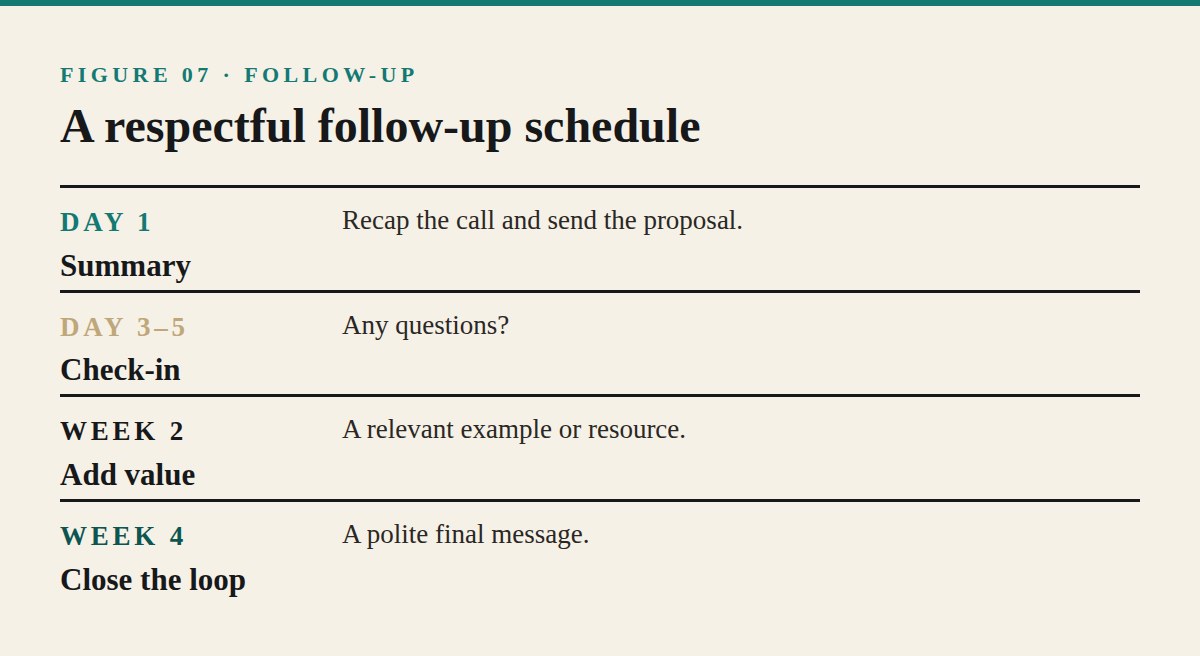
Many sales are lost not because customers say no, but because nobody follows up. Customers get busy, priorities change, emails are forgotten and decisions are postponed. A respectful follow-up process keeps the conversation alive without becoming pushy.
Follow-up is part of good service. It helps customers make decisions when they are ready.
Agree next steps in advance
The easiest follow-up happens when next steps are agreed during the conversation. Before ending a call, ask when the customer expects to decide and when it would be helpful for you to check in. This creates a natural reason to follow up.
Follow up promptly
Send a short follow-up message soon after a conversation or proposal. Summarise the main points, attach any promised information and confirm the next step. Prompt follow-up demonstrates professionalism and keeps momentum.
Add value with each message
Avoid follow-up messages that simply ask, "Have you decided yet?" Instead, provide something useful: a relevant case study, an answer to a question, a helpful article or additional information that supports the decision.
Each message should give the customer a reason to engage.
Use a simple schedule
A follow-up schedule helps ensure opportunities are not forgotten. For example:
- Day 1: send a summary and proposal.
- Day 3 to 5: check whether they have questions.
- Week 2: share a relevant example or resource.
- Week 4: ask whether the project remains a priority.
Adjust timing to your customer's decision process.
Keep a simple record of open opportunities, including the last contact date, next step and any notes.
Track every opportunity
Keep a simple record of open opportunities, including the last contact date, next step and any notes. A spreadsheet or customer management tool can prevent opportunities from slipping through the cracks.
Respect the customer's pace
Some decisions take weeks or months. If a customer says the timing is not right, ask when it would be appropriate to reconnect. Note the date and follow up then. Respecting their timeline builds trust.
Know when to close the loop
If several follow-ups receive no response, send a polite final message. For example: "I haven't heard back, so I'll assume this isn't a priority right now. If anything changes, I'd be happy to help." Many customers respond to this kind of message, and it leaves the relationship on good terms.
Stay in touch
Customers who are not ready today may become customers later. Invite them to your newsletter, share useful content occasionally and check in when relevant. Long-term relationships often produce future sales and referrals.
Common mistakes
Businesses often fail to follow up at all, send repetitive "just checking in" emails, follow up too aggressively or lose track of opportunities. Others give up after a single message. A respectful, value-focused and organised follow-up process works best.
An example in practice
A software consultant sent proposals and waited for replies, often hearing nothing. He created a follow-up process: a summary email the same day, a check-in after four days, a relevant case study after two weeks and a polite closing message after a month. He tracked every opportunity in a spreadsheet. Within months, more proposals turned into projects, and several prospects returned later after receiving his closing message.
Sample follow-up messages
A useful second message might read: "Hi Marco, I hope the proposal was clear. One thing I didn't mention on our call: a client in a similar situation reduced their quoting time by half in the first month. Happy to answer any questions." A closing message might read: "I haven't heard back, so I'll assume the timing isn't right. If things change, I'd be glad to help." Both are brief, helpful and free of pressure.
Closing · 08 of 08
Asking for the Decision
Clear, respectful questions help customers decide. Avoiding the question helps no one.
At the end of a sales process, many founders hesitate to ask for a decision. They fear sounding pushy or hearing "no". Instead, conversations end vaguely: "Let me know what you think." Customers, unsure of the next step, postpone decisions indefinitely.
Asking for the decision is not pressure. It is clarity. It helps customers move forward, whether the answer is yes, no or not yet.
Confirm the customer has what they need
Before asking for a decision, make sure the customer understands the offer, price, process, timeline and expected outcomes. Ask whether they have remaining questions or concerns. A decision is easier when uncertainty has been addressed.
Ask clearly
Use simple, direct questions:
- "Would you like to go ahead with the recommended package?"
- "Shall I send the agreement so we can reserve your start date?"
- "Which option feels right for you?"
- "Are you ready to begin?"
Clear questions make it easier for customers to respond.
Be comfortable with silence
After asking, give the customer time to think. Avoid filling the silence with additional explanations or discounts. Silence allows customers to consider the decision and share what they are thinking.
Respect any answer
If the customer says yes, confirm the next steps immediately. If they say no, thank them and ask, if appropriate, what influenced their decision. If they need more time, agree when you will follow up.
Each answer provides clarity and helps you plan.
Make the next step easy
Once a customer agrees, remove friction. Send the agreement, invoice or booking link promptly. Explain what happens next and when. A smooth transition from decision to start reinforces confidence.
If they say no, thank them and ask, if appropriate, what influenced their decision.
Use trial closes during the conversation
Throughout the conversation, ask questions that check alignment: "Does this approach make sense for your goals?" or "Would this timeline work for you?" These questions help identify concerns early and make the final decision feel natural.
Avoid manipulation
Avoid high-pressure tactics, false deadlines, guilt or exaggerated scarcity. Such approaches may produce immediate sales but often lead to regret, cancellations and damaged trust. Honest clarity is more effective in the long term.
Learn from every outcome
Track the outcomes of sales conversations and the reasons for decisions. Patterns may reveal improvements needed in your offer, pricing, proposals or qualification process.
Common mistakes
Salespeople often avoid asking for a decision, ask vague questions, talk through the silence after asking or treat "no" as failure. Others use aggressive closing techniques that damage trust. Clear, respectful questions and smooth next steps create better experiences.
An example in practice
A business coach ended consultations by saying, "Have a think and let me know." Many prospects never replied. She began asking, after answering final questions, "Would you like to start the six-week programme on the first of next month?" Most prospects gave a clear answer. More said yes, and those who said no often explained why, which helped her improve her offer and qualification.
Phrases that help
A few phrases make the final step easier for both sides. "Based on everything we've discussed, would you like to go ahead?" "Is there anything that would stop you from starting this month?" "Would it help if I held the start date for a few days while you decide?" Each is direct, respectful and invites a clear answer without pressure.
After the yes
The moments after a customer agrees matter. Thank them, confirm exactly what happens next and when, and send the agreement or invoice the same day. A short welcome message explaining the first steps reassures the customer that they made a good decision, and reduces the chance of second thoughts.
Before you close this edition
Your Action Plan
Your next 30 days
Week 1: Prepare questions. Write ten discovery questions about your customer's situation, goals, obstacles and decision process.
Week 2: Define fit. List the signs that a prospect is a strong fit, and the signs that you should refer them elsewhere.
Week 3: Improve your proposal. Rebuild your proposal template around the customer's goals, your recommendation, options, price and next steps.
Week 4: Follow up. Create a respectful follow-up schedule and contact every open opportunity using it.
Keep learning
Hustle Influence offers practical online courses and AI tools that help you turn ideas into action.
hustleinfluence.com
HUSTLE MAGHustle in Silence.