
Contents · Edition 018
Edition 018
From the Editors
Most founders write far more than they realise: website pages, emails, proposals, social posts, product descriptions, invoices and messages to customers. Each piece of writing either makes the business easier to understand and trust, or adds a little friction. Over thousands of words, those small differences add up to a great deal of business won or lost.
Copywriting is often associated with clever slogans and dramatic sales letters. For a small business, it is something quieter and more useful: the craft of explaining value clearly, to a specific person, in words they understand and believe.
This issue teaches that craft. We begin with clarity and with writing for one reader, then move to headlines, benefits, structure and proof. We cover editing, where most good writing is actually made, and finish with the line between persuasion and manipulation, which every honest business should know.
You do not need to be a natural writer. You need to care about your reader, cut what does not help them and rewrite until your meaning is impossible to miss.
The Editors, Hustle Mag
In This Edition
Copywriting for Founders
Clear Words That Explain Value and Move People to Act
Good copy does not sound like advertising. It sounds like a knowledgeable, honest person explaining why something matters to you. It is clear before it is clever, specific before it is impressive and focused on the reader rather than the writer.
This issue builds the skills step by step: clarity, writing for one reader, headlines, benefits, structure and proof, followed by editing and the ethics of persuasion. The principles apply to websites, emails, proposals, social posts and product descriptions alike.
Each article ends with an exercise you can apply to something you have already written.
Cover Story · 01 of 08
Clarity Before Cleverness
If readers have to work out what you mean, most of them will not bother.

Many businesses try to sound clever. They write slogans with double meanings, use abstract words such as "innovative solutions" or "next-level experiences" and describe their work in language only insiders understand. The result may sound impressive to the writer, but readers are left unsure what the business actually does.
Clarity is the foundation of effective copy. Readers should understand what you offer, who it is for and why it matters within seconds.
Say what you do plainly
Imagine explaining your business to a friend who knows nothing about your industry. What would you say? That plain explanation is often more effective than polished marketing language.
Compare "Empowering brands through transformative digital experiences" with "We design websites that help small restaurants take more bookings." The second sentence is less grand, but far clearer.
Prefer concrete words
Concrete words create pictures in the reader's mind. Abstract words make readers work. "Save time" is useful, but "Finish your weekly bookkeeping in thirty minutes instead of three hours" is concrete and memorable.
Replace vague terms such as "solutions", "excellence", "quality" and "innovative" with specific descriptions of what happens.
One idea at a time
Readers struggle with sentences and paragraphs that contain too many ideas. Focus each sentence on one idea and each paragraph on one main point. Short sentences are not simplistic; they help readers move easily through your message.
Avoid jargon
Every industry has its own vocabulary. Customers may not understand terms that seem obvious to you. Use the words your customers use. If a technical term is necessary, explain it briefly.
A useful test is to review customer emails and conversations. The language customers use to describe their problems is often the best language for your copy.
A useful test is to review customer emails and conversations.
Put the most important information first
Readers decide quickly whether to continue. Place the key message at the beginning: what you offer, who it is for and the main benefit. Supporting details can follow.
This principle applies to headlines, emails, product descriptions and entire web pages.
Clarity builds trust
Clear writing suggests a business that understands its work and respects its customers. Vague or confusing language can create suspicion, especially when it hides important information such as price, process or limitations.
Test your clarity
Show your copy to someone unfamiliar with your business and ask them to explain what you offer. If their explanation differs from your intention, revise the copy. Reading aloud can also reveal awkward phrases and unclear sentences.
Clever can come later
Creativity and personality have value, but they should support clarity, not replace it. A memorable phrase is useful only if readers understand it. Start with a clear message, then add personality where it strengthens the meaning.
Common mistakes
Founders often use vague buzzwords, write long sentences filled with several ideas, rely on industry jargon or bury the key message beneath introductions. Others prioritise sounding impressive over being understood. Plain words, concrete examples and a clear structure solve most clarity problems.
An example in practice
A software company's homepage headline read "Unlocking synergies for modern teams." Visitors rarely understood what the product did. After interviewing customers, the company rewrote it as "Plan your team's week in one shared calendar, without endless meetings." Visitors stayed longer, trial sign-ups increased and sales calls began with more relevant questions.
The plain-language swap
Keep a short list of words to replace whenever you see them: "solutions" becomes what you actually provide; "leverage" becomes "use"; "utilise" becomes "use"; "facilitate" becomes "help"; "world-class" becomes evidence. Running through this list during editing removes much of the vagueness that creeps into business writing.
Audience · 02 of 08
Write for One Reader
Copy written for everyone speaks to no one. Picture one person and write to them.
When writing for a business, it is tempting to address everyone who might possibly buy. The result is often generic copy filled with broad claims and cautious language. Readers do not feel that the message speaks to them, so they move on.
Effective copy is written for one reader at a time. Even when thousands of people read it, each should feel that the message understands their situation.
Define your reader
Start by describing the person you are writing for. What is their role or situation? What problem are they trying to solve? What have they already tried? What do they worry about? What result do they want?
A detailed picture of one reader helps you choose relevant examples, language and benefits.
Use their language
Readers respond to words that reflect how they think and speak. Collect phrases from customer emails, reviews, sales calls and support requests. If customers say "I never know if I'm making a profit", use that phrase rather than a technical alternative such as "insufficient financial visibility".
Familiar language creates immediate recognition.
Address their problem directly
Start with the reader's situation rather than your business. Describe the challenge they face and its consequences. When readers recognise themselves in your description, they become more receptive to your solution.
Write conversationally
Use "you" frequently and write as if speaking directly to the reader. Avoid formal corporate language that creates distance. A conversational tone does not mean being informal or careless; it means being natural and clear.
A conversational tone does not mean being informal or careless; it means being natural and clear.
Answer their questions
Think about the questions your reader would ask before buying: Will this work for me? How much does it cost? How long will it take? What happens next? Address these questions in your copy so readers do not need to search for answers.
Acknowledge their objections
Readers often have doubts. They may worry that the product is too expensive, too complicated or unsuitable for their situation. Acknowledge common concerns honestly and provide reassurance, evidence or alternatives.
Choose relevant examples
Examples are most persuasive when readers can relate to them. A café owner relates more easily to an example from another café than to one from a large technology company. Use stories, case studies and scenarios that resemble your reader's world.
Different pages, different readers
Different parts of your business may serve different readers. A service page for small businesses and one for larger companies may require different language, examples and concerns. Tailor each page to its intended reader.
Common mistakes
Copy often tries to appeal to everyone, focuses on the company instead of the reader, uses internal jargon or ignores the reader's questions and concerns. Others choose examples that feel distant from the reader's experience. A clear reader profile and genuine customer language make copy far more effective.
An example in practice
A financial planner's website spoke generally about "comprehensive wealth management solutions for individuals and families". Few visitors enquired. She rewrote her service page for one reader: a self-employed professional in their forties worried about irregular income and retirement planning. The page addressed those specific concerns, included a relevant client story and answered common questions. Enquiries increased and most came from her intended audience.
A reader profile in five lines
Before writing any important page, write five lines about the reader: who they are; the situation that brings them to you; what they have tried; what they fear; and what result would make them happy. Keep these lines visible while you write. When a sentence would not interest that person, cut it or rewrite it.
Headlines · 03 of 08
Headlines That Earn Attention
Most people read only the headline. Make it clear, specific and worth their time.

A headline decides whether the rest of your copy is read. On websites, in emails, on social media and in search results, readers scan headlines and decide within seconds whether to continue. A weak headline can hide excellent content. A strong headline earns attention by promising something relevant and valuable.
Good headlines are clear first and interesting second.
State the main benefit
The most effective headlines tell readers what they will gain. They answer the question: why should I care? Focus on the result or benefit rather than the feature.
Compare "New accounting software" with "Finish your monthly bookkeeping in thirty minutes." The second headline communicates value immediately.
Be specific
Specific headlines are more credible and compelling. Numbers, timeframes and concrete outcomes help readers understand exactly what is being offered.
Examples include "Five ways to reduce no-shows in your clinic" or "Plan a week of healthy dinners in twenty minutes."
Address the reader's problem
Headlines that reflect a reader's problem often attract attention because readers recognise themselves. For example: "Struggling to find time for marketing?" or "Is your website turning visitors away?"
Use these carefully and follow them with genuine solutions.
Keep it simple
Avoid clever wordplay that obscures meaning. A headline should be understood quickly, even by someone skimming. Short words and direct phrasing usually work best.
Match the content
The headline must accurately reflect what follows. Misleading headlines may attract clicks but damage trust when readers feel deceived. The body copy should deliver exactly what the headline promises.
On web pages and longer content, a supporting subheading can add clarity.
Use subheadings to support the headline
On web pages and longer content, a supporting subheading can add clarity. For example:
Headline: "Website design for physiotherapy clinics." Subheading: "Simple, fast websites that help patients book appointments online."
Together, they communicate both the offer and the benefit.
Write several versions
Professional writers rarely use the first headline they think of. Write several options with different approaches: benefit-focused, problem-focused, number-based and question-based. Then choose the clearest and most relevant one.
Test where possible
Email subject lines, advertisements and some web pages allow headline testing. Compare different versions and measure which produces more opens, clicks or enquiries. Use the results to improve future headlines.
Common headline structures
- Benefit: "Get more bookings from your website."
- How-to: "How to price your services with confidence."
- Number: "Seven mistakes that cost new freelancers money."
- Question: "Are you charging enough for your work?"
- Audience and result: "Bookkeeping for cafés that want clear monthly numbers."
Common mistakes
Headlines often fail because they are vague, focused on the company, overly clever, too long or disconnected from the content. Others promise more than the content delivers. Clear benefits, specific language and accurate promises create stronger headlines.
An example in practice
A yoga studio promoted a beginner course with the headline "Begin Your Journey." Few people signed up. The studio tested a new headline: "Beginner yoga in four weeks: build strength and flexibility with small classes and no experience needed." Sign-ups increased because readers understood exactly who the course was for and what they would gain.
A headline checklist
Before publishing, check each headline against four questions. Does it name the reader or their problem? Does it promise a specific result or useful information? Could a stranger understand it in three seconds? Does the content deliver exactly what it promises? A headline that passes all four is almost always stronger than one written purely to be clever.
Headlines across channels
The same principles apply everywhere, with small adjustments. Website headlines can be slightly longer, supported by a subheading. Email subject lines need to work in a narrow inbox view, so put the key words first. Social posts depend on the first line before the "more" cut-off. Article titles benefit from including the phrase readers would search for.
Value · 04 of 08
Benefits, Not Features
Features describe what something is. Benefits describe what it does for the reader.
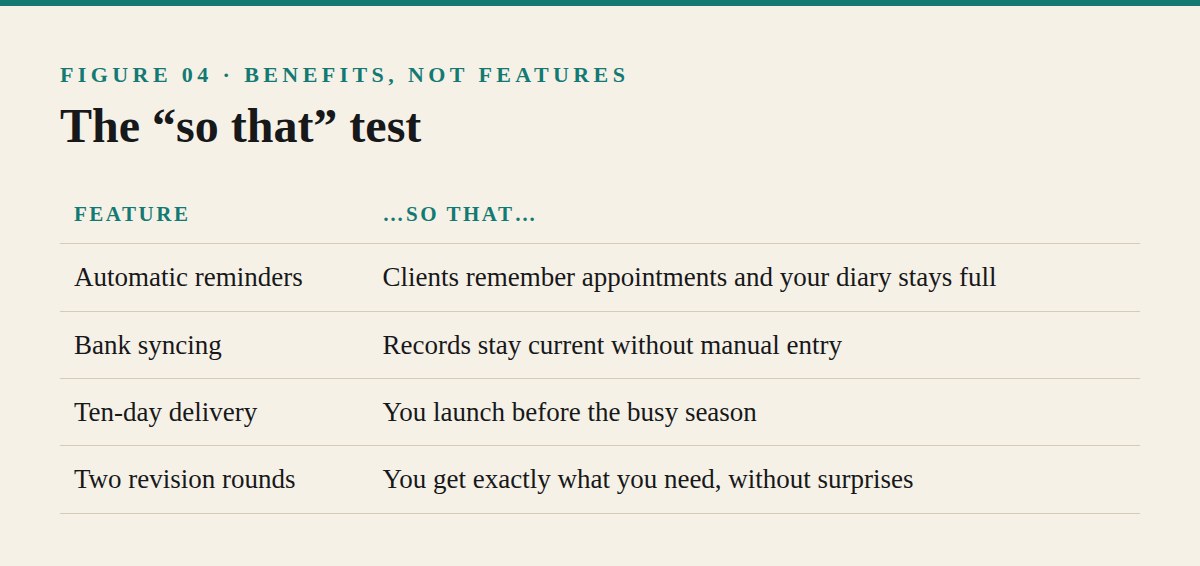
One of the most common copywriting mistakes is focusing on features rather than benefits. Founders naturally understand their products and services in terms of components: hours of support, software features, materials, specifications or services included. Customers, however, care primarily about what those features do for them.
Effective copy connects features to meaningful benefits.
Understand the difference
A feature is a characteristic of a product or service. A benefit is the result or advantage the customer experiences because of that feature.
For example:
- Feature: automatic appointment reminders.
- Benefit: fewer missed appointments and less time spent calling clients.
Features explain how. Benefits explain why it matters.
Use the "so that" test
A simple technique turns features into benefits: add "so that" after each feature and complete the sentence.
"Our software sends automatic reminders, so that clients remember their appointments and your schedule stays full."
Continue asking "so that" until you reach a benefit that matters to the customer.
Focus on outcomes customers value
Different customers value different outcomes. Some care about saving time, others about increasing revenue, reducing stress, avoiding mistakes or improving quality. Understand which benefits matter most to your reader and emphasise them.
Include emotional benefits
Many purchases involve emotional as well as practical benefits. A bookkeeping service may provide accurate records, but it may also give peace of mind. A fitness programme may improve strength, but also confidence. Acknowledging emotional benefits can make copy more relatable.
Keep emotional benefits honest and connected to real results.
Acknowledging emotional benefits can make copy more relatable.
Keep features where they help
Features still matter. They provide evidence that the benefits are real and help customers compare options. The most effective copy combines both: a clear benefit followed by the features that make it possible.
For example: "Spend less time on admin. Automatic invoices, payment reminders and bank syncing keep your records up to date."
Avoid exaggerated benefits
Benefits should be realistic and supported by evidence. Overpromising results, such as guaranteed income or dramatic transformations, damages credibility and may breach advertising rules. Specific, believable benefits are far more persuasive.
Prioritise the most important benefits
Not every benefit deserves equal attention. Identify the two or three most important to your reader and feature them prominently. Additional benefits can appear later in the copy.
Use examples and proof
Show benefits in action through examples, testimonials or case studies. "Clients reduced missed appointments by forty percent after introducing reminders" is more persuasive than a general claim.
Common mistakes
Copy often lists features without explaining their value, uses vague benefits such as "better results", exaggerates outcomes or highlights benefits the reader does not care about. Others remove features entirely, leaving benefits unsupported. Connecting relevant features to specific, believable benefits creates stronger copy.
An example in practice
A small coffee machine supplier described its products with technical specifications: pressure levels, boiler sizes and grinder settings. Café owners found the information difficult to evaluate. The supplier rewrote its product pages around benefits, such as "Serve more customers during busy mornings without longer queues", followed by the features that made it possible. Enquiries increased because owners could see how each machine supported their business.
A feature-to-benefit table
Draw a simple two-column table. In the left column, list every feature of your main offer. In the right column, complete "so that..." for each. Then circle the three benefits your ideal reader would care about most. Those three benefits should appear in your headline, first paragraph and main call to action, with the features below as supporting evidence.
Structure · 05 of 08
The Structure of Persuasive Copy
Good copy follows the path a reader's mind takes, from attention to understanding to action.
Persuasive copy is not a random collection of claims. It follows a logical sequence that mirrors how readers make decisions. They first notice something relevant, then recognise their problem, understand a possible solution, look for evidence, consider the details and finally decide whether to act.
When copy follows this sequence, readers move through it naturally.
Start with attention
The opening, usually a headline and first sentence, must earn attention by signalling relevance. State the main benefit, describe a recognisable problem or make a clear promise. Readers should immediately understand why the message matters to them.
Describe the problem
Help readers recognise their situation. Describe the challenge in specific terms, using language they would use themselves. Explain the consequences of the problem: lost time, missed revenue, frustration or risk.
Avoid exaggerating pain to create fear. The aim is recognition, not anxiety.
Introduce the solution
Present your product or service as a way to solve the problem. Explain what it is and how it works in simple terms. Focus on the outcome the reader wants.
Explain the benefits
Describe the main benefits clearly, supported by relevant features. Connect each benefit to the reader's goals and concerns. Keep the most important benefits near the beginning.
Provide proof
Readers need evidence before believing claims. Include testimonials, case studies, examples, results, credentials or demonstrations. Choose proof relevant to the reader's situation.
Include testimonials, case studies, examples, results, credentials or demonstrations.
Address objections
Anticipate common concerns: price, effort, timing, suitability or risk. Answer them honestly in the copy, perhaps through a frequently asked questions section, a guarantee or a short explanation.
Present the offer
Explain exactly what the reader receives: components, price, terms and timeline. Clear details help readers evaluate the offer and reduce hesitation.
Make the next step clear
End with one clear call to action. Tell readers exactly what to do next and what will happen when they do it. For example: "Book a twenty-minute call to discuss your website. You'll receive a short plan within two days."
Adapt the structure to the format
This sequence can be expanded for long sales pages or shortened for emails and social posts. A short email might include only attention, problem, solution and next step. A detailed service page may include every stage.
A simple outline
- Attention: headline and opening.
- Problem: the reader's situation and its impact.
- Solution: what you offer.
- Benefits: what changes for the reader.
- Proof: why they should believe you.
- Objections: answers to common concerns.
- Offer: details, price and terms.
- Action: the clear next step.
Common mistakes
Copy often jumps straight to features, presents the offer before explaining the problem, omits proof or ends without a clear call to action. Others include every possible detail without a logical order. A structured flow makes copy easier to follow and more persuasive.
An example in practice
A home cleaning service's homepage listed services and prices without context. Visitors often left without booking. The business restructured the page: a headline about reclaiming weekends, a short description of busy households struggling to keep up, an explanation of its service, three key benefits, customer reviews, answers to common questions, clear pricing and a booking button. Online bookings increased significantly.
Using the structure to diagnose weak copy
The outline is also a diagnostic tool. Read an underperforming page and label each paragraph with its stage. Missing stages explain many problems: no proof makes readers doubtful, no objections section leaves concerns unanswered, and a vague final step leaves interested readers unsure what to do. Filling the missing stage often improves results more than rewriting everything.
Credibility · 06 of 08
Proof in Words
Specific evidence turns claims into something readers can believe.
Readers are naturally sceptical of marketing claims. They have seen too many promises of "best quality", "exceptional service" and "guaranteed results". Claims become believable when they are supported by evidence. Copy that includes specific proof is far more persuasive than copy that relies on adjectives.
Proof transforms "trust me" into "here is why you can trust us".
Replace adjectives with evidence
Adjectives such as "fast", "reliable" and "experienced" are easy to write and easy to ignore. Replace them with facts. Instead of "fast delivery", write "orders shipped within twenty-four hours". Instead of "experienced team", write "fifteen years designing kitchens for family homes".
Specific details make claims credible.
Use customer testimonials
Testimonials are powerful because they come from someone other than the business. The most effective testimonials are specific: they describe the customer's situation, the solution and the result.
Compare "Great service!" with "Our clinic used to miss around ten appointments a week. After introducing their reminder system, we now miss two or three."
Include case studies
Case studies provide detailed proof. They explain a customer's problem, the approach taken and the outcome. Short case studies can appear on service pages, in proposals and in emails.
Show numbers carefully
Numbers can make proof more convincing: results achieved, customers served, time saved or projects completed. Use accurate numbers, explain them clearly and avoid exaggeration. Context matters; "a thirty percent increase in bookings over six months" is more meaningful than "huge growth".
Use examples of work
Portfolios, photographs, before-and-after comparisons, samples and demonstrations show readers what you can do. Visual proof is especially useful for creative and physical products.
Context matters; "a thirty percent increase in bookings over six months" is more meaningful than "huge growth".
Highlight credentials and recognition
Relevant qualifications, certifications, memberships, awards and media mentions can support credibility. Choose those that matter to your customers and explain why they are relevant.
Address risk with guarantees
A guarantee is a form of proof because it demonstrates confidence. Clearly explain any guarantees, refund policies or service commitments. Make sure the terms are fair and can be honoured.
Place proof strategically
Proof is most effective near the claims it supports and at the points where readers make decisions. Place testimonials beside pricing, case studies near service descriptions and guarantees close to calls to action.
Keep proof honest
Never invent testimonials, exaggerate results or use customer names and details without permission. Misleading proof damages trust and may breach consumer protection or advertising rules. Honest evidence is always stronger.
Common mistakes
Copy often relies on vague claims, generic testimonials, unsupported statistics or proof hidden on separate pages. Others use impressive but irrelevant evidence. Specific, relevant and honest proof placed close to decisions works best.
An example in practice
A small renovation company described itself as "trusted, professional and reliable". Visitors were unconvinced. It replaced the claims with project photographs, short case studies showing timelines and budgets, three detailed customer testimonials and a clear workmanship guarantee. Enquiries increased, and prospects arrived with greater confidence in the company's ability to deliver.
Building a proof bank
Create a simple document where you collect evidence as it appears: client messages praising your work, results with numbers, before-and-after photographs, notable projects and credentials. Note the date and whether you have permission to share each item. When writing any page, proposal or email, you can then choose the most relevant proof in minutes rather than searching from scratch.
Matching proof to the reader
Different readers need different evidence. A cautious buyer may need guarantees and detailed process explanations. A results-focused buyer may need numbers and case studies. A buyer worried about fit needs examples from businesses like theirs. When choosing proof for a page, ask which doubt this reader is most likely to have, and lead with the evidence that answers it.
Craft · 07 of 08
Editing Like a Professional
The first draft gets ideas onto the page. Editing makes them clear, concise and persuasive.
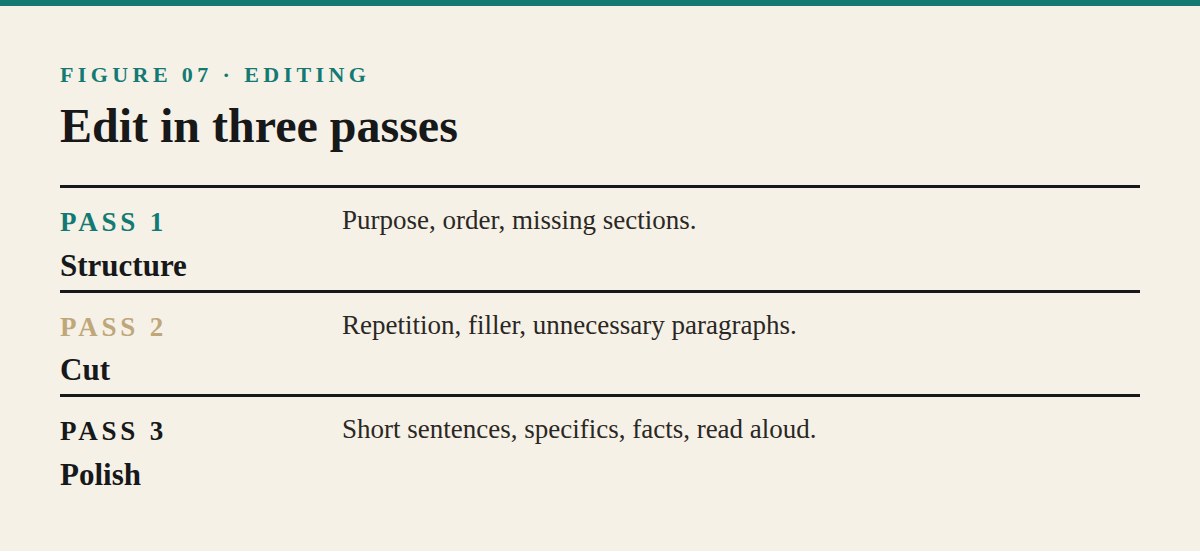
Good writing is usually rewritten writing. Even experienced copywriters rarely publish their first drafts. The first version helps organise ideas; editing transforms those ideas into clear, focused copy that readers understand quickly.
Many founders write a draft and publish immediately. A careful editing process often produces a larger improvement than spending more time on the initial writing.
Separate writing from editing
Write first without worrying about perfection. Then step away, ideally for a few hours or a day, before editing. Distance helps you see the copy as a reader would.
Check the purpose
Begin by asking whether the copy has a clear purpose. Who is it for? What should the reader understand? What action should they take? If these answers are unclear, revise the structure before polishing sentences.
Cut unnecessary words
Most drafts contain unnecessary words, repeated ideas and long introductions. Remove phrases that add little meaning, such as "in order to", "it is important to note that" or "we are pleased to announce". Shorter copy is often clearer and more persuasive.
Aim to make each sentence as simple as possible without losing meaning.
Shorten sentences and paragraphs
Long sentences can be difficult to follow, especially on mobile devices. Break complex sentences into shorter ones and keep paragraphs focused on one idea. White space improves readability.
Replace vague words
Look for vague terms such as "solutions", "quality", "innovative" or "great". Replace them with specific descriptions, examples or evidence.
Check the order
Ensure information appears in a logical sequence. The most important points should come first, supporting details later. Headings should guide readers through the structure.
The most important points should come first, supporting details later.
Read aloud
Reading aloud reveals awkward phrasing, repetition and unclear sentences. If you stumble while reading, readers may stumble too. Revise until the copy flows naturally.
Look for the reader's perspective
Count how often you write "we" and "our" compared with "you" and "your". Copy that focuses too heavily on the business can feel self-centred. Shift the focus to the reader's problems, goals and benefits.
Check facts and details
Verify prices, dates, names, links, claims and contact details. Small errors can undermine trust and create confusion.
Get a second opinion
Ask someone who represents your target reader to review important copy. Ask what they understood, what confused them and what would make them more likely to act. Fresh eyes notice problems that writers miss.
Common mistakes
Writers often publish first drafts, edit only for spelling, keep long introductions, retain unnecessary words or overlook unclear structure. Others edit endlessly without testing whether the copy works. A structured editing process followed by real-world feedback produces better results.
An example in practice
A consultant's service page was over twelve hundred words long and filled with general statements about strategy and transformation. She edited it in three rounds: removing repetition, replacing vague claims with examples and reorganising the page around client problems and outcomes. The final version was half the length, easier to read and produced more enquiries.
A three-pass editing method
Edit in three separate passes rather than all at once. In the first pass, check structure: purpose, order and missing sections. In the second, cut: remove repetition, filler phrases and unnecessary paragraphs. In the third, polish: shorten sentences, replace vague words, check facts and read aloud. Separating the passes makes each one faster and more thorough.
Words to search for
A quick search through any draft for certain words reveals easy improvements: "very", "really", "just", "that" (often removable), "in order to", "we believe", "solutions", "leading" and "innovative". Each instance is worth questioning. Many can be deleted; others should be replaced with something specific.
Principles · 08 of 08
Persuasion Without Manipulation
Persuasion helps people decide well. Manipulation helps them decide badly. Know the difference.
All marketing involves persuasion: presenting information in a way that encourages action. Persuasion becomes manipulation when it relies on deception, pressure or exploiting people's fears and vulnerabilities. Manipulative tactics may increase short-term sales, but they damage trust, attract complaints and can breach consumer protection rules.
Ethical persuasion helps customers make informed decisions that genuinely benefit them.
Be truthful
Every claim should be accurate and supported by evidence. Avoid exaggerated results, misleading comparisons and invented testimonials. If results vary between customers, say so.
Truthfulness builds credibility that lasts.
Avoid false urgency
Deadlines can be legitimate: a limited number of workshop places, an event date or a seasonal offer. Problems arise when urgency is invented, such as countdown timers that restart or "last chance" offers that are repeatedly extended. False urgency pressures people and erodes trust.
Use deadlines only when they are real.
Avoid false scarcity
Similarly, claims such as "only two left" should be accurate. Inventing scarcity to pressure buyers is manipulative and may be unlawful in some places.
Do not exploit fear or insecurity
It is reasonable to describe the consequences of a problem, but avoid exaggerating risks or making customers feel ashamed. Copy should help readers understand their situation, not make them anxious enough to act without thinking.
Be transparent about price and terms
Show prices, recurring charges, cancellation policies and important conditions clearly. Hidden fees and complicated terms undermine confidence. Customers should know exactly what they are agreeing to before purchasing.
Hidden fees and complicated terms undermine confidence.
Respect the reader's choice
Ethical copy makes the next step clear but leaves the decision to the reader. Avoid guilt-based language, such as "No thanks, I don't want to grow my business", which pressures people into compliance.
Use testimonials responsibly
Use genuine testimonials with permission, and avoid presenting exceptional results as typical. Where relevant, explain the circumstances behind the results.
Consider the customer's long-term interest
Ask whether the customer is likely to be glad they bought from you. If a tactic would lead to regret, refunds or complaints, it is probably not appropriate. Sustainable businesses depend on satisfied customers who return and recommend them.
Understand the rules
Advertising and consumer protection laws vary between countries. Many regulate claims, testimonials, pricing displays, subscriptions and urgency tactics. Learn the rules that apply to your business and seek advice where necessary.
Common mistakes
Businesses sometimes adopt manipulative tactics because they see others using them, such as fake countdowns, misleading price comparisons, exaggerated claims or guilt-based buttons. Others hide recurring charges or cancellation terms. These tactics may produce short-term gains but damage reputation and trust over time.
An example in practice
An online course creator used countdown timers that reset for every visitor, a crossed-out "original price" that had never been charged and a button reading "No, I don't want to succeed". A few customers complained publicly. She replaced these tactics with honest pricing, a real enrolment deadline for live cohorts, clear refund terms and genuine student stories. Conversions dipped briefly, then recovered, and refund requests fell significantly.
A simple ethics test
Before publishing persuasive copy, ask three questions. Would I be comfortable if a customer saw exactly how this works behind the scenes? Is every claim, deadline and number true? Would a reasonable customer be glad, a month later, that they acted on this message? If the answer to any question is no, rewrite the copy until it is yes.
Ethical persuasion that works
Honesty does not mean weak copy. The strongest ethical techniques are also the most effective: specific benefits, genuine proof, clear prices, real deadlines, fair guarantees and an easy next step. These help the right customers decide quickly and confidently, while allowing the wrong customers to recognise early that the offer is not for them.
Before you close this edition
Your Action Plan
Your next 30 days
Week 1: Rewrite your homepage headline. Make it state who you help and the result, in plain words.
Week 2: Turn features into benefits. List ten features of your main offer and write the benefit to the customer beside each.
Week 3: Add proof. Replace three vague claims with specific evidence: numbers, examples or customer words.
Week 4: Edit ruthlessly. Cut one important page by a third without losing meaning, then read it aloud and fix every stumble.
Keep learning
Hustle Influence offers practical online courses and AI tools that help you turn ideas into action.
hustleinfluence.com
HUSTLE MAGHustle in Silence.