
Contents · Edition 019
Edition 019
From the Editors
Ask most established small business owners where their best customers come from, and the answer is rarely advertising. It is recommendations: a satisfied client who mentioned them to a friend, an accountant who referred a client, a supplier who made an introduction. These customers arrive already trusting, often ready to buy, and frequently stay longer than any others.
Yet most businesses leave referrals to chance. They hope satisfied customers will mention them and assume partnerships will form naturally. Some do. Many more opportunities pass unnoticed.
This issue is about building those relationships deliberately, without awkwardness or manipulation. We look at why referrals work, how to build a simple referral system and how to ask for recommendations naturally. We then turn to partnerships: choosing the right partners, the formats that work, introductions and co-marketing, fair agreements and the long-term care that keeps relationships productive.
The foundation of every referral is the same: work good enough to recommend, and relationships honest enough to trust. Everything in this issue builds on that.
The Editors, Hustle Mag
In This Edition
Partnerships and Referrals
Growing Through Trusted Relationships With Partners and Customers
Referrals and partnerships are among the most efficient and trusted sources of growth for small businesses. They rely on something advertising cannot buy: the reputation you have earned with people who know your work.
This issue builds a deliberate approach. We start with why referred customers are so valuable, then design a simple referral system and learn to ask for referrals naturally. We choose partners carefully, explore partnership formats and co-marketing, set fair agreements and finish with nurturing relationships over years.
Each article ends with one step that strengthens your network of recommendations.
Cover Story · 01 of 08
Why Referrals Are the Best Customers
A recommendation carries trust that no advertisement can buy.
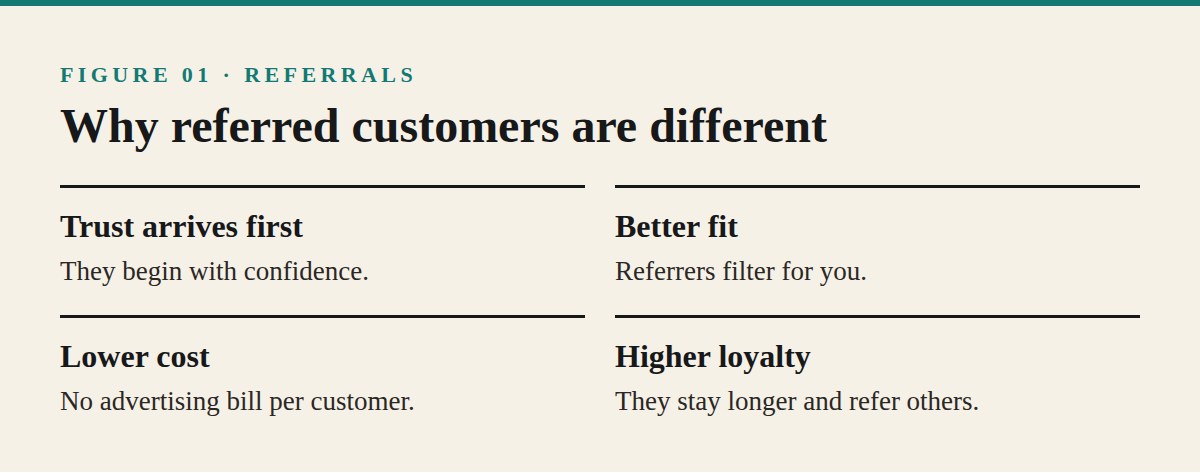
When someone recommends a business to a friend, colleague or client, they transfer part of their own credibility. The person receiving the recommendation arrives with a level of trust that would otherwise take months to build. For many small businesses, referred customers are the most valuable customers they have.
Understanding why referrals work helps you encourage them deliberately.
Trust arrives in advance
Customers referred by someone they trust usually begin with confidence. They have heard about your work, your reliability and the results you achieve. Instead of evaluating whether you are credible, they focus on whether your offer suits their needs.
This trust often leads to faster decisions and smoother sales conversations.
Better fit
People tend to recommend businesses to others who have similar needs. A satisfied client who understands your work is often a good filter, introducing people likely to benefit from what you offer.
Partners who serve similar customers can also make well-matched introductions.
Lower acquisition costs
Referrals usually cost less than many other marketing channels. While they require effort to encourage and maintain, they rarely involve the ongoing costs of advertising. Over time, a strong referral network can provide a steady flow of customers at relatively low cost.
Higher loyalty
Referred customers often stay longer and spend more because the relationship begins with trust and appropriate expectations. They may also become referrers themselves, creating a cycle of recommendations.
Referrals reflect quality
Referrals are earned through good work, reliable communication and positive experiences. A business that regularly receives referrals is usually delivering value. Conversely, a lack of referrals may indicate opportunities to improve the customer experience.
Over time, a strong referral network can provide a steady flow of customers at relatively low cost.
Referrals rarely happen by accident
Many satisfied customers would happily recommend a business, but they do not think of it unless prompted. They may not know exactly what you offer, who you help or how to introduce someone. A deliberate approach makes referrals easier and more frequent.
Referrals come from several sources
Referrals can come from customers, partners, suppliers, former colleagues, friends, peers in your industry and professional networks. Each source requires slightly different relationships and communication.
Track where referrals come from
Ask every new customer how they found you and record referral sources. This information shows which relationships are most valuable and helps you thank the people responsible.
Common mistakes
Businesses often assume referrals will happen naturally, fail to ask, forget to thank referrers or provide a poor experience that discourages recommendations. Others never track where referrals come from. Excellent service, clear communication and a simple referral process make a significant difference.
An example in practice
A bookkeeping practice noticed that its longest-standing clients had almost all been referred by existing clients or local accountants. It began tracking referral sources, thanking every referrer personally and making it easy for clients to introduce others. Over the following year, referrals became its largest source of new business, and new clients required less persuasion because they already trusted the practice.
Measuring the value of referrals
Compare referred customers with those from other channels on three measures: how quickly they decide, how long they stay and how much they spend over time. Many businesses discover that referred customers outperform others on all three, which justifies investing more time in the relationships that produce them.
Making yourself easy to recommend
People recommend businesses they can describe easily. If customers struggle to explain what you do, they will rarely mention you. A clear, simple description of who you help and the result you deliver, repeated consistently in your conversations, emails and website, gives customers the words they need. "She does bookkeeping for restaurants, and her monthly reports are brilliant" is easy to pass on.
System · 02 of 08
Building a Referral System
Turn occasional recommendations into a steady, predictable source of customers.
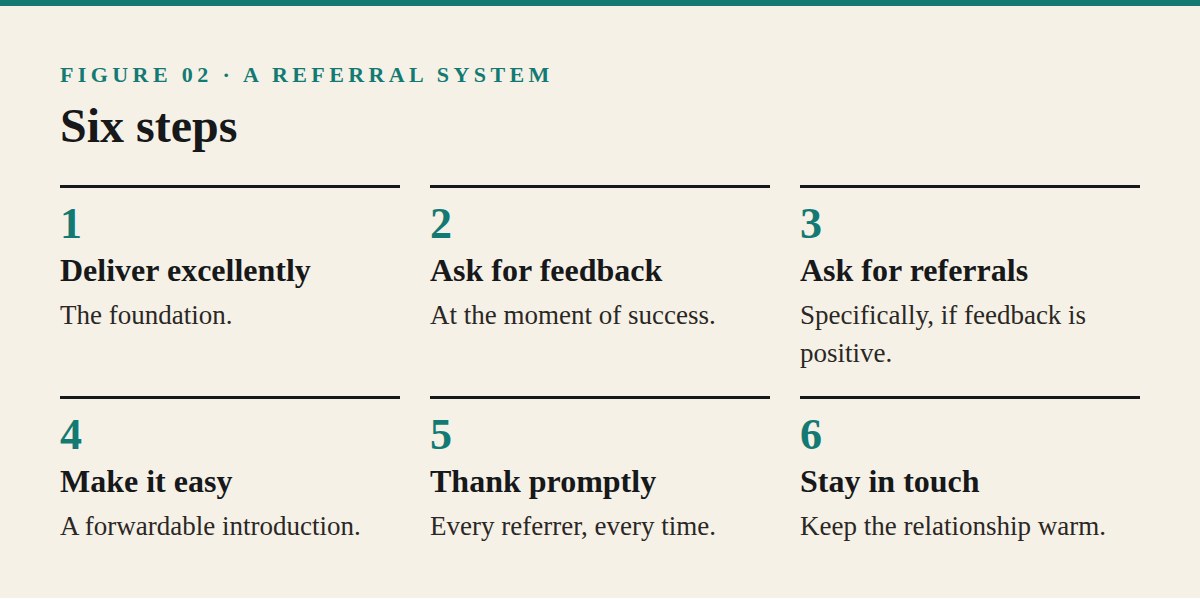
Many businesses receive referrals occasionally and treat them as lucky surprises. A referral system turns these occasional recommendations into a repeatable process. It identifies when customers are most likely to refer, makes referring easy and ensures that referrers are recognised and thanked.
A good referral system is simple, genuine and built on excellent customer experiences.
Deliver an experience worth recommending
The foundation of any referral system is service people are glad to recommend. Reliable delivery, clear communication, excellent results and responsive support give customers reasons to talk about you.
If customers are not satisfied, improving the experience should come before encouraging referrals.
Identify referral moments
Customers are most likely to refer when they have just experienced value: completing a project, achieving a result, receiving praise for your work or expressing satisfaction. These moments are natural opportunities to ask for referrals.
Map your customer journey and identify where these moments occur.
Define who you want to be referred
People find it easier to refer when they know exactly who you help. Create a short description of your ideal referral. For example: "Independent restaurants that want clearer monthly financial reports." Specific descriptions help referrers recognise suitable contacts.
Make referring easy
Provide simple ways for people to refer others: a short introduction email template, a page explaining who you help, a booking link or a short description they can forward. The easier the process, the more likely people are to act.
Ask consistently
Build referral requests into your process. For example, include a request in a project completion email, mention it during a final review meeting or ask after a customer shares positive feedback. Consistency matters more than perfect wording.
Always thank people who refer customers, whether or not the referral becomes a sale.
Recognise and thank referrers
Always thank people who refer customers, whether or not the referral becomes a sale. A personal message, a handwritten note or a small gift can show appreciation. Let referrers know when an introduction has been helpful.
Recognition encourages future referrals and strengthens relationships.
Consider referral incentives carefully
Some businesses offer discounts, credits or rewards for referrals. Incentives can work, but they should be appropriate for your industry and comply with any rules that apply. In some professions, referral payments are restricted or must be disclosed. Many referrers are motivated more by helping others than by rewards.
Track and review
Record who referred each customer, when and what happened. Review the information regularly to identify your strongest referral sources and the moments that produce the most recommendations.
A simple referral process
- Deliver excellent work.
- Ask for feedback at the end of a project.
- If feedback is positive, ask whether they know someone with a similar need.
- Provide an easy introduction method.
- Thank the referrer promptly.
- Keep them informed and stay in touch.
Common mistakes
Businesses often ask for referrals before customers have experienced value, provide vague descriptions of who they help, make referrals difficult or forget to thank referrers. Others rely entirely on incentives instead of service quality. Simple, consistent and appreciative processes work best.
An example in practice
A wedding planner received referrals occasionally but had no process. She introduced a final review call after each wedding, asked couples whether they knew others planning weddings and offered a short introduction email they could send. She also sent handwritten thank-you cards to every referrer. Within a year, most new enquiries came through recommendations from previous couples.
Building the system into your tools
Add referral steps directly to the tools you already use. Put the referral request into your project completion email template, add a "referred by" field to your enquiry form and set a reminder in your calendar to thank referrers within a day. When the system lives inside existing routines, it runs without relying on memory.
Conversations · 03 of 08
Asking for Referrals Without Awkwardness
Most satisfied customers are glad to help. They simply need a natural invitation.
Many founders feel uncomfortable asking for referrals. They worry about sounding desperate, imposing on customers or damaging relationships. As a result, they rarely ask, and referrals remain occasional. Yet satisfied customers are often happy to recommend businesses they value; they simply do not think of it unless invited.
Asking for referrals becomes natural when it is timely, specific and respectful.
Ask at the right moment
The best time to ask is when a customer has just experienced value: after completing a successful project, achieving a result or expressing satisfaction. Asking too early, before value has been delivered, can feel premature.
If a customer says something positive, that is often an ideal moment.
Be specific
General requests such as "If you know anyone who needs our services, let us know" are easy to forget. Specific requests are more effective because they help customers recognise suitable people.
For example: "Do you know another café owner who struggles to keep track of monthly costs?"
Explain why referrals matter
Briefly explain why referrals are important to your business. For example: "Most of our clients come through recommendations, so introductions to people with similar needs are very helpful." This makes the request feel genuine rather than transactional.
Make it easy
Offer a simple way to make an introduction. You could provide a short email template, a link to a page describing your services or offer to contact the person directly if they agree.
Remove as much effort as possible from the referrer.
Respect the answer
Some customers will not know anyone to refer, and that is perfectly fine. Thank them anyway and maintain the relationship. Pressure damages trust and makes future referrals less likely.
Briefly explain why referrals are important to your business.
Use multiple formats
Referral requests can be made in person, during meetings, in emails or in follow-up messages. Choose the format that feels most natural for your business and customer relationships.
Example wording
- "I'm glad the project went well. If you know anyone else facing a similar challenge, I'd be happy to help them too."
- "Many of our best clients come through introductions. Do you know another business owner who might benefit from clearer financial reports?"
- "If it would help, I can send a short email you could forward to anyone who might be interested."
Follow up and thank
If a customer refers someone, thank them promptly. Let them know you have contacted the person and appreciate their trust. Gratitude encourages future referrals and strengthens relationships.
Practise until it feels natural
Like any conversation skill, asking for referrals becomes easier with practice. Prepare a few phrases that suit your style and use them consistently.
Common mistakes
Founders often avoid asking altogether, ask before delivering value, use vague requests, apply pressure or forget to thank referrers. Others ask in a way that sounds scripted or insincere. Timely, specific and respectful requests are the most effective.
An example in practice
A freelance web designer rarely asked for referrals because it felt awkward. She added a short question to her project wrap-up meetings: "If you know another local business that needs a website update, I'd love an introduction." She also offered a simple forwardable email. Within six months, several new clients came through introductions from previous customers who said they had simply never thought to recommend her before.
When customers are unsure
Some customers want to help but cannot think of anyone immediately. Make it easy to return to later: "No problem at all. If someone comes to mind, here's a short note you can forward." Following up a few weeks later with a useful resource for them, not a repeated request, keeps the relationship warm and often prompts the introduction naturally.
Partners · 04 of 08
Choosing the Right Partners
The best partners serve the same customers, share your standards and complement what you offer.
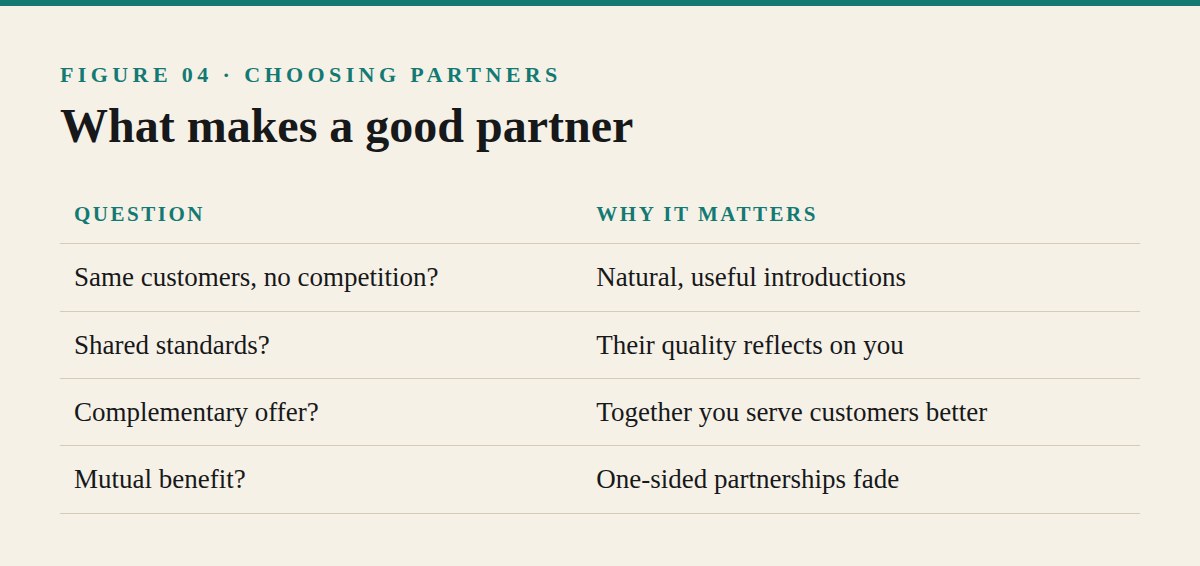
Partnerships can help small businesses reach new customers, expand services and create value they could not provide alone. A good partner can introduce clients, collaborate on projects, share expertise or co-create offers. A poor partner can damage your reputation, consume time and create conflict.
Choosing partners carefully is essential.
Serve the same customers
The most effective partnerships are between businesses that serve similar customers without competing directly. For example, a wedding photographer might partner with florists, planners and venues. A bookkeeper might partner with accountants, lawyers and business coaches.
Each partner benefits from introductions to customers who need complementary services.
Share standards and values
Your partners' behaviour reflects on you. Choose partners whose quality, reliability, communication and ethics match your own. If you recommend a partner who disappoints a client, your reputation suffers too.
Look for partners whose customers speak highly of them.
Complement your offer
Good partners provide something you do not offer or cannot provide as effectively. Together, you can serve customers more completely. For example, a web designer and copywriter can deliver a stronger website project together than either could alone.
Look for mutual benefit
Successful partnerships create value for both businesses. Consider what you can offer a potential partner: referrals, expertise, content, introductions, shared events or joint projects. Partnerships built only on what you want to receive rarely last.
Research before approaching
Learn about a potential partner before contacting them. Review their website, services, customer reviews and reputation. Understand their customers and how your services connect. Thoughtful preparation shows respect and increases the chance of a positive response.
Learn about a potential partner before contacting them.
Start small
Begin with a simple collaboration, such as exchanging referrals, writing a joint article or hosting a small event together. Small projects allow both sides to understand how the other works before making larger commitments.
Communicate expectations
Discuss how the partnership will work: how referrals are made, how clients are introduced, how communication happens and whether any fees or commissions apply. Clear expectations prevent misunderstandings.
Evaluate regularly
Review partnerships periodically. Are they creating value for customers and both businesses? Are standards being maintained? Are referrals flowing in both directions where appropriate? Partnerships may need adjustment or, occasionally, ending.
Common mistakes
Businesses often partner with anyone willing, choose partners based only on audience size, overlook quality standards or expect immediate results without contributing value. Others fail to discuss expectations. Careful selection, mutual benefit and clear communication lead to stronger partnerships.
An example in practice
A kitchen designer wanted more clients but disliked advertising. She identified local builders, interior designers and property developers whose clients often needed new kitchens. After researching reputations, she approached three companies with a proposal to exchange referrals and collaborate on showcase projects. One partnership in particular produced a steady flow of high-quality projects over several years.
A partner shortlist exercise
List every type of business your customers buy from immediately before or after they buy from you. For each type, note two or three local or online businesses with strong reputations. Score each on customer overlap, quality standards and what you could offer them. The highest-scoring two or three are your best first approaches.
How to make the first approach
Approach a potential partner with something useful rather than a request. Mention a specific connection between your customers, suggest one small, concrete collaboration and explain what they would gain. For example: "Several of my clients have asked for help with their websites after we finish their branding. I'd be glad to recommend you. Could we have a short call to understand how you work?" Specific, generous and low-commitment approaches are far more likely to receive a positive reply.
Signs a partnership is working
A healthy partnership shows clear signs: introductions flow in at least one useful direction, customers referred between you report good experiences, communication is easy and both sides feel the arrangement is fair. If these signs are missing after a reasonable period, discuss the partnership openly before investing further.
Formats · 05 of 08
Partnership Formats That Work
From simple referral exchanges to joint offers, choose the format that fits the relationship.
Partnerships can take many forms. Some are informal arrangements where businesses recommend each other. Others involve shared projects, joint events or combined services. Choosing the right format depends on your goals, your partner's goals and the level of trust between you.
Starting with simple formats and developing more complex arrangements over time is often the most effective approach.
Referral exchanges
The simplest partnership is a mutual referral arrangement: each business recommends the other when a customer needs complementary services. Referral exchanges require little formal structure but depend on trust and consistent quality.
For example, a personal trainer and a nutritionist may refer clients to each other.
Joint content
Partners can create content together: articles, guides, videos, webinars or podcasts. Joint content allows each business to reach the other's audience while providing useful information.
A garden designer and a landscaper might create a guide to planning a garden renovation.
Shared events
Workshops, seminars, networking events and online sessions can be organised jointly. Partners share planning, promotion and costs, while customers benefit from multiple perspectives.
A financial planner and a lawyer could host a workshop on preparing for business succession.
Bundled offers
Some partners combine services into a package. For example, a photographer, florist and venue might create a wedding package. Bundles can simplify buying for customers but require clear agreements about pricing, delivery, responsibilities and customer service.
Subcontracting and collaboration
Businesses may collaborate on client projects, with one acting as the main contact and subcontracting part of the work. This can allow small businesses to take on larger projects or offer services outside their core expertise.
Clear communication and agreements are essential, especially regarding responsibilities and quality standards.
Businesses may collaborate on client projects, with one acting as the main contact and subcontracting part of the work.
Affiliate and commission arrangements
Some partnerships involve paying commission or referral fees for introductions or sales. These arrangements can work well, but they must be transparent, fair and compliant with any rules that apply to your industry. Customers should not be misled about recommendations influenced by payments.
Co-branded resources
Partners can create co-branded checklists, templates or tools for customers. Each business contributes expertise and shares the resource with its audience.
Start with low commitment
Begin with formats that require minimal investment, such as referrals or joint content. As trust grows and results become clear, consider more complex arrangements like bundled offers or ongoing collaborations.
Define success
Agree what success looks like for each partnership: number of referrals, event attendance, leads generated, revenue or customer satisfaction. Clear goals help evaluate the partnership.
Common mistakes
Businesses often begin with complex partnerships before trust is established, create bundles without clear responsibilities or enter commission arrangements without transparency. Others choose formats that do not suit their customers. Starting simply and defining expectations reduces these risks.
An example in practice
A web designer and a copywriter often recommended each other informally. Over time, they began collaborating on website projects and created a joint package for small professional service firms. The package included strategy, copywriting and design, with clearly defined responsibilities. Customers appreciated working with a coordinated team, and both businesses gained more substantial projects.
Choosing your first format
If you are new to partnerships, choose the format that requires the least coordination and offers the clearest benefit to customers. For most small businesses, that is a referral exchange or a single piece of joint content. After three to six months, review results together and decide whether a deeper format, such as a joint event or bundled offer, makes sense.
Matching format to trust
The level of commitment in a format should match the trust between partners. Referral exchanges and joint content suit new relationships. Shared events and co-branded resources suit partners who have worked together successfully. Bundled offers and subcontracting suit established partners with proven standards and clear agreements.
Reach · 06 of 08
Introductions and Co-Marketing
A warm introduction and well-planned joint promotion can reach customers who already trust your partner.
One of the greatest benefits of partnerships is access to audiences that already trust your partner. A warm introduction from a respected business can open doors that cold marketing rarely achieves. Co-marketing, promoting each other or creating joint campaigns, extends this benefit by sharing audiences and resources.
The key is to provide value for customers while respecting the trust partners place in you.
Make introductions easy
When partners refer customers, make the process simple. Provide a short description of your services, an introduction email template and a clear next step, such as booking a call. Explain who is a good fit and who is not.
The easier it is to introduce you, the more likely introductions will happen.
Follow up quickly
When a partner introduces a customer, respond promptly and professionally. Thank the partner, contact the customer and keep the partner informed where appropriate. Fast, careful follow-up shows respect and protects the partner's reputation.
Create joint content
Co-marketing often begins with shared content. Partners might write a joint article, create a guide, appear on each other's podcasts or host a webinar together. Each partner promotes the content to its audience, increasing reach for both.
Choose topics that genuinely help customers and connect naturally to both businesses.
Share audiences responsibly
Partners may promote each other's content, events or offers through newsletters, social media or websites. Before sharing customer information or adding contacts to email lists, ensure you have appropriate permission and follow data protection rules.
Audience sharing should be based on promotion and invitations, not transferring personal data without consent.
Plan joint campaigns
For larger campaigns, agree on goals, responsibilities, timelines, messaging and how results will be measured. A clear plan ensures both partners contribute fairly and present a consistent message.
Choose topics that genuinely help customers and connect naturally to both businesses.
Protect your reputation
Promote partners whose quality you trust. Recommending a weak partner can damage your relationship with customers. Similarly, deliver excellent service to customers introduced by partners, as your performance reflects on them.
Recognise partner contributions
Thank partners publicly where appropriate, credit them in joint content and acknowledge successful collaborations. Recognition strengthens relationships and encourages future cooperation.
Measure results
Track introductions, sign-ups, event attendance, enquiries and sales generated through co-marketing activities. Review results together and identify what worked well.
Common mistakes
Businesses often make introductions difficult, respond slowly to referred customers, share contact information without permission or launch joint campaigns without clear responsibilities. Others promote partners without checking quality. Clear processes, prompt follow-up and careful selection make co-marketing successful.
An example in practice
A financial adviser and an accountant served similar small business clients. They created a joint guide on preparing for business growth and co-hosted an online workshop promoted to both audiences. Each followed up only with attendees who requested further information. The campaign produced new clients for both businesses and strengthened their partnership.
A warm introduction template
A short template helps partners introduce you well: "Hi Sara, I'd like to introduce you to Tom, who runs a bookkeeping practice for restaurants. You mentioned struggling to keep track of monthly costs, and Tom has helped several of my clients with exactly that. Tom, Sara runs two cafés in the city centre. I'll let you both take it from here." Provide this to partners so introductions are easy and consistent.
Simple co-marketing ideas
Some of the easiest co-marketing activities require little coordination: featuring a partner in your newsletter, writing a guest article for each other's website, recording a short joint video answering a common customer question or offering each other's customers a small welcome benefit. Start with one, measure the response and build from there.
Agreements · 07 of 08
Partner Agreements and Fairness
Clear agreements protect relationships. Fairness keeps them productive.
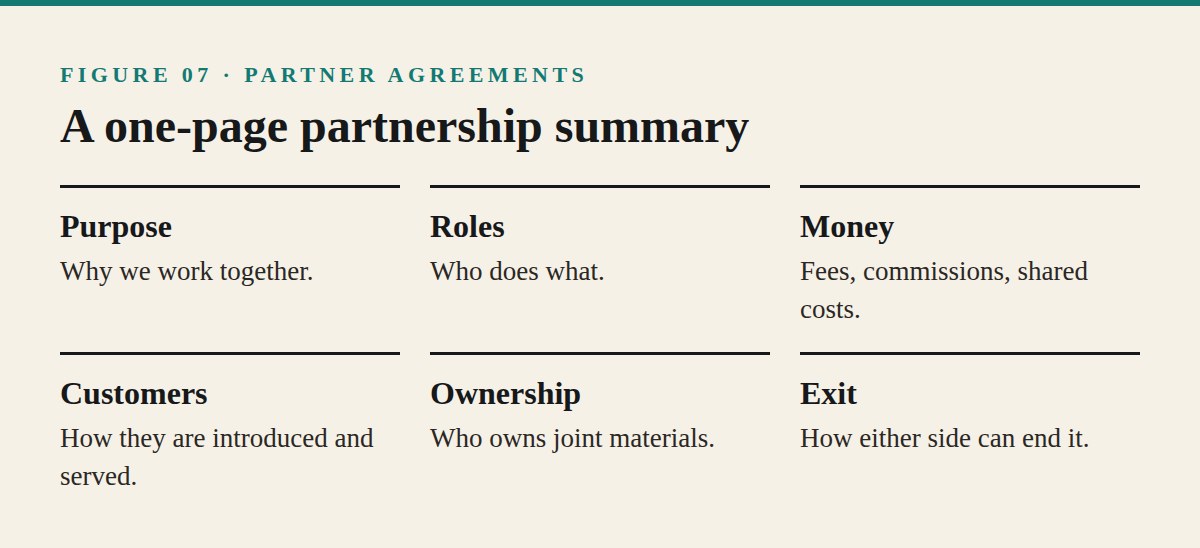
Partnerships often begin informally, built on trust and goodwill. Informal arrangements can work well for simple referrals, but as partnerships grow, unclear expectations can lead to misunderstandings, disputes and damaged relationships. Clear agreements help both sides understand responsibilities, benefits and boundaries.
Fairness ensures that the partnership remains worthwhile for everyone involved.
Discuss expectations early
Before starting a partnership, discuss how it will work. What does each partner expect? How will referrals be made? Who is responsible for which tasks? How will customers be supported? Open conversations at the beginning prevent assumptions later.
Put important terms in writing
For simple referral exchanges, a short written summary may be enough. For partnerships involving payments, shared projects, bundled offers or customer data, more formal agreements may be appropriate. Written terms reduce ambiguity and provide a reference point if questions arise.
For significant arrangements, consider seeking legal advice.
Clarify responsibilities
Define who is responsible for marketing, delivery, customer communication, invoicing, support and quality. In joint projects, customers should know who their main contact is and who handles each part of the service.
Agree financial arrangements
If commissions, referral fees, revenue sharing or shared costs are involved, agree how they are calculated, when they are paid and how they are tracked. Be transparent with customers where disclosure is required or appropriate.
Some professions restrict referral payments, so check the rules that apply.
Protect customer relationships
Discuss how customers will be treated, including communication standards, data protection and what happens if a customer is dissatisfied. Partners should not use shared customer relationships in ways the other partner has not agreed to.
Some professions restrict referral payments, so check the rules that apply.
Address intellectual property
Joint content, resources and materials may involve shared ownership. Agree who owns the work, how it can be used and whether either partner can continue using it after the partnership ends.
Plan for change
Partnerships evolve. Agree how either partner can end the arrangement, how outstanding commitments will be handled and how customers will be informed. Planning for an exit is not pessimistic; it protects both businesses.
Keep it fair
Fairness depends on mutual benefit, not perfect equality. Some partnerships involve more referrals in one direction, while the other partner contributes expertise, content or opportunities. Review the relationship periodically to ensure both sides feel it remains worthwhile.
Common mistakes
Partners often rely entirely on verbal agreements, avoid discussing money, fail to define responsibilities or overlook what happens when the partnership ends. Others create overly complex agreements for simple arrangements. Clear, proportionate agreements support long-term relationships.
An example in practice
A marketing consultant and a designer collaborated on client projects without written terms. When a client requested additional work, they disagreed about responsibilities and payment. Afterwards, they created a short written agreement covering roles, pricing, communication, ownership of work and how changes would be handled. Future projects ran smoothly, and the partnership continued successfully for years.
A one-page partnership summary
For most small partnerships, a one-page summary is enough: the purpose of the partnership; how introductions are made; who does what; any fees, commissions or shared costs; how customer information is handled; who owns joint materials; and how either side can end the arrangement. Both partners keep a copy and review it once a year.
Questions to answer before you agree
A few questions cover most of what partners need to discuss: What exactly will each of us do? How will customers be introduced and supported? Will any money change hands, and how is it calculated? Who owns materials we create together? How will we handle a dissatisfied customer? How can either of us end the arrangement? Writing down the answers is often enough to form a sound agreement.
Relationships · 08 of 08
Nurturing Relationships for the Long Term
The most valuable partnerships and referral sources are built over years, through consistent attention.
Many businesses invest effort in starting relationships but neglect maintaining them. A partner who once sent referrals may gradually forget about you. A satisfied customer who recommended you last year may not think of you again. Long-term relationships require consistent attention, genuine appreciation and mutual value.
Nurturing relationships turns occasional referrals into lasting sources of opportunity.
Stay in regular contact
Keep in touch with partners, referrers and past customers. This does not require constant communication. A periodic message, a coffee meeting, a useful article or an update about your business can keep relationships active.
Use a simple system to remind yourself when to reconnect.
Give before asking
Strong relationships are built on generosity. Refer customers to partners, share useful information, introduce people who can help each other and support partners' events or content. Giving value builds goodwill and makes partners more likely to support you in return.
Show appreciation
Thank people who refer customers or support your business. A personal message, handwritten note or small gift can show gratitude. Let referrers know when an introduction has been successful, while respecting customer confidentiality.
Appreciation should be genuine, not transactional.
Keep partners informed
Share relevant updates about your services, ideal customers and successes. Partners can only refer effectively if they understand what you offer and who you help. If your business changes, let them know.
Learn about their business
Ask partners about their goals, challenges and ideal customers. Understanding their needs helps you identify opportunities to support them, whether through referrals, collaboration or useful introductions.
Let referrers know when an introduction has been successful, while respecting customer confidentiality.
Deliver consistently
The strongest way to nurture referral relationships is to deliver excellent service to every referred customer. Consistent quality protects your reputation and encourages partners to continue recommending you.
Review relationships regularly
Periodically review your partnerships and referral sources. Which relationships are active? Which have faded? Which create the most value? Focus attention on relationships with strong mutual benefit and consider whether others need renewed effort or a different approach.
Celebrate shared successes
Recognise milestones and achievements together: successful joint projects, customer results or long-standing partnerships. Celebrating success reinforces the value of the relationship.
Common mistakes
Businesses often contact partners only when they need something, forget to thank referrers, fail to share updates or allow relationships to fade through neglect. Others focus on quantity of contacts instead of depth of relationships. Consistent, genuine engagement builds lasting networks.
An example in practice
An interior designer received regular referrals from two architects early in her career, but the referrals slowed as she became busy. She began meeting each architect every quarter, sharing photographs of projects completed for their clients, referring suitable clients to them and sending thank-you notes after successful introductions. Within a year, referrals increased again, and the relationships became her most reliable source of high-quality projects.
A relationship calendar
Keep a simple list of your most important partners and referrers with a planned contact rhythm: monthly for the closest partners, quarterly for regular referrers and twice a year for occasional supporters. Each contact should offer something: an update, an introduction, a useful article or a thank-you. Ten minutes a week maintaining this calendar protects some of your most valuable business relationships.
Being a good partner yourself
Relationships are nurtured from both sides. Refer customers generously, respond quickly to introductions, meet the standards you promised and speak well of partners in public. Partners remember who helped them grow, and they reciprocate naturally when the relationship feels genuinely mutual rather than transactional.
Reviving a faded relationship
If a valuable relationship has gone quiet, reconnect without apology or pressure: share a useful update, congratulate them on recent news or offer an introduction that helps them. One genuinely helpful message often restarts a relationship more effectively than a request to "catch up".
Before you close this edition
Your Action Plan
Your next 30 days
Week 1: Review your sources. Find out how your best customers found you and list everyone who has referred business before.
Week 2: Ask well. Ask three satisfied customers for referrals, using a specific description of who you help.
Week 3: Find partners. List five businesses that serve your customers without competing, and contact two with a useful idea.
Week 4: Say thank you. Thank every person who referred business in the past year, and set reminders to stay in touch.
Keep learning
Hustle Influence offers practical online courses and AI tools that help you turn ideas into action.
hustleinfluence.com
HUSTLE MAGHustle in Silence.