
Contents · Edition 021
Edition 021
From the Editors
Customers rarely remember every detail of what they bought. They remember how it felt. Whether the first reply was warm or careless. Whether they understood what would happen next. Whether a problem was handled with grace or indifference. Those feelings decide whether they return, and whether they recommend you to anyone.
For a small business, customer experience is one of the few advantages that cannot be outspent. A large competitor may have lower prices and bigger budgets. It rarely has the attention, flexibility and personal care a small business can offer at every step.
This issue treats experience as a deliberate strategy rather than a happy accident. We look at first impressions and onboarding, the moments that matter most, consistent standards across every touchpoint and personal touches that scale. We cover how to recover from mistakes, and how to measure whether the experience you intend is the experience customers actually receive.
Design the experience on purpose. Customers will notice, even if they cannot quite say why.
The Editors, Hustle Mag
In This Edition
The Customer Experience
Designing Every Step of the Customer Journey With Care
The customer experience is the sum of every interaction a customer has with your business: the website, the first reply, the purchase, the delivery, the support and the follow-up. Each interaction either builds confidence or erodes it.
This issue designs that experience step by step. We begin with experience as a strategic advantage, then work through first impressions, onboarding and the moments that matter most. We set standards across touchpoints, add personal touches that scale, build a system for recovering from mistakes and measure the results.
Each article ends with one improvement you can make this week.
Cover Story · 01 of 08
Experience as Strategy
When products are similar, the experience becomes the reason customers choose and return.

In many markets, products and services are increasingly similar. Customers can find several businesses offering comparable features at comparable prices. What often distinguishes one business from another is the experience: how easy it is to buy, how clearly the business communicates, how problems are handled and how customers feel throughout the relationship.
For small businesses, customer experience can be a powerful strategy rather than an afterthought.
Why experience matters
A positive experience increases the likelihood that customers return, recommend you and forgive occasional mistakes. A poor experience can undo excellent products. Customers may tolerate a slightly higher price for a business that is reliable, responsive and pleasant to deal with.
Experience influences loyalty, reviews, referrals and long-term revenue.
Small businesses have an advantage
Small businesses can often offer more personal attention, flexibility and responsiveness than larger competitors. Founders may know customers by name, adapt services to individual needs and respond quickly to feedback.
These strengths can become a deliberate competitive advantage.
Define the experience you want to create
Start by deciding how you want customers to feel. Confident? Cared for? Reassured? Delighted? Clear about what happens next? These intended feelings can guide decisions across the business, from website design to delivery and support.
Write a short statement describing the experience you aim to provide.
Experience is created at every touchpoint
Touchpoints include your website, social media, emails, phone calls, proposals, invoices, packaging, delivery, support, follow-up and even how you handle complaints. Customers judge the business through all of these interactions.
A great product with confusing invoices or slow replies can still feel disappointing.
Consistency matters more than occasional brilliance
Customers value reliable experiences. An occasional exceptional gesture is pleasant, but consistently clear communication, punctual delivery and helpful support build stronger trust.
Aim first for consistently good experiences, then add memorable moments.
A great product with confusing invoices or slow replies can still feel disappointing.
Align experience with your brand
Your customer experience should reflect your positioning and values. A premium service may emphasise personal attention and polished details. A practical, efficient service may emphasise speed and simplicity. The experience should match what customers expect from your brand.
Involve everyone who serves customers
If others work with you, ensure they understand the experience you want to create. Share standards, examples and customer feedback. Customers do not distinguish between departments or individuals; they experience the business as a whole.
Review the experience regularly
Customer expectations change and businesses evolve. Review the experience periodically, gather feedback and identify improvements. Small changes often produce noticeable benefits.
Common mistakes
Businesses often focus entirely on products and pricing while neglecting communication and support. Others try to create memorable moments while basic processes remain unreliable. Some never define the experience they want to deliver. A clear vision, consistent standards and regular review make experience a strategic advantage.
An example in practice
Two local bakeries offered similar products and prices. One responded slowly to orders, provided unclear pickup instructions and rarely followed up. The other confirmed orders immediately, sent a reminder the day before pickup and included handwritten thank-you notes with special orders. Over time, the second bakery received far more repeat orders and recommendations, despite charging slightly more.
An experience statement
Write one sentence describing the experience you want every customer to have, for example: "Customers should always know what happens next, feel personally looked after and never have to chase us." Test every process against it. If a step leaves customers uncertain or chasing, it does not yet meet the standard you have set.
Experience and price
A better experience often supports higher prices. Customers who feel looked after compare less and negotiate less, because they value the certainty and care they receive. Investing in experience is therefore not only about satisfaction; it can directly improve margins and reduce the time spent winning each customer.
Experience · 02 of 08
First Impressions
The first interaction shapes how customers interpret everything that follows.
First impressions form quickly. A potential customer may judge your business within seconds of visiting your website, reading your profile, receiving your first email or calling your business. These early impressions influence whether they trust you, continue the conversation and eventually buy.
Because first impressions are difficult to change, they deserve careful attention.
Identify your first touchpoints
Customers may first encounter your business through a website, search result, social media profile, review page, referral, advertisement, phone call or physical location. List the most common first touchpoints and evaluate each one from a new customer's perspective.
Make your website clear and credible
Your website is often the first serious impression. It should clearly explain what you offer, who it is for, the main benefit and how to take the next step. Professional design, readable text, current information and fast loading times signal credibility.
Outdated content, broken links or unclear messages create doubt.
Respond quickly to enquiries
The speed and quality of your first response matter. A prompt, helpful reply shows professionalism and care. Even if you cannot provide a full answer immediately, acknowledge the enquiry and explain when you will respond.
Slow or generic responses can lose interested customers.
Personalise the first reply
Use the customer's name, refer to their question and provide relevant information. Avoid copying and pasting long generic responses. A short, personalised reply often makes a stronger impression than a lengthy standard message.
Set clear expectations
Explain what happens next: how long it will take to receive a proposal, when a call will happen or what information you need. Clear expectations reduce uncertainty and make customers feel confident.
Explain what happens next: how long it will take to receive a proposal, when a call will happen or what information you need.
Show proof early
New customers may be uncertain about your credibility. Make reviews, testimonials, examples of work and clear policies easy to find. Early proof helps build trust before customers invest time in conversations.
Professional details matter
Small details influence perception: a professional email address, consistent branding, clear contact information, accurate opening hours and well-written messages. These details signal that the business is organised and reliable.
Consider physical first impressions
If customers visit a physical location, consider cleanliness, signage, accessibility, greeting and waiting experience. Physical environments create strong impressions that affect trust and comfort.
Review regularly
Ask friends, customers or colleagues to evaluate your first touchpoints. What did they understand? What confused them? What made them trust or doubt the business? Fresh perspectives reveal issues you may overlook.
Common mistakes
Businesses often neglect websites and profiles, respond slowly to enquiries, send generic replies or fail to explain the next step. Others hide proof and contact information. Clear, prompt and personalised first interactions create stronger impressions.
An example in practice
A home renovation company received many website enquiries but converted few into consultations. Its replies often took several days and contained long generic information. It introduced a policy of responding within four working hours with a short personalised message, a few relevant project examples and a link to book a consultation. Consultation bookings increased significantly.
A first-impression audit
Ask someone unfamiliar with your business to complete three tasks while you watch: find out what you offer from your website on a phone, send an enquiry and read your first reply. Note every hesitation, question and moment of doubt. Fix the first three issues they encounter; they are almost certainly costing you customers already.
First impressions for referred customers
Customers referred by others arrive with positive expectations, which raises the stakes. Thank them for getting in touch, mention who referred them where appropriate and respond especially promptly. Meeting the expectations set by the referrer protects both your reputation and theirs.
Onboarding · 03 of 08
Onboarding That Reassures
The moments after purchase decide whether customers feel confident or uneasy about their choice.

Immediately after buying, many customers experience uncertainty. They wonder whether they made the right choice, what happens next and whether the business will deliver what it promised. If communication is unclear or delayed, doubts can grow quickly. A thoughtful onboarding process reassures customers and sets the foundation for a successful relationship.
Onboarding is the process of welcoming new customers and helping them start well.
Confirm the purchase immediately
Send an immediate confirmation after purchase or agreement. Include key details: what was purchased, price, important dates and contact information. A clear confirmation reduces anxiety and provides a reference point.
Welcome the customer personally
A personal welcome message shows appreciation and builds connection. Thank the customer for choosing your business and express enthusiasm about working together.
For small businesses, a short personal message from the founder can be particularly effective.
Explain what happens next
Describe the next steps clearly: timelines, required information, meetings, delivery schedules or how to access the product. Customers should never have to guess what will happen.
A simple step-by-step overview is often enough.
Request information efficiently
If you need information from the customer, ask for it in a clear and organised way. Use a simple form, checklist or questionnaire rather than multiple scattered emails. Explain why the information is needed and when it is due.
Help customers achieve an early result
Early success increases confidence. For software, this might be completing a first task. For services, it might be an initial meeting or first deliverable. For products, it might be easy setup instructions.
Design onboarding to help customers experience value quickly.
If you need information from the customer, ask for it in a clear and organised way.
Provide useful resources
Offer guides, frequently asked questions, tutorials or tips that help customers use the product or prepare for the service. Anticipate common questions and answer them before customers need to ask.
Check in early
A short check-in shortly after onboarding begins can identify problems early. Ask whether the customer has questions or needs support. Early intervention prevents small issues from becoming frustrations.
Make support easy to find
Explain how customers can get help, including contact methods and expected response times. Easy access to support provides reassurance even if customers never need it.
Review and improve
Collect feedback about the onboarding experience. Which steps were clear? Where did customers feel uncertain? Use the answers to improve your process.
Common mistakes
Businesses often send no confirmation, provide incomplete information, overwhelm customers with too many emails or fail to explain next steps. Others focus on administrative tasks while neglecting the customer's feelings and need for reassurance. A clear, welcoming and well-paced onboarding process creates confidence.
An example in practice
A web design studio began projects by sending a long contract and waiting for clients to ask what happened next. Many clients felt unsure and delayed sending information. The studio introduced a welcome email with a project timeline, a short onboarding questionnaire, a kickoff meeting invitation and a list of frequently asked questions. Projects started more smoothly and clients reported feeling more confident.
A simple onboarding sequence
A reliable sequence for many businesses: an immediate confirmation; a personal welcome within a day; a "what happens next" message with timeline and any information needed; a resource that helps the customer get an early result; and a short check-in within the first week. Five touches, mostly templated, turn the anxious period after purchase into a confident start.
Onboarding for products
For product businesses, onboarding may be simpler but matters just as much: a clear order confirmation, dispatch and tracking updates, setup or care instructions included with the product and a short follow-up asking whether everything arrived as expected. These steps prevent many returns and support requests.
Experience · 04 of 08
Moments That Matter Most
Some moments shape a customer's memory far more than others. Design those moments deliberately.

Customers do not remember every interaction equally. Certain moments carry greater emotional weight: the first meeting, the moment a problem is solved, the delivery of a final result, an unexpected difficulty or the end of a project. These moments disproportionately shape how customers remember the experience.
Identifying and designing these moments can significantly improve customer satisfaction and loyalty.
Identify the critical moments
Review your customer journey and identify moments where emotions are strongest. Common examples include:
- The first conversation.
- The decision to buy.
- The first delivery or result.
- A problem or delay.
- Project completion.
- Renewal or repeat purchase.
Ask customers which moments they remember most and why.
Focus on peaks and endings
People often remember the most intense moments and the end of an experience. A strong ending can leave a lasting positive impression, while a disappointing conclusion can overshadow earlier satisfaction.
Pay special attention to how projects finish, orders arrive and relationships continue after the main transaction.
Reduce anxiety at uncertain moments
Moments of uncertainty, such as waiting for delivery, awaiting results or starting a project, can create anxiety. Clear communication, progress updates and realistic timelines reduce stress and build trust.
Celebrate achievements
When customers reach an important milestone, acknowledge it. A completed project, successful launch or achieved goal is an opportunity to celebrate with them. Recognition makes customers feel valued and reinforces the result.
Handle problems with care
Problems are critical moments. How you respond can strengthen or damage the relationship. Respond quickly, take ownership and communicate clearly. A well-handled problem can increase trust.
Recognition makes customers feel valued and reinforces the result.
Add thoughtful touches
Small gestures can make important moments memorable: a handwritten note, a personalised summary, a useful gift, a follow-up message or a short video explaining results. Thoughtful touches should feel genuine and appropriate to your brand.
Design the final experience
At the end of a project or purchase, provide a clear summary of what has been delivered, explain how to get support and suggest next steps. Ask for feedback and thank the customer.
A well-designed ending encourages repeat business and referrals.
Train for important moments
If others serve customers, ensure they understand which moments matter most and how to handle them. Provide examples, scripts or guidelines where helpful, while allowing genuine personal interaction.
Measure the effect
Gather feedback after key moments. Ask customers how they felt and what could improve. Track whether improvements lead to better reviews, repeat purchases or referrals.
Common mistakes
Businesses often treat every interaction equally, neglect project endings, communicate poorly during uncertain periods or respond defensively to problems. Others add gestures that feel generic or forced. Focusing on emotionally significant moments creates stronger impressions.
An example in practice
A wedding photographer delivered photographs through a simple download link with no further contact. Couples were satisfied, but few left reviews. She redesigned the delivery moment: a personalised video preview, a beautifully designed online gallery and a handwritten thank-you card. Couples began sharing their galleries enthusiastically, and reviews and referrals increased significantly.
Mapping your moments
Draw your customer journey as a simple line and mark each step with a small plus or minus sign based on how customers usually feel. The steps with the strongest feelings, positive or negative, are your moments that matter. Improve the most negative one first, then strengthen the most positive one so it becomes truly memorable.
The waiting moments
Some of the most important moments are ones where nothing visible happens: waiting for a delivery, a proposal or the next project stage. Short, proactive updates during these periods, even simply confirming that everything is on track, prevent anxiety and stop customers from feeling forgotten.
Consistency · 05 of 08
Standards Across Every Touchpoint
Customers should receive the same quality whether they email, call, visit or buy online.
Inconsistent experiences create uncertainty. A customer may receive a quick, friendly response by email but wait days for a phone call. A website may look polished while invoices contain errors. One team member may follow up carefully while another forgets. These inconsistencies weaken trust because customers cannot predict what will happen next.
Clear standards help every touchpoint reflect the same level of care and professionalism.
Identify all touchpoints
List every point where customers interact with your business: website, social media, enquiries, sales calls, proposals, contracts, onboarding, delivery, invoices, support, follow-up and reviews. Include physical touchpoints if relevant, such as premises or packaging.
Define simple standards
For each important touchpoint, define what good looks like. Standards should be specific and measurable where possible. Examples include:
- Respond to enquiries within one working day.
- Send a summary after every meeting.
- Confirm orders immediately.
- Send invoices with clear descriptions and payment terms.
- Follow up after project completion.
Simple standards are easier to follow consistently.
Align standards with your brand
Your standards should reflect the experience you want customers to have. A premium brand may require detailed personal communication and polished presentation. A fast, practical service may emphasise speed and simplicity.
Create templates and checklists
Templates for common emails, proposals, onboarding messages and project summaries help maintain consistency. Checklists ensure important steps are not forgotten. These tools also save time and make it easier to delegate work.
Share standards with everyone
If others serve customers, explain the standards and why they matter. Provide examples of good practice and encourage questions. Standards are effective only when everyone understands and follows them.
Monitor performance
Track whether standards are met. For example, review response times, customer feedback, complaints or missed follow-ups. Regular monitoring helps identify areas needing improvement.
Provide examples of good practice and encourage questions.
Allow for judgement
Standards should guide behaviour, not prevent common sense. Allow flexibility for unusual situations, such as urgent requests or sensitive problems. Encourage staff or partners to prioritise the customer's needs while maintaining overall quality.
Update standards over time
As your business grows, customer expectations and processes change. Review standards periodically and adjust them to reflect new tools, services or lessons learned.
Recognise good performance
Acknowledge team members or partners who consistently provide excellent experiences. Recognition reinforces standards and encourages continued attention to quality.
Common mistakes
Businesses often rely on memory rather than clear standards, set unrealistic expectations, fail to share standards with others or never review whether they are being met. Others create rigid rules that prevent sensible decisions. Clear, realistic and regularly reviewed standards improve consistency.
An example in practice
A small accounting firm received mixed reviews: some clients praised its responsiveness, while others complained about slow replies and unclear invoices. The firm introduced standards for response times, meeting summaries, invoice descriptions and quarterly check-ins, supported by templates and a shared checklist. Within months, complaints decreased and client reviews became consistently positive.
A one-page standards sheet
Write your standards on a single page grouped by stage: enquiry, sale, onboarding, delivery, support and follow-up. For each, list one or two specific commitments. Keep the page where everyone who serves customers can see it, and review it together every few months. Short, visible standards are followed far more reliably than long manuals.
Standards for difficult days
Standards are tested when things are busy. Decide in advance which standards are non-negotiable, such as acknowledging every enquiry within a day, and which can flex temporarily. Knowing the minimum you will always deliver helps protect the experience during peak periods, holidays or staff absence.
Testing your standards as a customer
Once a quarter, test your own standards: send an enquiry from a personal address, place a small order or book a call as a customer would. Note whether each standard was met. Mystery-shopping your own business takes little time and reveals gaps that internal reports often miss.
Relationships · 06 of 08
Personal Touches at Scale
Customers want to feel known. Systems can help you stay personal as you grow.
One of the greatest strengths of small businesses is personal attention. Founders often remember customer names, preferences and stories. As businesses grow, however, maintaining that personal touch becomes harder. Customers may begin to feel like transactions rather than individuals.
With thoughtful systems, it is possible to remain personal while serving more customers.
Record useful information
Keep simple records of customer preferences, important dates, previous purchases and relevant notes. A customer relationship tool, spreadsheet or shared document can help. Record only information that genuinely improves the experience and respect privacy rules.
Use names and context
Address customers by name and refer to previous conversations or purchases where appropriate. Small acknowledgements show that you remember them and value the relationship.
Personalise communication
Templates save time, but they should be adapted. Add a sentence that refers to the customer's situation, project or question. Personalised communication feels more caring than generic messages.
Celebrate milestones
Acknowledge important milestones: anniversaries of working together, completed projects, business launches or customer achievements. A short message or small gesture can strengthen relationships.
Use thoughtful follow-ups
After a purchase or project, follow up to ask how things are going. Mention specific details where possible. For example: "How is the new website working for your spring bookings?" Specific follow-ups feel more genuine.
Offer choices
Allow customers to choose communication preferences, delivery options or service levels where practical. Choices make customers feel respected and help you serve them more effectively.
After a purchase or project, follow up to ask how things are going.
Empower staff to personalise
If others serve customers, give them the freedom to make small personal gestures, such as resolving minor issues quickly or adding a thoughtful note. Clear guidelines help maintain consistency while allowing genuine care.
Automate carefully
Automation can support personal experiences, such as reminders, birthday messages or follow-ups. However, poorly personalised automated messages can feel insincere. Use automation to save time on routine tasks while keeping important interactions human.
Ask for feedback
Invite customers to share preferences and suggestions. Feedback helps you understand what personal touches matter most and which may feel unnecessary.
Common mistakes
Businesses often rely entirely on generic templates, forget customer details, overuse automation or collect excessive personal information. Others attempt personal gestures that feel artificial or intrusive. Genuine, relevant and respectful personalisation builds stronger relationships.
An example in practice
A small online tea shop grew from a few dozen customers to several thousand. To maintain its personal approach, it recorded customers' favourite teas and occasionally included handwritten notes recommending similar blends. It also sent personalised follow-up emails after first orders. Customers frequently mentioned these touches in reviews, and repeat purchase rates remained high as the business grew.
Personal touches that cost little
Some of the most appreciated gestures require minutes, not money: a handwritten line on an invoice, a short voice message after a project milestone, remembering a customer's busy season and checking in before it, or sending a useful article that relates to their situation. Choose two or three gestures that suit your business and make them part of your routine.
Knowing where to stop
Personalisation should feel helpful, not intrusive. Avoid referring to information customers did not knowingly share, and never use personal details in ways they would not expect. The aim is for customers to feel remembered and respected, not observed.
Making personal touches consistent
Personal touches should not depend on one person's memory or mood. Add them to your processes: a note field in your customer records, a reminder to send a milestone message and a line in your project completion checklist for a handwritten thank-you. When personal care is part of the system, every customer receives it, not only the ones you happen to remember.
Recovery · 07 of 08
Recovering From Mistakes
Problems are inevitable. A clear recovery process turns them into proof that customers can rely on you.
Every business makes mistakes. Deliveries arrive late, products are damaged, messages are missed and projects encounter unexpected problems. Customers understand that mistakes happen. What they remember is how the business responds.
A clear recovery process helps you resolve problems quickly, protect relationships and learn from what went wrong.
Respond quickly
Speed matters. Acknowledge the problem as soon as possible, even if you need time to investigate. A prompt response reassures customers that their concern is being taken seriously.
Silence often makes problems feel worse.
Listen fully
Let customers explain the problem without interruption. Ask questions to understand what happened and how it affected them. Listening carefully helps you identify the real issue and shows respect.
Acknowledge and apologise
Acknowledge the customer's experience and apologise sincerely where appropriate. Avoid defensive explanations or blaming others. A genuine apology can reduce frustration and rebuild trust.
Take ownership
Take responsibility for resolving the problem, even if another supplier or partner contributed to it. Customers want a solution, not a list of who caused the issue.
Offer a clear solution
Explain what you will do to fix the problem and when. Solutions may include replacing a product, correcting work, providing a refund, offering additional support or adjusting timelines. Choose a solution that addresses the customer's needs.
Recognise inconvenience
Where appropriate, offer a gesture that recognises the inconvenience caused: an additional service, discount, small gift or priority support. The gesture should feel sincere rather than an attempt to avoid responsibility.
Solutions may include replacing a product, correcting work, providing a refund, offering additional support or adjusting timelines.
Follow up
After resolving the problem, follow up to ensure the customer is satisfied. This final step shows care and gives you an opportunity to confirm that the issue has been fully addressed.
Fix the root cause
Investigate why the problem occurred. Was it a process gap, communication issue, supplier problem or training need? Address the underlying cause to prevent future occurrences.
Document recovery guidelines
Create simple guidelines for handling common problems. Include response times, apology wording, available solutions and when to escalate. Guidelines help everyone respond consistently.
Common mistakes
Businesses often respond slowly, become defensive, blame suppliers, offer solutions that do not match the customer's needs or fail to follow up. Others fix individual problems without addressing root causes. Fast, sincere and solution-focused recovery protects relationships.
An example in practice
A furniture maker delivered a table with a damaged leg just before a customer's family celebration. The owner called the customer within an hour, apologised, arranged a replacement leg to be fitted the next morning and included a set of matching coasters as a gesture of apology. Afterwards, he improved packaging and inspection procedures. The customer left a positive review praising the response.
A recovery script
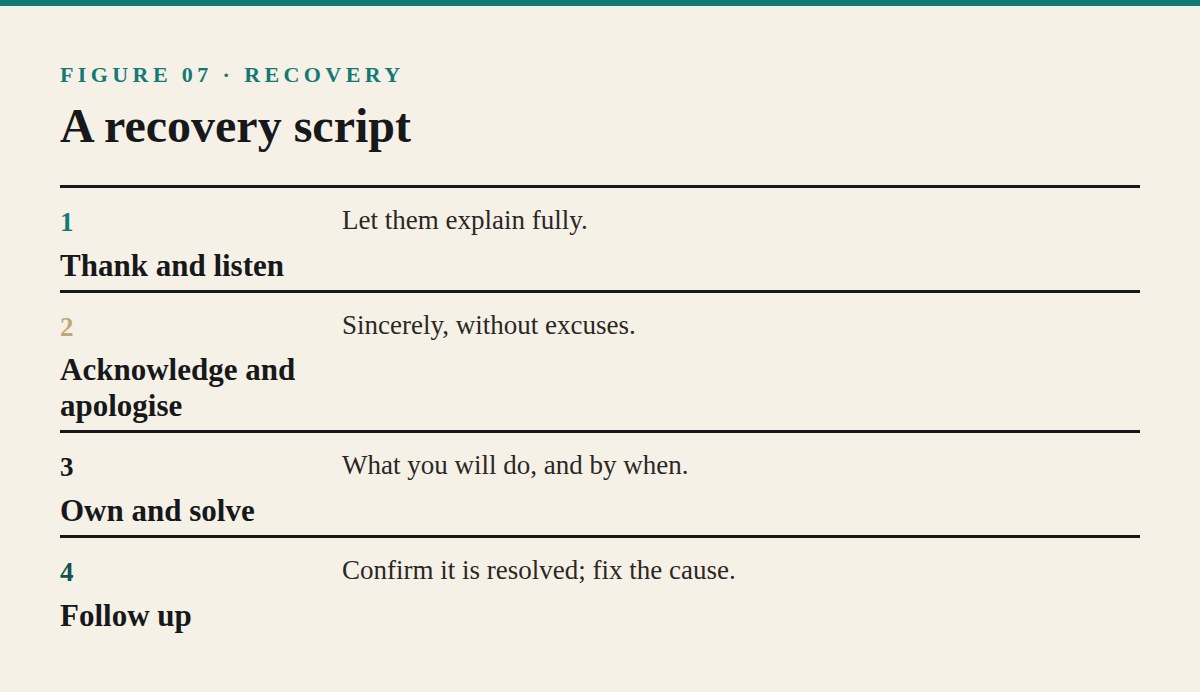
A simple script helps in stressful moments: thank the customer for telling you; acknowledge the problem and its impact; apologise sincerely; explain what you will do and by when; confirm that the solution works for them; and follow up once it is resolved. Keeping this sequence in mind prevents defensive reactions and ensures nothing important is missed.
When the customer is wrong
Sometimes a complaint is based on a misunderstanding. Even then, start by listening and acknowledging the customer's frustration, then explain the facts calmly and offer whatever help you reasonably can. Customers who feel heard often accept an explanation they would have rejected if it came first.
Keeping a problem log
Record every significant problem in a simple log: date, what happened, how it was resolved and the root cause. Review the log monthly. Repeated causes reveal where processes, suppliers or training need attention, and the log shows whether your fixes are actually working.
Measurement · 08 of 08
Measuring the Experience
Intentions are not results. Measure whether customers actually experience what you designed.
Many businesses believe they provide a good customer experience. Customers may see things differently. Without measurement, it is difficult to know whether improvements are working, where problems occur or how experiences change over time.
Measuring customer experience helps turn good intentions into consistent results.
Ask customers directly
The simplest way to measure experience is to ask. Short surveys, feedback forms, follow-up emails or conversations can reveal how customers feel about your business.
Keep questions focused and easy to answer.
Use simple satisfaction questions
Common questions include:
- "How satisfied were you with your experience?"
- "How likely are you to recommend us to a friend or colleague?"
- "What could we have done better?"
- "What did you value most?"
A combination of rating questions and open responses provides both measurable data and useful insights.
Measure key moments
Gather feedback after important moments such as onboarding, delivery, project completion or support interactions. Feedback tied to specific moments is easier to act upon than general comments.
Track operational indicators
Some experience indicators can be measured directly:
- Response times.
- Delivery times.
- Repeat purchase rates.
- Complaint frequency.
- Refund or return rates.
- Customer retention.
These indicators often reveal experience problems before customers mention them.
Read reviews regularly
Online reviews provide valuable feedback about customer experience. Read both positive and negative reviews, identify recurring themes and respond professionally.
Look for patterns
Individual comments can be useful, but patterns are more important. If several customers mention unclear communication or slow delivery, prioritise those areas for improvement.
When customers provide feedback, acknowledge it and explain what actions you have taken where appropriate.
Close the feedback loop
When customers provide feedback, acknowledge it and explain what actions you have taken where appropriate. Customers are more willing to share feedback when they see it leads to improvements.
Share insights internally
If others work with you, share customer feedback and experience metrics regularly. Use positive feedback to recognise good work and negative feedback to identify improvement opportunities.
Review regularly
Set a regular schedule, such as monthly or quarterly, to review experience data. Compare results over time and track whether improvements make a difference.
Common mistakes
Businesses often rely on assumptions, collect feedback but never act on it, ask too many survey questions or focus only on positive reviews. Others measure satisfaction without looking at retention or complaints. Simple, regular and action-oriented measurement works best.
An example in practice
A small software company assumed its onboarding process was effective. It introduced a short survey after the first week asking new customers how easy it was to get started. Many reported confusion with one setup step. After improving instructions and adding a short video guide, satisfaction scores increased and support requests fell noticeably.
A simple experience dashboard
Track a handful of numbers monthly in one place: a satisfaction or recommendation score from recent customers, average response time, repeat purchase or renewal rate, complaints received and the most common theme in feedback. Five numbers reviewed every month give a clear picture of whether the experience is improving, without a complicated system.
Turning measurement into action
After each review, choose one improvement to make before the next one. Assign it to a specific person, set a date and check the relevant measure afterwards. Measuring without acting creates reports; measuring with one clear action each month creates a steadily better experience.
Asking at the right moment
Timing affects the quality of feedback. Ask soon after a key moment, while the experience is fresh, and keep the request short. A single question sent the day after delivery usually produces more honest and useful answers than a long survey sent months later.
Before you close this edition
Your Action Plan
Your next 30 days
Week 1: Experience it yourself. Go through your business as a new customer, from first contact to follow-up, and note every moment of friction or uncertainty.
Week 2: Fix the first impression and onboarding. Improve your first reply and create a clear welcome message explaining what happens next.
Week 3: Set standards. Write simple standards for response times, communication and delivery, and share them with anyone who serves customers.
Week 4: Listen. Ask recent customers one experience question and fix the most common problem they mention.
Keep learning
Hustle Influence offers practical online courses and AI tools that help you turn ideas into action.
hustleinfluence.com
HUSTLE MAGHustle in Silence.