
Every business makes mistakes. Deliveries arrive late, products are damaged, messages are missed and projects encounter unexpected problems. Customers understand that mistakes happen. What they remember is how the business responds.
A clear recovery process helps you resolve problems quickly, protect relationships and learn from what went wrong.
Respond quickly
Speed matters. Acknowledge the problem as soon as possible, even if you need time to investigate. A prompt response reassures customers that their concern is being taken seriously.
Silence often makes problems feel worse.
Listen fully
Let customers explain the problem without interruption. Ask questions to understand what happened and how it affected them. Listening carefully helps you identify the real issue and shows respect.
Acknowledge and apologise
Acknowledge the customer's experience and apologise sincerely where appropriate. Avoid defensive explanations or blaming others. A genuine apology can reduce frustration and rebuild trust.
Take ownership
Take responsibility for resolving the problem, even if another supplier or partner contributed to it. Customers want a solution, not a list of who caused the issue.
Offer a clear solution
Explain what you will do to fix the problem and when. Solutions may include replacing a product, correcting work, providing a refund, offering additional support or adjusting timelines. Choose a solution that addresses the customer's needs.
Recognise inconvenience
Where appropriate, offer a gesture that recognises the inconvenience caused: an additional service, discount, small gift or priority support. The gesture should feel sincere rather than an attempt to avoid responsibility.
Solutions may include replacing a product, correcting work, providing a refund, offering additional support or adjusting timelines.
Follow up
After resolving the problem, follow up to ensure the customer is satisfied. This final step shows care and gives you an opportunity to confirm that the issue has been fully addressed.
Fix the root cause
Investigate why the problem occurred. Was it a process gap, communication issue, supplier problem or training need? Address the underlying cause to prevent future occurrences.
Document recovery guidelines
Create simple guidelines for handling common problems. Include response times, apology wording, available solutions and when to escalate. Guidelines help everyone respond consistently.
Common mistakes
Businesses often respond slowly, become defensive, blame suppliers, offer solutions that do not match the customer's needs or fail to follow up. Others fix individual problems without addressing root causes. Fast, sincere and solution-focused recovery protects relationships.
An example in practice
A furniture maker delivered a table with a damaged leg just before a customer's family celebration. The owner called the customer within an hour, apologised, arranged a replacement leg to be fitted the next morning and included a set of matching coasters as a gesture of apology. Afterwards, he improved packaging and inspection procedures. The customer left a positive review praising the response.
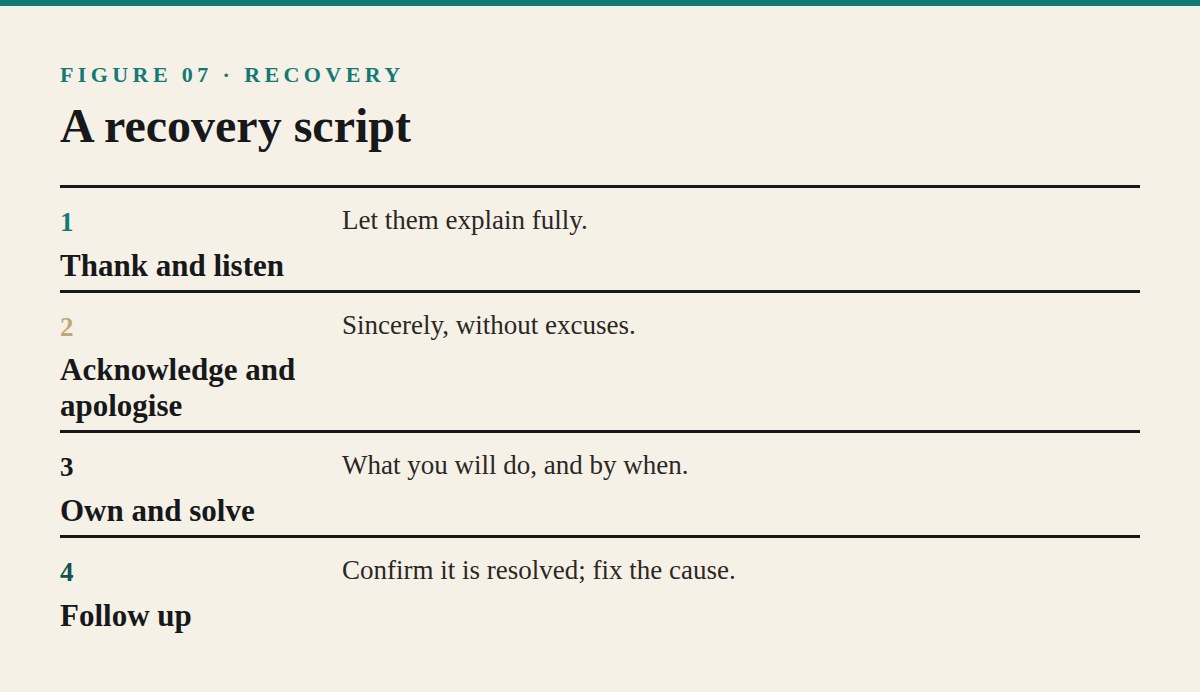
A recovery script
A simple script helps in stressful moments: thank the customer for telling you; acknowledge the problem and its impact; apologise sincerely; explain what you will do and by when; confirm that the solution works for them; and follow up once it is resolved. Keeping this sequence in mind prevents defensive reactions and ensures nothing important is missed.
When the customer is wrong
Sometimes a complaint is based on a misunderstanding. Even then, start by listening and acknowledging the customer's frustration, then explain the facts calmly and offer whatever help you reasonably can. Customers who feel heard often accept an explanation they would have rejected if it came first.
Keeping a problem log
Record every significant problem in a simple log: date, what happened, how it was resolved and the root cause. Review the log monthly. Repeated causes reveal where processes, suppliers or training need attention, and the log shows whether your fixes are actually working.