
Contents · Edition 024
Edition 024
From the Editors
This issue closes Volume II of Hustle Mag. Across twelve issues, we have built a marketing system, created content and social media with purpose, written emails and copy that work, learned to sell without pressure, grown through referrals and careful advertising, designed the customer experience, kept customers loyal and built communities around them. It seems right to finish with the public record of all that work: reputation and reviews.
Before most customers contact a business today, they read what others have said about it. Reviews have become the modern version of word of mouth, visible to strangers and permanent. A strong reputation brings customers in quietly. A weak or neglected one turns them away before you ever know they existed.
This issue treats reputation as the business asset it is. We look at how good reviews are earned, how to ask for them honestly and where they matter most. We cover responding to every review, handling negative feedback with grace, showcasing what customers say and monitoring your reputation over time, along with the rules that keep the practice honest.
Thank you for reading Volume II. Volume III turns to systems, money and leadership.
The Editors, Hustle Mag
In This Edition
Reputation and Reviews
Earning, Managing and Responding to Public Feedback
Reputation is what people say about your business when you are not in the room. Reviews make that conversation visible to everyone considering you. Earned honestly and managed carefully, they become one of the most persuasive forms of proof a small business can have.
This issue builds a complete approach to reputation. We begin with reputation as an asset and how reviews are earned, then ask for reviews honestly and choose the platforms that matter. We cover responding to reviews, handling negative feedback, showcasing what customers say and monitoring and protecting your reputation.
Each article ends with one step that strengthens your reputation this week.
Cover Story · 01 of 08
Reputation as an Asset
A strong reputation lowers the cost of every sale. Treat it with the care you give any valuable asset.
Reputation rarely appears on a balance sheet, yet it influences almost every part of a business. It affects how easily customers trust you, how much they are willing to pay, how often they recommend you and how forgiving they are when something goes wrong. Online reviews have made reputation more visible than ever.
Treating reputation as an asset encourages deliberate attention rather than occasional reaction.
Reputation lowers the cost of winning customers
Prospects who see consistent positive feedback arrive with greater confidence. They ask fewer questions, compare less and decide faster. A strong reputation makes marketing and sales more efficient.
Reputation supports pricing
Businesses with excellent reputations often face less price resistance. Customers are willing to pay for the reassurance that comes from strong evidence of quality and reliability.
Reputation compounds
Each satisfied customer adds to your reputation, which attracts more customers, who may add further positive feedback. Over years, this cycle can become one of the strongest advantages a small business has.
Reputation is fragile
Reputation built over years can be damaged quickly by poor service, careless responses or public disputes. Protecting it requires consistent standards and thoughtful communication.
Reviews are only part of reputation
Reviews are the most visible element, but reputation also includes referrals, word of mouth, media coverage, partner perceptions and how you behave in your industry. Strong reputations are consistent across all of these.
Reputation reflects reality
The most reliable way to build a strong reputation is to deliver excellent products and experiences. Marketing can make a good reputation visible, but it cannot create one that the business does not deserve.
Protecting it requires consistent standards and thoughtful communication.
Know your current reputation
Search for your business online. Read reviews on major platforms, check how your business appears in search results and ask customers how they would describe you to others. Understanding your current reputation is the starting point.
Identify recurring themes
Look for patterns in feedback. Do customers consistently praise particular strengths? Do certain complaints appear repeatedly? Themes reveal what to protect and what to improve.
Make reputation a regular agenda item
Review reputation monthly: new reviews, responses, recurring themes and actions taken. Regular attention prevents problems from growing unnoticed.
Common mistakes
Businesses often ignore reviews until a negative one appears, focus on star ratings while ignoring comments or try to manage reputation through marketing rather than improving the underlying experience. Others react emotionally to criticism. Steady, honest attention protects reputation best.
An example in practice
A small dental practice rarely checked its online reviews. When a new manager did, she found several comments praising the dentists but criticising long waiting times and unclear billing. The practice introduced appointment reminders, adjusted scheduling and explained costs before treatment. Over the following year, reviews improved, and new patients frequently mentioned the practice's reputation when booking.
Reputation and recruitment
Reputation affects more than customers. Potential employees, freelancers and partners also research businesses before working with them. A strong, well-managed reputation makes it easier to attract good people, while visible neglect or hostile responses to criticism can discourage the very talent a growing business needs.
A reputation snapshot
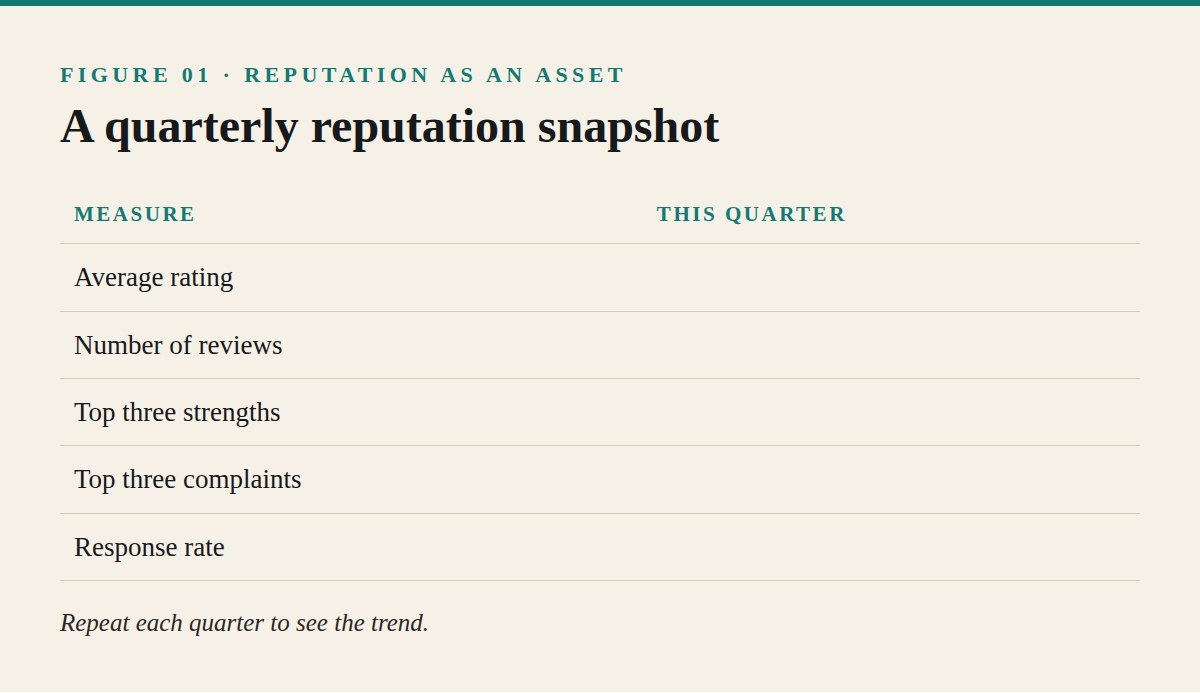
Create a one-page snapshot today: your average rating on each main platform, the number of reviews, the three most common positive themes, the three most common complaints and your response rate. Repeat it every quarter. Over time, these snapshots show clearly whether your reputation is strengthening or slipping.
Reputation and every team member
Everyone who serves customers shapes reputation, not only the founder. Share recent reviews with anyone involved, celebrate praise for specific people and discuss criticism constructively. When everyone sees how their work appears in public feedback, care for the experience becomes shared.
Foundations · 02 of 08
Earning Reviews
The best reviews are earned long before anyone asks for them.
Many businesses focus on asking for reviews. Asking matters, but the foundation of good reviews is an experience worth describing. Customers write positive reviews when they feel well served, achieve results or experience something better than they expected. When the experience is ordinary, even frequent requests produce few enthusiastic reviews.
Earning reviews means designing experiences customers want to talk about.
Deliver what you promise
Reliability is the first requirement. Deliver on time, at the agreed quality and within the agreed price. Customers rarely praise reliability explicitly, but they quickly criticise its absence.
Communicate clearly
Many positive reviews mention communication: quick replies, clear explanations, regular updates and honesty about problems. Clear communication reduces anxiety and builds trust throughout the experience.
Exceed expectations thoughtfully
Customers remember moments when a business went slightly beyond what was expected: a helpful tip, a thoughtful follow-up, an unexpected small extra or a problem solved quickly. These moments often appear in reviews.
Exceeding expectations does not require expensive gestures. It requires attention.
Help customers achieve results
Customers are most enthusiastic when they achieve the outcome they wanted. Support them in getting results, not just in completing a purchase. A customer who succeeds becomes a natural advocate.
Make the ending memorable
The end of an experience strongly influences how customers remember it. A clear summary, a thank-you message and an offer of continued support create positive final impressions, often just before customers decide whether to leave a review.
Handle problems well
Customers who experience a problem that is handled quickly and generously often leave especially positive reviews. Strong recovery demonstrates reliability under pressure.
Customers who experience a problem that is handled quickly and generously often leave especially positive reviews.
Remove friction
Small frustrations, such as confusing invoices, difficult booking processes or unclear instructions, can turn an otherwise positive experience into a neutral one. Review your processes for friction customers might mention.
Listen to existing reviews
Your current reviews show what customers value and what frustrates them. Strengthen the features customers praise and fix the issues they criticise.
Train everyone who serves customers
If others work with you, ensure they understand the experience you want to deliver. Every interaction contributes to reviews.
Common mistakes
Businesses often ask for reviews without improving the experience, focus on gestures while basic reliability suffers or ignore the problems customers mention repeatedly. Others treat reviews as a marketing task rather than a reflection of service quality. Excellent experiences are the most reliable source of excellent reviews.
An example in practice
A small removal company received few reviews despite asking customers regularly. Feedback revealed that customers felt anxious on moving day because they did not know when the team would arrive. The company introduced arrival-time text messages, a friendly introduction from the team leader and a short follow-up call after the move. Reviews increased, and many specifically praised the communication.
What customers write about
Look at your best existing reviews and note the specific things customers mention: perhaps punctuality, a particular team member, clear explanations or a result they achieved. These are the elements of your experience that are most worth protecting and strengthening, because they are what customers naturally choose to describe.
Designing review-worthy moments
Choose one stage of your customer journey and ask what would make it noticeably better than customers expect. It might be a personal welcome, a faster turnaround, a useful extra resource or a thoughtful follow-up. Small, consistent improvements at key moments often appear in reviews within weeks.
Reviews for small or new businesses
New businesses often have few reviews, which can make prospects hesitant. Focus on delivering an excellent experience to every early customer, ask each one honestly for feedback and display the reviews you have prominently. A handful of detailed, genuine reviews is more persuasive than a large number of short ones.
Requests · 03 of 08
Asking for Reviews Honestly
Most satisfied customers will leave a review if asked at the right moment, in the right way.
Even satisfied customers rarely leave reviews unprompted. They may intend to, but busy lives intervene. Businesses that ask consistently and honestly usually receive far more reviews than those that hope customers will remember.
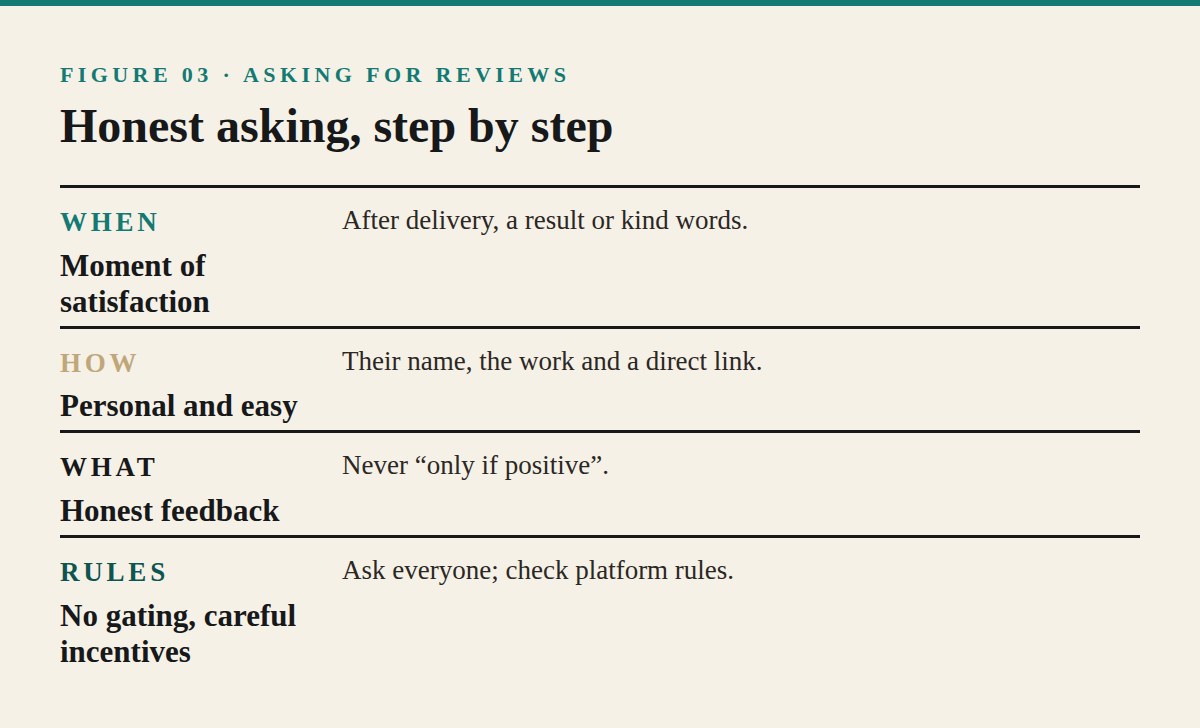
Asking well means choosing the right moment, making the process easy and respecting both customers and the rules.
Ask at the moment of satisfaction
The best time to ask is when customers have just experienced value: after successful delivery, a completed project, a positive comment or an achieved result. Asking too early, before value has been delivered, rarely works.
Make it personal
A personal request is more effective than a generic automated message. Use the customer's name, mention the work or product and explain briefly why reviews matter to your business.
For example: "It was a pleasure working on your garden. Reviews help other homeowners find us. If you have a minute, we would be grateful for your thoughts."
Make it easy
Provide a direct link to the review page. Remove unnecessary steps. The easier the process, the more likely customers are to complete it.
Ask for honest feedback
Ask customers to share their honest experience, not specifically a positive review. Honest requests build trust and comply with the rules of most platforms and many consumer protection laws.
Avoid selective asking
Some businesses ask only customers they believe are happy, a practice sometimes called review gating. Many platforms prohibit it, and in some places it may be considered misleading. Ask customers consistently, regardless of their expected opinion.
Be careful with incentives
Offering rewards in exchange for reviews is restricted or prohibited on many platforms and may require disclosure or be unlawful in some places. Rewards conditional on positive reviews are particularly problematic. Check the rules before offering any incentive.
Many platforms prohibit it, and in some places it may be considered misleading.
Follow up once
If a customer does not respond, one polite reminder is reasonable. Repeated requests can feel pushy and damage the relationship.
Build asking into your process
Add review requests to your standard processes: project completion emails, order follow-ups or final meetings. Consistency produces steady reviews over time rather than occasional bursts.
Thank reviewers
Thank customers who leave reviews, whether publicly through a response or privately. Appreciation encourages future engagement and shows prospective customers that you value feedback.
Common mistakes
Businesses often never ask, ask at the wrong moment, make reviewing difficult, ask only happy customers or offer incentives that breach platform rules. Others send repeated reminders. Consistent, honest and well-timed requests produce the best results.
An example in practice
A personal trainer received occasional reviews from enthusiastic clients. She added a simple step to her programme: after each client completed their first twelve weeks, she sent a personal message thanking them, mentioning their progress and including a direct review link with a request for honest feedback. Her reviews increased steadily, and prospective clients often mentioned them during consultations.
A simple review request template
A useful template: "Hi Elena, thank you for choosing us for your kitchen renovation. It was a pleasure working with you. Reviews help other homeowners find a builder they can trust, so if you have a couple of minutes, we would really value your honest thoughts here: [link]. Thank you either way." Personalise the first line every time.
Measuring your requests
Track how many review requests you send and how many reviews result. If the response rate is low, test a different moment, a shorter message or a more personal approach. Small changes to timing and wording often double the number of reviews received.
Asking in person
For businesses that meet customers face to face, a brief in-person request can be powerful: thank them, mention that reviews help others find you and offer a card or message with the direct link. Customers are often happy to agree when asked warmly at the end of a positive experience.
Platforms · 04 of 08
Choosing Review Platforms
Focus on the platforms your customers actually check before they decide.
Reviews can appear in many places: search engine business profiles, map listings, industry directories, marketplaces, social media pages, specialist review sites and your own website. Trying to build reviews everywhere spreads customer goodwill thin. Focusing on the platforms that matter most to your customers produces stronger results.
The right platforms depend on your industry, location and how customers research decisions.
Find out where customers look
Ask customers where they read reviews before choosing you. Search for your business and competitors to see which platforms appear most prominently. Notice which sites rank highly when people search for your type of service.
Local businesses
For businesses serving local customers, search engine business profiles and map listings are often the most influential. They appear prominently when people search for nearby services and frequently display ratings directly in results.
Industry-specific platforms
Many industries have specialist directories or review sites: hospitality, trades, healthcare, legal services, software and wedding services, among others. Customers in these industries often trust specialist platforms more than general ones.
Marketplaces
If you sell through online marketplaces, product reviews within those marketplaces strongly influence purchasing decisions. Follow each marketplace's rules carefully.
Your own website
Displaying testimonials and reviews on your website gives you control over presentation and allows you to place proof near important decisions. Use genuine, verifiable feedback and obtain permission where appropriate.
Focus on one or two main platforms
Choose one primary platform and perhaps one secondary platform. Direct review requests to these platforms consistently. A strong presence on the most important platform is more valuable than a few reviews scattered across many sites.
A strong presence on the most important platform is more valuable than a few reviews scattered across many sites.
Claim and maintain your profiles
Claim your business profiles on relevant platforms. Ensure details such as name, address, contact information, opening hours, services and photographs are accurate and consistent.
Inaccurate profiles create confusion and reduce trust.
Understand each platform's rules
Each platform has rules about requesting reviews, incentives, responses and business conduct. Read and follow them to avoid penalties or removal of reviews.
Monitor all relevant platforms
Even if you focus requests on one or two platforms, monitor others where customers might leave feedback. Respond where appropriate and keep information accurate.
Common mistakes
Businesses often spread review requests across too many platforms, neglect their main search profile, leave outdated information on listings or ignore platform rules. Others focus on platforms customers rarely use. A focused, well-maintained presence produces better results.
An example in practice
A wedding florist asked customers to leave reviews on several platforms and ended up with only a few reviews on each. After asking recent couples where they had researched suppliers, she discovered that most relied on a wedding directory and her local search profile. She directed all review requests to those two platforms and maintained both profiles carefully. Within a year, her reviews became a significant source of new enquiries.
Keeping profiles fresh
Profiles with recent photographs, current information and regular updates appear more trustworthy and are often shown more prominently. Add new photographs of your work every few months, update services and seasonal information, and answer questions customers post. A maintained profile signals an active, attentive business.
Encouraging reviews in the right place
Once you have chosen your main platform, make it the default destination in every review request. Include its direct link in emails, receipts, follow-up messages and printed cards where appropriate. Consistency concentrates reviews where they have the greatest influence on new customers.
Consistent details everywhere
Make sure your business name, address and phone number are identical across every platform and directory. Inconsistent details confuse customers and can reduce how prominently search engines display your business. A quick audit of your listings once or twice a year prevents these small but costly errors.
Responses · 05 of 08
Responding to Every Review
Every response is read by future customers. Reply as if they are watching, because they are.
Many businesses respond only to negative reviews, or not at all. Yet responses to reviews are read not only by the reviewer but by every prospective customer who visits your profile. Thoughtful responses show that the business listens, cares about customers and takes feedback seriously.
Responding consistently turns reviews into an ongoing demonstration of your service.
Respond to positive reviews
Thank customers who leave positive reviews. Personalise the response by mentioning a detail from their review or their project. A brief, warm reply shows appreciation and encourages others to leave feedback.
For example: "Thank you, Sarah. It was a pleasure helping you plan your new kitchen, and we're delighted the storage solutions are working so well."
Respond to mixed reviews
Mixed reviews often contain valuable feedback. Thank the customer, acknowledge what went well, address the concern and explain any improvements. A balanced response shows openness.
Respond promptly
Aim to respond within a few days. Prompt responses show attentiveness and allow you to address concerns before they escalate.
Keep responses professional
Even when a review feels unfair, respond calmly and professionally. Avoid sarcasm, defensiveness or arguments. Future customers judge the business by the tone of its responses.
Avoid sharing private information
Never disclose personal details, transaction information or sensitive data in public responses. Invite the customer to continue the conversation privately if details need discussing.
Avoid copying the same response
Repeating identical responses to every review appears automated and insincere. Use templates as a starting point, but personalise each reply.
Use responses to show improvement
When reviews highlight problems that have been fixed, mention the improvement briefly. This reassures future customers that feedback leads to action.
Use templates as a starting point, but personalise each reply.
Keep responses concise
Responses should be clear and brief. Long explanations can appear defensive. Address the main points and offer further contact where appropriate.
Assign responsibility
Decide who responds to reviews and how often reviews are checked. Clear responsibility ensures consistency.
Learn from patterns
Review feedback regularly to identify recurring praise and complaints. Use these patterns to improve products, services and communication.
Common mistakes
Businesses often ignore positive reviews, respond defensively to criticism, copy identical replies, reveal private information or wait weeks to respond. Others write long justifications. Prompt, personal and professional responses build trust.
An example in practice
A small guesthouse responded only to negative reviews and often defended itself at length. A new manager began replying to every review within two days: thanking guests personally for positive feedback, acknowledging concerns calmly and noting improvements where relevant. Future guests began mentioning the thoughtful responses, and the guesthouse's rating gradually improved.
A response template for each type
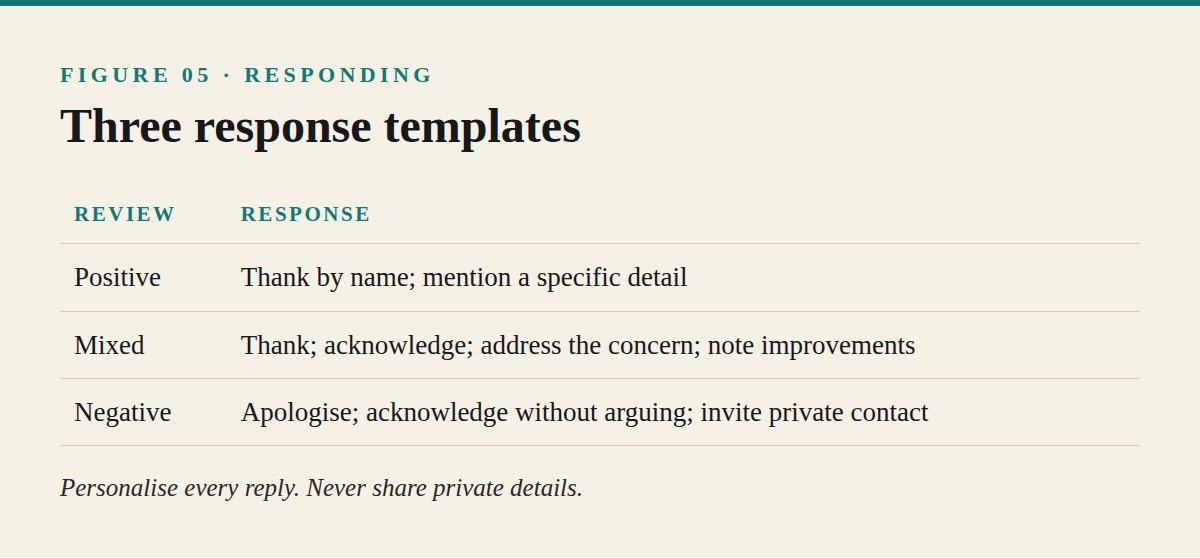
Prepare three short templates. Positive: thank the reviewer by name and mention a specific detail they appreciated. Mixed: thank them, acknowledge what went well, address the concern and mention any improvement. Negative: apologise for their experience, acknowledge the issue without arguing and invite them to continue privately. Personalise every response; templates provide structure, not the final words.
Responses as marketing
A well-written response is also an opportunity to reinforce what makes your business distinctive, without turning it into an advertisement. A brief mention of your care for detail, your guarantee or your local knowledge, where relevant, reminds prospective customers why others chose you.
Making responses a routine
Set a fixed time each week, or a quick daily check for busy businesses, to read and respond to new reviews. A short, regular routine prevents a backlog and ensures every reviewer receives a timely, considered reply.
Responding when you are unsure who the reviewer is
Sometimes you cannot identify a reviewer from your records. Respond politely, thank them for the feedback and invite them to contact you directly so you can understand what happened. Avoid suggesting they are not a real customer in public; a calm invitation protects your reputation either way.
Criticism · 06 of 08
When Feedback Turns Negative
A calm, honest response to criticism can build more trust than a perfect rating.
Negative reviews are inevitable for any active business. Even excellent businesses occasionally disappoint customers, face misunderstandings or encounter unreasonable expectations. A negative review can feel personal and frustrating, but how you respond often matters more than the review itself.
A thoughtful response can reassure future customers and sometimes even restore the relationship with the reviewer.
Pause before responding
Avoid responding immediately when emotions are high. Read the review carefully, gather facts and consider the customer's perspective. A calm response is always more effective than a defensive one.
Acknowledge the experience
Begin by acknowledging the customer's experience and thanking them for the feedback. For example: "Thank you for sharing your experience. We're sorry the delivery did not meet your expectations."
Acknowledgement shows respect, even if you disagree with some details.
Apologise where appropriate
If the business made a mistake, apologise sincerely and clearly. Avoid conditional apologies such as "We're sorry if you felt..." which can sound dismissive.
Explain briefly, without arguing
If context is helpful, explain briefly and factually. Avoid long justifications, blaming the customer or arguing publicly.
Offer to resolve the issue privately
Invite the customer to continue the conversation through a direct contact method. This allows you to discuss details, resolve problems and protect privacy.
Fix the underlying issue
Use negative feedback as an opportunity to improve. Investigate the cause and take action to prevent similar problems.
Invite the customer to continue the conversation through a direct contact method.
Update publicly where appropriate
If the issue is resolved, consider updating your response or encouraging the customer to share an update, if platform rules allow and the customer is willing.
Handle unfair or false reviews carefully
Some reviews may contain inaccurate information or violate platform policies. Respond factually and professionally. If a review breaches platform rules, use the platform's reporting process. Avoid public accusations.
Do not let one review define you
A single negative review among many positive ones rarely deters customers. In fact, a few critical reviews can make positive reviews appear more credible. Focus on the overall pattern of feedback.
Look for patterns
Repeated complaints about the same issue indicate a problem that needs attention. Address systemic issues rather than responding to each complaint individually.
Common mistakes
Businesses often respond defensively, argue publicly, ignore negative reviews or reveal private customer information. Others offer compensation publicly in ways that encourage further complaints. Calm acknowledgement, private resolution and genuine improvement are more effective.
An example in practice
A restaurant received a negative review complaining about slow service on a busy evening. The owner replied politely, acknowledged the delay, explained that staffing had been affected by illness and invited the guest to contact him directly. He also adjusted staffing procedures for busy nights. The guest later updated the review, praising the owner's response and the improved experience on a return visit.
A response structure for criticism
A reliable structure keeps negative responses calm: thank the reviewer; acknowledge their experience; apologise where appropriate; add brief, factual context only if it helps; mention any change made; and invite them to continue privately with a named contact. Keep it to four or five sentences. Shorter responses read as confident; long ones read as defensive.
Looking after yourself
Negative reviews can be upsetting, especially for founders who care deeply about their work. Give yourself time before responding, ask a trusted colleague to read your draft and remember that future customers judge the overall pattern of reviews, not a single comment.
When to report a review
Platforms usually allow businesses to report reviews that contain abuse, discriminatory language, conflicts of interest or content clearly unrelated to the business. Use these processes carefully and only for genuine breaches. Reporting reviews simply because they are critical rarely succeeds and can damage your credibility.
Proof · 07 of 08
Showcasing Reviews Well
Reviews are powerful proof. Place them where customers make decisions.
Many businesses collect positive reviews but leave them hidden on review platforms. Prospective customers may never see them unless they search actively. Showcasing reviews strategically turns customer feedback into persuasive proof throughout the buying process.
The key is relevance, honesty and placement.
Place reviews near decisions
Display reviews where customers are making decisions: beside pricing, on service pages, near booking buttons, in proposals and on checkout pages. Proof is most persuasive when it addresses concerns at the moment they arise.
Choose relevant reviews
Select reviews that relate to the page or offer. A review praising a website redesign is more useful on a website design page than on a general homepage.
Relevant reviews help prospects imagine similar results.
Use specific reviews
Specific reviews are more persuasive than general praise. Reviews mentioning results, timelines, communication or particular benefits provide stronger evidence.
Include names and context
Where permitted, include the customer's name, business or location. Context increases credibility. Always obtain permission where required and respect privacy.
Mix formats
Reviews can be shown as text quotes, star ratings, short video testimonials, screenshots from review platforms or case studies. Different formats suit different pages.
Keep reviews current
Recent reviews show that the business continues to deliver good experiences. Update showcased reviews regularly and remove outdated ones where appropriate.
Show ratings honestly
If you display ratings, ensure they are accurate and current. Do not selectively present information in a misleading way.
Do not selectively present information in a misleading way.
Use reviews in marketing
Share reviews in social media posts, emails, presentations and sales conversations. A relevant review can reinforce a message more effectively than your own claims.
Connect reviews to stories
Turn strong reviews into short case studies by adding context: the customer's challenge, your approach and the result. Stories make reviews more memorable.
Respect platform terms
Some review platforms have rules about how reviews can be reproduced or displayed. Check the terms before copying content or using platform logos.
Common mistakes
Businesses often hide reviews on separate testimonial pages, display generic praise, use outdated reviews or present ratings selectively. Others use reviews without permission or ignore platform rules. Relevant, specific and current reviews placed near decisions work best.
An example in practice
A small software company had excellent reviews on a software comparison site but displayed only a general testimonial page on its website. It added relevant reviews beside pricing plans, feature pages and the trial sign-up button, along with a short customer story on each service page. Trial sign-ups increased because prospects saw evidence at the moment they were deciding.
Matching reviews to pages
Create a simple table listing each important page on your website and the customer concern it must address: price, quality, speed, suitability or trust. Then choose one or two reviews that answer that concern directly. Updating this table every few months keeps your proof relevant and current.
Using reviews offline
Reviews can support offline sales too. Include a few relevant quotes in printed brochures, proposals and presentations, or display them in a physical location. A short line from a satisfied customer can reassure a prospect in a meeting just as effectively as on a website.
Asking permission gracefully
When you want to feature a review prominently, a short message asking permission is courteous and often appreciated. Customers usually feel proud to be featured, and the request itself strengthens the relationship.
Video testimonials
Short video testimonials can be especially convincing because viewers see and hear real customers. Keep them brief, natural and focused on one result or experience. A phone recording with good light and clear sound is often enough; authenticity matters more than production quality.
Protection · 08 of 08
Monitoring and Protecting Your Reputation
A short, regular routine catches problems early and keeps your reputation on course.

Reputation can change quickly. A series of negative reviews, an unresolved complaint, outdated business information or a public disagreement can affect how customers perceive your business. Regular monitoring helps you detect problems early, respond promptly and protect the reputation you have built.
Monitoring does not require complex tools. A simple routine is often enough.
Set a monitoring schedule
Check your main review platforms and online mentions regularly, such as weekly or monthly depending on your business volume. Busy businesses may need more frequent checks.
Use alerts
Many platforms provide notifications for new reviews. Search alerts can notify you when your business name appears online. Alerts help you respond quickly.
Track key metrics
Monitor indicators such as:
- Average rating.
- Number of reviews.
- Response rate.
- Response time.
- Recurring themes in feedback.
Tracking trends over time is more useful than focusing on individual reviews.
Keep business information accurate
Check that your business name, address, contact details, opening hours, services and photographs are accurate across platforms. Inaccurate information frustrates customers and can lead to negative reviews.
Watch for suspicious activity
Occasionally, businesses may receive fake reviews or reviews intended for another business. Use platform reporting processes where reviews violate policies. Avoid creating fake reviews for your own business, which can damage trust and may breach platform rules and the law.
Know the rules on fake reviews
Many jurisdictions and platforms prohibit fake reviews, paid positive reviews without disclosure and the suppression of negative reviews. Understand the rules that apply to your business and ensure everyone acting on your behalf follows them.
Many jurisdictions and platforms prohibit fake reviews, paid positive reviews without disclosure and the suppression of negative reviews.
Prepare a response plan
Write a short plan for handling reputation issues: who monitors reviews, who responds, how quickly responses are expected and when issues should be escalated. Preparation helps you act calmly under pressure.
Learn from feedback
Use monitoring to identify recurring problems and opportunities. Share insights with everyone involved in serving customers and track whether improvements reduce complaints.
Protect your reputation offline too
Reputation is also shaped by referrals, community involvement, supplier relationships and how you treat employees and partners. Consistent behaviour across all relationships strengthens reputation.
Review quarterly
Every quarter, review overall reputation trends, recurring themes, profile accuracy and progress on improvements. Use this review to plan actions for the next quarter.
Common mistakes
Businesses often check reviews only occasionally, ignore outdated profile information, react emotionally to criticism or attempt to manipulate reviews. Others monitor reviews but fail to act on recurring feedback. Regular monitoring combined with genuine improvement protects reputation best.
An example in practice
A small hotel checked its reviews only when guests mentioned them. After a run of complaints about noise from building work went unanswered for weeks, its rating fell. The manager introduced weekly monitoring, alerts for new reviews, prompt responses and a clear explanation of the temporary work on the booking page. Ratings recovered after the work finished, and guests appreciated the transparency.
A monthly reputation routine
A simple monthly routine takes less than an hour: read all new reviews; respond to any without replies; update your reputation snapshot with rating, volume and themes; check that business information is accurate on your main platforms; and choose one improvement based on recurring feedback. Recording each month's actions creates a clear history of how your reputation has been managed.
Closing Volume II
This issue completes Volume II. Reputation brings together everything covered in these twelve issues: a clear message, useful content, honest selling, careful advertising, a thoughtful experience and relationships that last. A strong reputation is not created by managing reviews alone; it is the visible result of serving customers well, consistently, over time.
Before you close this edition
Your Action Plan
Your next 30 days
Week 1: Review your reputation. Search for your business, read every review on the main platforms and note recurring themes.
Week 2: Respond. Reply thoughtfully to every recent review, positive and negative.
Week 3: Ask honestly. Add a simple review request to the moment customers are happiest, with a direct link.
Week 4: Showcase and monitor. Place your best reviews near your prices and calls to action, and set a monthly reputation check.
Thank you for reading Volume II
Volume III, Systems, Money & Leadership, continues the collection.
hustleinfluence.com
HUSTLE MAGHustle in Silence.