
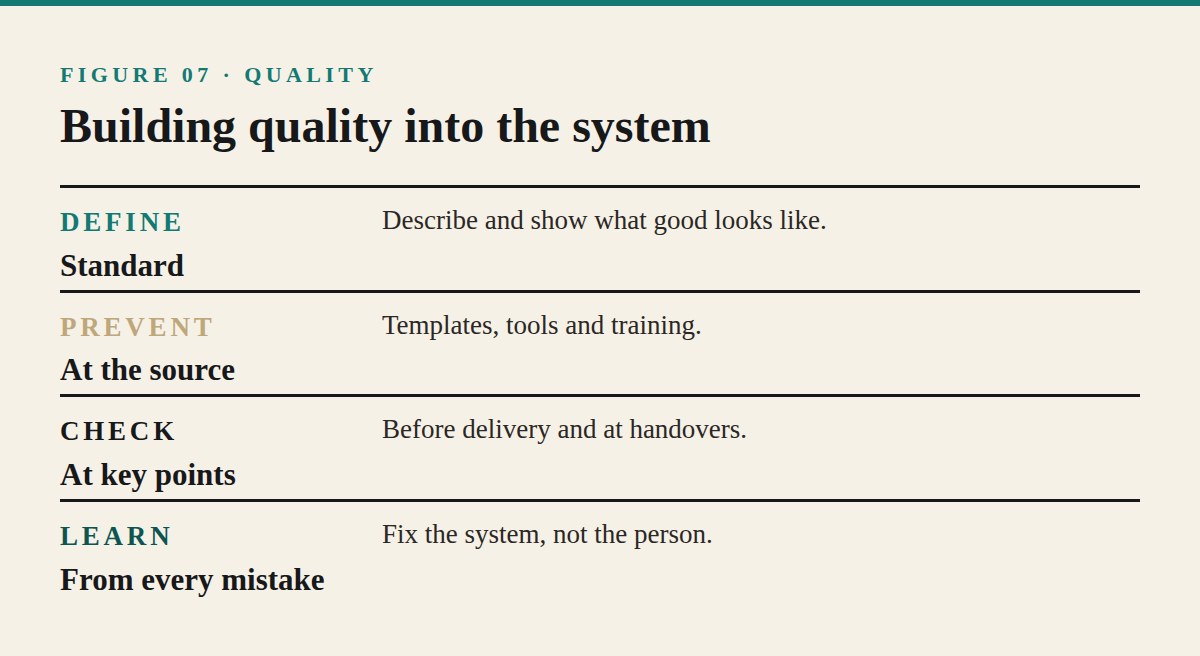
In many small businesses, quality depends on the founder checking everything personally. When the founder is busy or away, quality slips. As the business grows, this approach becomes impossible. Lasting quality comes from building standards and checks into the system itself, so good work is the normal outcome rather than the result of heroic effort.
Define what good looks like
Quality begins with a clear standard. For each core process, describe what a good result looks like: accuracy, completeness, presentation, timing and customer experience. Use examples where possible, such as a model report, a correctly packed order or a well-written client email.
People cannot meet a standard they have never seen.
Prevent errors at the source
The most effective quality systems prevent mistakes rather than catching them later. Clear procedures, templates, checklists, good tools and adequate training all reduce errors at the source. Ask where mistakes usually begin and redesign that step.
Build checks at the right points
Some checks are still necessary. Place them where errors are most costly or most likely: before delivery to a customer, before money is sent or received and at handovers between people. A short check at the right moment prevents much larger problems.
Use peer review
For important work, a second person can review before delivery. Peer review catches errors the original author misses and spreads knowledge across the team. Even a brief review against a checklist is valuable.
Measure quality
Track a few simple indicators: error rates, rework, customer complaints, refunds, returns and on-time delivery. These numbers show whether quality is improving or slipping, and help you see the effect of system changes.
These numbers show whether quality is improving or slipping, and help you see the effect of system changes.
Learn from every problem
When something goes wrong, look for the cause in the system rather than blaming the person. Was a step missing? Was the standard unclear? Was the tool unreliable? Fix the system so the same mistake is less likely to happen again.
Make quality everyone's responsibility
Encourage everyone involved to raise concerns, suggest improvements and stop work when something seems wrong. People closest to the work often notice problems first. A culture that welcomes these observations protects quality far better than inspection alone.
A practical tool: the quality standard sheet
For each core process, create a one-page sheet showing the standard: a description of a good result, an example, the three most common mistakes and how to avoid them, and the final check before delivery. Display or link these sheets wherever the work is done.
Questions after a mistake
After any significant mistake, ask four questions without blame: What happened? Why did the system allow it? What change would prevent it? How will we know the change worked? Recording the answers in a simple log turns mistakes into permanent improvements.
Common mistakes
Businesses often rely on the founder's final check, define standards vaguely, inspect too late or blame individuals instead of fixing systems. Others measure nothing, so quality changes go unnoticed. Clear standards, error prevention, well-placed checks and blame-free learning create reliable quality.
An example in practice
A small printing business received occasional complaints about colour mismatches and incorrect quantities. Instead of checking every job personally, the owner created a quality standard sheet for each product, introduced a pre-print checklist confirming file, colour profile and quantity, and added a quick peer check before dispatch. Complaints fell significantly, and the owner no longer needed to inspect every order.
Quality and speed
Many founders fear that quality systems will slow work down. In practice, well-designed systems usually speed it up, because less time is spent on rework, corrections and customer complaints. The few minutes spent on a checklist are almost always cheaper than fixing a mistake after it reaches the customer.