
Contents · Edition 028
Edition 028
From the Editors
There comes a moment in most growing businesses when the founder can no longer do everything. Work is turned away, quality slips under pressure, evenings disappear and the business is limited by the hours one person has in a day. The answer is help. The difficulty is knowing when, what kind and how to choose well.
Hiring is one of the most consequential decisions a small business makes. A good first hire can multiply capacity, bring skills the founder lacks and make the business more enjoyable to run. A poor choice can cost months of money, energy and confidence. The difference rarely comes down to luck. It comes down to preparation.
This issue walks through that preparation. We look at the signs that it is time to hire and how to define the role clearly. We consider the difference between employees and contractors, writing a job description, finding candidates and interviewing for the real work. We finish with onboarding and the first ninety days, where many hires succeed or fail.
Employment rules vary widely between countries, so treat this issue as general guidance and seek qualified advice where you operate. The principles of hiring well, however, are universal: clarity, fairness and genuine support.
The Editors, Hustle Mag
In This Edition
Hiring Your First Help
Freelancers, Contractors and First Hires: When and How
Hiring your first help is a turning point. It changes how the business works, how decisions are made and what the founder spends time on. Done well, it creates capacity and resilience. Done poorly, it creates cost and stress.
This issue guides the process from decision to settled team member. We begin with the signs that it is time to hire and defining the role, then compare employees and contractors. We cover job descriptions, finding candidates and interviewing, and finish with onboarding and the first ninety days.
Each article ends with one step towards a successful first hire. Employment rules differ by country; seek qualified advice for your situation.
Cover Story · 01 of 08
Signs It Is Time to Hire
Hire too early and costs outrun revenue. Hire too late and the business is limited by your hours.
Many founders hesitate to hire because it feels risky: a regular cost, legal responsibilities and the challenge of finding the right person. Others hire too early, adding costs before the business can support them. Knowing the signs that it is time to hire helps you make the decision with confidence rather than anxiety.
You regularly turn away work
If you often decline projects, delay enquiries or lose customers because you lack capacity, the business may be constrained by your time rather than by demand. Help could allow the business to serve more customers profitably.
Quality or service is slipping
When you are overloaded, details are missed, responses slow down and quality suffers. If customers begin to notice, it may be time to bring in help before reputation is affected.
You spend too much time on low-value tasks
Track how you spend a typical week. If many hours go to administration, scheduling, routine production or tasks others could do, your time may be better invested in sales, strategy, key client work or product development.
Work is predictable and recurring
Hiring is safer when the work is consistent. If certain tasks repeat every week or month, they may form the basis of a role. Irregular or unpredictable work may be better handled by freelancers.
Your systems are ready
Before hiring, it helps to have basic systems in place: documented processes, templates, clear standards and tools. A new team member can become productive much faster when the work is clearly defined.
Calculate the full cost of help, including pay, taxes, equipment, training and management time.
The numbers support it
Calculate the full cost of help, including pay, taxes, equipment, training and management time. Estimate how the hire will increase revenue, protect quality or free your time for higher-value work. If the numbers do not work yet, consider smaller steps such as part-time help or freelancers.
Start with flexible options
Many first hires begin as part-time roles, freelancers or contractors for specific tasks. Flexible arrangements allow you to test the need, the work and the working relationship before making a larger commitment.
A practical tool: the time audit
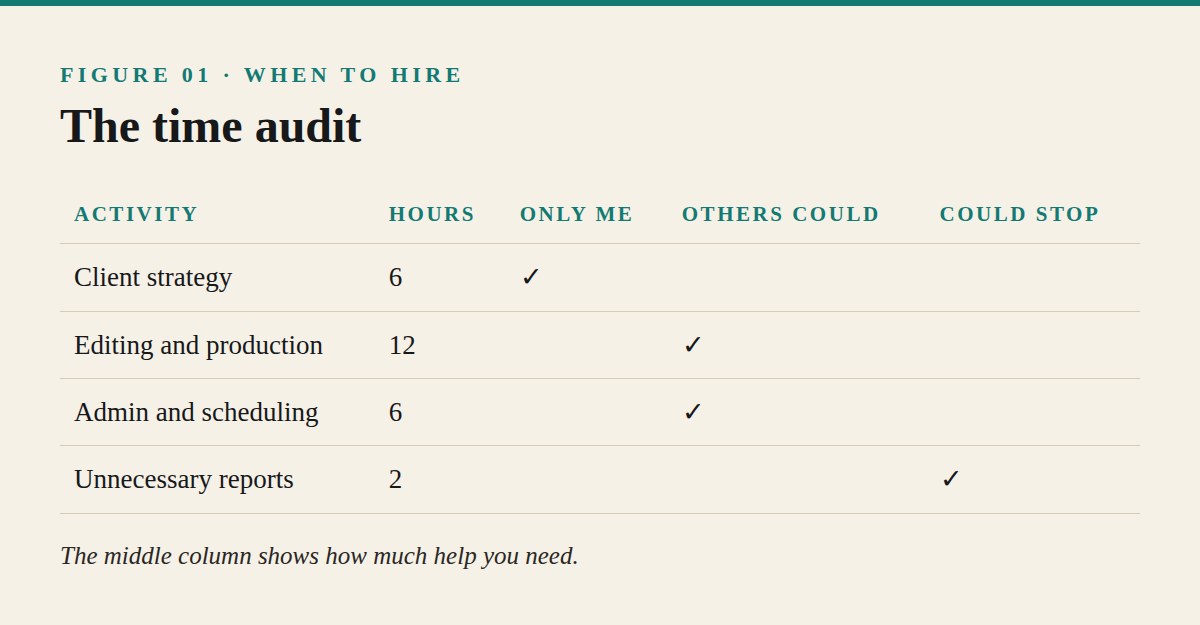
For one or two weeks, record every task you do in thirty-minute blocks. At the end, mark each task as something only you can do, something someone else could do with training or something that could be removed. The total hours in the second group show how much help you need, and what kind.
Questions before deciding
Ask: What would I do with ten extra hours a week? How much revenue could that time produce? Which tasks drain my energy most? Is the work consistent enough for a regular role? Do I have the cash to cover the cost for several months while the person settles in? Honest answers make the decision clearer.
Common mistakes
Founders often wait until they are exhausted, hire for tasks that are not yet clearly defined, underestimate the total cost or hire full-time when part-time help would suffice. Others hire to solve a problem that is really a pricing or systems issue. Evidence from a time audit and realistic numbers lead to better decisions.
An example in practice
A wedding photographer spent many evenings editing photographs and answering emails, leaving little time for marketing or rest. A time audit showed about fifteen hours a week of editing and administration that others could do. She hired a part-time editor on a trial basis, documented her editing style and later added a few hours of administrative support. Bookings increased because she had time for marketing, and her evenings returned.
Hiring and identity
For many founders, hiring changes their role from doing all the work to leading and organising it. This shift can feel uncomfortable at first. Accepting that your value increasingly lies in direction, quality and relationships, rather than in personally completing every task, is part of growing a business beyond yourself.
Planning · 02 of 08
Defining the Role
A clear role attracts the right people and makes success measurable from the first day.
Many first hires struggle not because the person is wrong, but because the role is unclear. The founder knows they need help but has not defined exactly what the person should achieve, which tasks they own and how success will be judged. Vague roles create confusion, frustration and disappointment on both sides.
Defining the role carefully before recruiting is one of the most valuable steps in hiring.
Start with outcomes
Begin by describing what the role should achieve, not just a list of tasks. For example: "Ensure every customer enquiry receives a helpful reply within one working day" or "Prepare accurate monthly reports for all clients by the fifth of each month."
Outcomes help the person understand why the work matters and how success is measured.
List responsibilities
Next, list the main responsibilities required to deliver those outcomes. Group related tasks together. Use your time audit to identify which tasks will move from you to the new person.
Define skills and qualities
Separate essential skills from desirable ones. Essential skills are required from the start; desirable skills can be developed later. Also consider personal qualities important for your business, such as reliability, attention to detail, communication or initiative.
Decide the scope and hours
Estimate how many hours the role requires each week and whether the work is regular or seasonal. Decide whether the role is part-time, full-time, temporary or project-based. Be realistic: a role that is too small may not attract committed candidates, while one that is too large may overwhelm them.
Clarify decision rights
Decide which decisions the person can make independently and which require approval. Clear decision rights reduce constant questions and build confidence.
Be realistic: a role that is too small may not attract committed candidates, while one that is too large may overwhelm them.
Set measures of success
Choose a few simple measures that show whether the role is succeeding: response times, accuracy, deadlines met, customer satisfaction or output. Share these measures from the beginning.
Consider growth
Think about how the role might evolve as the business grows. Explaining potential future responsibilities can attract candidates interested in developing with your business.
Check the budget
Calculate the full cost of the role, including pay, taxes, contributions, equipment, software and training. Ensure the role is financially sustainable for at least several months.
A practical tool: the role scorecard
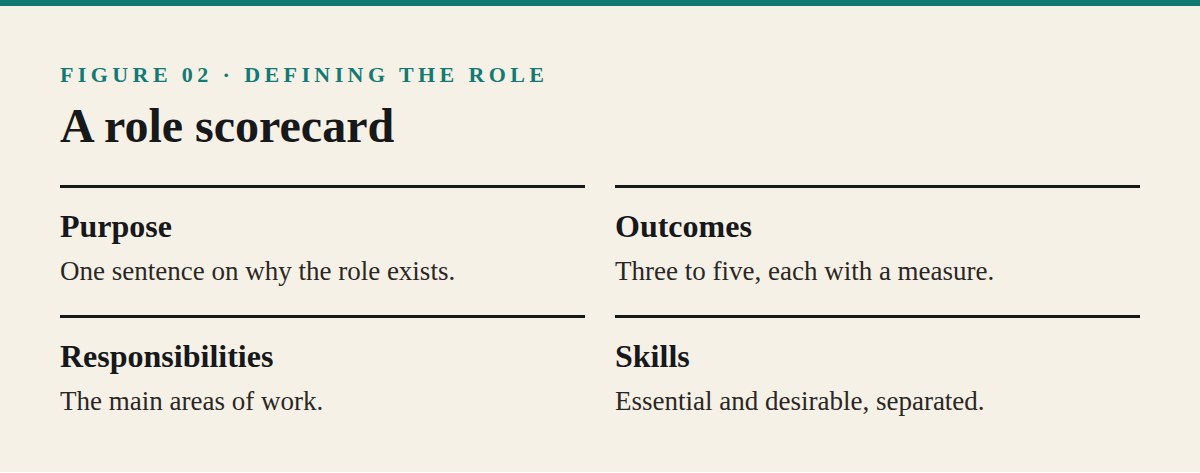
Write a one-page scorecard with four sections: the purpose of the role in one sentence, three to five outcomes with measures, the main responsibilities, and the essential and desirable skills. Use the scorecard to write the job description, guide interviews and review performance later.
Questions to sharpen the role
Ask: If this person succeeds, what will be different in six months? Which of my current tasks will they own completely? What will they need to decide alone? What would make this role frustrating for a capable person? Answering these questions often reveals gaps before they become problems.
Common mistakes
Founders often define roles too vaguely, combine unrelated tasks into one role, expect a single person to have every skill or forget to define decision rights. Others create roles without measuring success. A clear scorecard prevents most of these problems.
An example in practice
A small online shop owner hired an assistant to "help with everything". The assistant tried to respond to customers, manage social media and pack orders, but priorities were unclear and frustration grew. For the next hire, the owner wrote a role scorecard focused on order fulfilment and customer service, with clear outcomes and measures. The new team member became productive within weeks and stayed with the business for years.
Roles for part-time help
Part-time roles need especially clear boundaries. Define which days or hours the person works, which tasks must be completed within that time and how urgent issues are handled when they are not working. Clear boundaries help part-time team members succeed without feeling pressure to be constantly available.
Arrangements · 03 of 08
Employee or Contractor?
The right arrangement depends on the work, the relationship and the law where you operate.
When founders need help, they can usually choose between hiring an employee, engaging an independent contractor or freelancer, or using an agency. Each arrangement has different implications for flexibility, cost, control, responsibilities and legal obligations. Choosing correctly protects both the business and the people who work with it.
This article provides general information only. Employment and contractor rules vary significantly between countries and sometimes between regions. Seek qualified advice before deciding.
Employees
Employees usually work regularly for one business, follow its processes and schedules, and are integrated into the team. Employers typically have responsibilities such as payroll taxes, contributions, holiday pay, sick leave, workplace protections and written employment terms, depending on local law.
Employment can provide stability, loyalty and the chance to develop someone over time.
Contractors and freelancers
Independent contractors generally run their own businesses, choose how to perform the work, often serve several clients and provide their own equipment. They invoice for services rather than receiving wages.
Contractors can offer flexibility and specialist skills, especially for project-based or irregular work.
Agencies
Agencies can provide skilled people or complete services without the business managing individuals directly. They may cost more but can reduce administrative effort and provide additional expertise.
Classification matters
In many countries, whether someone is legally an employee or contractor depends on the actual working relationship, not just the contract title. Factors may include control over how work is done, working hours, exclusivity, equipment, financial risk and integration into the business.
Misclassifying an employee as a contractor can create legal and financial consequences. Seek professional advice when unsure.
Consider the nature of the work
Ongoing, regular work closely integrated into daily operations may suit employment. Specialist, project-based or occasional work may suit contractors. Consider how much control and flexibility you need.
Misclassifying an employee as a contractor can create legal and financial consequences.
Compare total costs
Employees may involve payroll taxes, benefits, equipment and training. Contractors may charge higher rates but often require less administration. Compare total costs over a realistic period, including management time.
Think about the relationship
Consider what kind of relationship you want. Employees may become long-term team members with growing responsibilities. Contractors may provide flexible expertise across several projects.
Document arrangements clearly
Whatever arrangement you choose, put terms in writing: responsibilities, pay, working arrangements, confidentiality, intellectual property and how the arrangement can end. Clear agreements prevent misunderstandings.
A practical tool: the arrangement comparison
Create a short table comparing employee, contractor and agency options for your role: expected cost over twelve months, flexibility, control over how work is done, administrative effort, legal obligations and long-term potential. Bring the table to a conversation with an accountant or employment adviser.
Questions for your adviser
Ask: Based on how this work will be done, how is the person likely to be classified here? What are my obligations as an employer? What must a contractor agreement include? How do intellectual property rights work for each arrangement? What records must I keep? Clear answers prevent costly mistakes.
Common mistakes
Businesses often choose arrangements based only on cost, call employees contractors without checking the rules, forget intellectual property terms or operate without written agreements. Others never review arrangements as roles evolve. Understanding local rules and documenting terms protects everyone.
An example in practice
A marketing consultant initially worked with a freelance designer on a project basis. As the designer became involved daily, followed fixed hours and worked only for the consultancy, the founder sought advice and learned the relationship might be treated as employment where she operated. She offered the designer a part-time employment contract, clarifying responsibilities and protections for both sides.
Recruiting · 04 of 08
Writing a Job Description That Attracts
A good job description attracts the right people and politely discourages the wrong ones.
A job description is often the first impression candidates have of your business. Many descriptions are long lists of duties and generic requirements that could apply to any company. They attract many unsuitable applicants and few excellent ones. A clear, honest and specific description helps the right people recognise that the role is for them.
Start with the purpose
Open with why the role exists and what it will achieve. For example: "You will make sure every customer receives fast, friendly support and help us keep our customers happy as we grow." A clear purpose helps candidates understand the importance of the role.
Describe your business honestly
Explain what the business does, who it serves and what makes it different. Share your values and working style. Small businesses can attract candidates who value variety, responsibility and close collaboration, so describe those benefits honestly.
Focus on outcomes and responsibilities
List the main outcomes and responsibilities from your role scorecard. Use clear language and avoid jargon. Candidates should understand what a typical week might look like.
Separate essential and desirable skills
List essential skills separately from desirable ones. Long lists of requirements can discourage capable candidates, particularly those who feel they must meet every item. Focus on what genuinely matters.
Be clear about practical details
Include working hours, location or remote arrangements, contract type, start date and, where appropriate, salary or pay range. Clear details save time for both you and candidates.
Include working hours, location or remote arrangements, contract type, start date and, where appropriate, salary or pay range.
Explain what you offer
Describe what the role offers: learning opportunities, flexibility, responsibility, a supportive team or the chance to grow with the business. Be truthful and avoid promises you cannot keep.
Use inclusive language
Write in a way that welcomes a broad range of suitable candidates. Avoid unnecessary requirements or language that could discourage people unfairly. Check that your description complies with applicable equality and employment rules.
Explain how to apply
State clearly how candidates should apply, what they should include and what the selection process involves. Consider asking a short, relevant question that shows how candidates think, rather than requesting lengthy documents.
A practical tool: the job description outline
Use a simple structure: about the business, the purpose of the role, what you will do, what success looks like, what you bring (essential and desirable), practical details, what we offer and how to apply. Keeping the same outline for future roles makes recruiting faster and more consistent.
Questions to test your description
Before publishing, ask someone who matches your ideal candidate to read it and answer: What would you be doing in a typical week? What would success look like after three months? Would you apply, and why or why not? Their answers reveal unclear sections and unrealistic expectations.
Common mistakes
Job descriptions often list too many requirements, focus only on duties, omit practical details, oversell the role or use vague phrases such as "fast-paced environment" without explanation. Others make the application process unnecessarily complicated. Clear, honest and specific descriptions attract better candidates.
An example in practice
A small accounting firm received dozens of unsuitable applications for an assistant role described with a long list of generic requirements. It rewrote the description around the role's purpose, three main outcomes, essential skills and clear practical details, including the pay range and hybrid working arrangement. Applications fell in number but rose in quality, and the firm hired an excellent candidate within a month.
Where the description appears
Remember that candidates may read your description on a phone, in a job listing or forwarded by a friend. Keep paragraphs short, put the most important information first and make sure the role title is clear and recognisable. A familiar title is easier to find than a creative one that candidates would never search for.
Recruiting · 05 of 08
Finding Good Candidates
The best candidates rarely come from one advertisement. Use several channels and your network.
Once the role and description are clear, the next challenge is reaching suitable candidates. Small businesses often post one job advertisement and wait. Sometimes this works; often it produces few suitable applicants. Using several channels, especially personal networks, usually produces better results.
Start with your network
Many successful small business hires come through recommendations: friends, former colleagues, customers, suppliers and partners. People who know your business can recommend candidates who fit both the role and the culture.
Share the role personally with people you trust and ask whether they know someone suitable.
Ask existing contacts
Former freelancers, interns or people who have previously expressed interest in working with you may be strong candidates. They may already understand your business and values.
Use relevant job platforms
General job sites reach large audiences, while specialist platforms reach people with particular skills. Choose platforms used by the type of candidate you need. For creative roles, portfolios and professional communities may be useful; for local roles, local job boards may work well.
Share through your own channels
Post the role on your website, social media and newsletter. Your audience already knows your business and may include suitable candidates or people who can share the role.
Consider education and training providers
Colleges, universities and training organisations can help connect businesses with students or graduates, particularly for entry-level, apprenticeship or part-time roles where available.
Look for evidence of skills
When reviewing applications, focus on evidence: portfolios, work samples, examples of achievements or answers to a relevant question. Evidence often tells you more than a polished CV.
For creative roles, portfolios and professional communities may be useful; for local roles, local job boards may work well.
Respond promptly
Good candidates may receive several opportunities. Acknowledge applications quickly and keep candidates informed about the next steps. A respectful process reflects well on your business, even for those you do not hire.
Keep a talent list
Some candidates may be excellent but not right for the current role. With permission, keep their details for future opportunities. A list of promising people can make future hiring much faster.
Treat candidates fairly
Use consistent criteria for evaluating candidates and follow applicable equality and employment rules. Fair processes help you choose the best person and protect your reputation.
A practical tool: the candidate tracker
Create a simple sheet with columns for name, source, date applied, key evidence, scores against your essential skills, stage and next action. Tracking candidates prevents anyone being forgotten, shows which channels produce the best applicants and supports fair, consistent decisions.
Questions to ask your network
When sharing the role, ask specific questions rather than general requests: "Do you know someone organised and friendly who enjoys customer service and wants part-time work?" Specific descriptions help people think of suitable candidates far more readily than "Know anyone looking for a job?"
Common mistakes
Businesses often rely on a single advertisement, ignore personal networks, judge candidates mainly on CVs, respond slowly or treat unsuccessful candidates poorly. Others evaluate candidates inconsistently. Multiple channels, evidence-based screening and respectful communication improve results.
An example in practice
A small interior design studio advertised a junior designer role on a large job site and received many unsuitable applications. The founder then shared the role with former tutors, industry contacts and the studio's newsletter, asking applicants to submit a short portfolio and answer one design question. The strongest candidate came through a recommendation from a former tutor and became a valuable long-term team member.
Timing your search
Recruiting usually takes longer than founders expect. Start the search well before the help becomes urgent, ideally several weeks ahead. Hiring under pressure often leads to compromises, while hiring with time allows you to wait for the right person.
Selection · 06 of 08
Interviewing for the Real Job
Conversations reveal personality. Real tasks reveal ability. Use both.

Interviews are often treated as conversations about a candidate's background and personality. These conversations matter, but they can be misleading. Some people interview brilliantly yet struggle with the actual work; others are less polished in interviews but excellent in practice. The best selection processes combine structured conversations with practical evidence of how candidates perform the real job.
Use the role scorecard
Base the interview on your role scorecard: the outcomes, responsibilities, essential skills and qualities. Prepare questions that explore each area. Using the same questions for all candidates makes comparisons fairer and more reliable.
Ask about past behaviour
Questions about how candidates handled real situations often reveal more than hypothetical questions. For example: "Tell me about a time you had to manage several urgent requests at once. What did you do?" Ask follow-up questions to understand their actions and results.
Use a practical task
Where appropriate, ask candidates to complete a short, relevant task: responding to a customer email, editing a document, solving a simple problem or reviewing a sample project. Practical tasks show how candidates think and work.
Keep tasks reasonable in length and respect candidates' time. For substantial work, consider paying for the task.
Explain the role honestly
Describe the real challenges and expectations of the role. Honest explanations help candidates decide whether the role suits them and reduce the risk of early disappointment.
Listen more than you talk
Give candidates time to explain their experience and ask questions. Their questions can reveal motivation, understanding and priorities.
Honest explanations help candidates decide whether the role suits them and reduce the risk of early disappointment.
Score candidates consistently
After each interview, score candidates against the same criteria before discussing them. Consistent scoring reduces the influence of first impressions and personal bias.
Check references thoughtfully
Speak with previous employers or clients where appropriate. Ask specific questions about reliability, quality of work, communication and areas for development.
Follow fair practices
Avoid questions that are unrelated to the role or may be discriminatory. Follow applicable employment and equality rules. Fair processes help you select the best person and treat candidates respectfully.
A practical tool: the interview scorecard
Create a sheet listing each essential skill and quality from the role scorecard, with one or two questions for each and a score from one to five. Add a section for the practical task and notes. Complete it immediately after each interview, before comparing candidates.
Questions worth asking
Useful questions include: "Walk me through how you would approach this task." "Tell me about a mistake you made at work and what you learned." "What kind of support helps you do your best work?" "What would you want to achieve in your first three months?" Each reveals how a candidate thinks, learns and works.
Common mistakes
Founders often rely on informal conversations, ask different questions of each candidate, hire based on personal chemistry alone, skip practical tasks or fail to check references. Others oversell the role. Structured questions, relevant tasks and consistent scoring lead to better decisions.
An example in practice
A small software company hired a support specialist based mainly on a friendly interview. The new hire struggled with written communication. For the next hire, the founder used a structured interview and asked finalists to reply to three realistic customer emails. One candidate who seemed quieter in conversation wrote outstanding responses and became the company's most valued support team member.
Making the final decision
When comparing finalists, return to the scorecard and the evidence. If two candidates score similarly, consider which one would be most likely to succeed in the first ninety days and grow with the business. Avoid choosing simply because someone is similar to you; complementary strengths often make a stronger team.
Onboarding · 07 of 08
Onboarding a New Team Member
The first weeks decide how quickly someone becomes productive, and whether they stay.

Many small businesses invest considerable effort in finding the right person, then provide little structure once they arrive. The new team member is introduced to a few tasks, given access to some systems and expected to learn as they go. Confusion, slow progress and early frustration often follow.
Thoughtful onboarding helps new team members feel welcome, understand their role and become productive faster.
Prepare before the first day
Before the new person starts, prepare equipment, accounts, access to tools, documentation, a schedule for the first days and any paperwork required. Arriving to a prepared environment signals that the business values them.
Welcome them personally
Spend time welcoming the new team member. Explain the business's purpose, customers, values and how their role contributes. A personal welcome builds connection and confidence.
Share the role scorecard
Review the role's purpose, outcomes, responsibilities and success measures together. Clear expectations help the new person focus on what matters most.
Introduce systems gradually
Walk through key processes using the documentation you have created. Start with the most important tasks and introduce additional responsibilities over time. Avoid overwhelming them with everything at once.
Give early tasks with clear outcomes
Provide meaningful tasks early, with clear instructions and achievable goals. Early successes build confidence and allow you to identify where additional support is needed.
Schedule regular check-ins
Plan frequent check-ins during the first weeks, perhaps daily at first and then weekly. Use these conversations to answer questions, review progress and identify problems early.
Plan frequent check-ins during the first weeks, perhaps daily at first and then weekly.
Encourage questions
Make it clear that questions are welcome. New team members may hesitate to ask, especially in small businesses where the founder seems busy. Encourage them to note questions and discuss them during check-ins.
Introduce people and partners
If the business works with partners, freelancers or key customers, introduce the new team member appropriately. Understanding relationships helps them work effectively.
A practical tool: the two-week onboarding plan
Write a simple plan showing what the new person will do each day of their first two weeks: introductions, systems to learn, documents to read, tasks to complete and check-in times. Share it before they start. A clear plan reduces anxiety and ensures nothing important is forgotten.
Questions for the first check-in
At the first week's end, ask: What has been clearer than expected? What has been confusing? Which documents or processes were missing or unclear? What would help you most next week? Use the answers to improve both the person's support and your onboarding plan for future hires.
Common mistakes
Businesses often fail to prepare equipment and access, overwhelm new team members with information, provide no clear early tasks, delay feedback or assume experienced hires need no onboarding. Others treat onboarding as paperwork rather than learning. Preparation, structure and regular support create better beginnings.
An example in practice
A small accounting practice often found that new staff took months to become confident. It created a two-week onboarding plan with daily objectives, documented procedures, a buddy for questions and daily check-ins during the first week. New team members began handling client work independently much sooner, and staff reported feeling far more supported.
Onboarding improves your systems
Every new team member is also a test of your systems. Their questions reveal undocumented steps, unclear procedures and missing templates. Keep a list of everything they ask during their first month, and use it to improve your documentation. Each hire should make the next onboarding easier.
Onboarding remote team members
Remote team members need extra attention during onboarding. Send equipment early, test access to every tool before the first day, schedule short video check-ins more frequently and introduce them to colleagues deliberately. Without the informal conversations of a shared office, structure and regular contact matter even more.
Development · 08 of 08
The First 90 Days
The first three months set expectations, habits and trust. Plan them deliberately.
The first ninety days are a crucial period for any new team member. During this time, they learn the role, understand expectations, build relationships and develop confidence. For the founder, it is an opportunity to confirm whether the hire is succeeding and to provide the support needed for long-term success.
A structured approach makes this period more productive for everyone.
Set goals for each month
Divide the first ninety days into three stages with clear goals:
- Month 1: learn the business, systems and core tasks.
- Month 2: take ownership of key responsibilities with support.
- Month 3: work independently and contribute improvements.
These stages provide direction and make progress visible.
Review progress regularly
Hold regular check-ins to review progress against the role scorecard and goals. Discuss what is going well, where support is needed and what should change.
Give specific feedback
Feedback is most useful when it is timely and specific. Acknowledge good work clearly and explain how improvements can be made when necessary. Avoid waiting until a formal review to raise concerns.
Encourage ownership
As confidence grows, gradually increase responsibility. Allow the team member to make more decisions within agreed boundaries. Ownership builds engagement and frees more of the founder's time.
Ask for their perspective
New team members often notice inefficiencies or opportunities that others overlook. Ask what they have learned, what could be improved and what support would help them perform better.
New team members often notice inefficiencies or opportunities that others overlook.
Address problems early
If concerns arise, discuss them early. Clarify expectations, identify causes and agree on actions. Many problems can be resolved through clearer instructions, additional training or adjusted priorities.
Confirm fit fairly
By the end of the first ninety days, both sides should have a clearer view of whether the role is working. If performance or fit remains a concern despite support, follow fair and lawful processes appropriate to your arrangement and location.
Celebrate milestones
Recognise progress and achievements. Celebrating milestones builds motivation and reinforces the value of the team member's contribution.
A practical tool: the 30-60-90 plan
Write a one-page plan with three columns, one for each month. In each, list the goals, responsibilities to take on, measures of success and support to be provided. Review it together at each monthly check-in and update it as the person progresses.
Questions for the ninety-day review
At the end of the period, discuss: What has gone well? Which outcomes have been achieved? Where is more support needed? What responsibilities should come next? What could the business do better for future hires? A thoughtful review sets the direction for the months ahead.
Common mistakes
Founders often provide little structure after onboarding, delay feedback, increase responsibilities too quickly or too slowly, or avoid difficult conversations until problems become serious. Others focus only on tasks and forget development. Clear goals, regular feedback and gradual ownership support long-term success.
An example in practice
A small e-commerce business hired an operations assistant and created a thirty-sixty-ninety-day plan. In the first month, the assistant learned order processing and customer service. In the second, she managed daily fulfilment independently. By the third month, she had improved the returns process and reduced shipping errors. The founder gained several hours each week and promoted her to operations coordinator within a year.
Your role as the founder
During the first ninety days, the founder's job shifts from doing the work to supporting someone else to do it well. This takes time and patience, but it is an investment. The hours spent explaining, reviewing and encouraging in these months are repaid many times over when the team member becomes fully independent.
Before you close this edition
Your Action Plan
Your next 30 days
Week 1: Decide what to hand over. Track your time for a week and list the tasks someone else could do.
Week 2: Define the role. Write the outcomes, responsibilities, skills and hours needed, and check employment rules where you operate.
Week 3: Recruit. Publish a clear description and approach people through your network.
Week 4: Prepare onboarding. Document the key processes and plan the new person's first two weeks before they start.
Keep learning
Hustle Influence offers practical online courses and AI tools that help you turn ideas into action.
hustleinfluence.com
General information only, not legal advice. Employment rules vary by country; consult a qualified adviser.
HUSTLE MAGHustle in Silence.