
Contents · Edition 035
Edition 035
From the Editors
Running a business means making decisions without enough information. Should we hire now or wait? Raise prices or hold them? Launch the new service, accept the large client, sign the lease, change the supplier? Rarely are all the facts available, and rarely is the right answer obvious. Yet the decisions must still be made.
Many founders respond in one of two ways. Some delay, waiting for certainty that never arrives while opportunities pass. Others decide on instinct alone and discover too late what a little thought would have revealed. Both approaches are understandable. Neither is necessary.
This issue offers a practical middle path. We look at deciding without all the facts and distinguishing reversible decisions from those that are hard to undo. We cover framing decisions well, gathering evidence through small tests and weighing options simply. We examine the thinking traps that mislead even experienced founders, the right speed for different decisions and how a decision journal turns experience into judgement.
Good decisions do not guarantee good outcomes; luck always plays a part. But good decision habits, repeated over years, tilt the odds steadily in your favour.
The Editors, Hustle Mag
In This Edition
Decisions Under Uncertainty
Making Good Decisions Without Perfect Information
Every important business decision involves uncertainty. The goal is not to eliminate uncertainty, which is impossible, but to decide well despite it: gathering enough information, considering the right options and acting at the right speed.
This issue builds practical decision habits. We begin with deciding without complete information and recognising reversible and irreversible choices. We cover framing decisions, using evidence and small tests, and weighing options. We finish with common thinking traps, decision speed and learning from past decisions.
Each article ends with one habit that improves the next decision you make.
Cover Story · 01 of 08
Deciding Without All the Facts
Waiting for certainty is itself a decision, and often an expensive one. Learn to decide with enough information.
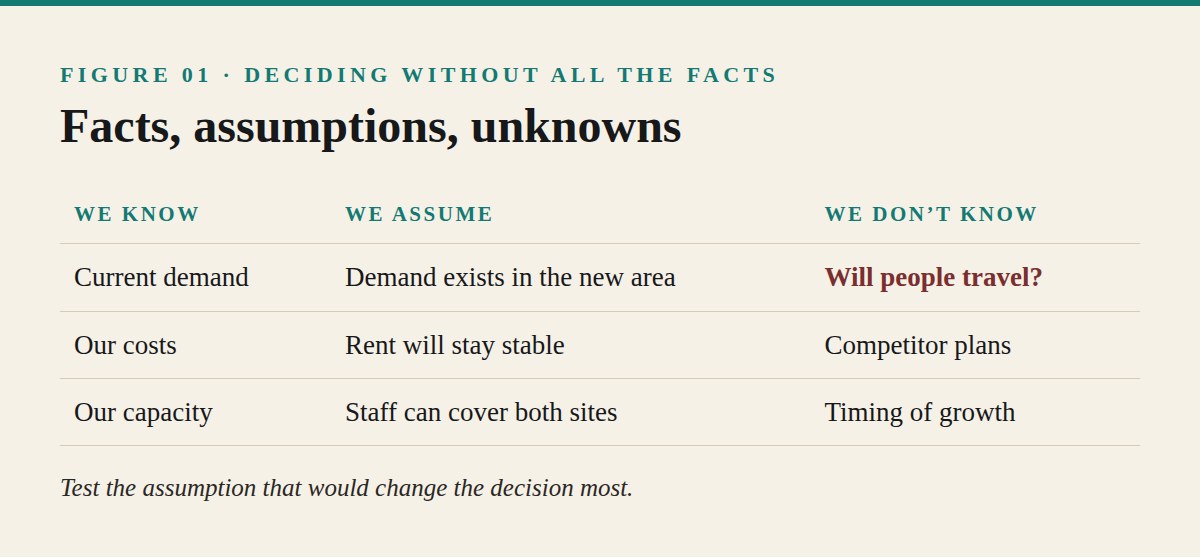
Founders face uncertainty constantly. Markets change, customers behave unpredictably, competitors appear and new opportunities rarely come with complete information. Many founders respond by delaying decisions until they feel certain. Unfortunately, certainty seldom arrives, and delay carries its own costs: missed opportunities, continued problems and lost momentum.
Good decision-makers do not wait for perfect information. They decide when they have enough.
Waiting has a cost
Every postponed decision has consequences. A delayed hire may mean overloaded staff and slower growth. A delayed price increase may mean months of lower profit. A delayed product change may allow competitors to move first. When considering whether to wait, ask what waiting will cost.
Define "enough information"
Before gathering information, decide what you actually need to know to make a reasonable choice. Identify the two or three uncertainties that matter most. Information beyond those points may feel reassuring but rarely changes the decision.
Separate facts, assumptions and unknowns
Write down what you know, what you are assuming and what remains unknown. This simple step clarifies thinking and shows where evidence is strongest and weakest. Often, founders discover that the decision rests on one or two key assumptions worth testing.
Accept that some uncertainty remains
No amount of research removes all uncertainty. Customers may still surprise you, and markets may still shift. Accepting this allows you to focus on making a sensible decision rather than a perfect one.
Consider the range of outcomes
Instead of predicting a single result, think about the best case, the most likely case and the worst case. Ask whether the business could survive the worst case and whether the most likely case justifies the decision.
Often, founders discover that the decision rests on one or two key assumptions worth testing.
Build in flexibility
When uncertainty is high, prefer choices that keep options open: shorter commitments, smaller initial investments, trials and staged approaches. Flexibility allows you to adjust as you learn more.
Set a decision date
Open-ended deliberation often leads to endless delay. Choose a date by which you will decide, and work towards it. A deadline focuses information-gathering on what matters.
Decide, then learn
Once a decision is made, observe the results and adjust when necessary. Treat decisions as part of a learning process rather than final verdicts on your judgement.
A practical tool: the facts and assumptions table
Draw three columns: what we know, what we assume and what we do not know. Fill them in for any significant decision. Circle the assumption that would change your decision most if it were wrong. Testing that single assumption is often the fastest route to a confident choice.
Questions to ask before deciding
Ask: What happens if I wait three months? What is the smallest commitment that would let me learn more? What would I need to see to change my mind? Could the business survive the worst realistic outcome? Am I gathering information to decide, or to avoid deciding? Honest answers reveal whether more research is useful or simply comfortable.
Common mistakes
Founders often delay decisions in search of certainty, gather information that does not affect the choice, confuse assumptions with facts or make large irreversible commitments when uncertainty is high. Others decide quickly without identifying key risks. Deciding with enough information, while preserving flexibility, produces better results.
An example in practice
A small fitness studio considered opening a second location for over a year, repeatedly postponing the decision. The founder finally listed facts, assumptions and unknowns, and identified one key uncertainty: whether there was enough demand in the new area. She ran a series of pop-up classes in a rented hall for two months. Attendance confirmed demand, and she signed a lease with confidence.
Decision Types · 02 of 08
Reversible or Irreversible?
Some decisions can be undone easily; others cannot. Treat them differently.

Not all decisions deserve the same level of analysis. Changing a newsletter format, testing a new social media post or adjusting a website headline can be reversed quickly if they do not work. Signing a long lease, taking on major debt, selling part of the business or making a key hire are much harder to undo.
Recognising the difference helps you decide quickly where speed matters and carefully where mistakes would be costly.
Reversible decisions
Reversible decisions can be changed with limited cost or consequence. Examples include testing prices on a new offer, adjusting marketing messages, trying a new tool on a monthly plan or changing a process.
For these decisions, speed often matters more than perfection. Making a reasonable choice, observing results and adjusting is usually better than prolonged analysis.
Irreversible decisions
Irreversible or hard-to-reverse decisions carry significant long-term consequences. Examples include long-term contracts, major investments, legal structures, partnerships, large loans or entering a new market with substantial upfront costs.
These decisions deserve careful preparation, consultation and consideration of risks.
Ask how difficult reversal would be
For each decision, ask: if this proves wrong, how easily could we undo it, and at what cost? Consider financial costs, time, reputation, relationships and legal obligations.
Turn irreversible decisions into reversible ones
Many decisions that seem irreversible can be structured to reduce commitment. For example, a trial period before hiring, a short initial lease, a pilot project before a full launch or a staged investment. Breaking large decisions into smaller steps reduces risk.
Delegate reversible decisions
Reversible decisions can often be delegated to team members with clear guidelines. This speeds up the business and frees the founder to focus on decisions with greater consequences.
Breaking large decisions into smaller steps reduces risk.
Avoid overthinking small decisions
Spending excessive time on easily reversible choices slows progress and drains energy. Set a time limit for minor decisions and move forward.
Take time for major decisions
For decisions that are difficult to reverse, slow down. Gather evidence, consider alternatives, consult trusted advisers and review risks carefully. Pressure to decide quickly should be examined critically.
A practical tool: the reversibility scale
Rate each decision from one to five, where one is easily reversed at little cost and five is very difficult or expensive to undo. Decisions scoring one or two can be made quickly or delegated. Decisions scoring four or five deserve a written analysis, a trusted second opinion and, ideally, a smaller first step.
Questions to classify a decision
Ask: What would it cost to undo this in six months? Who else would be affected if we reversed it? Are there contracts, legal obligations or reputational effects? Could we test this on a small scale first? The answers show whether to move fast or slow down.
Common mistakes
Founders often spend weeks analysing small reversible choices while rushing into major commitments. Others fail to look for ways to make large decisions more reversible. Matching effort to reversibility leads to faster progress and fewer costly mistakes.
An example in practice
An online shop owner spent several weeks debating which email newsletter design to use, while agreeing to a twelve-month warehouse contract after a single conversation. After a costly mistake with the warehouse, she began rating decisions by reversibility. Newsletter and marketing changes were tested quickly, while contracts and major purchases required written analysis and advice. Decisions became faster where it was safe and more careful where it mattered.
Speed as a competitive advantage
Small businesses can often move faster than larger competitors, because fewer approvals are needed. Using that speed for reversible decisions, testing ideas quickly, adjusting offers and trying new approaches, is one of the genuine advantages of being small. Reserve slow, careful thinking for the few decisions that are hard to undo.
Clarity · 03 of 08
Framing the Decision
The way you frame a decision shapes the options you see. A better question often leads to a better answer.
Many poor decisions begin with a poorly framed question. A founder might ask, "Should we hire a salesperson?" when the real question is, "How can we increase sales over the next year?" The first question offers only yes or no. The second opens many possible solutions: improving marketing, raising prices, partnering with others, refining the offer or hiring.
Framing the decision well expands options and improves outcomes.
Define the real goal
Start by asking what you are trying to achieve. What problem needs solving or opportunity needs pursuing? State the goal clearly, for example: "Reduce late deliveries" or "Increase monthly profit by ten percent."
The goal guides every other part of the decision.
Avoid yes-or-no framing
Questions that allow only yes or no limit creativity. Instead of "Should we launch this product?", ask "What is the best way to serve this customer need?" Broader framing reveals alternatives.
Generate at least three options
Before deciding, list at least three possible approaches. Include options that seem unconventional, smaller in scale or less expensive. Having several options improves the chance of finding the best one.
Include the option to do nothing
Sometimes the best decision is to wait, maintain the current approach or improve existing processes. Consider the consequences of doing nothing as a genuine option.
Clarify constraints
Identify constraints such as budget, time, people, legal requirements and capacity. Constraints help eliminate unrealistic options early.
Define success criteria
Decide how you will judge the options. Criteria might include cost, speed, risk, customer impact, profitability and alignment with long-term goals. Clear criteria make comparisons more objective.
Criteria might include cost, speed, risk, customer impact, profitability and alignment with long-term goals.
Identify what would change your mind
Ask what information or result would cause you to choose differently. This protects against holding onto a preferred option despite contrary evidence.
Involve others where appropriate
Team members, advisers and customers may see the problem differently. Their perspectives can reveal options and risks you have not considered.
A practical tool: the decision frame
Before any significant decision, write five lines: the goal, the constraints, at least three options including doing nothing, the criteria for choosing and what would change your mind. Keep it to one page. This frame often makes the right choice clearer before any detailed analysis begins.
Questions to improve framing
Ask: What problem are we really trying to solve? What would we do if our preferred option were impossible? What would a competitor or an outsider do? What is the smallest version of this decision? What would we regret not considering? These questions widen the view before narrowing it to a choice.
Common mistakes
Founders often frame decisions too narrowly, consider only one option, ignore constraints or fail to define success criteria. Others frame decisions around a preferred solution instead of the underlying goal. Clear framing leads to more creative and effective decisions.
An example in practice
A marketing agency founder debated whether to hire a second designer because projects were often delayed. When she reframed the question as "How can we deliver projects on time?", she identified other options: improving project scheduling, using freelance designers during peaks and reducing revisions through clearer briefs. She chose a combination of scheduling changes and freelance support, avoiding a permanent hire while solving the problem.
Framing as a team habit
Teams make better decisions when they share the same frame. Before discussing any significant choice in a meeting, write the goal and options where everyone can see them. Shared framing keeps conversations focused, prevents people from debating different questions and makes it easier to reach agreement.
Framing under time pressure
Even when a decision must be made quickly, a two-minute frame helps: state the goal, name two alternatives and note the main risk. This brief pause often prevents rushed choices that miss a simpler or safer option.
Evidence · 04 of 08
Evidence and Small Tests
When opinion and evidence disagree, evidence should usually win. Small tests create evidence quickly and cheaply.

Many business decisions are based on opinions: what the founder believes customers want, what competitors seem to be doing or what feels right. Opinions are useful starting points, but they can be wrong. Evidence reduces uncertainty by showing what actually happens.
Small tests allow businesses to gather evidence quickly, cheaply and with limited risk.
Identify the key uncertainty
Before testing, identify the assumption that matters most. For example, will customers pay a higher price? Will a new service attract enough demand? Will a process change reduce errors?
Focus testing on the uncertainty most likely to affect the decision.
Design a small test
A good test is small enough to run quickly but realistic enough to provide meaningful evidence. Examples include a pilot project, a limited-time offer, a trial with a small group of customers, a short advertising test or a process trial for one team.
Define success before testing
Decide in advance what result would support the decision and what result would suggest changing course. Clear success criteria prevent interpreting results based on hope.
Use existing data
Before creating a new test, review existing evidence: sales data, customer feedback, website analytics, previous projects or industry information. Existing data may answer the question without additional effort.
Talk to customers
Customer conversations can reveal needs, objections and preferences. Ask about past behaviour rather than hypothetical intentions. People are often better at describing what they have done than predicting what they will do.
People are often better at describing what they have done than predicting what they will do.
Measure carefully
Track relevant outcomes during the test: sales, sign-ups, costs, time saved, errors or satisfaction. Keep measurement simple and consistent.
Learn from unexpected results
Tests do not always confirm assumptions. Unexpected results provide valuable lessons and may reveal better opportunities.
Scale gradually
If a test succeeds, expand gradually. Larger rollouts may reveal new challenges that did not appear in the initial test.
A practical tool: the test card
Before each test, complete a card with five lines: the assumption being tested, the test itself, how long it will run, the measure of success and the decision you will make depending on the result. After the test, add the actual result and what you learned. A collection of test cards becomes a valuable record of evidence.
Questions before testing
Ask: What is the riskiest assumption in this decision? What is the cheapest way to learn whether it is true? How long will the test need to run for a meaningful result? What will we do if the result is ambiguous? Is the test realistic enough to reflect how customers or the team will really behave?
Common mistakes
Businesses often run tests without clear success criteria, rely on opinions instead of evidence, test too many variables at once or scale too quickly after limited success. Others ask customers hypothetical questions and treat the answers as reliable predictions. Clear, small and well-measured tests produce more useful evidence.
An example in practice
A small bakery considered adding a subscription service for weekly bread deliveries. Instead of investing in new equipment and marketing immediately, it offered the service to fifty existing customers for one month. Thirty-two signed up, and most renewed. Using this evidence, the bakery expanded the service gradually and adjusted delivery routes based on what it learned during the trial.
When testing is not possible
Some decisions cannot be tested in advance, such as signing a major contract or making a one-time investment. In these cases, look for indirect evidence: experiences of similar businesses, expert advice, historical data and small related experiments. Even partial evidence improves a decision compared with relying on opinion alone.
Analysis · 05 of 08
Weighing Options Simply
You do not need complex models to compare choices well. A few clear criteria and honest scores go a long way.
Once you have several options, the next challenge is choosing between them. Some founders rely entirely on intuition; others build complicated spreadsheets that take longer to create than the decision deserves. A simple, structured comparison usually provides enough clarity to make a confident choice.
Use clear criteria
Start with the criteria defined when framing the decision. Common criteria include cost, expected benefit, risk, speed, customer impact, effort required and alignment with long-term goals. Choose four to six criteria that matter most for this decision.
Weight what matters most
Not every criterion is equally important. Assign simple weights, such as one to three, to reflect importance. For example, customer impact might matter more than speed for a quality-focused business.
Score each option
Score each option against each criterion on a simple scale, such as one to five. Multiply scores by weights and total them. The result is not a perfect answer, but it reveals how options compare and where trade-offs lie.
Consider the range of outcomes
For important options, consider best, likely and worst outcomes. An option with a slightly lower expected benefit but much lower risk may be wiser than one with a high potential reward and a severe downside.
Estimate costs and benefits roughly
Where possible, estimate costs and benefits in money or time. Rough estimates are better than none. For example, an option costing €5,000 that saves ten hours a week may be easy to justify.
Look at the trade-offs
The scoring may show that each option has strengths and weaknesses. Discuss these trade-offs explicitly. Sometimes the best solution combines elements from several options.
Sometimes the best solution combines elements from several options.
Check your intuition
After scoring, notice your reaction. If the top-scoring option feels wrong, ask why. Intuition may be recognising a factor missing from the criteria, or it may reflect bias. Either way, the discussion improves the decision.
Keep it proportionate
Use simple comparisons for moderate decisions and more detailed analysis only for major, hard-to-reverse choices. The effort should match the stakes.
A practical tool: the weighted decision table
Create a table with options as columns and criteria as rows. Add a weight column, score each option from one to five, multiply and total. Add a final row noting the biggest risk of each option. This table takes fifteen minutes and makes reasoning visible, easy to discuss and easy to revisit later.
Questions while weighing
Ask: Which criterion would we be most upset to have ignored later? What is the worst realistic outcome of each option? Could we combine the best parts of two options? Does the highest score match what we would advise a friend to do? Would we still choose this if the cost were twenty percent higher?
Common mistakes
Founders often compare options against unclear or changing criteria, give equal weight to everything, ignore downside risks or build complex models for simple decisions. Others score options to justify a decision already made. Honest, simple comparisons lead to clearer and more defensible decisions.
An example in practice
A small software company needed to choose between three ways to improve customer support: hiring a support specialist, outsourcing support or building a self-service help centre. Using a weighted table with criteria for cost, customer satisfaction, speed and scalability, the founders found that the help centre scored highest overall but was slow to implement. They combined the help centre with temporary outsourced support, gaining both speed and long-term efficiency.
Making the reasoning visible
Writing down how you weighed options has a further benefit: it can be shared and challenged. Team members and advisers can see the reasoning, question assumptions and suggest missing criteria. Later, if the outcome is disappointing, the record helps you understand whether the reasoning or the circumstances were at fault.
When options are very close
If two options score almost equally, the difference may matter less than you think. Choose the more reversible option, the one that teaches you more or simply the one you can start sooner. Spending weeks on a near-tie usually costs more than either choice would.
Judgement · 06 of 08
Common Thinking Traps
Even experienced founders fall into predictable thinking traps. Knowing them is the first defence.

The human mind uses shortcuts to make decisions quickly. These shortcuts are often useful, but they can also lead to predictable errors, especially when decisions involve uncertainty, money or strong emotions. Experienced founders are not immune; confidence and past success can make some traps even more likely.
Recognising common thinking traps helps you pause and check your reasoning.
Confirmation bias
People tend to look for information that supports what they already believe and overlook evidence that contradicts it. A founder excited about a new product may notice positive feedback while dismissing warning signs.
To counter this, actively look for evidence that would prove your preferred option wrong.
Sunk cost thinking
Founders sometimes continue investing in a project because of the time or money already spent, even when evidence suggests stopping. Past investment cannot be recovered; decisions should focus on future costs and benefits.
Ask: if we were starting today, would we choose this?
Overconfidence
People often overestimate their knowledge and the accuracy of their predictions. Optimistic sales forecasts, short project timelines and underestimated costs are common results.
Use ranges instead of single estimates and compare forecasts with past performance.
Anchoring
The first number encountered can strongly influence later judgements. An initial price, budget or estimate may anchor discussions, even if it was arbitrary.
Develop your own estimates before hearing others' numbers where possible.
Recency bias
Recent events can feel more important than they are. A single bad month may cause unnecessary panic, while a strong recent result may create excessive optimism.
Look at longer-term trends before making significant decisions.
A single bad month may cause unnecessary panic, while a strong recent result may create excessive optimism.
Following the crowd
Seeing competitors adopt a strategy can create pressure to follow, even when it does not suit your business. Consider whether the strategy fits your customers, strengths and goals.
Loss aversion
People often fear losses more than they value equivalent gains. This can make founders avoid sensible risks or hold on to declining products.
Compare options based on expected outcomes rather than fear of loss alone.
Use simple safeguards
Practical safeguards include writing down assumptions, asking someone to argue the opposite view, consulting people outside the business, sleeping on important decisions and reviewing past forecasts.
A practical tool: the pre-mortem
Before committing to a major decision, imagine it is a year later and the decision has failed badly. Spend ten minutes writing all the reasons it might have failed. This simple exercise surfaces risks that optimism and confirmation bias usually hide, and often suggests precautions worth taking before you begin.
Questions to check your thinking
Ask: What evidence would prove me wrong, and have I looked for it? Would I make this choice if I had not already invested in it? Where did this number come from? Am I reacting to one recent event? Am I doing this because it fits us, or because others are doing it? Asking these questions regularly builds better judgement.
Common mistakes
Founders often assume they are immune to bias, rely heavily on recent events, continue failing projects because of past investment or seek only supportive opinions. Others make important decisions alone without challenge. Simple safeguards reduce the effect of predictable thinking errors.
An example in practice
A founder had spent eight months developing a new software feature that customers rarely used. She felt reluctant to stop because of the time already invested. During a pre-mortem and review with an adviser, she recognised sunk cost thinking and confirmation bias in her reasoning. The team paused the feature and redirected effort to improvements customers had requested repeatedly, which increased retention significantly.
Traps in teams
Groups have their own traps: people may agree with the founder to avoid conflict, or follow the most confident voice. Invite quieter team members to speak first and reward honest disagreement.
Timing · 07 of 08
Decision Speed
Slow decisions cost opportunities; rushed decisions cost mistakes. Match speed to the stakes.
The speed of decision-making affects every business. Decisions made too slowly can delay progress, frustrate teams and allow opportunities to pass. Decisions made too quickly can lead to avoidable mistakes. Effective founders adjust their decision speed to the importance, reversibility and urgency of each choice.
Recognise slow decisions
Slow decision-making often appears as repeated discussions, postponed choices, endless research or waiting for unanimous agreement. Teams may become uncertain and hesitant, and the founder can become a bottleneck.
Recognise rushed decisions
Rushed decisions often happen under pressure, excitement or fear. Warning signs include skipping basic research, ignoring risks, accepting artificial deadlines or committing large resources without considering alternatives.
Match speed to reversibility
Reversible, low-risk decisions can usually be made quickly and adjusted if necessary. Irreversible or high-impact decisions deserve more time and preparation.
Set decision deadlines
For important decisions, set a date by which the decision will be made. Deadlines encourage focused preparation and prevent open-ended delay.
Define decision rights
Clarify who makes which decisions. If every decision requires the founder, the business slows down. Delegating decisions within clear boundaries speeds up operations and develops the team.
Use a simple decision process
A consistent process helps decisions move efficiently: define the question, identify options, gather key evidence, consult the right people, decide and communicate the decision.
Once a decision is made, explain what was decided, why and what happens next.
Accept good enough
Many decisions do not require the perfect answer. A good decision made promptly is often better than a perfect decision made too late, especially when it can be adjusted later.
Communicate decisions clearly
Once a decision is made, explain what was decided, why and what happens next. Clear communication prevents confusion and repeated debate.
A practical tool: the decision speed guide
Create a simple guide with three categories. Quick decisions (reversible, low cost): decide within a day, often delegated. Considered decisions (moderate impact): decide within a week using a decision frame. Major decisions (hard to reverse, high impact): decide within a set period using full analysis and advice. Share the guide with your team so everyone knows how decisions are made.
Questions about decision speed
Ask: How many decisions are waiting on me right now? Which could someone else make? Which have I postponed more than twice? Am I being pressured to decide faster than this decision deserves? What would happen if we decided today with the information we already have? Answers reveal whether you are too slow, too fast or about right.
Common mistakes
Founders often delay decisions in search of certainty, make major decisions under pressure, keep all decisions centralised or reopen decisions repeatedly without new information. Others decide quickly but fail to communicate the outcome. Matching speed to the stakes and clarifying decision rights improves both speed and quality.
An example in practice
A small design agency's projects were frequently delayed because clients waited days for decisions on minor changes that only the founder could approve. She introduced a decision speed guide, allowing project managers to approve minor changes within agreed limits and reserving larger decisions for weekly review. Project timelines shortened, client satisfaction improved and the founder gained more time for strategic work.
Decisions and team confidence
When decisions are made promptly and explained clearly, teams gain confidence and momentum. When decisions are repeatedly delayed or reversed, people become hesitant and wait for instructions instead of acting. Consistent decision speed is therefore not only an efficiency matter; it shapes how confidently the whole team works.
Reopening decisions
Decisions should be revisited when new information appears, not simply because someone is uncomfortable with them. Agree a rule: a decision can be reopened if circumstances change significantly or evidence contradicts the original assumptions. This prevents endless debate while keeping the business able to correct genuine mistakes.
Learning · 08 of 08
Learning From Decisions
Experience becomes judgement only when you review your decisions honestly. A decision journal makes that possible.
Founders make hundreds of decisions each year, yet few systematically review them. As a result, the same mistakes are repeated, lucky outcomes are mistaken for good judgement and good decisions with unlucky outcomes are wrongly abandoned. Reviewing decisions turns experience into improved judgement.
A decision journal is one of the simplest tools for learning from experience.
Separate decision quality from outcome
A good decision can lead to a poor outcome because of luck or unforeseen events. A poor decision can lead to a good outcome by chance. Judging decisions only by outcomes can teach the wrong lessons.
Evaluate the quality of the reasoning, information and process at the time of the decision.
Record decisions as you make them
For significant decisions, write down the date, the decision, the options considered, the key information available, the reasoning, expected outcomes and how confident you feel. Recording these details at the time prevents hindsight from rewriting your memory.
Note your expectations
Write what you expect to happen and when. For example: "We expect the new service to attract ten clients within three months." Clear expectations make later reviews more objective.
Review regularly
Review past decisions after a set period, such as three or six months. Compare actual outcomes with expectations. Ask what went as expected, what surprised you and what you would do differently.
Look for patterns
Over time, a decision journal reveals patterns. Perhaps you consistently underestimate costs, overestimate demand or make better decisions when you consult others. These insights improve future decisions.
Ask what went as expected, what surprised you and what you would do differently.
Share lessons with the team
Discuss significant decisions and lessons learned with your team. Shared reflection builds collective judgement and encourages open discussion of mistakes.
Celebrate good process
Recognise decisions made with sound reasoning and good preparation, even when outcomes were disappointing. This encourages thoughtful decision-making rather than reckless risk-taking.
Update your methods
Use lessons from reviews to improve your decision process: adding new criteria, consulting different people, gathering better evidence or adjusting forecasts.
A practical tool: the decision journal page
Use a simple template for each significant decision: date, decision, options considered, key information, reasoning, expected outcome, confidence level and review date. At the review, add the actual outcome, what surprised you and the lesson learned. Ten minutes per decision builds a valuable personal record over the years.
Questions for decision reviews
Ask: Was the outcome mainly due to the decision or to circumstances? What information did we have, and what did we miss? Were our assumptions reasonable at the time? Did we consider the right options? What would we do differently with the same information? These questions separate luck from judgement.
Common mistakes
Founders often judge decisions only by outcomes, rely on memory instead of written records, review decisions only when things go wrong or fail to identify recurring patterns. Others avoid reviewing mistakes because it feels uncomfortable. Honest, regular reviews accelerate learning.
An example in practice
A small consultancy founder began recording major decisions, including pricing changes, hiring choices and new services. After a year of reviews, she noticed that her revenue forecasts were consistently thirty percent too optimistic, while decisions made after consulting her accountant tended to perform better. She adjusted her forecasting approach and made consultation a standard step for financial decisions.
The long-term value
A decision journal becomes more valuable each year. Patterns invisible in any single decision become clear across dozens: which advisers improve your thinking, which assumptions you repeatedly get wrong and which situations call for more caution. Over time, the journal becomes a personal guide to how you make your best decisions.
Before you close this edition
Your Action Plan
Your next 30 days
Week 1: List open decisions. Write down the decisions you are postponing and mark each as reversible or hard to reverse.
Week 2: Frame one properly. For the most important decision, define the real question, at least three options and what would change your mind.
Week 3: Test before committing. Design a small, inexpensive test that reduces your biggest uncertainty.
Week 4: Start a decision journal. Record your next three significant decisions, your reasoning and what you expect to happen.
Keep learning
Hustle Influence offers practical online courses and AI tools that help you turn ideas into action.
hustleinfluence.com
HUSTLE MAGHustle in Silence.