
Choosing a strategic partner is one of the most important decisions a business can make. A strong partner can accelerate growth and strengthen your reputation. A poor one can damage customer relationships, consume resources and create disputes. Because strategic partnerships involve deeper commitments, they deserve careful evaluation, often called due diligence.
Check strategic fit
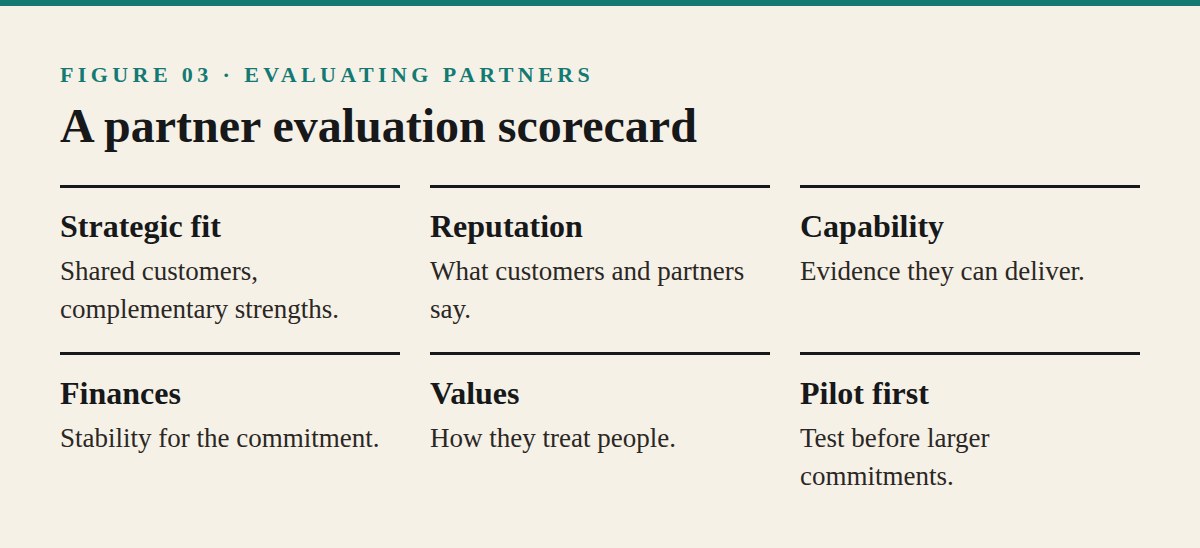
Begin by confirming that the partner's goals align with yours. Do you serve similar customers without competing directly? Do your strengths complement each other? Would the partnership support both businesses' long-term strategies? Misaligned goals often lead to conflict later.
Assess reputation
Research the partner's reputation with customers, suppliers, employees and other partners. Read reviews, speak with mutual contacts and ask for references from businesses that have worked with them. A partner's reputation will become partly yours.
Evaluate capabilities
Confirm that the partner can deliver what the partnership requires: production capacity, distribution reach, technical skills, customer service or financial resources. Ask for evidence rather than relying on claims.
Understand financial stability
For significant partnerships, understand the partner's financial health. A partner facing financial difficulties may struggle to meet commitments. Depending on the partnership, it may be appropriate to request financial information or seek professional advice.
Compare values and culture
Partners with different values regarding customer care, quality, ethics or communication may struggle to work together. Observe how the partner treats customers, staff and suppliers.
Observe how the partner treats customers, staff and suppliers.
Test with a pilot
Where possible, begin with a limited pilot: a small project, a single location or a trial period. A pilot reveals how the partner works in practice before larger commitments are made.
Clarify decision-makers
Understand who makes decisions in the partner organisation and who will manage the relationship day to day. Partnerships often struggle when the people who agreed the deal are not involved in delivering it.
Identify risks
List potential risks: dependence on the partner, reputational exposure, intellectual property concerns, financial risks and what happens if the partner is acquired or changes strategy. Plan how each risk would be managed.
A practical tool: the partner evaluation scorecard
Score each potential partner from one to five on strategic fit, reputation, capability, financial stability, values, communication and risk. Add notes and evidence for each score. Comparing partners side by side makes decisions more objective and highlights areas to investigate further before committing.
Questions to ask potential partners
Ask: Why do you want this partnership, and what does success look like for you? Who else have you partnered with, and how did it go? Who will manage our relationship? How do you handle disagreements? What would make you end a partnership? Their answers reveal priorities, experience and expectations.
References matter
Speak with at least two businesses that have worked with the partner. Ask what went well, what was difficult, how problems were handled and whether they would partner again. References often reveal more than any presentation or proposal.
Common mistakes
Founders often choose partners based on size or prestige, skip reference checks, ignore cultural differences, commit without a pilot or overlook financial stability. Others fail to identify who will manage the relationship. Careful evaluation reduces the risk of costly partnerships.
An example in practice
A small food producer was approached by a large distributor offering national reach. Before signing, the founder spoke with three other producers who worked with the distributor. Two reported late payments and pressure to reduce prices. She negotiated a six-month pilot in one region with clear payment terms. The pilot revealed similar issues, and she chose a smaller distributor with better reviews instead, achieving steady, profitable growth.