
Contents · Edition 040
Edition 040
From the Editors
In Volume II, we looked at referrals and simple partnerships: businesses recommending each other and promoting each other's work. This issue goes further, into strategic partnerships: deeper alliances that can open new markets, create new products, multiply distribution and build value that neither business could create alone.
Strategic partnerships can transform a small business. A distribution agreement can place a product in hundreds of new locations. A licensing deal can turn expertise into income without additional delivery effort. A joint venture can combine complementary strengths to serve customers neither partner could reach alone.
They also carry real risks. Larger commitments, shared customers, intellectual property and money create complexity, and partnerships that begin with enthusiasm can end in dispute. This issue explores how to pursue strategic partnerships wisely. We look at the main types, how to evaluate partners carefully and the specific opportunities in distribution, licensing and joint ventures. We cover structuring agreements, with the professional advice they deserve, and managing partnerships over many years.
The best strategic partnerships are built slowly, documented clearly and sustained by genuine mutual benefit.
The Editors, Hustle Mag
In This Edition
Strategic Partnerships
Alliances, Licensing and Collaborations That Create Long-Term Value
Strategic partnerships are deeper, longer-term collaborations between businesses: alliances that share customers, capabilities, intellectual property or investment. They can accelerate growth dramatically, but they require careful selection, clear agreements and ongoing management.
This issue explores strategic partnerships step by step. We start with how they differ from referral relationships and the main types available, then cover evaluating partners. We look at distribution partnerships, licensing and joint ventures, then structuring agreements and managing partnerships over years.
Each article ends with one step towards partnerships that create lasting value. Agreements of this kind deserve qualified legal and financial advice.
Cover Story · 01 of 08
Beyond Referrals
Strategic partnerships combine strengths to create value neither business could create alone.

Many small businesses build relationships with partners who refer customers or promote each other's work. These relationships are valuable, but they are usually informal and limited in scope. Strategic partnerships go further. They involve deeper collaboration, shared goals and often formal agreements that combine the strengths of two businesses to create significant long-term value.
What makes a partnership strategic
A strategic partnership typically has several characteristics. It supports a major business goal, such as entering a new market, developing a product or expanding distribution. It involves a meaningful commitment of time, resources or capabilities from both sides. It lasts for an extended period. And it creates value that neither business could easily achieve alone.
Why strategic partnerships matter
For small businesses, strategic partnerships can provide access to resources that would otherwise take years to build: established customer bases, distribution networks, technical capabilities, manufacturing capacity, brand credibility or specialist expertise. A well-chosen partner can accelerate growth while reducing the investment and risk of building everything independently.
Common goals
Strategic partnerships often pursue goals such as:
- Reach: accessing new customers, regions or channels.
- Capability: gaining skills, technology or capacity.
- Product: creating new offers together.
- Credibility: benefiting from a respected partner's reputation.
- Efficiency: sharing costs, facilities or resources.
Being clear about the goal guides every later decision.
Strategic partnerships carry more risk
Deeper collaboration brings greater exposure: shared customers, intellectual property, financial commitments and reputational links. If the partnership goes wrong, the consequences can be significant. Careful selection and clear agreements are essential.
Deeper collaboration brings greater exposure: shared customers, intellectual property, financial commitments and reputational links.
Start from your strategy
The best partnerships begin with your business strategy, not with an attractive invitation. Ask what your business needs to achieve over the next few years, and whether a partnership is the best way to achieve it compared with building the capability yourself or acquiring it in another way.
Build gradually
Strategic partnerships often begin as smaller collaborations: a referral relationship, a joint project or a pilot. Starting small allows both partners to build trust and test compatibility before larger commitments.
Think long term
Strategic partnerships may last for many years. Consider how each partner's goals might evolve, how the partnership will adapt and how it could end fairly if circumstances change.
A practical tool: the partnership purpose statement
Before approaching any strategic partner, write a short statement: the goal the partnership would achieve, why a partner is better than doing it alone, what you would contribute, what you need from the partner and how success would be measured after a year. If the statement is difficult to write, the partnership may not yet be strategic.
Questions to ask yourself
Ask: Which major goal could a partner help us reach faster? What strengths do we have that others would value? What would we be unwilling to share or risk? How much time could we realistically commit? Would we be comfortable being publicly associated with this partner for years?
Common mistakes
Founders often pursue partnerships because they sound impressive, commit before testing compatibility, underestimate the time required, overlook risks to reputation and intellectual property or enter partnerships without clear goals. Others treat strategic partnerships as informal arrangements. A clear purpose and gradual approach reduce risk.
An example in practice
A small company producing organic skincare struggled to reach customers outside its region. Instead of opening shops, it formed a strategic partnership with a regional chain of wellness centres, which stocked its products, trained staff to recommend them and co-created a treatment using the products. Both businesses benefited: the skincare company gained distribution and credibility, while the wellness centres gained a distinctive offer. The partnership began with a pilot in three locations before expanding.
Options · 02 of 08
Types of Strategic Partnership
Distribution, licensing, joint ventures and alliances each create value differently. Choose the form that fits your goal.
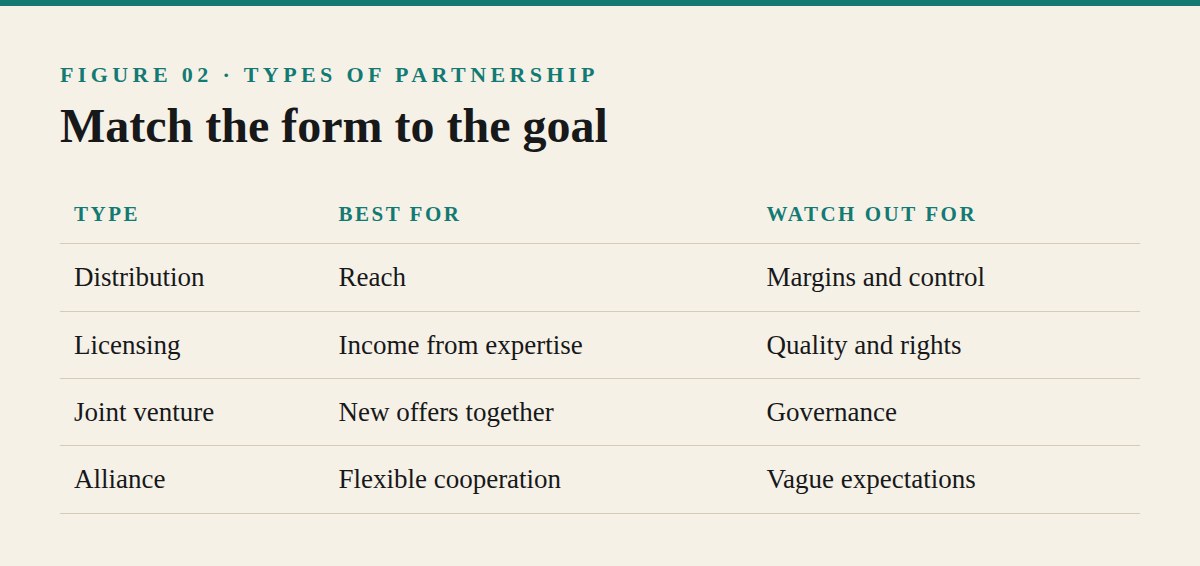
Strategic partnerships take many forms. Each type suits different goals, levels of commitment and risks. Understanding the options helps founders choose the arrangement that best fits their strategy and capacity, rather than defaulting to whatever a potential partner proposes.
Distribution partnerships
In a distribution partnership, another business sells or delivers your products or services to its customers. Examples include retailers stocking your products, platforms offering your service or wholesalers supplying your goods to other businesses. Distribution partnerships can expand reach quickly but often involve sharing margins and some loss of control over the customer experience.
Licensing arrangements
Licensing allows another business to use your intellectual property, such as content, designs, methods, software or brand, in exchange for fees or royalties. Licensing can generate income without additional delivery effort, but it requires clear agreements and careful protection of quality and rights.
Joint ventures
A joint venture combines resources from two or more businesses to pursue a specific project or create a new offer. The partners share investment, risk and reward. Joint ventures can be powerful but involve the greatest complexity and need clear governance.
Co-development partnerships
Partners may collaborate to develop a new product, service or technology. Each contributes expertise, resources or customer insight. Agreements must clarify ownership of what is created.
White-label arrangements
In white-label arrangements, one business produces a product or service that another sells under its own brand. This can provide additional revenue for the producer and a ready-made offer for the seller.
Each contributes expertise, resources or customer insight.
Strategic alliances
Some partnerships are less formal: businesses agree to cooperate in specific ways, such as joint marketing, shared events or coordinated services, without creating a new entity. Alliances are flexible but rely heavily on trust and clear expectations.
Supplier partnerships
Long-term partnerships with key suppliers can provide better terms, joint planning, product development and priority during shortages. These relationships go beyond transactions to shared success.
Match type to goal
Choose the form based on what you want to achieve. For reach, consider distribution. For income from expertise, consider licensing. For new products requiring combined strengths, consider co-development or joint ventures. For flexibility, consider alliances.
A practical tool: the partnership type comparison
Create a table with each partnership type as a row and columns for your goal fit, level of commitment, control over the customer experience, risk to intellectual property, potential income and complexity. Score each from one to five. The table helps you choose an appropriate form and discuss it clearly with potential partners.
Questions to choose a type
Ask: How much control do we need over how customers experience our product? How much risk can we accept? Do we want income, reach, capability or a new product? How long should the arrangement last? How easily could we exit if it does not work? The answers point towards the most suitable form.
Combining types
Partnerships often evolve from one type to another. A supplier partnership may lead to co-development, or a distribution arrangement may grow into a joint venture. Starting with a simpler form and deepening the relationship as trust grows is often wiser than beginning with the most complex arrangement.
Common mistakes
Businesses often accept the partnership type a partner proposes without considering alternatives, choose complex structures for simple goals, underestimate the loss of control in distribution deals or license intellectual property without protecting quality. Others choose informal alliances for arrangements that need formal agreements. Matching form to goal reduces risk.
An example in practice
A small software company that created scheduling tools for clinics received two proposals: one from a larger software provider wanting to buy a licence to include its tools, and another from a clinic association wanting to distribute it to members. After comparing the options, the founders chose the distribution partnership, which preserved their brand and customer relationships, and negotiated a limited licence for a specific feature with the larger provider.
Due Diligence · 03 of 08
Evaluating Partners Carefully
A strategic partner's reputation, finances and values become linked to yours. Look closely before committing.
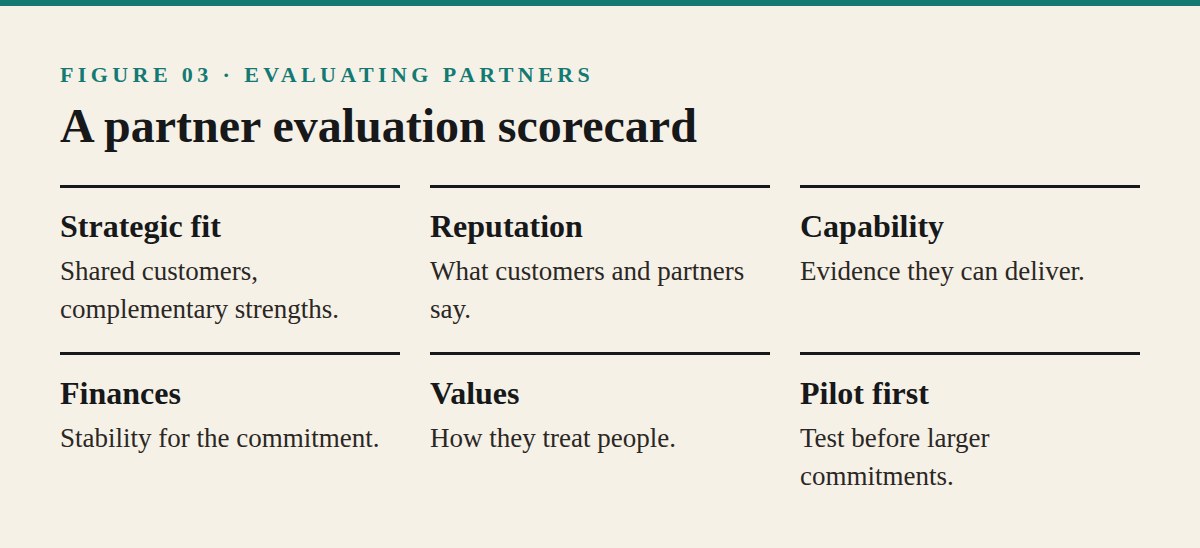
Choosing a strategic partner is one of the most important decisions a business can make. A strong partner can accelerate growth and strengthen your reputation. A poor one can damage customer relationships, consume resources and create disputes. Because strategic partnerships involve deeper commitments, they deserve careful evaluation, often called due diligence.
Check strategic fit
Begin by confirming that the partner's goals align with yours. Do you serve similar customers without competing directly? Do your strengths complement each other? Would the partnership support both businesses' long-term strategies? Misaligned goals often lead to conflict later.
Assess reputation
Research the partner's reputation with customers, suppliers, employees and other partners. Read reviews, speak with mutual contacts and ask for references from businesses that have worked with them. A partner's reputation will become partly yours.
Evaluate capabilities
Confirm that the partner can deliver what the partnership requires: production capacity, distribution reach, technical skills, customer service or financial resources. Ask for evidence rather than relying on claims.
Understand financial stability
For significant partnerships, understand the partner's financial health. A partner facing financial difficulties may struggle to meet commitments. Depending on the partnership, it may be appropriate to request financial information or seek professional advice.
Compare values and culture
Partners with different values regarding customer care, quality, ethics or communication may struggle to work together. Observe how the partner treats customers, staff and suppliers.
Observe how the partner treats customers, staff and suppliers.
Test with a pilot
Where possible, begin with a limited pilot: a small project, a single location or a trial period. A pilot reveals how the partner works in practice before larger commitments are made.
Clarify decision-makers
Understand who makes decisions in the partner organisation and who will manage the relationship day to day. Partnerships often struggle when the people who agreed the deal are not involved in delivering it.
Identify risks
List potential risks: dependence on the partner, reputational exposure, intellectual property concerns, financial risks and what happens if the partner is acquired or changes strategy. Plan how each risk would be managed.
A practical tool: the partner evaluation scorecard
Score each potential partner from one to five on strategic fit, reputation, capability, financial stability, values, communication and risk. Add notes and evidence for each score. Comparing partners side by side makes decisions more objective and highlights areas to investigate further before committing.
Questions to ask potential partners
Ask: Why do you want this partnership, and what does success look like for you? Who else have you partnered with, and how did it go? Who will manage our relationship? How do you handle disagreements? What would make you end a partnership? Their answers reveal priorities, experience and expectations.
References matter
Speak with at least two businesses that have worked with the partner. Ask what went well, what was difficult, how problems were handled and whether they would partner again. References often reveal more than any presentation or proposal.
Common mistakes
Founders often choose partners based on size or prestige, skip reference checks, ignore cultural differences, commit without a pilot or overlook financial stability. Others fail to identify who will manage the relationship. Careful evaluation reduces the risk of costly partnerships.
An example in practice
A small food producer was approached by a large distributor offering national reach. Before signing, the founder spoke with three other producers who worked with the distributor. Two reported late payments and pressure to reduce prices. She negotiated a six-month pilot in one region with clear payment terms. The pilot revealed similar issues, and she chose a smaller distributor with better reviews instead, achieving steady, profitable growth.
Reach · 04 of 08
Distribution Partnerships
The right distribution partner can put your offer in front of thousands of customers. Protect your margins and your brand.
Distribution partnerships allow other businesses to sell or deliver your products and services to their customers. Retailers, wholesalers, platforms, resellers, associations and complementary service providers can all act as distribution partners. For small businesses, these partnerships can provide reach that would otherwise require years of marketing effort.
Distribution also changes the economics and control of your business. Managed well, it accelerates growth; managed poorly, it erodes margins and brand.
Understand the partner's customers
The best distribution partners serve customers who closely match your ideal customers. Before agreeing, understand who buys from the partner, how they buy and why. A partner with a large audience that does not fit your offer will produce little.
Know your margins
Distribution partners typically take a share of the sale through discounts, commissions or wholesale pricing. Calculate whether your margins remain healthy after these costs, including marketing support, packaging, shipping and returns. Some businesses price differently for direct and distributed sales.
Protect the customer experience
When others sell your product, you lose some control over how customers experience it. Agree standards for presentation, product information, customer support and returns. Provide training and materials that help partners represent your offer accurately.
Avoid over-dependence
A single large distribution partner can become a significant share of revenue. If the partner changes terms or ends the relationship, the business may suffer. Maintain direct sales and diversify distribution where possible.
Agree clear terms
Distribution agreements should cover pricing, payment terms, exclusivity, territories, minimum orders, marketing responsibilities, returns, product changes and how the agreement can end. Seek legal advice for significant agreements.
Provide training and materials that help partners represent your offer accurately.
Consider exclusivity carefully
Partners may request exclusivity in a market or channel. Exclusivity can encourage commitment but may limit other opportunities. If granted, link it to performance targets and review periods.
Support your partners
Distribution works best when partners are equipped to sell: product training, marketing materials, sales support and responsive communication. Partners who understand your offer sell more of it.
Measure performance
Track sales, margins, returns, customer feedback and costs for each distribution partner. Review performance regularly and discuss improvements together.
A practical tool: the distribution economics sheet
For each potential partner, calculate the price the partner pays, your direct costs, any marketing or support costs, payment timing and resulting margin per unit. Compare with direct sales. The sheet shows whether distribution adds profitable growth or simply adds volume at an unacceptable margin.
Questions before agreeing
Ask: How many of the partner's customers match our ideal customer? What margin remains after all costs? What happens to customer service and returns? Is exclusivity requested, and is it linked to performance? What share of our revenue could this partner become, and is that safe?
Common mistakes
Businesses often accept distribution deals without calculating margins, grant exclusivity without performance conditions, become dependent on one partner, fail to train partners or lose control of product presentation. Others neglect direct sales entirely. Careful economics and clear terms make distribution profitable.
An example in practice
A small craft gin producer was offered a deal with a large supermarket chain. Its distribution economics sheet showed that after wholesale discounts, promotional requirements and delivery costs, margins would be very thin. The founder instead partnered with a group of independent bottle shops and restaurants, offering training and tasting events. Volume grew more slowly, but margins remained healthy and the brand's premium positioning was protected.
Starting with a trial
Where possible, begin distribution partnerships with a trial period or limited territory. A trial reveals real sales, costs and operational challenges before larger commitments, and it gives both partners time to build trust and refine how they work together.
Licensing · 05 of 08
Licensing Your Work
Expertise, content, designs and methods can earn income beyond your own delivery capacity, if rights and quality are protected.
Many small businesses own valuable intellectual property without realising it: training materials, courses, designs, photographs, software, methods, templates, recipes or a recognised brand. Licensing allows other businesses to use this intellectual property in exchange for fees or royalties. It can generate income without requiring additional delivery time, extending the reach of your expertise far beyond your own capacity.
This article provides general information. Licensing involves legal rights that vary by country; seek qualified legal advice before entering licensing agreements.
Identify what you could license
Review what your business has created: content, systems, designs, tools or methods that others might value. Consider which assets are distinctive, proven and useful to other businesses or markets you do not serve directly.
Understand ownership
Before licensing, confirm that your business owns the intellectual property or has the right to license it. Work created by employees, contractors or partners may involve different ownership rules. Clarify ownership in writing where necessary.
Choose the licensing model
Licences can take different forms: a one-time fee, recurring payments, royalties based on sales or usage, or a combination. Consider which model reflects the value of the asset and how the licensee will use it.
Define the scope
A licence should specify what can be used, how, where and for how long. Scope may include territories, industries, channels, formats and whether the licence is exclusive or non-exclusive. Narrow scope protects future opportunities.
Protect quality
When others use your methods, content or brand, their quality affects your reputation. Include standards, approval rights, training requirements or usage guidelines in the agreement.
Scope may include territories, industries, channels, formats and whether the licence is exclusive or non-exclusive.
Consider exclusivity carefully
Exclusive licences can command higher fees but prevent you from licensing to others in the same scope. Link exclusivity to performance targets and review periods where possible.
Monitor usage
Agree how usage will be reported and how payments will be calculated. Regular reporting allows you to verify that the licence is being used as agreed.
Plan for the end
Agreements should explain what happens when the licence ends: whether the licensee must stop using materials, how remaining stock or content is handled and how customers are transitioned.
A practical tool: the licensing opportunity list
List each asset your business has created, who might value it, how they would use it, the potential licensing model and the risks to your reputation or core business. Rank the assets by value and ease of licensing. Start with one well-defined asset and a single trusted licensee.
Questions before licensing
Ask: Do we clearly own this asset? Would licensing compete with our own sales? How will quality be protected? How will we know how much the licensee uses it? What happens if the licensee damages our reputation? Clear answers, confirmed with legal advice, protect both the asset and the business.
Licensing and your brand
Licensing a brand, rather than content or methods, carries particular reputational risk, because customers associate the licensee's behaviour with your name. Brand licensing usually requires stronger quality controls, approval rights and careful partner selection than licensing materials or tools.
Common mistakes
Businesses often license intellectual property without confirming ownership, grant broad or exclusive rights too cheaply, fail to protect quality, lack reporting arrangements or forget to plan for the end of the agreement. Others undervalue their assets. Clear scope, quality controls and legal advice make licensing a valuable source of income.
An example in practice
A small training company developed a successful workshop programme for customer service teams. Instead of hiring more trainers to expand nationally, it licensed the programme to two regional training providers. The licence included trainer certification, usage reports, quality reviews and a royalty on each workshop delivered. The company earned additional income while protecting the programme's standards and reputation.
Collaboration · 06 of 08
Joint Ventures and Co-Created Products
When two businesses combine complementary strengths, they can create offers neither could build alone.

Some opportunities require capabilities that no single small business possesses. A joint venture or co-development partnership allows two or more businesses to combine resources, expertise and customer access to create a new offer, enter a new market or pursue a specific project. These collaborations can be highly rewarding, but they require careful planning because partners share investment, risk and reward.
This article provides general information. Joint ventures can involve significant legal, tax and financial considerations; seek qualified advice before committing.
Start with a clear opportunity
Joint ventures should begin with a specific opportunity: a customer need, product idea or market neither partner can address effectively alone. Define the opportunity, the target customers and the expected outcome.
Combine complementary strengths
The best joint ventures combine different strengths: one partner may contribute technology, another distribution; one expertise, another production capacity. Partners with overlapping capabilities may compete rather than complement each other.
Define contributions
Agree what each partner will contribute: money, time, people, intellectual property, customer access, equipment or expertise. Clear contributions help determine fair ownership and profit sharing.
Agree how decisions are made
Joint ventures need clear governance. Decide who makes day-to-day decisions, which decisions require agreement from both partners and how disagreements will be resolved.
Share risks and rewards fairly
Agree how costs, revenue and profit will be shared and how losses will be handled. Fairness should reflect contributions and risks, not simply size or reputation.
Agree who owns them, who can use them and what happens if the partnership ends.
Clarify ownership of what is created
New products, designs, software or brands created together must have clearly defined ownership. Agree who owns them, who can use them and what happens if the partnership ends.
Start with a pilot
A small pilot project allows partners to test collaboration, customer demand and economics before larger investment.
Plan for different outcomes
Discuss what happens if the venture succeeds beyond expectations, struggles or needs to end. Plans for buyouts, exits or dissolution protect both partners.
A practical tool: the joint venture outline
Before formal negotiations, write a one-page outline: the opportunity, target customers, what each partner contributes, how decisions are made, how profits and losses are shared, who owns what is created, milestones for the pilot and how the venture could end. Discuss the outline with your partner and advisers before drafting a formal agreement.
Questions before forming a joint venture
Ask: Could either partner pursue this opportunity alone? What happens if one partner contributes less than expected? Who will lead the venture day to day? How will disagreements be resolved? What happens if one partner wants to leave or is acquired? Clear answers prevent many future disputes.
Keeping both businesses healthy
A joint venture should not weaken either partner's core business. Agree how much time and money each will commit, protect existing customers and review the venture's demands regularly. The most successful joint ventures strengthen both partners rather than drawing resources away from what already works.
Common mistakes
Partners often begin joint ventures with enthusiasm but vague agreements, overlook governance, assume ownership of new intellectual property, invest heavily before testing demand or fail to plan exits. Others choose partners with overlapping rather than complementary strengths. Clear contributions, governance and exit plans reduce risk.
An example in practice
A small fitness equipment designer and a physiotherapy clinic created a joint venture to develop a home rehabilitation kit. The designer contributed product development and manufacturing contacts, while the clinic contributed clinical expertise and patient feedback. They agreed ownership of the design, profit sharing, decision-making and a pilot with fifty patients. The pilot succeeded, and the product later became a significant source of revenue for both partners.
Agreements · 07 of 08
Structuring Strategic Agreements
Clear agreements protect relationships. The time to agree difficult details is while everyone is still enthusiastic.
Strategic partnerships often begin with shared enthusiasm and verbal agreements. As the partnership grows, unclear expectations about responsibilities, money, intellectual property or exits can create serious disputes. A well-structured written agreement protects both partners and the relationship itself.
This article provides general information, not legal advice. Strategic agreements can have significant legal, tax and financial consequences; consult qualified professionals before signing.
Begin with shared understanding
Before drafting any agreement, discuss the partnership in detail: goals, responsibilities, contributions, timelines and expectations. A shared understanding makes drafting faster and reduces later disagreements.
Define the purpose and scope
The agreement should state what the partnership aims to achieve and what activities it covers. Clear scope prevents disagreements about activities outside the partnership.
Set out responsibilities
Describe what each partner will do: marketing, delivery, customer support, development, sales or administration. Include service standards and timelines where relevant.
Clarify financial terms
Agree how revenue, costs, fees, commissions, royalties or profits will be calculated and paid. Define payment timing, reporting and how disputes about figures will be resolved.
Protect intellectual property
Specify who owns existing intellectual property, how each partner may use the other's assets and who owns anything created during the partnership.
Address confidentiality
Partners often share sensitive information: customer data, pricing, methods or plans. Confidentiality terms define how such information may be used and protected.
Define payment timing, reporting and how disputes about figures will be resolved.
Include performance measures
Agree how success will be measured and reviewed. Performance measures can support exclusivity, renewal or adjustments to terms.
Plan for problems and endings
Include processes for resolving disputes, handling breaches, changing terms and ending the partnership. Define notice periods, what happens to customers and shared assets, and any obligations that continue after the agreement ends.
Comply with relevant rules
Depending on the partnership, rules concerning data protection, competition, consumer protection and industry regulations may apply. Professional advice helps ensure compliance.
A practical tool: the agreement checklist
Before meeting a lawyer, prepare answers to ten questions: purpose, scope, each partner's responsibilities, financial terms, intellectual property, confidentiality, data handling, performance measures, dispute resolution and how the partnership ends. Arriving prepared reduces legal costs and ensures the agreement reflects what both partners actually intend.
Questions to test the agreement
Ask: What happens if one partner fails to deliver? If revenue is much higher or lower than expected? If one partner is acquired? If customers are unhappy with the other partner's work? If we want to end the partnership in two years? An agreement that answers these questions clearly is far less likely to lead to dispute.
Reviewing agreements over time
Strategic partnerships evolve, and agreements should evolve with them. Schedule periodic reviews of key terms, especially as volumes grow, new products are added or circumstances change. Updating terms by agreement is far easier than resolving disputes about arrangements that no longer reflect reality.
Common mistakes
Partners often rely on verbal promises, leave financial or intellectual property terms unclear, overlook data protection, avoid discussing exits or sign agreements without professional advice. Others copy templates that do not fit their partnership. Thoughtful, well-advised agreements protect relationships and value.
An example in practice
Two small businesses, a software developer and a marketing agency, co-created a platform for local retailers. They initially worked under an informal arrangement. As revenue grew, disagreements arose over ownership and profit sharing. With legal advice, they formalised an agreement defining ownership of the platform, revenue split, responsibilities, decision-making and exit terms. The partnership continued successfully, and later expansion was much easier to negotiate.
Keeping the agreement accessible
Once signed, make sure the people managing the partnership know the key terms: responsibilities, deadlines, reporting and payment arrangements. A short summary of the agreement, shared with relationship owners, prevents misunderstandings far more effectively than a long document stored away and forgotten.
Management · 08 of 08
Managing Partnerships Over Years
Signing the agreement is the beginning, not the end. Long-term partnerships need regular attention, honest conversation and shared wins.
Many strategic partnerships begin with enthusiasm but gradually lose momentum. Contacts change, priorities shift, communication becomes irregular and small frustrations accumulate. Partnerships that succeed over many years are managed deliberately: they have clear owners, regular reviews, honest communication and continued mutual benefit.
Assign relationship owners
Each partner should name a person responsible for managing the partnership day to day. Relationship owners coordinate activities, monitor performance and address issues promptly. When owners change, plan a proper handover.
Hold regular reviews
Schedule regular reviews, perhaps monthly at first and quarterly later. Review performance against agreed measures, discuss challenges and identify opportunities. Regular reviews prevent problems from growing unnoticed.
Share information openly
Partnerships work best when both sides share relevant information: customer feedback, performance data, market changes and plans. Openness builds trust and supports better decisions.
Address issues early
Small problems, such as late payments, missed commitments or quality concerns, should be raised promptly and constructively. Delays often turn manageable issues into serious disputes.
Celebrate shared success
Recognise achievements together: milestones reached, customer successes and growth in results. Shared celebrations strengthen relationships and reinforce the value of the partnership.
Keep creating mutual value
Partnerships remain strong when both sides continue to benefit. Look for new ways to support each other, improve results and adapt to changing circumstances.
Partnerships remain strong when both sides continue to benefit.
Review the agreement periodically
As the partnership evolves, review whether the agreement still reflects reality. Update terms by mutual agreement when responsibilities, volumes or goals change.
Know when to change or end
Not every partnership lasts forever. If goals diverge or the partnership no longer creates value, discuss changes openly. If ending is necessary, follow the agreed process, protect customers and preserve goodwill where possible.
A practical tool: the partnership health check
Every quarter, score the partnership from one to five on results against goals, communication, trust, fairness of value, ease of working together and future potential. Ask your partner to score it too, then compare. Differences in scores often reveal concerns that would otherwise remain unspoken.
Questions for partnership reviews
Ask: Are we achieving what we set out to achieve? Is the value fair for both sides? What has frustrated either of us recently? What has changed in our businesses or markets? What new opportunity could we pursue together? Regular, honest conversations keep partnerships healthy.
Closing thought on partnerships
Strategic partnerships are among the most powerful tools a small business can use to grow beyond its own resources. Their strength comes from careful choice, clear agreement and steady care over time. Treated as long-term relationships rather than transactions, they can become lasting sources of growth and resilience.
Common mistakes
Partners often stop communicating after signing, fail to assign owners, avoid raising issues, never review agreements or continue partnerships long after they stop creating value. Others focus only on their own benefit. Deliberate management keeps partnerships productive and fair.
An example in practice
A small coffee roaster supplied a regional café chain for several years, but communication had become irregular and the chain began trialling another supplier. The roaster introduced quarterly reviews with the chain's operations manager, shared sales data and customer feedback, and proposed seasonal blends developed together. The relationship strengthened, and the chain expanded the partnership to new locations.
When people change
Partnerships often weaken when the people who built them move on. When a relationship owner changes on either side, arrange a proper introduction, share the history and the agreement summary, and hold an early review together. Continuity of understanding matters as much as continuity of contract.
Growing the partnership
Successful partnerships often have room to grow: new products, new territories, deeper integration or shared investment. Discuss growth opportunities during reviews, test them with small pilots and update agreements as the partnership expands. Growth built on proven trust is usually far safer than growth agreed at the start.
Before you close this edition
Your Action Plan
Your next 30 days
Week 1: Define the goal. Decide what a strategic partnership should achieve: reach, capability, product or investment.
Week 2: Shortlist partners. Identify five potential partners whose strengths complement yours and research their reputation.
Week 3: Start a conversation. Approach one partner with a specific, mutually beneficial idea and a small first step.
Week 4: Plan the agreement. List the key terms to agree and arrange qualified advice before committing.
Keep learning
Hustle Influence offers practical online courses and AI tools that help you turn ideas into action.
hustleinfluence.com
General information only, not legal advice. Consult qualified advisers before entering partnership agreements.
HUSTLE MAGHustle in Silence.