
Contents · Edition 042
Edition 042
From the Editors
Many founders build businesses that earn good incomes, yet reach middle age with surprisingly little personal security. The business absorbed every spare euro. Savings were postponed until the business was more established. Personal finances were managed in whatever time remained after work, which was usually none.
A business can be the engine of long-term wealth, but income alone is not wealth. Wealth is what remains and grows after income has been earned: savings, assets and security that do not depend on working every day. Turning business income into lasting security requires deliberate habits, patience and, for most people, good professional advice.
This issue explores educational principles for that journey. We look at the difference between income and wealth, paying yourself and saving consistently, building financial security first and avoiding debt traps. We discuss the principle of not keeping everything in one basket, thinking in decades, protecting what you build and the often-overlooked question of how much is enough.
Please read this issue as general education, not personal financial advice. We do not recommend any specific investment, product or strategy. Financial decisions depend on your circumstances, country and goals, and deserve the guidance of a qualified, independent adviser.
The Editors, Hustle Mag
In This Edition
Building Long-Term Wealth
Educational Principles for Turning Business Income Into Lasting Security
Long-term wealth for most founders comes not from a single big win but from steady habits: paying themselves fairly, saving consistently, avoiding costly debt, spreading risk and protecting what they build over many years.
This issue explains these principles in general terms. We begin with the difference between income and wealth and the habit of paying yourself and saving. We cover financial security, avoiding debt traps, diversification, long-term thinking, protection and defining what is enough.
Each article ends with one step towards greater personal security. This issue is educational only and is not financial advice; consult a qualified, independent adviser for decisions about your own finances.
Cover Story · 01 of 08
Income Is Not Wealth
A business can produce a good income for years without creating lasting security. Wealth is what you keep and build.
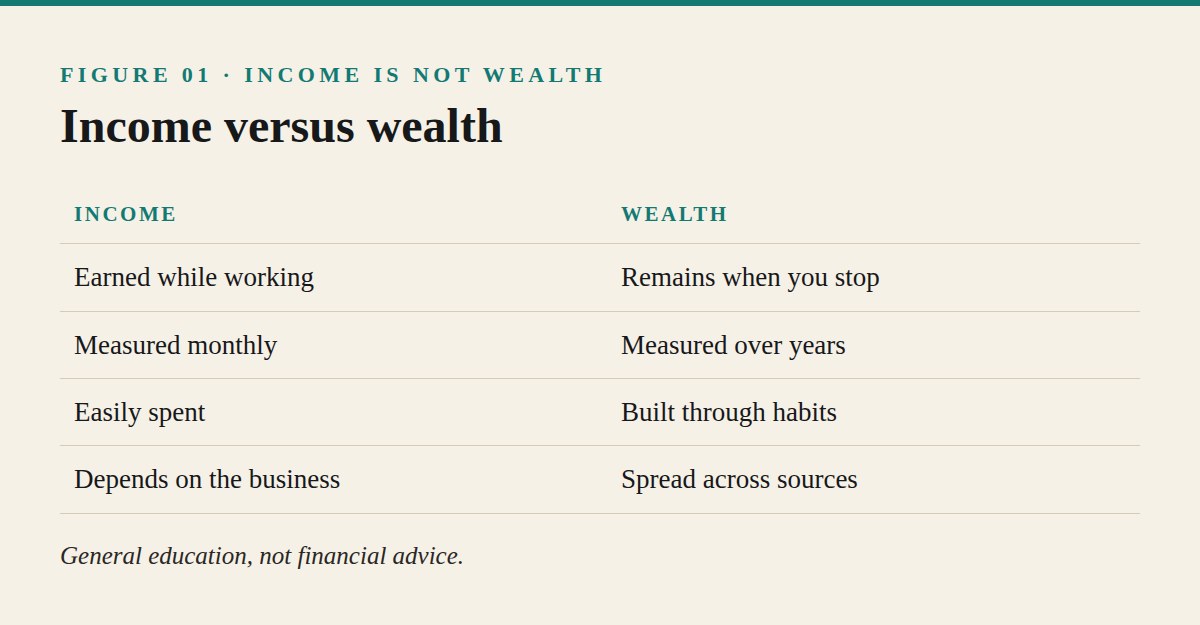
Many founders measure financial success by income: how much the business earns and how much they take home each month. Income is important, but it is not the same as wealth. Income depends on continuing to work. Wealth is what remains and grows over time: savings, assets and security that can support you even when you are not working.
This article provides general education, not financial advice.
Why the distinction matters
A founder may earn a strong income for many years and still have little security if most of it is spent or reinvested into the business without building personal savings. If the business struggles, illness occurs or the founder wishes to step back, there may be little to fall back on.
Understanding the difference helps founders make more deliberate decisions about money.
The business is not the whole picture
For many founders, the business is their largest asset. Yet its value may be uncertain, difficult to sell or heavily dependent on the founder. Relying entirely on the business for future security concentrates risk in one place.
Wealth grows through habits
For most people, long-term wealth grows through consistent habits over many years: earning reliably, spending less than they earn, saving regularly, avoiding expensive debt and allowing savings time to grow. These habits are less exciting than dramatic opportunities, but they are far more dependable.
Lifestyle can absorb income
As income rises, spending often rises with it: a larger home, a better car, more expensive habits. Rising lifestyle costs can absorb higher income, leaving little to build security. Being deliberate about spending allows more income to become lasting wealth.
Rising lifestyle costs can absorb higher income, leaving little to build security.
Start where you are
It is never too early or too late to begin. Small, regular savings started today are valuable, and improvements made later in a career still make a meaningful difference.
Understand your full financial picture
List your personal savings, debts, assets and income sources. Note how much depends on the business. This picture shows your current position and where changes may be needed.
Seek professional guidance
Personal finance decisions depend on individual circumstances, local rules and tax considerations. A qualified, independent financial adviser can help you understand options and create a plan suited to your situation.
A practical tool: the personal balance sheet
On one page, list what you own (savings, property, pension or retirement savings, investments and an honest estimate of your business value) and what you owe (mortgages, loans and credit balances). Note what share of your net worth depends on the business. Update it once a year to see whether your wealth, not just your income, is growing.
Questions to ask yourself
Ask: If my business income stopped for six months, how would I manage? How much of my net worth depends on the business? Has my spending risen faster than my savings? What would financial security mean for me in ten years? When did I last review my personal finances properly?
Common mistakes
Founders often confuse high income with wealth, reinvest everything into the business while neglecting personal savings, allow lifestyle spending to rise with every increase in income or avoid reviewing personal finances altogether. Others assume a future business sale will solve everything. Deliberate habits and professional guidance build more reliable security.
An example in practice
A consultant earned a strong income for over a decade but realised, after a health scare, that she had few personal savings outside her business. She created a personal balance sheet, began paying herself a regular salary, set up automatic savings and met an independent financial adviser to plan for the long term. Within a few years, her financial security no longer depended entirely on continuing to work every month.
Habits · 02 of 08
Paying Yourself and Saving Consistently
Security grows from regular habits: a fair, predictable owner income and automatic personal saving.

Many founders pay themselves irregularly: whatever remains at the end of the month, or nothing at all during difficult periods. This makes personal planning difficult and often means savings are postponed indefinitely. Paying yourself deliberately and saving consistently are two of the most important habits for building long-term security.
This article provides general education, not financial advice.
Set a regular owner income
Decide on a regular amount you will pay yourself, based on what the business can sustainably afford. A predictable income makes personal budgeting easier and creates a clearer separation between business and personal finances. Your accountant can help you consider the most appropriate way to pay yourself in your country and business structure.
Pay yourself before discretionary spending
Treat your owner income as an essential cost rather than an afterthought. A business that consistently cannot pay its owner fairly may need changes in pricing, costs or structure.
Save automatically
Set up an automatic transfer to savings shortly after you receive your income. Automation removes the need for willpower and ensures saving happens consistently.
Start with a manageable percentage
Begin with a percentage of income you can maintain, even if it is small. Increase it gradually as income grows. Consistency matters more than the starting amount.
Save part of every increase
When income rises, allocate part of the increase to savings before adjusting your lifestyle. This simple habit allows savings to grow without feeling restrictive.
Begin with a percentage of income you can maintain, even if it is small.
Smooth irregular income
If business income varies, consider keeping a personal buffer account. In strong months, add to the buffer; in weaker months, draw from it to maintain a steady personal income.
Keep accounts separate
Keep business and personal finances in separate accounts. Separation supports clearer decisions, simpler taxes and better visibility of personal savings.
Review regularly
Review your income and savings at least once a year, or after major changes in business performance or personal circumstances.
A practical tool: the personal money flow
Draw a simple flow: business account to owner income account, then automatic transfers to an emergency fund, long-term savings and any specific goals, with the remainder for everyday spending. Write the amount or percentage for each transfer. Seeing the flow on one page makes it easier to maintain and adjust.
Questions to ask yourself
Ask: Do I pay myself a regular, predictable amount? What percentage of my income do I save automatically? What happened to my last income increase? Do I have a buffer for weaker months? Would a qualified adviser help me make better use of what I save? The answers show where small changes could make the biggest difference over time.
Why consistency matters
Small amounts saved consistently over many years can grow significantly, because savings that remain invested or deposited can earn returns on previous returns over time. The exact outcome depends on many factors, which is why professional guidance matters, but the principle is the same: starting early and continuing steadily usually matters more than finding the perfect moment.
Common mistakes
Founders often pay themselves irregularly, save only what remains at the end of the month, increase spending with every rise in income or mix personal and business accounts. Others postpone saving until the business is more established, which can mean postponing indefinitely. Regular income and automatic saving build security steadily.
An example in practice
A small business owner paid himself irregularly and rarely saved, believing he would start when the business was more stable. With his accountant, he set a regular monthly salary, created a personal buffer account and arranged an automatic transfer of ten percent of his income to savings. When his income rose the following year, he increased savings to fifteen percent. Within three years, he had built a meaningful financial cushion for the first time.
Security · 03 of 08
Financial Security First
Before thinking about growth or investment, build a foundation that can absorb life's surprises.
Founders often think about wealth in terms of growth: investments, business value or future opportunities. Yet security comes first. Without a financial foundation, a single unexpected event, such as illness, a business slowdown or a family emergency, can force difficult decisions and undo years of progress.
This article provides general education, not financial advice.
Build a personal emergency fund
A personal emergency fund is money set aside to cover essential living costs during unexpected events. Many people aim for several months of essential expenses, but the right amount depends on personal circumstances, income stability and responsibilities. Founders with irregular income may choose a larger fund.
Keep the emergency fund accessible and separate from everyday spending.
Separate personal and business reserves
A business reserve protects the business; a personal emergency fund protects you and your family. Keeping both prevents business difficulties from immediately becoming personal crises, and vice versa.
Know your essential costs
Calculate the minimum monthly amount needed to cover essential personal expenses: housing, food, utilities, insurance, transport and debt repayments. This figure helps you set an emergency fund target and understand your financial resilience.
Protect income
Consider how you would manage if you were unable to work for an extended period. Depending on where you live, options may include insurance or public support schemes. A qualified adviser can explain what applies to your situation.
Reduce fragility
Fragility comes from high fixed personal costs, little savings and heavy dependence on one income source. Reducing fixed costs, building savings and developing additional security can make your finances more resilient.
A qualified adviser can explain what applies to your situation.
Build security gradually
Security does not need to be built all at once. Regular contributions, even small ones, gradually create a meaningful foundation.
Protect security once built
Avoid using emergency funds for non-emergencies. If you use the fund, create a plan to rebuild it.
Review regularly
As life changes, such as a new home, children or changes in business income, review your emergency fund and protections.
A practical tool: the security checklist
Review five areas each year: emergency fund in months of essential costs, separation of personal and business money, understanding of how you would manage if unable to work, level of high-cost debt and whether key documents and arrangements are up to date. Mark each as strong, adequate or weak, and address the weakest first.
Questions to ask yourself
Ask: How many months could I cover essential living costs if my income stopped? Would a difficult quarter in the business become a personal crisis? What would happen if I were unable to work for three months? Which fixed costs could I reduce if needed? Who would I turn to for professional advice?
Security and better decisions
Financial security does more than protect against emergencies. It allows founders to make business decisions calmly: declining unsuitable clients, waiting for the right opportunity or investing for the long term without fear. Founders under constant financial pressure often make short-term choices that weaken both their business and their future.
Common mistakes
Founders often keep no personal emergency fund, rely on the business account as a personal safety net, carry high fixed personal costs or use emergency savings for non-essential spending. Others overlook how they would manage if unable to work. A strong foundation makes every other financial goal more achievable.
An example in practice
A graphic designer with a successful freelance business had no personal savings outside her business account. When a major client delayed payment for three months, she struggled to pay personal bills. Afterwards, she calculated her essential monthly costs, built a personal emergency fund covering six months over two years and spoke with an adviser about protecting her income. Future business slowdowns caused far less personal stress.
Debt · 04 of 08
Avoiding Debt Traps
Debt can be a useful tool or a heavy burden. Understanding the difference protects both your business and your future.
Debt is a normal part of financial life for many people and businesses. A mortgage, a business loan for equipment or a short-term credit facility may be sensible in the right circumstances. However, debt can also become a trap when it is expensive, poorly understood or used to fund spending that does not create lasting value.
This article provides general education, not financial advice.
Understand the true cost
The cost of debt includes interest, fees, penalties and the impact on cash flow. Expensive forms of borrowing can grow quickly if balances are not repaid. Always understand the total cost before borrowing.
Distinguish productive and unproductive debt
Some debt may support long-term value, such as financing a home or business equipment that increases productivity. Other debt funds consumption, such as lifestyle spending or covering ongoing losses. Debt used to fund consumption often creates a burden without lasting benefit.
Be cautious with expensive revolving credit
Credit cards and other revolving credit can be convenient, but carrying balances over time can be costly. Paying balances in full where possible avoids accumulating expensive debt.
Avoid mixing personal and business debt unnecessarily
Using personal credit to fund a business, or business borrowing for personal needs, can blur financial boundaries and increase risk. Some business loans may require personal guarantees; understand the implications fully before agreeing.
Watch total debt levels
Even manageable individual debts can become difficult when combined. Consider total monthly repayments relative to income and how they would be affected if income fell.
Even manageable individual debts can become difficult when combined.
Have a repayment plan
For existing debt, create a plan to repay it. Many people prioritise repaying the most expensive debt first while maintaining minimum payments on others. A qualified adviser can help you choose an approach suited to your circumstances.
Avoid borrowing to escape problems
Borrowing to cover ongoing business losses or personal overspending rarely solves the underlying problem. Address the cause before considering more debt.
Seek help early
If debt becomes difficult to manage, seek advice early. Many countries offer independent debt advice services. Early action usually provides more options.
A practical tool: the debt overview
List every debt with the lender, balance, interest rate, monthly payment, end date and whether it is personal or business. Add the total monthly repayments and compare them with your income. The overview shows which debts are most expensive and helps you plan repayment with an adviser.
Questions before borrowing
Ask: What will this debt help me achieve? What is the total cost, including fees? Could I manage the repayments if my income fell by a quarter? Is there a way to achieve the same goal without borrowing? Does the loan require a personal guarantee, and what would that mean? Clear answers prevent many debt problems before they begin.
Debt and freedom
Reducing expensive debt increases freedom. Lower repayments mean more income available for saving, more flexibility in business decisions and less stress during difficult periods. For many founders, becoming free of costly debt is one of the most powerful steps towards long-term security.
Common mistakes
People often underestimate the cost of borrowing, carry high-interest balances for long periods, use debt to fund lifestyle spending, sign personal guarantees without understanding them or delay seeking help. Others borrow to cover losses rather than addressing the cause. Careful borrowing and a clear repayment plan protect financial wellbeing.
An example in practice
A café owner used several credit cards to cover personal expenses during a slow year and gradually accumulated significant balances. With guidance from an independent adviser, she listed all debts, stopped adding new balances, reduced personal spending and focused extra payments on the most expensive card while paying minimums on the rest. Over two years, she cleared the expensive debt and redirected those payments into savings.
Principles · 05 of 08
Not All in One Basket
When nearly everything you own depends on one business, one setback can affect everything. Spreading risk is a long-standing principle of security.
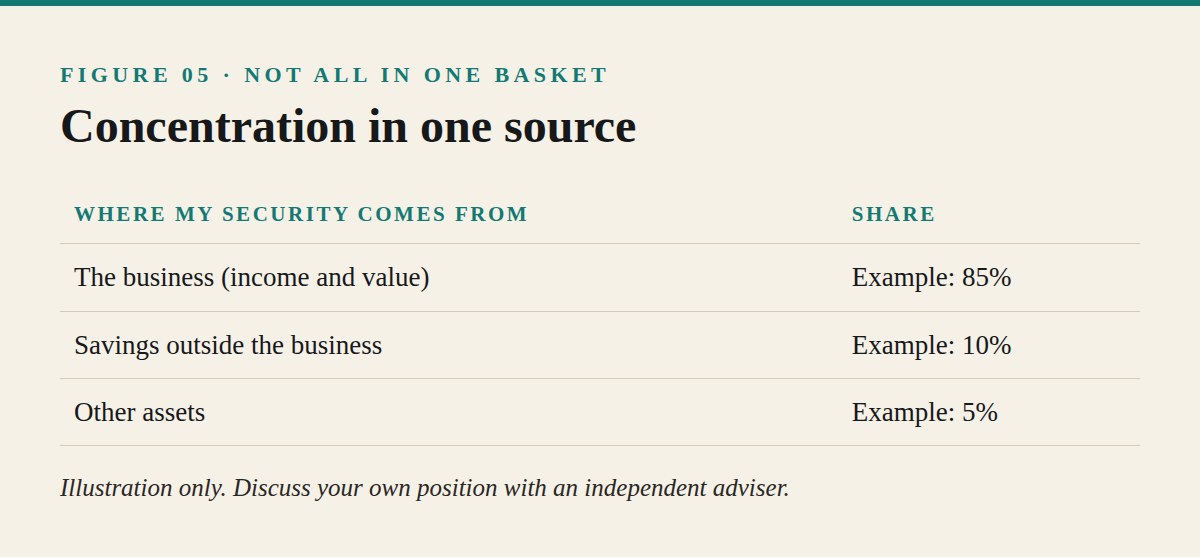
For many founders, the business represents most of their financial life: their income, their largest asset and often their retirement plan. This concentration can feel natural, because the founder knows and controls the business. Yet it also means that a single setback, such as a market change, illness, a major customer loss or an unsuccessful sale, can affect income and wealth at the same time.
The principle of diversification, spreading risk across different sources, is one of the oldest ideas in financial planning.
This article provides general education only. It does not recommend any specific investment, product or strategy. Decisions about investing depend on individual circumstances, goals and local rules, and should be made with a qualified, independent financial adviser.
Understand concentration risk
Concentration risk arises when a large share of your wealth depends on one asset or source. For founders, the business is often that asset. Its value may change with market conditions, may be difficult to sell and may depend heavily on the founder's continued involvement.
Separate income and wealth sources
Diversification can begin simply: building personal savings outside the business so that your financial security does not depend entirely on its performance. Over time, many people choose to build assets that are separate from their business.
Diversification is about reducing risk, not chasing returns
The purpose of diversification is not to find the highest possible return, but to reduce the chance that a single event damages your entire financial position. Different assets tend to behave differently under different conditions.
Understand that all investments carry risk
Every investment involves risk, including the possible loss of money. Higher potential returns usually come with higher risk. Understanding your own tolerance for risk and your time horizon is essential before making investment decisions.
Avoid decisions based on excitement
Fashionable opportunities, promises of quick returns or pressure to act immediately are warning signs. Sound decisions are usually made calmly, with an understanding of risks and costs.
Understanding your own tolerance for risk and your time horizon is essential before making investment decisions.
Consider costs and complexity
Investment products and services involve costs that can affect long-term results. Complex products may be harder to understand. A qualified adviser can explain costs and suitability.
Seek independent advice
Personal circumstances, tax rules and available options differ widely. An independent, qualified adviser can help you understand diversification in the context of your goals and risk tolerance.
Review over time
As your business, income and life change, your level of concentration may change too. Review your financial picture periodically.
A practical tool: the concentration snapshot
Using your personal balance sheet, calculate what share of your net worth and your income depends on the business. Write both numbers down. You do not need to act immediately, but seeing them clearly is a useful starting point for a conversation with an independent adviser about whether your level of concentration suits your goals.
Questions to discuss with an adviser
Ask: How concentrated is my financial position in my business? What level of risk is appropriate for my age, goals and circumstances? What costs would different approaches involve? How would my plan change if I sold or stepped back from the business? How often should we review it? Good advisers welcome these questions and explain the answers clearly.
Common mistakes
Founders often keep almost all their wealth in their business, assume a future sale will provide security, make investment decisions based on excitement or tips, ignore costs or avoid seeking independent advice. Others confuse diversification with chasing many fashionable opportunities. Understanding the principle and seeking qualified guidance leads to better decisions.
An example in practice
A founder in her forties realised that her business represented nearly all her net worth and provided all her income. Concerned about the risk, she began building personal savings outside the business and arranged a meeting with an independent financial adviser to understand her options and risk tolerance. Over several years, her financial security became less dependent on the business, giving her greater confidence in both business and personal decisions.
Diversification within the business
The same principle applies inside the business: avoiding dependence on one customer, supplier or product, as discussed in earlier issues. A founder who reduces concentration both inside the business and in personal finances builds resilience at two levels, so that no single event can threaten everything at once.
Patience · 06 of 08
Thinking in Decades
Wealth is built slowly. Time, patience and consistency matter more than timing or luck.

Founders are used to thinking in months and quarters: sales targets, cash flow and immediate priorities. Long-term financial security requires a different perspective. Many of the most powerful forces in personal finance, such as consistent saving, the growth of savings over time and the effect of good habits, work slowly over many years.
This article provides general education, not financial advice.
Time is a powerful ally
Money saved early has more time to grow. Growth on previous growth, often called compounding, means that consistent saving over decades can produce results far larger than the amounts originally saved. The exact outcome depends on many factors, but the principle encourages starting early and continuing steadily.
Plan for later life
Founders often lack the workplace retirement arrangements available to many employees. It is therefore particularly important to think about how you will support yourself in later life. Options and rules vary widely between countries; a qualified adviser can explain what applies to you.
Set long-term goals
Consider what you want your life to look like in ten, twenty or thirty years. Do you want the option to work less, step back from the business or pursue other interests? Long-term goals help guide saving, spending and business decisions.
Avoid reacting to short-term noise
Markets, economies and businesses fluctuate. Reacting emotionally to short-term changes can lead to poor decisions. Long-term plans help you remain steady during uncertain periods.
Maintain consistency
Consistency often matters more than finding the perfect moment. Regular saving and periodic reviews can produce better results than occasional large efforts.
Reacting emotionally to short-term changes can lead to poor decisions.
Review your plan periodically
Life changes: family, health, business performance and personal goals. Review your long-term plan regularly and adjust it with professional guidance.
Protect your future self
Decisions today affect your future self. Avoid sacrificing long-term security for short-term spending or business risks that could threaten everything you have built.
Balance today and tomorrow
Thinking in decades does not mean ignoring the present. A healthy approach balances enjoying life today with preparing for the future.
A practical tool: the ten-year letter
Write a short letter from your future self ten years from now describing the life you hope to be living: your work, finances, health and relationships. Then list three financial habits that would make that life more likely. Review the letter once a year and discuss its goals with your adviser.
Questions about the long term
Ask: How will I support myself if I stop working? At what age would I like the option to work less? Am I saving regularly for later life? How would a business sale or closure affect my plans? Who can help me understand my options? Answering these questions early creates time to act.
Patience and the business
Thinking in decades also benefits the business. Founders with long-term personal security can make patient business decisions: investing in quality, building lasting relationships and resisting short-term pressures that could harm the business over time. Personal and business patience reinforce each other.
Common mistakes
Founders often postpone thinking about later life, assume the business will provide for retirement, react emotionally to short-term changes or stop saving during busy periods. Others focus only on the present and neglect future security. Long-term thinking, consistency and professional advice build lasting security.
An example in practice
A founder in his thirties assumed that selling his business someday would fund his retirement. After writing a ten-year letter, he realised he wanted more certainty. He began saving regularly for later life, reviewed his plan annually with an adviser and treated a possible business sale as an additional benefit rather than his only plan. Twenty years later, he had options regardless of what happened to the business.
Protection · 07 of 08
Protecting What You Build
Years of work can be undone by one unprotected event. Simple protections preserve what you build for yourself and your family.
Building wealth takes years. Protecting it requires attention too. Unexpected events, such as illness, accidents, legal disputes, business failures or the death of a founder, can have serious consequences for families and businesses. Thoughtful protection helps ensure that years of effort are not undone by a single event.
This article provides general education only. Insurance, legal and estate arrangements depend on individual circumstances and local laws; seek qualified professional advice.
Understand your risks
Consider events that could seriously affect your finances: inability to work, major health issues, legal claims, property damage, business disruption or death. Understanding these risks helps you decide what protection may be appropriate.
Review insurance needs
Depending on your circumstances and country, insurance may help protect against certain risks: business liability, property, income loss, health or life. A qualified adviser or broker can help you understand options and avoid gaps or unnecessary cover.
Separate business and personal risks
Business structures, contracts and insurance can help separate business risks from personal finances. Understand how your business structure affects personal liability and seek advice where necessary.
Prepare key documents
Many people benefit from having up-to-date legal documents such as a will and arrangements for who can make decisions on their behalf if they become unable to do so. Requirements vary by country; a qualified legal professional can advise.
Plan for the business
Consider what would happen to your business if you were unable to work or died. Who would make decisions? How would customers, staff and suppliers be informed? What happens to ownership? Business continuity and succession planning protect both the business and your family.
Consider what would happen to your business if you were unable to work or died.
Keep information organised
Store important documents, account details, insurance policies and key contacts securely, and ensure a trusted person knows how to access essential information if needed.
Review regularly
Life events such as marriage, children, divorce, property purchases or major business changes may require updates to protection and documents.
Avoid overprotection
Protection has costs. The goal is not to insure against every possible event, but to protect against risks that would cause serious hardship. Professional advice can help find a sensible balance.
A practical tool: the protection review
Once a year, review five areas: insurance policies and whether they still fit your situation, legal documents and whether they are current, business continuity arrangements, where important information is stored and who could access it, and any changes in your life that require updates. Note any gaps and arrange professional advice to address them.
Questions to ask yourself
Ask: What would happen to my family's finances if I could not work for a year? Is my will up to date? Who would run or close the business if I could not? Would my family know where to find important documents? When did I last review my insurance? These questions are uncomfortable but important.
Protection as care
Protection is ultimately about care for the people who depend on you: family, employees, customers and partners. Taking a few practical steps to prepare for difficult events is one of the most responsible things a founder can do, and it often brings peace of mind that makes everyday work easier.
Common mistakes
Founders often postpone protection planning, assume insurance is too expensive without reviewing options, lack up-to-date legal documents, fail to plan for the business if something happens to them or keep important information where nobody else can find it. Others buy unnecessary cover without understanding their risks. Regular, advised reviews provide sensible protection.
An example in practice
A founder of a small engineering firm had no will, limited insurance and no plan for the business if he became seriously ill. After discussing his situation with legal and financial professionals, he updated his documents, reviewed his insurance, created a business continuity plan naming a trusted manager and organised key information for his family. He described the process as uncomfortable but reassuring.
Purpose · 08 of 08
Knowing What Is Enough
Without a definition of enough, more is never enough. Clarity about what you need brings freedom as well as security.
Many founders pursue growth without ever defining what success means for them. Income rises, the business grows and yet the sense of security or satisfaction remains elusive. Each goal is followed by another, often with longer hours and higher stakes. Without a clear idea of what is enough, it is easy to sacrifice health, relationships and freedom in pursuit of more.
This article offers reflections rather than financial advice.
Define what enough means to you
Enough is personal. It depends on your values, family, lifestyle, goals and sense of purpose. It may include financial security, time with family, health, meaningful work or the freedom to choose how you spend your days.
Write down what a good life looks like for you. Be specific.
Separate needs from comparisons
Comparison with others can drive endless pursuit of more: larger businesses, higher incomes or more visible success. Your definition of enough should reflect your own priorities, not those of others.
Translate enough into financial goals
Once you understand what enough means, consider what financial resources would support it. A qualified adviser can help translate personal goals into a realistic financial plan.
Consider time as wealth
Money is only one form of wealth. Time, health, relationships and freedom are also valuable. Sometimes choosing a smaller, calmer business provides a better life than pursuing maximum growth.
Align business goals with life goals
Your business should support the life you want. If growth plans require sacrifices you do not want to make, it may be worth reconsidering the goals or the approach.
A qualified adviser can help translate personal goals into a realistic financial plan.
Recognise progress
Founders often focus on what remains to be achieved and overlook what has already been accomplished. Recognising progress builds satisfaction and perspective.
Revisit enough over time
Your definition of enough may change as life changes. Review it periodically and adjust plans accordingly.
Use enough to guide decisions
A clear sense of enough helps with difficult choices: whether to accept a major opportunity, take on more risk, expand, reduce working hours or sell the business.
A practical tool: the enough statement
Write a short statement describing what enough means for you in five areas: financial security, time, health, relationships and meaningful work. For each, note one sign that you have reached it. Keep the statement with your business plan and refer to it when considering major decisions.
Questions to reflect on
Ask: What would I do with my time if I had enough money? Which goals am I pursuing because they matter to me, and which because others expect them? What am I sacrificing to grow, and is it worth it? What would make me feel secure? When will I know I have succeeded?
Closing thought on wealth
This issue has explored principles for turning business income into lasting security: paying yourself, saving consistently, avoiding debt traps, spreading risk, thinking in decades and protecting what you build. Knowing what is enough gives these principles direction. Wealth is ultimately a means to a good life, not an end in itself.
Common mistakes
Founders often pursue growth without defining success, compare themselves constantly with others, sacrifice health and relationships for financial goals or never recognise progress already made. Others assume more money will automatically bring satisfaction. A clear definition of enough brings both direction and freedom.
An example in practice
A founder of a successful design agency planned to triple the business within five years, which would require longer hours and constant travel. After writing an enough statement, she realised that her priorities were financial security, time with her young children and creative work. She chose moderate growth, hired a studio manager and reduced her working week. Her income remained strong, and she described her life as calmer and more satisfying.
Before you close this edition
Your Action Plan
Your next 30 days
Week 1: See your full picture. List your personal savings, debts, assets and how much of your wealth depends on the business.
Week 2: Pay yourself deliberately. Set a regular owner income and an automatic transfer to personal savings.
Week 3: Build security. Decide on a personal emergency fund target and review any expensive debt.
Week 4: Get advice. Book a meeting with a qualified, independent financial adviser to discuss your long-term plan.
Keep learning
Hustle Influence offers practical online courses and AI tools that help you turn ideas into action.
hustleinfluence.com
General education only, not financial, investment or tax advice. Consult a qualified, independent adviser about your situation.
HUSTLE MAGHustle in Silence.