
Traditional budgeting assumes a predictable monthly salary. For founders and freelancers, income may vary significantly from month to month. Budgeting based on an average month, or worse, a good month, can lead to overspending when income is strong and financial stress when income falls.
A budget designed for irregular income creates stability even when business income is unpredictable.
This article provides general education, not financial advice.
Know your essential costs
Start by calculating your essential monthly personal costs: housing, utilities, food, transport, insurance, debt repayments and other necessary expenses. This is the minimum amount you need each month to maintain your basic lifestyle.
Identify your realistic minimum income
Review your income over the past twelve months or longer. Identify the lowest realistic monthly income, excluding unusual exceptions. This figure provides a cautious basis for planning.
Budget from the minimum
Build your core budget around your essential costs and realistic minimum income. Treat income above this level as additional money for savings, buffer building, debt repayment or planned spending.
Create a personal income buffer
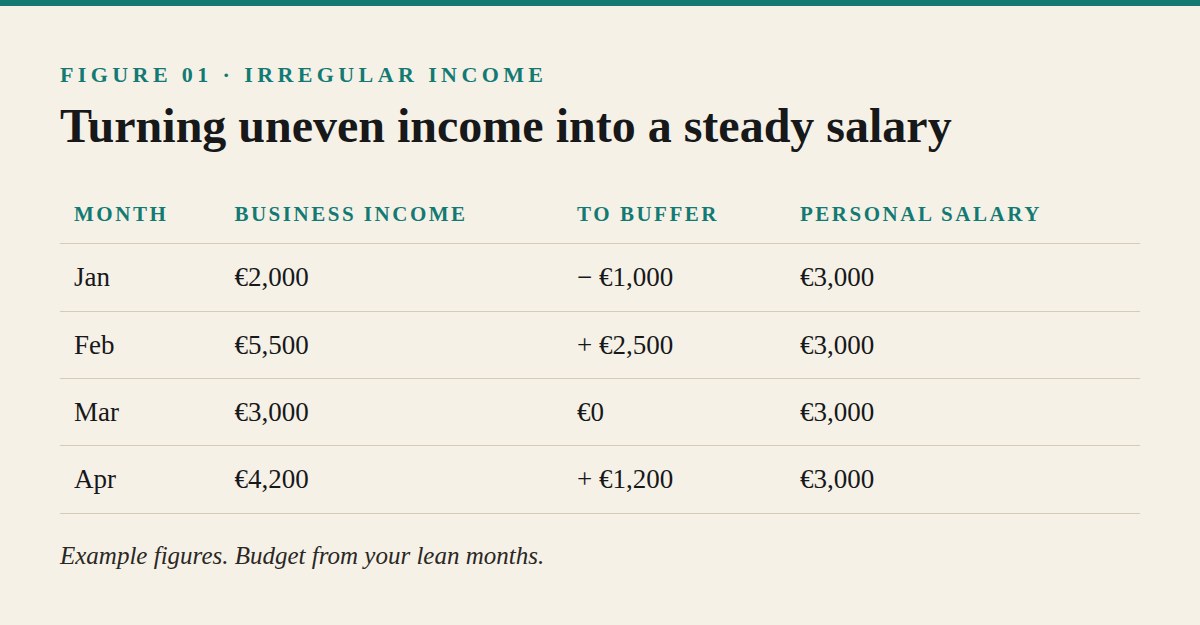
A buffer account smooths income fluctuations. When business income is strong, add money to the buffer. When income is weak, draw from it to maintain your regular personal income. Over time, the buffer turns irregular business income into a steady personal salary.
Pay yourself a regular amount
Where possible, transfer a consistent amount from your business or buffer account to your personal account each month. A regular personal income makes budgeting and planning much easier.
Where possible, transfer a consistent amount from your business or buffer account to your personal account each month.
Prioritise spending
Divide spending into categories: essential costs, savings and goals, and flexible spending. Flexible spending can be adjusted during lean months, while essential costs and savings remain protected.
Plan for irregular expenses
Some costs occur annually or occasionally: insurance, holidays, car maintenance, gifts and professional fees. Set aside money monthly for these expenses so they do not disrupt your budget.
Review regularly
Review your budget every month at first, then every quarter. Adjust it as income patterns, costs and goals change.
A practical tool: the irregular income budget
Create a simple budget with four lines: essential monthly costs, regular personal income you pay yourself, monthly amount for irregular expenses and monthly savings. Below it, note your buffer target, usually several months of personal income, and your current buffer balance. Update the balance monthly and adjust the regular income if the buffer grows or shrinks consistently.
Questions to ask yourself
Ask: What is my lowest realistic monthly income? Which costs are essential and which are flexible? How many months could my buffer cover? Do I spend more in strong months than I should? Which irregular costs often catch me by surprise? The answers show where your budget needs strengthening.
Starting the buffer
If you have no buffer yet, begin by setting aside a share of every payment above your regular income. Even a small buffer reduces stress significantly, and it grows quickly during strong months. Once it covers several months of personal income, irregular business income stops feeling like a personal emergency.
Common mistakes
Founders often budget based on average or best months, spend extra income immediately, ignore irregular expenses or pay themselves whatever happens to be available. Others never build a buffer, so every lean month becomes stressful. Budgeting from a realistic minimum and building a buffer creates stability.
An example in practice
A freelance photographer earned most of her income during the wedding season and struggled financially every winter. She calculated her essential monthly costs, reviewed two years of income and set a regular monthly personal salary based on her quieter months. During the busy season, she transferred surplus income into a buffer account. The following winter, she continued receiving her regular salary without financial stress.