
Running a business affects more than the founder. Irregular income, financial risk, long hours and uncertainty can create stress for partners and families. Many founders avoid discussing money at home, hoping to protect loved ones from worry. Unfortunately, silence often creates more anxiety than honest conversation.
Open, regular money conversations help households plan together and navigate uncertainty with confidence.
This article provides general guidance, not financial advice.
Share the reality
Explain how the business generates income, how income varies and what risks exist. Partners and family members who understand the situation can plan more effectively and feel less uncertain.
Agree shared goals
Discuss what matters most to your household: financial security, buying a home, education, travel, reducing working hours or later-life plans. Shared goals help guide financial decisions.
Set a household budget together
Build a household budget based on realistic income and essential costs. Agree how flexible spending will change during strong and lean periods.
Discuss risk openly
Business decisions such as borrowing, investing savings or signing personal guarantees can affect the whole household. Discuss significant risks before committing.
Schedule regular money meetings
A short monthly conversation about income, spending, savings and upcoming costs keeps everyone informed. Regular discussions prevent surprises and make difficult conversations easier.
Celebrate progress
Acknowledge achievements together: reaching savings goals, paying off debt or completing a successful business year. Celebrating progress builds motivation and shared commitment.
Regular discussions prevent surprises and make difficult conversations easier.
Respect different money personalities
People have different attitudes towards money: some prefer security, others are more comfortable with risk. Understanding these differences helps households find balanced decisions.
Seek outside help when needed
Financial advisers, accountants or neutral third parties can help households understand options and make decisions together, especially when finances are complex.
A practical tool: the monthly money meeting
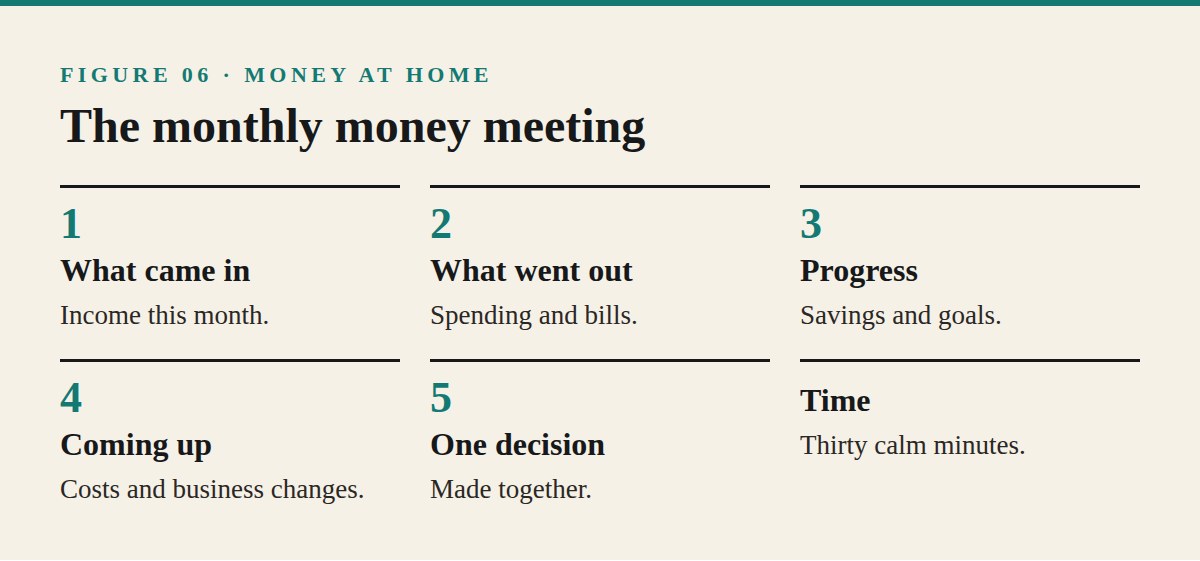
Hold a thirty-minute conversation each month covering five topics: what came in, what went out, progress on savings and goals, upcoming costs or business changes and one decision to make together. Keep it calm and regular. Short, predictable conversations prevent money from becoming a source of tension.
Questions to discuss together
Ask: What does financial security mean to each of us? How much uncertainty are we comfortable with? What would we do in a lean year? What are our most important goals for the next five years? What business decisions should we discuss together before making them? Honest answers build a shared plan.
When income is uncertain
During uncertain periods, keep conversations frequent and factual. Share what you know, what you are doing and what the household might need to adjust. Partners usually cope far better with honest uncertainty than with unexplained worry or sudden surprises.
Common mistakes
Founders often avoid money conversations, make major financial decisions alone, hide business difficulties, assume partners share their attitude to risk or discuss money only during crises. Others focus only on problems rather than goals and progress. Regular, honest conversations build trust and shared direction.
An example in practice
A founder of a small design agency rarely discussed the business with his partner, who felt anxious about irregular income. They began holding a monthly money meeting, agreed shared savings goals and a household budget based on the agency's quieter months, and discussed major business decisions together. Household stress fell noticeably, and both partners felt more confident about their financial future.
Including the wider family
Where appropriate, older children or other family members can also benefit from understanding how a family business works. Age-appropriate conversations about income, spending and saving can teach valuable lessons, and help everyone understand why some months feel different from others.