
Whether applying for a loan, grant or investment, preparation significantly affects the outcome. Lenders and investors want to understand the business, its finances, its plans and its risks. Clear, organised information demonstrates professionalism and helps them make decisions more quickly.
This article provides general education, not financial or legal advice.
Define the funding request
Be clear about how much capital you need, what it will be used for, how it will create value and how it will be repaid or generate a return. A specific request is more persuasive than a general need for money.
Organise financial records
Prepare accurate financial statements, management accounts, tax records and bank statements. Well-organised records demonstrate reliable financial management.
Prepare forecasts
Create realistic forecasts for revenue, costs, profit and cash flow. Include cautious scenarios and explain key assumptions. Funders value realism over optimism.
Explain the business clearly
Describe what the business does, who its customers are, how it makes money, its competitive strengths and its growth opportunity. Keep explanations simple and supported by evidence.
Show traction
Evidence of progress, such as revenue growth, customer retention, repeat purchases, contracts, partnerships or successful pilots, builds confidence.
Be honest about risks
Every business faces risks. Identify the main risks and explain how you plan to manage them. Honest discussion of risks often increases credibility.
Describe what the business does, who its customers are, how it makes money, its competitive strengths and its growth opportunity.
Understand the funder's perspective
Lenders focus on repayment and security. Investors focus on growth and return. Grant providers focus on programme objectives. Tailor your information to their priorities.
Prepare for questions
Anticipate common questions about finances, customers, competition, management and plans. Clear answers demonstrate understanding and preparation.
A practical tool: the funding pack
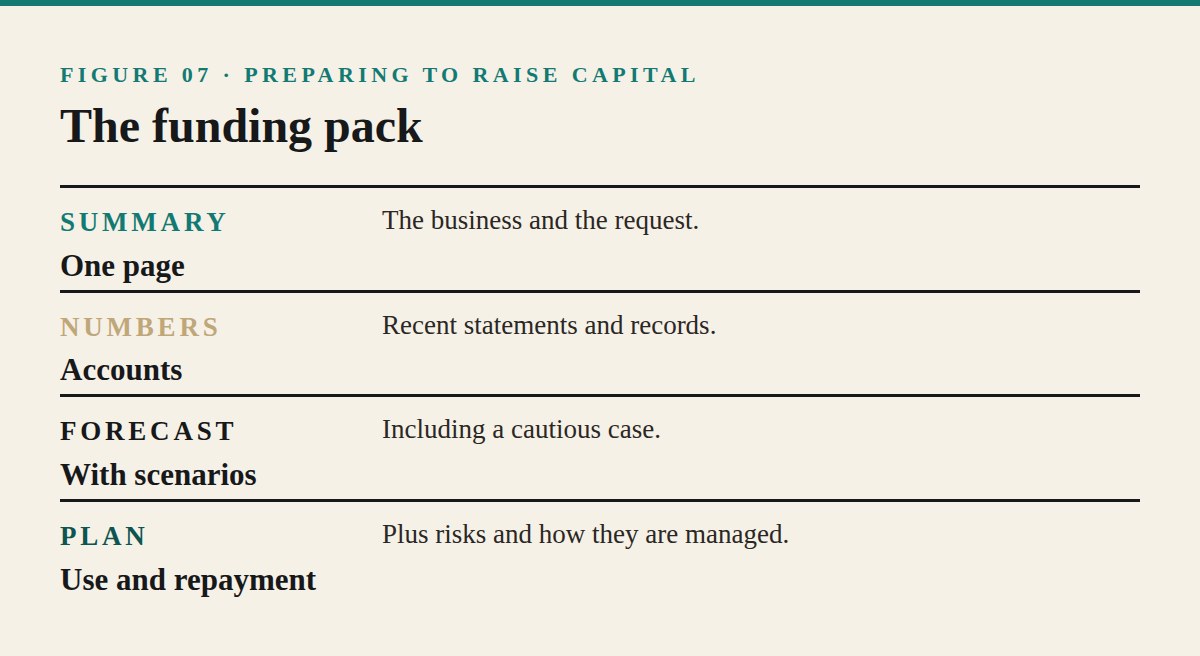
Create a short pack with six sections: a one-page summary of the business and request, recent financial statements, a cash flow forecast with cautious scenarios, evidence of traction, key risks and how they are managed, and how the funding will be used and repaid or returned. Keep it updated so you can respond quickly when opportunities arise.
Questions funders often ask
Prepare answers to common questions: How will this money be used, and what will it achieve? How do you know customers want this? What happens if sales are lower than forecast? What are your margins and cash position? Who runs the business, and what experience do they have? What do you need beyond money?
Preparation improves the business
Preparing to raise capital often reveals gaps in financial records, unclear plans or untested assumptions. Fixing these gaps improves the business whether or not funding is obtained. Many founders find the preparation itself as valuable as the funding they eventually receive.
Common mistakes
Founders often seek funding without clear financial records, present unrealistic forecasts, request vague amounts, ignore risks or fail to tailor information to the funder. Others prepare hastily when cash is already tight. Thorough preparation increases the chances of securing appropriate funding.
An example in practice
A small food producer applied for a loan to expand production but was initially declined because the application lacked clear forecasts. With her accountant, she prepared a funding pack with accurate accounts, a cash flow forecast including a cautious scenario, evidence of growing retail orders and a clear explanation of how the new equipment would increase capacity. Her second application was approved on better terms.
Practising the conversation
Before meeting a lender or investor, practise explaining the business and your request aloud, ideally with an adviser or experienced founder who can ask difficult questions. Practice reveals unclear explanations and weak points in the plan, and it helps you stay calm and concise when the real conversation happens.
After a refusal
If an application is declined, ask for feedback. Lenders and investors often explain what concerned them: weak forecasts, limited track record or unclear use of funds. Address the feedback, strengthen the plan and consider whether a different type of funding would suit the business better.