
Contents · Edition 045
Edition 045
From the Editors
Every founder will eventually leave their business. Some will sell it, some will hand it to family or colleagues, some will step back while keeping ownership and some will close it. The only question is whether that departure happens on the founder's terms, at a time of their choosing, or is forced by circumstances such as illness, exhaustion or a sudden change in the market.
Many founders avoid thinking about exit because the business is closely tied to their identity, or because it seems far away. Yet the decisions that make a good exit possible are made years in advance: building a business that can run without its founder, keeping clean records, developing people and understanding what the business is worth.
This issue explores exit and succession with that long view. We look at why early planning matters, the main exit options and how to build a transferable business. We consider business value, preparing for a sale, family and internal succession, stepping back without selling and, finally, the personal question of life after the business.
This is general education, not legal, tax or financial advice. Exits involve significant legal and tax considerations that vary by country and situation, and deserve qualified professional guidance well before any decision.
The Editors, Hustle Mag
In This Edition
Exit and Succession
Selling, Handing Over or Stepping Back From a Business
An exit is the moment a founder leaves day-to-day ownership or leadership of a business. A good exit protects the founder's financial security, the business's future, its employees and its customers. Good exits are rarely improvised; they are prepared over years.
This issue covers exit and succession step by step. We begin with planning early and the main options, then building a transferable business and understanding value. We look at preparing for a sale, family and internal succession, stepping back without selling and life after the business.
Each article ends with one step towards an exit on your terms. This issue is educational only; consult qualified legal, tax and financial advisers before any exit decision.
Cover Story · 01 of 08
Plan Your Exit Early
The best exits are prepared years in advance. Planning early creates choices; waiting removes them.

Many founders avoid thinking about leaving their business. The business may feel like part of their identity, or retirement may seem distant. Yet every founder will eventually leave, whether through sale, succession, stepping back or closure. Exits that are planned years in advance usually produce better outcomes than those forced by illness, burnout, family circumstances or sudden market changes.
This article provides general education, not legal, tax or financial advice.
Why early planning matters
Many of the factors that make a business valuable or transferable take years to build: strong systems, capable people, diverse customers, reliable financial records and reduced dependence on the founder. Starting early gives time to strengthen these areas.
Exit planning improves the business today
A business prepared for exit is often a better business to run. Clear systems, delegated responsibilities and strong financial management reduce stress and improve performance, even if exit is many years away.
Define what a good exit means to you
Consider your goals. Do you want to sell for financial security, hand the business to family or employees, step back while retaining income or eventually close it? Do you care most about financial outcome, the future of employees, the continuity of the brand or your own time and wellbeing?
Consider timing
Think about when you might want to leave and what needs to happen before then. Timing may depend on personal goals, business performance, market conditions and family considerations.
Prepare for the unexpected
Exit planning also prepares for unplanned events. If you were suddenly unable to work, would the business continue? Who would make decisions? Succession and continuity planning protect your family, employees and customers.
Succession and continuity planning protect your family, employees and customers.
Involve the right people
Discuss your plans with trusted advisers, family members or business partners as appropriate. Accountants, lawyers and financial advisers can help you understand options and implications.
Review regularly
Exit plans should evolve as the business and your life change. Review your plan at least once a year.
Start with small steps
Exit planning does not require immediate major decisions. Begin by documenting key processes, strengthening financial records and reducing dependence on yourself.
A practical tool: the exit vision
Write a one-page exit vision: when you would ideally like to leave, how (sale, succession, stepping back or closure), what you want for yourself financially and personally, what you want for employees and customers, and the three biggest obstacles today. Review it each year. The vision gives direction to decisions that might otherwise seem unrelated to exit.
Questions to ask yourself
Ask: If I had to leave the business within a year, what would happen? Who could run it without me? What would a buyer or successor worry about most? How much of my financial future depends on the business? What do I want my life to look like after the business? Honest answers reveal where preparation should begin.
The emotional side of exit
Exit is not only a financial and practical matter. For many founders, the business represents years of effort, identity and purpose. Acknowledging the emotional side early, and discussing it with people you trust, makes later decisions clearer and helps prevent delays caused by understandable reluctance to let go.
Common mistakes
Founders often postpone exit planning, assume the business will be easy to sell, remain indispensable to daily operations, keep poor records or ignore the possibility of unexpected events. Others focus only on price and overlook personal goals and the future of employees. Early, regular planning creates better choices.
An example in practice
A founder of a small engineering firm assumed he would sell the business when he retired, but advisers explained that it depended heavily on his personal relationships and expertise. Over five years, he trained a management team, documented processes, diversified clients and improved financial reporting. When he decided to retire, the business attracted several interested buyers and continued successfully after the sale.
Options · 02 of 08
Exit Options
Selling is only one way to leave a business. Understanding every option helps you choose the one that fits your goals.
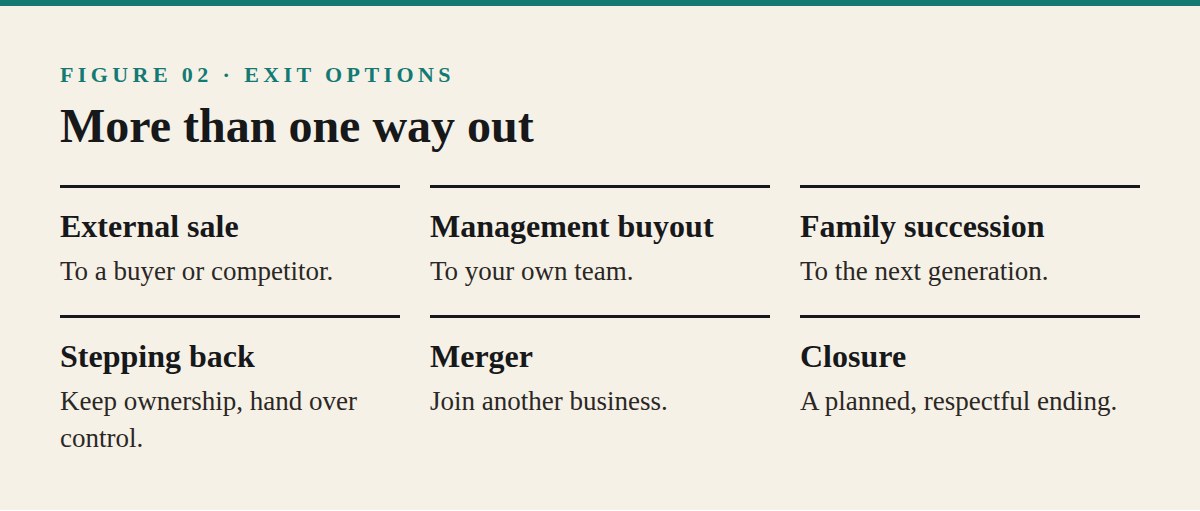
Founders often assume that exit means selling the business to a buyer. In reality, there are several ways to leave a business, each with different financial, practical and personal implications. Understanding the options helps you choose the path that best fits your goals and circumstances.
This article provides general education only. Each option involves legal and tax considerations that depend on your country and situation; seek qualified professional advice.
Selling to an external buyer
The business may be sold to an individual, a competitor, a supplier, a customer or another company. An external sale may provide a significant financial return, but it requires preparation, buyer interest and often a transition period during which the founder supports the new owner.
Selling to management or employees
Managers or employees who already know the business may buy it. This can provide continuity for staff and customers. Financing the purchase may require careful planning and sometimes staged payments.
Passing the business to family
Some founders hand the business to family members. Family succession can preserve legacy and values, but it requires careful planning, fairness, preparation of the successor and clear communication within the family.
Stepping back while retaining ownership
Founders may appoint a manager or management team to run the business while they remain owners. This option can provide continued income while reducing involvement.
Merging with another business
A merger combines the business with another organisation. It may strengthen both businesses and provide a gradual transition for the founder.
It may strengthen both businesses and provide a gradual transition for the founder.
Closing the business
Sometimes closing the business is the best option, particularly if it depends heavily on the founder or cannot be transferred. A well-planned closure protects customers, employees, suppliers and the founder's reputation.
Consider your priorities
Each option balances different priorities: financial outcome, speed, continuity, legacy, involvement after exit and care for employees and customers. Clarifying your priorities helps narrow the choices.
Keep options open
Building a strong, transferable business keeps more options available. A business that depends entirely on the founder may have only one realistic option: closure.
A practical tool: the exit options comparison
Create a table with each exit option as a row and columns for likely financial outcome, timeline, continuity for employees and customers, your involvement afterwards, complexity and fit with your priorities. Score each from one to five. Review the comparison with your advisers to identify the most suitable options for further planning.
Questions to compare options
Ask: Which matters more to me: the highest price, the future of my team or the continuation of the brand? How involved do I want to be after exit? Is there a natural successor inside the business or family? Would a buyer see value beyond my personal involvement? What would closing the business mean for customers and employees?
Combining options
Exits do not have to follow a single path. A founder might step back first, appointing a manager, then later sell to that manager, or transfer ownership to family gradually while retaining a share. Combining options over time can provide flexibility and a smoother transition for everyone involved.
Common mistakes
Founders often consider only one exit option, overlook internal succession, assume family members want to take over, delay planning until options are limited or focus only on price. Others fail to consider the impact on employees and customers. Understanding all options allows better decisions.
An example in practice
The owner of a small accounting practice planned to sell to a larger firm. After comparing exit options with an adviser, she realised that her two senior accountants were interested in buying the practice. They agreed a gradual transition over three years, with staged payments and the founder reducing her role over time. Clients remained loyal, staff stayed and the founder achieved a smooth exit.
Transferability · 03 of 08
Building a Transferable Business
A business that depends on its founder is difficult to sell, hand over or step away from. Transferability is built deliberately.

A business is transferable when it can continue successfully without its founder. Customers stay, employees know what to do, systems run reliably and financial performance remains steady. Transferable businesses are generally easier to sell, hand over or manage from a distance. Businesses that depend entirely on their founders often have fewer exit options.
This article provides general education, not legal or financial advice.
Reduce founder dependence
List the tasks, decisions, relationships and knowledge that currently depend on you. Gradually delegate responsibilities, document knowledge and develop others so the business can function without your constant involvement.
Build strong systems
Documented processes, checklists, templates and quality standards allow others to deliver consistent results. Systems make the business easier to understand and manage for a new owner or leader.
Develop leaders
Capable managers and team members provide continuity. Invest in training and gradually increase their responsibilities. A strong team reassures buyers and successors.
Diversify customers
Heavy reliance on a few large customers increases risk for buyers and successors. Broadening the customer base improves stability and transferability.
Formalise relationships
Important relationships with customers, suppliers and partners should be documented and, where appropriate, supported by written agreements. Relationships that exist only through the founder can be difficult to transfer.
Maintain clean financial records
Accurate, well-organised financial records make the business easier to understand and value. They also support due diligence during a sale.
Important relationships with customers, suppliers and partners should be documented and, where appropriate, supported by written agreements.
Protect intellectual property
Ensure the business owns key assets such as trademarks, website domains, content, software and designs. Clear ownership supports transferability.
Test your absence
Take extended time away and observe how the business performs. Problems that arise during your absence reveal areas needing further development.
A practical tool: the founder dependence list
List every area where the business depends on you: key customers, supplier relationships, technical knowledge, approvals, sales and decisions. For each, note who could take it over, what documentation or training is needed and a target date. Work through the list over months or years; each item completed increases transferability.
Questions to test transferability
Ask: Could the business operate for a month without me? Which customers would leave if I left? Who knows how our most important processes work? Are key relationships documented? Does the business own all its essential assets? Would a newcomer understand our finances quickly? Each weak answer is a task worth completing.
Transferability and value
Transferability affects both the ability to exit and the value of the business. Buyers usually pay more for businesses that run reliably without the founder, because the risk of losing customers or performance after the sale is lower. Every step towards transferability is also a step towards a stronger, more valuable business.
Common mistakes
Founders often remain involved in every decision, keep knowledge in their heads, rely on a few customers, neglect documentation or assume buyers will learn everything after the sale. Others never test whether the business can run without them. Deliberate transferability creates more options and greater value.
An example in practice
A founder of a small marketing agency handled all major client relationships personally. Advisers warned that buyers would see this as a major risk. Over three years, she introduced account managers for each client, documented service processes and gradually reduced her involvement in daily work. When she later explored a sale, buyers were reassured that clients remained loyal to the agency rather than to her personally.
Transferability as freedom
A transferable business gives the founder freedom long before any exit: the ability to take real holidays, recover from illness without crisis and focus on strategy rather than daily operations. Even founders who never plan to sell benefit from building a business that does not depend entirely on them.
Value · 04 of 08
Understanding Business Value
A business is worth what a buyer believes it will earn in future, adjusted for the risks they see. Knowing the drivers helps you build value.
Founders often have a figure in mind for what their business is worth, sometimes based on years of effort or personal financial needs. Buyers, however, value businesses differently. They focus on future earnings, risks, growth potential and how easily the business can continue without its founder.
Understanding the drivers of business value helps founders build value over time and set realistic expectations.
This article provides general education only. Business valuation is complex and depends on many factors; seek qualified valuation, legal and tax advice.
Value reflects future potential
Buyers usually assess value based on the future earnings they expect the business to generate and the risks involved. Past effort and personal circumstances do not determine value.
Profitability matters
Consistent, sustainable profitability is often one of the most important value drivers. Buyers generally prefer businesses with reliable earnings and healthy margins.
Risk affects value
Factors that increase risk can reduce value: dependence on the founder, a few large customers, inconsistent records, declining performance, weak systems or uncertain market conditions.
Recurring revenue can increase value
Predictable recurring revenue, such as subscriptions, retainers or long-term contracts, can make future earnings more reliable and attractive.
Growth potential matters
Buyers may value businesses with clear growth opportunities, such as new markets, products or customer segments.
Transferability is essential
A business that can operate without its founder is generally more valuable than one that depends heavily on personal relationships or expertise.
Documented processes, capable managers and a stable team make the business easier to run and reduce buyer risk.
Strong systems and people add value
Documented processes, capable managers and a stable team make the business easier to run and reduce buyer risk.
Valuation methods vary
Different methods may be used depending on the business, industry and buyer. Professional valuers and advisers can explain which approaches are appropriate.
A practical tool: the value driver review
Score your business from one to five on eight value drivers: profitability, consistency of earnings, recurring revenue, customer diversity, independence from the founder, quality of systems, strength of the team and growth potential. The lowest scores show where improvement would most increase value over the coming years.
Questions to understand value
Ask: Would a buyer believe our profits will continue without me? Which risks would worry them most? How much of our revenue recurs each year? Are our financial records clear enough for a buyer to understand quickly? What growth opportunities could a new owner pursue? Answering these honestly builds realistic expectations.
Building value over time
Value is rarely built in the months before a sale. It grows over years through steady improvements to profitability, systems, people and customer relationships. Founders who regularly review value drivers, even with no immediate plan to sell, build businesses that are more valuable whenever an exit eventually happens.
Common mistakes
Founders often base expectations on personal needs or effort, ignore risks that reduce value, overlook the importance of transferability, rely on informal valuation estimates or begin improving value only shortly before a sale. Others focus only on revenue rather than sustainable profit. Understanding value drivers supports better long-term decisions.
An example in practice
The founder of a small IT services company expected a high sale price based on annual revenue. An adviser explained that buyers would be concerned about inconsistent profits, dependence on two major clients and the founder's personal involvement. Over the next four years, the founder improved margins, introduced monthly support contracts, diversified clients and developed a management team. When the business was eventually sold, the valuation was substantially higher than the initial estimate would have supported.
Value beyond price
For many founders, the value of an exit includes more than the sale price: the future of employees, the continuation of the brand, the terms of the transition and the founder's own role afterwards. Considering these factors alongside price helps founders choose offers that fit their goals, not simply the highest number.
Sale · 05 of 08
Preparing for a Sale
A sale is a long process. Preparation shortens it, reduces surprises and protects the value you have built.
Selling a business can take many months or even years from first preparation to completion. Buyers examine finances, contracts, operations, customers and risks carefully before committing. Businesses that are well prepared usually move through the process more smoothly, attract more confidence from buyers and are less likely to encounter costly surprises.
This article provides general education only. Business sales involve significant legal, tax and financial considerations; work with qualified professionals throughout the process.
Start preparing early
Ideally, begin preparing for a sale several years in advance. This allows time to strengthen financial performance, reduce founder dependence, improve systems and resolve issues that might concern buyers.
Organise financial records
Buyers will review financial statements, tax records, management accounts, forecasts and key performance indicators. Accurate, consistent and well-organised records build confidence.
Review contracts and agreements
Gather and review customer contracts, supplier agreements, leases, employment documents, partnership agreements and intellectual property records. Identify any terms that could affect a sale, such as change-of-ownership clauses.
Resolve outstanding issues
Address unresolved disputes, unclear ownership of assets, outdated contracts or compliance concerns before approaching buyers. Issues discovered during due diligence can delay or derail a sale.
Strengthen management
A capable management team reassures buyers that the business can continue successfully after the founder leaves.
Understand the process
A sale often involves preparing information, identifying potential buyers, confidential discussions, offers, due diligence, negotiating terms and completing legal documentation. Advisers can explain each stage and help manage it.
A capable management team reassures buyers that the business can continue successfully after the founder leaves.
Maintain business performance
The sale process can be time-consuming and distracting. Continue focusing on customers, employees and results. A decline in performance during the sale can reduce buyer confidence.
Plan the transition
Buyers may expect the founder to support the business for a period after the sale. Consider what role you are willing to play and for how long.
A practical tool: the sale readiness checklist
Review ten areas: three years of clean financial records, documented processes, capable management, diverse customers, written key contracts, clear ownership of intellectual property, no unresolved disputes, compliance up to date, an understanding of likely value and a transition plan. Mark each as ready, in progress or not started, and work with advisers on the gaps.
Questions to prepare for buyers
Prepare answers to questions buyers commonly ask: Why are you selling? How dependent is the business on you? Which customers account for most revenue? What are the main risks? What growth opportunities exist? How would the transition work? Clear, honest answers build trust and keep the process moving.
Confidentiality
News of a possible sale can unsettle employees, customers and suppliers. Keep discussions confidential until appropriate, use confidentiality agreements with potential buyers and plan carefully how and when key people will be told. Advisers can help manage this sensitive part of the process.
Common mistakes
Founders often begin preparing too late, present disorganised records, overlook problematic contracts, allow performance to decline during the sale process or underestimate the time and effort required. Others enter negotiations without professional advice. Early preparation and expert guidance protect value and reduce stress.
An example in practice
A founder of a small manufacturing company decided to sell within three years. She worked with her accountant to clean up financial reporting, renewed key customer contracts, documented operating procedures and promoted a production manager to take on more responsibility. When the business was marketed, due diligence progressed smoothly, and the sale completed with few unexpected issues.
Choosing advisers early
The right advisers make a significant difference: an accountant familiar with business sales, a lawyer experienced in transactions and, for larger businesses, a specialist who can identify suitable buyers. Engage them early, ask about their experience with businesses like yours and agree fees clearly before work begins.
Succession · 06 of 08
Family and Internal Succession
Handing a business to family or colleagues can preserve its character, if successors are prepared and arrangements are fair.
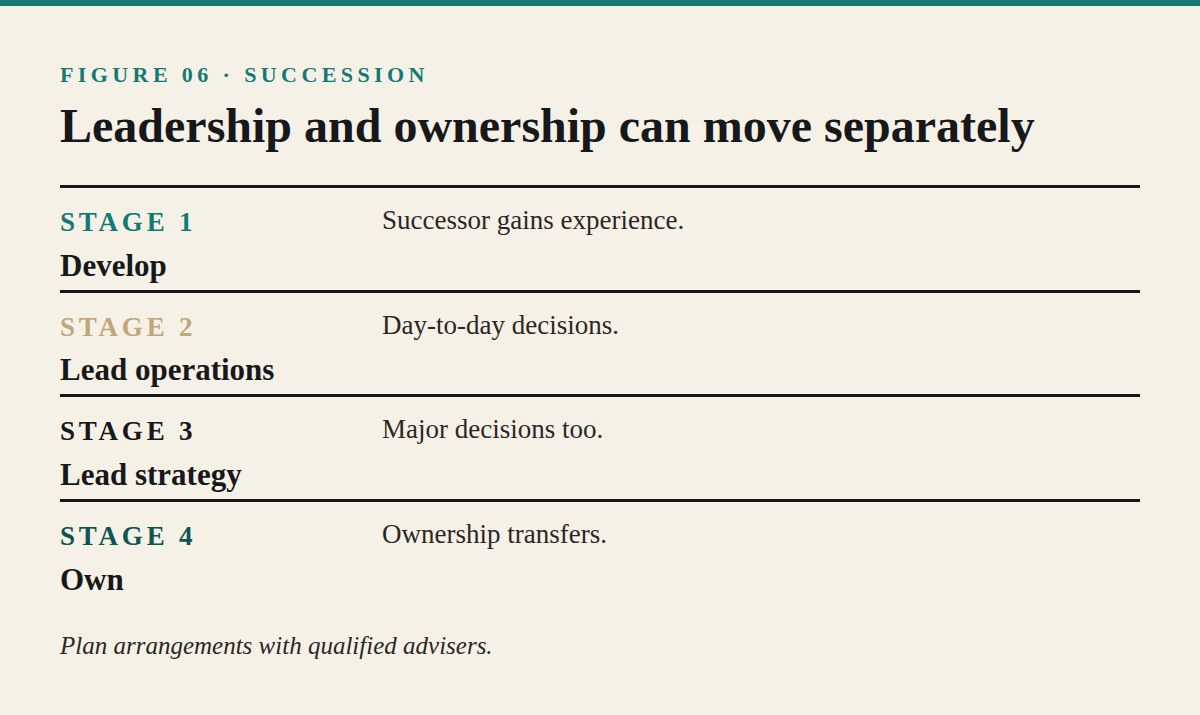
Some founders prefer to pass their business to family members, managers or employees rather than selling to an outside buyer. Internal succession can preserve the business's values, culture and relationships, and provide continuity for customers and staff. It also involves unique challenges: preparing successors, ensuring fairness, managing expectations and arranging finance.
This article provides general education only. Succession involves legal, tax and family considerations; seek qualified professional advice.
Identify potential successors
Consider who might lead or own the business in future: family members, senior managers or a group of employees. Successors should have the interest, capability and commitment to lead the business successfully.
Do not assume interest
Family members or employees may not want to take over. Discuss intentions openly and early. Succession plans built on assumptions often fail.
Prepare successors gradually
Leadership skills, business knowledge and relationships take time to develop. Provide successors with increasing responsibility, training, mentoring and exposure to key decisions over several years.
Separate leadership and ownership
Leadership and ownership do not have to transfer at the same time. A successor may lead the business before owning it, or ownership may transfer gradually over time.
Ensure fairness
In family businesses, succession can affect relationships between family members, especially if some are involved in the business and others are not. Fairness does not always mean equal shares; it means transparent decisions that consider everyone's interests.
Successors may need to finance the purchase of the business.
Plan the financial arrangements
Successors may need to finance the purchase of the business. Options can include staged payments, financing from lenders or gradual transfer of ownership. Professional advice helps structure arrangements that work for both sides.
Communicate the plan
Employees, customers and suppliers may be affected by succession. Communicate clearly when appropriate to maintain confidence and continuity.
Allow the successor to lead
Founders sometimes remain involved after succession and struggle to let go. Agree roles and boundaries clearly so the successor can lead effectively.
A practical tool: the succession plan
Write a plan with six sections: potential successors and their readiness, the development each needs, the timeline for leadership and ownership transfer, financial arrangements, how other family members or stakeholders will be treated and the founder's role after transition. Review it annually with the successor and advisers.
Questions for succession conversations
Ask potential successors: Do you want to lead this business, and why? What would you change? What support would you need? What timeline feels realistic? Ask yourself: Am I prepared to let someone else make decisions? How will family members not involved in the business be treated fairly? Honest conversations prevent painful misunderstandings later.
Succession as a gradual process
Successful successions are usually gradual. A successor may first lead a department, then manage daily operations, then take on strategic decisions and finally ownership. Each stage builds confidence on both sides, gives customers and staff time to adjust and allows problems to be addressed before the founder fully steps away.
Common mistakes
Founders often assume family members want to take over, delay preparing successors, transfer leadership too quickly, ignore fairness among family members or fail to plan financing. Others remain too involved after succession. Early conversations, gradual preparation and clear arrangements improve outcomes.
An example in practice
The founder of a family bakery hoped her son would take over, but he was unsure. They discussed expectations openly, and he spent three years managing different parts of the business while attending a management course. Ownership transferred gradually through a structured arrangement agreed with advisers, and the founder remained available as an adviser for a year. The bakery continued to thrive under the next generation.
Stepping Back · 07 of 08
Stepping Back Without Selling
You can keep ownership and income while giving up daily control, if the business is ready to run without you.
Not every founder wants to sell. Some want to keep ownership and continue benefiting from the business while reducing their involvement. Stepping back can provide more time, flexibility and freedom while preserving income and long-term value. It requires a business that can operate reliably without the founder's constant attention.
This article provides general education, not legal or financial advice.
Define your future role
Decide what role you want after stepping back. You might remain involved in strategy, key relationships or occasional decisions, or you might become an owner with little day-to-day involvement. Clarity helps others understand their responsibilities.
Build a strong management team
A capable manager or management team is essential. Leaders should understand the business, share its values and be trusted to make decisions. Developing internal leaders or recruiting experienced managers may take time.
Document systems and responsibilities
Clear processes, standards and responsibilities allow the business to operate consistently without relying on the founder's knowledge.
Delegate authority, not just tasks
Managers need authority to make decisions within agreed limits. Define decision rights clearly so the business can respond quickly without waiting for founder approval.
Establish reporting
Agree what information managers will report and how often: financial results, key metrics, customer feedback and major issues. Regular reporting keeps the founder informed without daily involvement.
Set boundaries
Founders often find it difficult to step back. Agree how and when you will be contacted and avoid undermining managers by intervening in routine decisions.
Regular reporting keeps the founder informed without daily involvement.
Align incentives
Consider how managers will be rewarded for strong performance. Fair pay, recognition and, where appropriate, performance-related rewards can encourage commitment.
Review regularly
Hold regular reviews with the management team to discuss performance, strategy and challenges. Adjust roles and responsibilities as the business evolves.
A practical tool: the stepping-back plan
Write a plan with five parts: your future role, the leaders who will run the business, the decision rights each holds, the reports you will receive and how often, and a timeline for reducing your involvement in stages. Review progress every quarter and adjust the pace based on how well the business performs.
Questions before stepping back
Ask: Who could run the business day to day? Which decisions am I genuinely willing to delegate? What information do I need to feel confident without being involved? How will I resist stepping in unnecessarily? What will I do with the time I gain? Clear answers make the transition smoother for everyone.
Stepping back gradually
Most successful transitions happen in stages: first delegating daily operations, then most decisions, and finally strategy except for major choices. Gradual steps allow managers to build confidence and the founder to adjust. They also reveal gaps in systems or skills while there is still time to fix them calmly.
Common mistakes
Founders often step back before the business is ready, delegate tasks without authority, interfere in managers' decisions, lack clear reporting or fail to define their own role. Others step back too abruptly. Gradual, structured transitions create stability and trust.
An example in practice
The founder of a small software company wanted more time with her family but did not want to sell. Over two years, she appointed and developed an operations manager and a sales lead, documented key processes, defined decision rights and introduced monthly management reports. She gradually reduced her involvement to quarterly strategy meetings while remaining owner. The business continued to grow, and she gained the flexibility she wanted.
Staying connected without interfering
Stepping back does not mean disappearing. Founders can remain valuable as advisers, ambassadors for the brand or mentors to new leaders. The key is to offer support when asked and through agreed channels, rather than stepping into daily decisions that now belong to others.
Next Chapter · 08 of 08
Life After the Business
Many founders plan the exit carefully and forget to plan what comes next. Purpose, structure and identity matter as much as money.
Founders often spend years preparing for the financial and practical aspects of exit, yet give little thought to life afterwards. For many, the business has provided not only income, but identity, purpose, routine, relationships and a sense of achievement. Leaving it can bring freedom, but also uncertainty or loss.
Planning life after the business helps ensure the next chapter is meaningful.
This article offers reflections rather than professional advice.
Recognise the emotional transition
Leaving a business can create mixed emotions: relief, pride, excitement, uncertainty or even grief. These feelings are normal. Acknowledging them helps founders adjust more easily.
Think beyond financial goals
Financial security is important, but it is only one part of a fulfilling life. Consider what will give your days purpose, structure and satisfaction after exit.
Explore your interests
Many founders have postponed interests during years of building a business. Exit can provide time to pursue hobbies, learning, travel, creative work or new experiences.
Consider new forms of contribution
Some founders choose to mentor entrepreneurs, invest in other businesses, serve on boards, volunteer, teach or start new ventures. Using experience to help others can provide meaning and connection.
Maintain relationships
The business may have provided daily social contact. Invest in relationships with family, friends and communities to maintain connection after leaving.
Some founders choose to mentor entrepreneurs, invest in other businesses, serve on boards, volunteer, teach or start new ventures.
Create structure
Without the routines of business, some founders struggle with unstructured time. Create new rhythms for work, learning, health, relationships and rest.
Take time before major decisions
After exit, it can be helpful to pause before committing to new ventures or major changes. Time allows reflection and clearer decisions.
Revisit your enough statement
Return to your definition of enough. Use it to guide how you spend time, money and energy in the next chapter.
A practical tool: the next chapter plan
Write a one-page plan with five areas: purpose (what will give your days meaning), structure (a weekly rhythm), relationships (people to invest time in), health (habits to protect) and contribution (how you will use your experience). Add one concrete first step for each. Begin drafting it well before your exit.
Questions to reflect on
Ask: What parts of running the business will I miss most? What will I not miss? What have I always wanted to do but postponed? How do I want to use my experience to help others? What would a fulfilling week look like after the business? These reflections shape a next chapter worth looking forward to.
Closing thought on exit
This issue has explored how founders can leave their businesses on their own terms: planning early, understanding options, building transferable and valuable businesses, preparing for sale or succession and stepping back thoughtfully. Planning life afterwards completes the picture. A good exit is not only a successful transaction; it is the beginning of a meaningful next chapter.
Common mistakes
Founders often focus only on the financial outcome, underestimate the emotional impact of leaving, rush into new commitments, lose social connections or struggle with unstructured time. Others fail to plan the next chapter at all. Thoughtful preparation helps founders move forward with confidence.
An example in practice
A founder sold her design agency after twenty years. Although the sale was financially successful, she initially felt restless and uncertain without daily responsibilities. Using a next chapter plan, she began mentoring young entrepreneurs, joined the board of a local charity, travelled with her family and took up painting. A year later, she described her life as busy, fulfilling and more balanced than ever.
Before you close this edition
Your Action Plan
Your next 30 days
Week 1: Imagine your exit. Write down when and how you would ideally like to leave the business, and what matters most to you.
Week 2: Test transferability. List the tasks, relationships and knowledge that depend only on you.
Week 3: Strengthen the business. Choose one dependency to reduce through documentation, delegation or training.
Week 4: Get advice. Book a conversation with an accountant or adviser about exit options and timing.
Keep learning
Hustle Influence offers practical online courses and AI tools that help you turn ideas into action.
hustleinfluence.com
General education only, not legal, tax or financial advice. Consult qualified professionals before any exit or succession decision.
HUSTLE MAGHustle in Silence.