
Contents · Edition 047
Edition 047
From the Editors
Most business advice focuses on the business: how to grow it, fund it, run it and eventually leave it. Less attention is given to the person at its centre. Yet the founder's health, relationships, identity and sense of purpose shape everything the business becomes, and they must last far longer than any single strategy or product.
Many founders reach a point where the business is succeeding but they are not. They are tired, isolated, uncertain of who they are outside their work or questioning why they started. Others face setbacks so painful that they wonder whether to continue at all. These experiences are common, rarely discussed and entirely human.
This issue is about building a career that can last decades. We look at treating entrepreneurship as a long career rather than a sprint, and at identity beyond the business. We consider health over decades, relationships that sustain you, and the mentors and peers who make the journey less lonely. We explore recovering from setbacks, continuous learning and reinvention, and finally purpose and legacy.
The most important asset in your business is you. Looking after that asset is not a distraction from success. It is what makes lasting success possible.
The Editors, Hustle Mag
In This Edition
The Resilient Founder
Sustaining Health, Relationships and Purpose Over a Long Career
Resilience is the ability to keep going, recover from difficulty and continue growing over many years. For founders, it depends on health, relationships, identity, learning and a sense of purpose, not on willpower alone.
This issue explores resilience across a whole career. We begin with seeing entrepreneurship as a long career and building an identity beyond the business. We cover health, relationships, mentors and peers, then look at setbacks, learning and reinvention, and finish with purpose and legacy.
Each article ends with one step towards a career and life that can last.
Cover Story · 01 of 08
A Career, Not a Sprint
Entrepreneurship can last decades. The habits that win a sprint often lose a career.

Many founders begin their businesses with intense energy: long hours, constant availability and little rest. This intensity may help during the early stages, but it rarely lasts. Over years, exhaustion can damage health, relationships, creativity and judgement. Some founders burn out and leave entrepreneurship altogether, not because their business failed, but because the way they worked became unsustainable.
Seeing entrepreneurship as a long career, rather than a sprint, changes how founders work and live.
The difference between a sprint and a career
A sprint requires maximum effort for a short time. A career requires sustainable effort over decades. Founders who treat every year as a sprint often perform well briefly but struggle to maintain energy, enthusiasm and good decisions over time.
Expect seasons
Every career has seasons: launch periods, growth phases, difficult years, plateaus and periods of renewal. Some seasons require more intensity, others more rest and reflection. Recognising seasons helps founders adjust expectations and avoid feeling that every period must be equally demanding.
Build habits that last
Habits matter more than occasional bursts of effort. Regular sleep, exercise, planning, learning, rest and time with loved ones create the foundation for a long career. Small, consistent habits often outperform intense efforts that cannot be maintained.
Protect your future self
Decisions made today affect the founder you will be in ten years. Constant overwork, neglected health or damaged relationships may provide short-term gains but impose long-term costs.
Build a business that supports you
Systems, delegation, capable people and sound finances allow the business to function without constant founder effort. A business that depends entirely on the founder's energy is difficult to sustain over decades.
Constant overwork, neglected health or damaged relationships may provide short-term gains but impose long-term costs.
Measure success over longer periods
Founders often judge themselves by short-term results. Measuring progress over years reveals the cumulative effect of consistent effort and reduces pressure to achieve everything immediately.
Renew regularly
Long careers require renewal: holidays, learning, new challenges, reflection and occasional changes in role. Renewal keeps work meaningful and energy high.
Accept that careers evolve
Your role and interests may change over time. You may move from doing the work to leading, from leading to strategy or even into new ventures. Evolution is a natural part of a long career.
A practical tool: the career map
Draw a timeline of your working life so far and the decades ahead. Mark the main seasons you have experienced and the ones you expect: building, growing, leading, stepping back or new ventures. For the next five years, write what season you are entering and what it will require from you. The map helps you plan energy, learning and rest across a whole career.
Questions to ask yourself
Ask: Could I work this way for another twenty years? What season am I in now, and what does it require? Which habits are protecting my future self, and which are harming it? What would renewal look like for me? How do I want to be working in ten years? These questions shift attention from the next quarter to the next decade.
The value of longevity
Founders who last decades gain advantages that newer founders cannot buy: deep experience, strong networks, refined judgement and trusted reputations. Simply remaining healthy, motivated and in the game for many years is one of the most powerful competitive advantages an entrepreneur can have.
Common mistakes
Founders often treat every year as a sprint, neglect health and relationships, build businesses that depend entirely on them or judge themselves only by short-term results. Others resist natural changes in their role. Sustainable habits, supportive systems and regular renewal allow careers to last.
An example in practice
A founder worked seventy-hour weeks for the first six years of her design agency and eventually felt exhausted and disillusioned. Instead of leaving, she redesigned her working life: appointing a studio manager, limiting her hours, taking a month away each year and focusing on the creative strategy she enjoyed most. Ten years later, she was still leading the agency with renewed energy and described the second decade as far more rewarding than the first.
Identity · 02 of 08
More Than Your Business
When your identity depends entirely on your business, every setback feels personal. A broader identity brings stability.
Founders often become closely identified with their businesses. They introduce themselves through their work, think about it constantly and measure their worth by its success. This deep commitment can drive remarkable achievement. It can also create vulnerability. When the business struggles, the founder feels personally diminished. When the founder eventually steps back or exits, they may feel lost.
A broader identity provides stability across the ups and downs of a long career.
Why identity matters
If your sense of self depends entirely on business results, every setback becomes a personal failure and every success brings only temporary relief. A broader identity allows you to experience business challenges without feeling that your whole self is at stake.
Recognise the different parts of your life
Most people have several roles and interests: family member, friend, community member, learner, creator, athlete, volunteer or mentor. Each contributes to identity and meaning. Founders often neglect these roles during intense periods of building a business.
Separate worth from results
Business results depend on many factors, including luck, markets and timing. Your worth as a person is not defined by revenue, growth or recognition. Separating personal worth from business outcomes supports healthier decisions and greater resilience.
Maintain interests outside work
Hobbies, creative pursuits, sports, learning and community involvement provide enjoyment, perspective and connection. They also help founders recover from stress and return to work with fresh energy.
Invest in relationships beyond business
Relationships with family and friends that are not built around the business provide support and grounding. They remind founders that they are valued for who they are, not only for what they achieve.
They also help founders recover from stress and return to work with fresh energy.
Prepare for future transitions
Founders will eventually step back, sell, hand over or close their businesses. A broad identity makes these transitions easier and helps founders find meaning in the next chapter.
Reflect on values
Values, such as honesty, curiosity, generosity or craftsmanship, often remain constant even as roles change. Understanding your values provides a stable foundation for identity.
Talk about it
Discussing identity with trusted friends, mentors or professionals can help founders understand how closely they are tied to their businesses and how to build balance.
A practical tool: the identity circle
Draw a circle and divide it into segments representing the parts of your life: business, family, friendships, health, learning, community, creativity and any others that matter to you. Shade each segment according to how much time and attention it receives today. Choose one neglected segment and plan one regular activity to strengthen it.
Questions to reflect on
Ask: How do I describe myself when I am not talking about work? How do I feel when the business has a bad month? What did I enjoy before starting the business? Who values me for reasons unrelated to my work? What would remain if the business disappeared tomorrow? These reflections reveal how broad or narrow your identity has become.
Identity and better leadership
Founders with a broad identity often lead better. They are less defensive about mistakes, more open to feedback and calmer under pressure, because their sense of self does not depend on every decision being right. Teams benefit from leaders who can separate their worth from the business's daily ups and downs.
Common mistakes
Founders often define themselves entirely through their work, neglect interests and relationships outside the business, measure personal worth by results or postpone thinking about identity until exit. Others assume a narrow focus is necessary for success. A broader identity strengthens both resilience and long-term wellbeing.
An example in practice
A founder of a growing software company had spent years thinking about little except the business. When a major product launch failed, he felt personally devastated. With the help of a mentor, he reconnected with long-neglected interests in music and cycling, spent more time with friends and family and began volunteering with a local youth programme. When later setbacks occurred, he found them easier to manage and approached the business with greater perspective.
Health · 03 of 08
Health Over Decades
Your health is the foundation of every decision, relationship and ambition. Protect it as carefully as your business.

Founders often neglect their health during intense periods: sleep is cut short, exercise is postponed, meals are rushed and stress becomes constant. For a while, the body and mind cope. Over years, however, poor habits can reduce energy, concentration, judgement and resilience. Health is not a separate concern from business success. It is the foundation that makes success possible.
This article offers general wellbeing guidance, not medical advice. Consult a healthcare professional about your own health.
Sleep comes first
Regular, sufficient sleep supports concentration, mood, decision-making and physical health. Founders who consistently sacrifice sleep often work longer but think less clearly. Protecting sleep is one of the most effective investments in performance.
Move regularly
Physical activity supports energy, mood and long-term health. It does not need to be extreme. Regular walking, cycling, strength training or other enjoyable activities can make a meaningful difference. Scheduling exercise as a fixed appointment helps maintain consistency.
Eat for energy
Irregular meals and convenience food can affect energy and concentration. Simple habits, such as planning meals, eating regularly and staying hydrated, support steady performance throughout the day.
Manage stress
Some stress is unavoidable in business. Chronic stress without recovery can affect health and wellbeing. Regular breaks, time outdoors, hobbies, conversations with trusted people and periods without work-related communication help manage stress.
Take mental health seriously
Feelings of persistent exhaustion, anxiety, low mood or overwhelm are common among founders and deserve attention. Speaking with a trusted person or a qualified professional can help. Seeking support is a sign of strength, not weakness.
Simple habits, such as planning meals, eating regularly and staying hydrated, support steady performance throughout the day.
Schedule regular check-ups
Preventive healthcare can identify issues early. Regular check-ups and following professional advice support long-term health.
Build health into your routine
Health habits are easier to maintain when built into daily routines: a morning walk, a fixed bedtime, regular meal times or scheduled exercise. Routine reduces reliance on motivation.
Model healthy habits
Founders influence their teams. Leaders who respect rest, reasonable working hours and wellbeing encourage healthier cultures.
A practical tool: the health foundation plan
Write a simple plan with five lines: your target sleep schedule, two times each week for physical activity, one habit for eating well during busy days, one daily practice for managing stress and the date of your next health check-up. Put the activities in your calendar. Review the plan each month and adjust it when your circumstances change.
Questions to ask yourself
Ask: How many nights a week do I sleep well? When did I last exercise regularly for a month? How do I feel at the end of most working days? What usually happens to my health during busy periods? When did I last see a doctor for a routine check-up? Honest answers show where small changes could have the greatest effect.
Health during demanding seasons
Some periods will be unavoidably demanding: launches, crises or seasonal peaks. During these times, protect the basics rather than abandoning them: keep sleep as regular as possible, take short walks, eat properly and plan a recovery period afterwards. Minimum habits maintained during hard times prevent a short crisis from becoming a long decline.
Common mistakes
Founders often sacrifice sleep for productivity, postpone exercise during busy periods, ignore signs of stress or exhaustion, avoid seeking support or neglect routine healthcare. Others try dramatic health changes that cannot be sustained. Small, consistent habits protect health across a long career.
An example in practice
A founder of an e-commerce business regularly worked late into the night and felt constantly tired. After a health scare, she created a health foundation plan: a fixed bedtime, three morning walks a week, regular meals and a weekly evening without work. She also began seeing her doctor for regular check-ups. Within months, her energy and concentration improved, and she found she accomplished more in fewer hours.
Relationships · 04 of 08
Relationships That Sustain You
Strong relationships provide support, perspective and joy. They need time, attention and protection from the demands of work.
Running a business can consume enormous time and emotional energy. Relationships with partners, family and friends are often the first things to suffer during busy periods. Missed dinners, distracted conversations and cancelled plans may seem temporary, but over years they can weaken the relationships that provide support, perspective and meaning.
Strong relationships are one of the most important sources of resilience for founders.
Relationships provide support
During difficult periods, trusted relationships provide encouragement, practical help and emotional support. Founders with strong relationships often recover from setbacks more effectively.
Protect time together
Schedule regular time for important relationships, just as you schedule meetings with customers. Shared meals, weekends, holidays and simple routines create connection.
Be present
Time together matters most when attention is genuine. Put away devices, avoid constant work discussions and focus on the people you are with.
Share the journey
Explain the challenges and successes of the business with your partner or close family. Shared understanding reduces misunderstandings and helps loved ones feel included rather than excluded.
Respect boundaries
Agree boundaries around work, such as evenings without business calls or weekends reserved for family. Boundaries protect relationships from being constantly displaced by work.
Agree boundaries around work, such as evenings without business calls or weekends reserved for family.
Maintain friendships
Friendships often fade during intense periods of business building. Make time for friends who know you beyond your business and remind you of other parts of your life.
Repair when needed
Work pressures can strain relationships. Acknowledge when you have been distracted or unavailable, apologise where appropriate and make changes.
Celebrate together
Share milestones and achievements with the people who support you. Celebrating together reinforces connection and recognises the role they play.
A practical tool: the relationship calendar
List the five relationships that matter most to you. For each, write one regular commitment, such as a weekly dinner, a monthly outing or a call every Sunday, and put it in your calendar as a recurring appointment. Review the list each quarter. If a commitment keeps being cancelled, treat it as a warning sign rather than an inconvenience.
Questions to reflect on
Ask: Who are the people I most rely on, and how much time have I given them recently? When did I last have a conversation not about work? What would my partner or family say about my availability? Which friendships have I allowed to fade? What one change would improve my most important relationship? Honest answers point to where attention is needed.
Relationships and decision-making
Close relationships also improve decisions. People who know you well can notice exhaustion, challenge unrealistic plans and remind you of your values when business pressures are high. Founders who share their thinking with trusted people often avoid decisions made in isolation, stress or haste.
Common mistakes
Founders often assume relationships will wait until the business is established, bring work into every conversation, cancel personal plans repeatedly, neglect friendships or keep loved ones uninformed about business challenges. Others take support for granted. Deliberate time and attention keep relationships strong over decades.
An example in practice
The founder of a small consultancy realised that years of long hours had left little time for his family and friends. He introduced a relationship calendar: a weekly family evening, a monthly dinner with friends and regular conversations with his partner about the business. He also stopped checking email after dinner. His relationships grew stronger, and he described his family as his most reliable source of encouragement during difficult periods.
Support · 05 of 08
Mentors and Peers
Founding a business can be lonely. Mentors offer experience; peers offer understanding. Both make the journey wiser and lighter.

Many founders carry decisions, uncertainty and responsibility largely alone. Employees may not see the full picture, friends may not understand business challenges and family members may worry. This isolation can make difficult decisions harder and setbacks heavier. Mentors and peer founders provide experience, perspective and understanding that are difficult to find elsewhere.
The value of mentors
Mentors are experienced people who share knowledge, ask useful questions and offer perspective. They may have faced similar challenges, made mistakes worth avoiding or developed expertise valuable to your business. A good mentor helps you think more clearly rather than simply telling you what to do.
The value of peers
Peer founders understand the realities of running a business: uncertainty, responsibility, financial pressure and difficult decisions. Peer groups, informal networks or regular conversations with other founders provide support, ideas and honest feedback.
Find the right mentors
Look for mentors whose experience, values and communication style suit you. They may be experienced founders, industry leaders, former managers, advisers or members of business networks. You may benefit from different mentors for different areas, such as finance, leadership or growth.
Make mentoring relationships easy
Approach potential mentors respectfully with a specific request, such as a short conversation about a particular challenge. Prepare questions, respect their time and follow up with appreciation. Many mentoring relationships begin informally.
Join peer communities
Business associations, founder groups, industry networks, local business communities and structured peer advisory groups can connect you with other founders. Regular meetings create trust and continuity.
Approach potential mentors respectfully with a specific request, such as a short conversation about a particular challenge.
Give as well as receive
Share your own experience with others. Supporting other founders strengthens relationships and often deepens your own understanding.
Be open
Mentors and peers can help only if you share your real challenges. Honest conversations about difficulties often provide the greatest value.
Apply what you learn
Advice is valuable only when considered and applied. Reflect on suggestions, test ideas and report back on what worked.
A practical tool: the support map
List the areas where you most need perspective: strategy, finance, leadership, sales or wellbeing. For each, write the name of someone who could help, whether a mentor, peer or adviser. Where there is a gap, identify one way to find support: a business network, an introduction from a contact or an industry group. Contact one person this month.
Questions to ask a mentor
Useful questions include: "What would you do in my situation?" "What mistakes do founders at my stage often make?" "What am I not seeing?" "What did you wish you had known earlier?" "How did you handle a similar decision?" Specific questions produce more useful answers than general requests for advice.
Mentoring as the business grows
Your needs will change over time. Early on, you may need practical guidance on sales or finances. Later, leadership, strategy or exit planning may matter more. Review your support map each year and seek new mentors or peers as your challenges evolve.
Common mistakes
Founders often try to solve every problem alone, wait until a crisis to seek advice, choose mentors based only on prestige or share only successes with peers. Others ask for advice but never apply it. Regular, honest relationships with mentors and peers make leadership less lonely and decisions wiser.
An example in practice
A founder of a small manufacturing business felt increasingly isolated as the company grew. She joined a monthly peer group of founders from different industries and asked a retired business owner to act as an informal mentor. Discussing challenges openly helped her approach decisions about hiring, pricing and expansion with greater confidence. She later described the group as one of the most valuable investments she had made.
Resilience · 06 of 08
Recovering From Setbacks
Every long career includes failures, losses and disappointments. Resilience is not avoiding them; it is learning and continuing.
Every founder experiences setbacks: a failed product, a lost customer, a cash crisis, a poor hire, a partnership that ends badly or even the closure of a business. Setbacks can be painful, both financially and emotionally. They may damage confidence and create doubt about the future.
Resilience does not mean avoiding setbacks. It means recovering, learning and moving forward.
Allow yourself to feel the impact
Setbacks often bring disappointment, frustration, embarrassment or sadness. Acknowledging these feelings is healthier than pretending they do not exist. Give yourself time to process what happened.
Separate the event from your identity
A failed project or difficult year does not define your worth or ability. Many successful founders experienced significant failures before later success. Separating the event from your identity helps you recover more quickly.
Stabilise first
After a significant setback, focus first on stability: protecting cash, communicating with customers, supporting employees and addressing urgent risks. Stabilising the situation creates space for reflection.
Learn without blame
Review what happened honestly. What decisions, assumptions or circumstances contributed? What was within your control and what was not? Focus on lessons rather than self-criticism or blaming others.
Seek support
Talk with trusted people: mentors, peers, family or friends. If a setback leaves you feeling overwhelmed, persistently low or unable to cope, speaking with a qualified professional can help. Seeking support is a sign of strength.
If a setback leaves you feeling overwhelmed, persistently low or unable to cope, speaking with a qualified professional can help.
Rebuild gradually
Recovery often happens in small steps. Set modest goals, rebuild routines and focus on actions within your control. Each small success helps restore confidence.
Use setbacks to improve
Many founders become stronger after setbacks because they improve systems, decision-making, financial reserves or relationships. Lessons learned can prevent similar problems in future.
Remember past recoveries
Reflect on difficulties you have overcome before. Remembering previous recoveries can strengthen confidence during current challenges.
A practical tool: the setback review
After a significant setback, write answers to five questions: What happened? What was within my control? What did I learn? What will I change? What strengths helped me cope? Keep the review in a file alongside earlier ones. Reading past reviews during later difficulties is a powerful reminder that you have recovered before.
Questions to support recovery
Ask: What do I need right now: rest, support, information or action? What is the most important thing to stabilise first? Who can I talk to honestly? What small step can I take today? What would I say to a friend facing the same setback? Kindness towards yourself makes clearer thinking possible.
Setbacks and the team
When setbacks affect the business, the team looks to the founder for direction. Share what happened honestly, explain the plan for recovery and acknowledge the effort people are making. Teams that recover from difficulty together often become stronger and more trusting than they were before.
Common mistakes
Founders often blame themselves excessively, avoid discussing setbacks, rush into new decisions before stabilising, isolate themselves or ignore lessons in order to forget the experience. Others give up too quickly. Reflection, support and gradual rebuilding create lasting resilience.
An example in practice
A founder closed a café after three difficult years and felt deeply disappointed. She took several months to rest and reflect, spoke regularly with a mentor and completed a setback review. She realised that her location choice and fixed costs had been the main problems, while her product and customer relationships had been strong. Two years later, she launched a catering business with lower fixed costs and built it into a successful company.
Growth · 07 of 08
Learning and Reinvention
The skills that built your business will not carry it for decades. Lifelong learning keeps founders and businesses relevant.
Markets change, technologies evolve and the role of the founder shifts as a business grows. The skills that helped launch a business may not be enough to lead it years later. Founders who continue learning remain adaptable, curious and effective. Those who stop learning risk falling behind, becoming frustrated or losing enthusiasm for their work.
Lifelong learning and occasional reinvention help founders sustain long careers.
Learning is a habit
Continuous learning does not require constant courses or qualifications. Regular reading, listening to experienced practitioners, attending events, experimenting with new tools and reflecting on experience all contribute to learning.
Learn what your role requires
As businesses grow, founders often need new skills: leadership, financial management, strategy, delegation and communication. Identify the skills your current and future roles require and focus learning there.
Stay curious about your market
Keep learning about customers, competitors, technology and industry trends. Curiosity helps founders spot opportunities and risks earlier.
Learn from experience
Every project, success and setback offers lessons. Regular reflection, decision journals and reviews turn experience into knowledge.
Experiment
Trying new approaches, tools or ideas on a small scale keeps learning practical. Experiments reveal what works and build confidence in adapting.
Embrace reinvention
Over a long career, founders may reinvent their roles: moving from technical work to leadership, from leadership to strategy or from one business to another. Reinvention can bring new energy and purpose.
Regular reflection, decision journals and reviews turn experience into knowledge.
Teach others
Teaching team members, mentoring others or sharing knowledge publicly deepens understanding and reinforces learning.
Make time for learning
Learning often gives way to urgent work. Schedule regular time for learning and treat it as an investment in both yourself and the business.
A practical tool: the learning plan
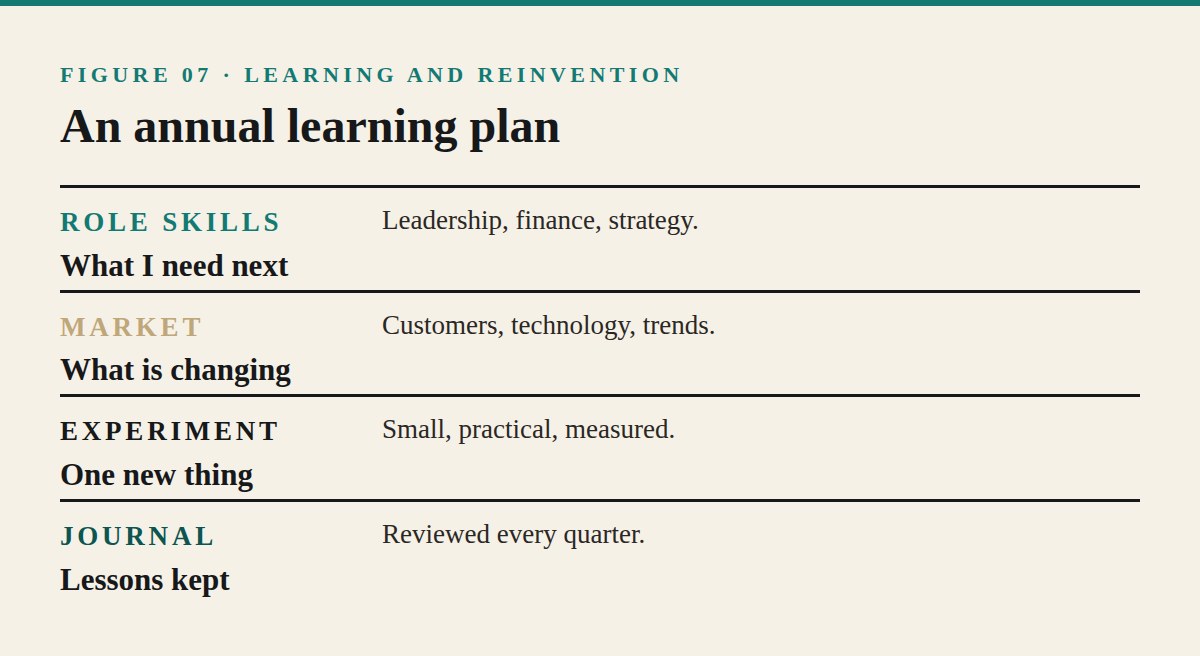
Each year, write a simple plan with three sections: skills to develop for your role, topics to explore about your market and one experiment to try. For each, note how you will learn (reading, courses, mentors or practice) and when. Review progress every quarter and record the most valuable lessons in a learning journal.
Questions to guide learning
Ask: What skill would most improve my leadership this year? What do I not understand well about my customers or market? Which new tool or idea could change our work? What have I learned from recent mistakes? Who could teach me something important? The answers shape a learning plan that serves both you and the business.
Reinvention as renewal
Reinvention does not mean abandoning what you have built. It often means applying experience in new ways: leading a new service line, mentoring other founders, writing about your field or starting a related venture. Many founders find that reinvention brings back the excitement they felt in their early years.
Common mistakes
Founders often stop learning once the business is established, focus only on technical skills, rely solely on past experience, resist new ideas or never make time for reflection. Others consume information without applying it. Deliberate, applied learning keeps founders relevant and energised.
An example in practice
A founder of a printing business saw demand for traditional printing decline. Instead of resisting change, he took courses in digital design and packaging, attended industry events and experimented with custom packaging services for small brands. Over several years, the business reinvented itself as a packaging and print specialist, and the founder described his work as more interesting than ever.
Learning from younger colleagues
Experienced founders can learn a great deal from younger team members and newer entrepreneurs, especially about technology, changing customer habits and new ways of working. Reverse mentoring, where a junior colleague shares their perspective with a senior leader, keeps founders curious and connected to how the world is changing.
Meaning · 08 of 08
Purpose and Legacy
Purpose sustains you through difficult years. Legacy is what your work leaves behind in the lives of others.
Founders often start businesses for practical reasons: income, independence or opportunity. Over time, many discover that money alone does not sustain motivation through decades of effort. Purpose, a sense of why the work matters, provides energy during difficult periods and meaning during successful ones. Legacy reflects the lasting impact of a founder's work on customers, employees, communities and family.
Discover your purpose
Purpose often becomes clear through reflection. Consider what you enjoy most about your work, which achievements make you proud and how your business improves the lives of others. Purpose may be found in serving customers, creating opportunities for employees, building something of quality or contributing to a community.
Connect purpose to daily work
Purpose is most powerful when connected to everyday activities. Remind yourself how routine tasks contribute to customer outcomes, team growth or community impact.
Share purpose with your team
When team members understand the purpose of the business, they often find greater meaning in their work. Shared purpose strengthens culture and commitment.
Consider your impact
Your business affects many people: customers who benefit from your products, employees who build careers, suppliers who grow with you and communities where you operate. Reflect on the impact you want to have.
Think about legacy
Legacy is not only for large businesses. It may include the reputation of your business, the people you have helped develop, the values you have upheld or the knowledge you have shared. Consider what you would like people to remember about your work.
Mentoring, teaching and sharing lessons learned help others benefit from your experience.
Build legacy through actions
Legacy is created through consistent actions over time: treating people fairly, maintaining quality, supporting others and contributing to your community.
Share your knowledge
Mentoring, teaching and sharing lessons learned help others benefit from your experience. Knowledge shared can create impact long after a business changes hands.
Revisit purpose over time
Purpose may evolve as your career progresses. Periodically reflect on why your work matters and how you want to contribute in the next stage of life.
A practical tool: the purpose and legacy statement
Write two short paragraphs. The first answers: Why does my work matter, and to whom? The second answers: What would I like my work to leave behind for customers, my team, my community and my family? Keep the statement with your vision and three-year plan, and read it when you face difficult decisions or periods of doubt.
Questions to reflect on
Ask: What moments in my work have made me proudest? Whose lives are better because of what we do? What do I want employees to say about working here? What would I like to teach others before I retire? How do I want to be remembered in my industry or community? These questions reveal purpose that numbers alone cannot measure.
Closing thought on resilience
This issue has explored what sustains a founder over a long career: sustainable habits, a broad identity, health, relationships, mentors and peers, recovery from setbacks and lifelong learning. Purpose and legacy give these practices meaning. A resilient founder is not someone who never struggles, but someone who knows why the work matters and keeps going for the right reasons.
Common mistakes
Founders often focus only on financial goals, assume purpose will appear naturally, keep purpose to themselves or think legacy matters only for large companies. Others neglect the human impact of their decisions. Deliberate reflection on purpose and legacy brings meaning and direction to a long career.
An example in practice
The founder of a small engineering company had built a profitable business but felt increasingly disconnected from his work. Reflecting on purpose, he realised that he valued developing young engineers and solving practical problems for local manufacturers. He introduced an apprenticeship programme, mentored junior staff and shared his expertise at local colleges. Years later, many engineers he trained held senior roles across the region, a legacy he valued more than any financial result.
Before you close this edition
Your Action Plan
Your next 30 days
Week 1: Take stock. Rate your health, relationships, energy, learning and sense of purpose from one to five.
Week 2: Protect the foundations. Choose one health habit and one relationship to invest in consistently.
Week 3: Find your people. Contact one potential mentor and one peer founder you would like to learn from.
Week 4: Reflect on purpose. Write why you do this work and what you would like it to leave behind.
Keep learning
Hustle Influence offers practical online courses and AI tools that help you turn ideas into action.
hustleinfluence.com
HUSTLE MAGHustle in Silence.