
Contents · Edition 048
Edition 048
From the Editors
This is the final issue of Hustle Mag's Complete Collection. Over forty-eight issues and four volumes, we have travelled the whole journey of building a business: from the first idea and the first customer, through marketing, sales and loyalty, into systems, money and leadership, and finally towards growth, wealth and the long view.
Reading about business is valuable. Acting on what you read is what changes a business. So this issue does something different. Instead of introducing new ideas, it brings the whole collection together: the core lessons of each volume, distilled into a few pages, and a practical method for turning them into one personal plan you can follow.
We begin with the whole journey and then distil each volume in turn. We help you write a one-page business plan that connects your vision, customers, systems, finances and personal goals. We set out your next ninety days and finish with how to keep learning and returning to the collection as your business grows.
Thank you for reading. Whether you are starting your first business or leading one you have built for years, we hope these pages have helped you build something you are proud of, and a life you are glad to live alongside it. Hustle in silence. Let the work speak.
The Editors, Hustle Mag
In This Edition
The Complete Playbook
Bringing the Whole Collection Together Into One Personal Plan
The Complete Playbook brings forty-seven issues together into one practical plan. It does not repeat every idea; it distils the most important lessons and shows how they connect, so you can decide where to focus next.
This issue begins with the whole journey, then distils each of the four volumes: Foundations; Marketing, Sales and Customers; Systems, Money and Leadership; and Growth, Wealth and Long-Term Strategy. It finishes with your one-page business plan, your next ninety days and how to keep going.
Each article ends with one step that turns the collection into action.
Cover Story · 01 of 08
The Whole Journey
From the first idea to the long view, building a business follows a path. Knowing where you are on it shows what to do next.
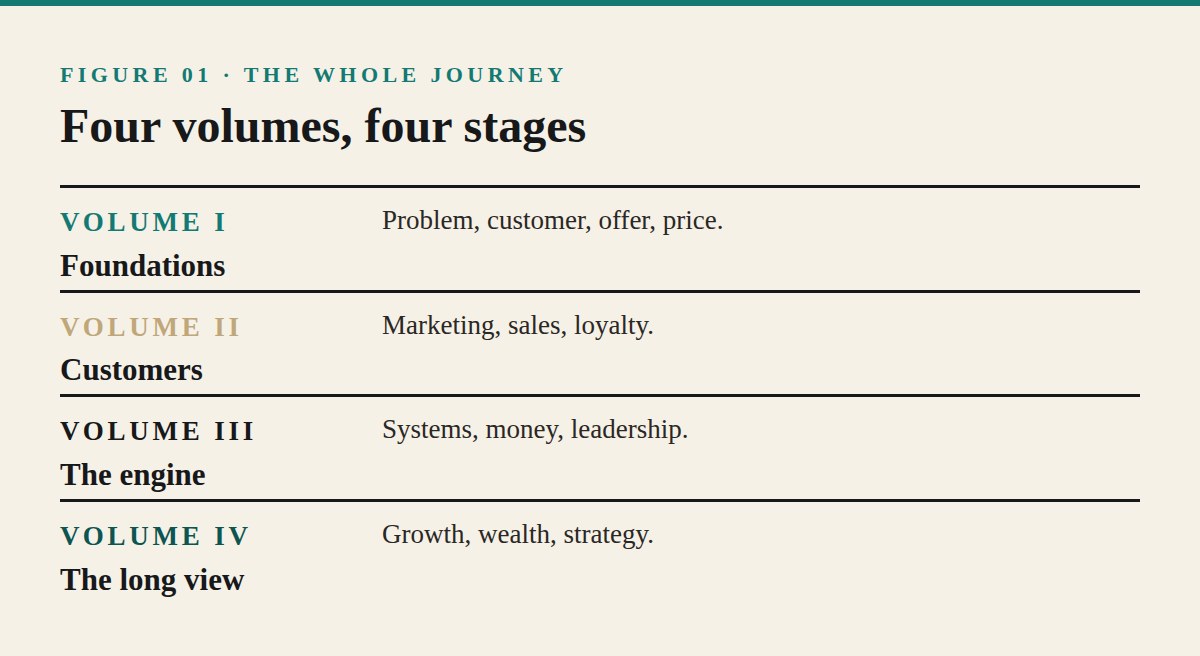
Every business is unique, yet most follow a recognisable path. An idea becomes an offer. An offer finds its first customers. Customers become a reliable flow through marketing, sales and loyalty. The business builds systems, manages money and develops people. Finally, it grows, creates wealth and plans for the long term. Understanding this path helps founders see where they are, what matters most now and what will matter next.
Stage one: foundations
The journey begins with a real problem, a clear customer and an offer that solves the problem well. Validation, pricing, simple operations and legal and financial foundations turn an idea into a working business. This stage is about proving that customers will pay.
Stage two: customers
Once the offer works, the focus shifts to attracting and keeping customers reliably: a marketing system, useful content, purposeful social media, email, honest selling, partnerships, careful advertising, an excellent customer experience, loyalty, community and reputation. This stage is about building a steady flow of the right customers.
Stage three: the engine
As the business grows, it needs an engine that runs without constant founder effort: documented systems, sound cash flow and profit, the first hires, good leadership, reliable operations, sensible tools, protected time, fair negotiation, resilience, good decisions and meaningful metrics. This stage is about building a business that works.
Stage four: the long view
Finally, the business grows deliberately, protects its quality, expands carefully, forms strategic partnerships and reinvests wisely. The founder turns business income into personal security, plans funding and eventual exit, and develops long-term strategy and personal resilience. This stage is about building something that lasts.
The stages overlap
Businesses rarely move neatly from one stage to the next. A growing business may still need to strengthen its foundations. An established business may need to rebuild its marketing. The stages are a map, not a strict sequence.
An established business may need to rebuild its marketing.
Find your current stage
Ask which stage presents your biggest challenges today. Many founders try to work on later-stage questions, such as scaling or exit, while earlier foundations remain weak. Strengthening the stage you are actually in usually produces the greatest progress.
Return to the collection
Each volume of the collection corresponds to one stage of the journey. Use the volume that matches your current stage as your main reference, and return to others as your business evolves.
A practical tool: the twelve-area assessment
Score your business from one to five on twelve areas, three per stage. Foundations: problem and customer, offer and pricing, basic operations. Customers: marketing system, sales, retention. Engine: systems, money, people. Long view: growth, personal finances, strategy. The three lowest scores are your priorities for the next ninety days.
Questions to locate yourself
Ask: Do customers reliably pay for what we offer? Do we have a steady flow of the right customers? Could the business run for a month without me? Are we profitable with healthy cash? Do I have a clear long-term direction and personal financial security? The first question answered "no" usually shows the stage that needs attention.
The journey is personal
No two founders travel the same path. Some build small, independent businesses that last for decades; others grow larger companies or move between ventures. The map is the same, but the destination is yours to choose, guided by the vision and definition of enough you have written along the way.
Common mistakes
Founders often focus on later stages before earlier foundations are strong, try to improve everything at once or assume that progress through the stages is permanent. Others never step back to see the whole journey. A clear map helps founders focus on what matters now.
An example in practice
A founder with a three-year-old business felt pressure to raise investment and expand nationally. Completing the twelve-area assessment, she found her lowest scores were retention, systems and money. She postponed expansion, improved onboarding and follow-up, documented key processes and introduced monthly profit reviews. A year later, the business was more profitable, less dependent on her and genuinely ready for growth.
Volume I · 02 of 08
Volume One Distilled: Foundations
Every lasting business rests on a real problem, a clear customer, a valuable offer and simple, sound foundations.

The first volume of the collection covered the foundations of a business: the idea, the customer, the offer, validation, pricing, lean operations, legal and financial basics, digital models, credibility and the step from side project to business. These foundations remain important long after a business is established. Many later problems can be traced back to weaknesses here.
Start with a real problem
Businesses succeed when they solve problems people genuinely care about. The strongest ideas come from understanding customers, their frustrations and the results they want, rather than from a product the founder simply likes.
Know your customer
A clearly defined customer makes every decision easier: messaging, pricing, product design and marketing. Businesses that try to serve everyone often struggle to become known for anything.
Validate before building
Evidence beats assumptions. Conversations, pre-sales, pilots and small tests show whether customers will pay before significant money and time are invested.
Create a clear offer
A strong offer explains what the customer receives, the result it delivers, the price and why they should trust you. Clarity makes buying easier.
Price with confidence
Prices should reflect value, cover costs and support a healthy margin. Underpricing is one of the most common and damaging mistakes in small businesses.
Operate lean
Keeping costs and complexity low in the early years allows the business to learn, adapt and survive. Spend where it creates value; avoid commitments the business cannot yet support.
Spend where it creates value; avoid commitments the business cannot yet support.
Build sound foundations
Appropriate legal structures, clear contracts, protected intellectual property, separate finances, good records and an understanding of tax obligations protect the business from avoidable problems. Qualified advisers help with the details.
Choose the right model
Services, digital products, subscriptions, content, marketplaces, online shops and hybrid models each have different economics. Choosing a model that suits your strengths and customers matters.
Earn credibility quietly
Proof, consistency and genuine expertise build credibility more reliably than loud promotion. A strong reputation grows from reliable work.
Make the leap carefully
Moving from a side project to a full business works best with evidence, financial preparation and a clear transition plan.
A practical tool: the foundations check
Answer ten questions with yes or no: Do we solve a real problem? Is our customer clearly defined? Have customers paid for our offer? Is the offer easy to explain? Are prices profitable? Are fixed costs manageable? Are finances separated and records current? Are key contracts in place? Do we have visible proof? Do we have a cash buffer? Each "no" points to a Volume I issue worth revisiting.
Questions to revisit regularly
Even established businesses benefit from asking: Has our customer changed? Is our offer still the clearest solution to their problem? Are our prices still right? Have our costs crept up? Are our legal and financial foundations still current? Foundations are not built once; they are maintained.
Common mistakes
Founders often build before validating, define customers too broadly, underprice, add costs too early, neglect legal and financial basics or rely on promotion instead of proof. Others treat foundations as finished once the business is running. Returning to foundations regularly keeps the business strong.
An example in practice
A founder of a growing online course business noticed falling conversion rates. Reviewing the foundations check, she realised her customer definition had become vague as she added courses for different audiences. She refocused on her original customer group, clarified her core offer and adjusted pricing. Conversion recovered, and new courses were designed around the clarified customer.
Foundations as a lifelong discipline
Founders who periodically return to the basics, the customer, the problem, the offer and the price, tend to build businesses that remain relevant for decades. When growth slows or confusion appears, the answer often lies not in a new tactic, but in revisiting these simple, fundamental questions.
Volume II · 03 of 08
Volume Two Distilled: Customers
Lasting growth comes from serving the right customers well, consistently, and giving them reasons to return and recommend you.
The second volume explored marketing, sales and customers: building a marketing system, creating content that sells, using social media with purpose, email marketing, selling without pressure, copywriting, partnerships and referrals, careful advertising, customer experience, retention and loyalty, community and reputation. Together, these issues describe how a business attracts the right customers and keeps them.
Build a marketing system
Marketing works best as a steady system: a clear customer, one core message, a few chosen channels, a consistent rhythm and simple measurement. Systems outperform occasional bursts of activity.
Create useful content
Content that genuinely helps customers builds trust before the first conversation and continues working for years. Specific, practical content connected to your offers attracts the right people.
Use social media with purpose
Choose platforms where your customers are, define the role social media plays and move followers towards channels you own, especially email.
Value your email list
Email remains one of the most effective owned channels. Welcome sequences, useful newsletters and respectful offers build relationships and sales.
Sell honestly
Selling is helping customers make good decisions. Discovery, qualification, clear recommendations, good proposals, respectful follow-up and clear questions create trust and results.
Write clearly
Clear, specific, benefit-focused copy written for one reader helps customers understand your value. Honesty in persuasion protects trust.
Grow through relationships
Referrals and partnerships bring customers who arrive with trust. Deliberate referral systems and well-chosen partners make growth more efficient.
Clear, specific, benefit-focused copy written for one reader helps customers understand your value.
Advertise carefully
Advertising amplifies what already works. Know your numbers, test small and scale gradually.
Design the experience
Every touchpoint shapes how customers feel. First impressions, onboarding, important moments, consistent standards and good recovery from mistakes create loyalty.
Keep customers
Retention is often more profitable than acquisition. Ongoing value, regular contact, honest upsells and attention to why customers leave increase lifetime value.
Build community and reputation
Communities built around shared goals deepen loyalty. Reviews and reputation, earned through excellent service and managed honestly, bring new customers quietly.
A practical tool: the customer engine check
Score your business from one to five on six areas: marketing system, content and owned channels, sales process, customer experience, retention and referrals or reputation. The lowest score shows where to focus. Revisit the Volume II issues connected to that area and choose one improvement for the next ninety days.
Questions to revisit regularly
Ask: Do we have a steady flow of the right customers? Which channel brings our best customers? How quickly do we respond to enquiries? Why do customers leave? How many new customers come from referrals? What do our reviews say? These questions reveal the health of the customer engine.
The customer at the centre
Every issue in Volume II returns to the same principle: lasting growth comes from genuinely serving customers. Marketing, sales and experience are not tricks to extract money; they are ways of helping the right people find, choose and benefit from what you offer.
Common mistakes
Businesses often chase new tactics instead of building systems, focus only on acquiring new customers, rely entirely on rented platforms, use pressure in sales or neglect the experience after purchase. Others ignore reputation until problems appear. A balanced, customer-centred approach creates lasting growth.
An example in practice
A small fitness studio scored low on retention and referrals in its customer engine check. Revisiting the relevant issues, the owner improved onboarding for new members, introduced monthly check-ins, created a member community and began asking satisfied members for referrals. Within a year, retention rose significantly and referrals became the studio's largest source of new members.
Volume III · 04 of 08
Volume Three Distilled: Systems, Money and Leadership
A business that runs well has documented systems, healthy finances, capable people and a founder who leads rather than does everything.
The third volume explored the inner workings of a business: systems that scale, cash flow, profit, hiring, leadership, operations, tools, time and energy, negotiation, risk and resilience, decisions and metrics. Together, these issues describe how a business becomes reliable, profitable and less dependent on its founder.
Systemise what matters
Document core processes, use checklists and templates, and build quality into the system. Systems allow work to be delegated and quality to remain consistent.
Manage cash carefully
Profit is not cash. Understand your cash conversion cycle, get paid on time, manage supplier payments, plan for seasons and maintain reserves.
Design for profit
Know your unit economics and margins, focus on profitable customers and offers, manage costs deliberately and set profit aside first.
Hire and lead well
Hire when the evidence supports it, define roles clearly, onboard thoughtfully and lead through direction, expectations, one-to-ones, feedback, recognition and a healthy culture.
Run operations deliberately
Map workflows, plan capacity, set priorities, find bottlenecks, design clean handovers and maintain a regular operating rhythm.
Choose tools carefully
Define processes before choosing tools, automate carefully, use AI responsibly, protect data and review your technology regularly.
Protect time and energy
Focus founder time on work only the founder can do, protect deep work, keep meetings purposeful and maintain a sustainable pace.
Prepare thoroughly, understand interests, protect value and follow through on agreements.
Negotiate fairly
Prepare thoroughly, understand interests, protect value and follow through on agreements.
Build resilience
Identify risks, reduce concentration, protect operations and data, prepare for financial shocks and plan for continuity.
Decide and measure well
Decide with enough information, match effort to reversibility, test assumptions, learn from decisions and track a small set of meaningful metrics.
A practical tool: the engine check
Score your business from one to five on six areas: systems, cash and profit, people and leadership, operations, resilience and metrics. Choose the lowest-scoring area, revisit the related Volume III issues and select one improvement for the next ninety days. Repeat the check each quarter to see the engine strengthen.
Questions to revisit regularly
Ask: Could the business run for a month without me? How many months of costs do our reserves cover? Do we know the profit of each main offer? Does each team member know what success looks like? Where does work wait longest? What are our biggest risks? Which ten numbers tell us how we are doing?
From founder to leader
The central theme of Volume III is the founder's transition from doing everything to building a business that works. Each system documented, each person developed and each number understood moves the founder from operator to leader, and the business from fragile to dependable.
Common mistakes
Founders often remain the bottleneck, confuse profit with cash, hire without clear roles, run operations by memory, buy tools before defining processes, overwork, avoid negotiation, ignore risks or track too many numbers. Others focus on systems while neglecting people. A balanced engine supports growth without exhausting the founder.
An example in practice
A founder of a small marketing agency scored low on cash and profit and on systems. Revisiting Volume III, she introduced deposits and staged payments, began monthly profit reviews, documented client onboarding and reporting, and delegated routine work to a trained team member. Within a year, the agency had a three-month cash reserve and she worked significantly fewer hours.
The engine and the founder's life
A strong engine changes the founder's life as much as the business. Reliable systems, healthy cash and capable people mean real holidays, calmer evenings and time for strategic thinking. Many founders discover that building the engine is what finally allows them to enjoy the business they created.
Volume IV · 05 of 08
Volume Four Distilled: Growth and Wealth
Lasting success means growing deliberately, building personal security and thinking in decades.

The fourth volume looked further ahead: the business of growth, scaling without losing quality, new markets and products, strategic partnerships, reinvestment, long-term wealth, personal finance, funding, exit and succession, long-term strategy and the resilient founder. Together, these issues describe how a working business becomes a lasting one, and how its founder builds security and a fulfilling life alongside it.
Grow as a system
Growth comes from connected stages: attracting, converting, retaining and expanding. Understand your growth equation, focus on the weakest stage, run experiments and make sure growth increases profit, not just revenue.
Protect quality
Growth exposes weaknesses. Protect the core experience customers value, turn personal standards into shared standards, train for consistency and say no to growth that would damage your reputation.
Expand carefully
Expand when the core business is strong, start next door to what you already do well, test before launching and protect the core during expansion.
Partner strategically
Strategic partnerships, such as distribution, licensing and joint ventures, can create value neither business could achieve alone. Choose partners carefully, agree terms clearly with professional advice and manage relationships over years.
Reinvest wisely
Reinvest in the areas that remove your biggest constraint: people, systems, marketing and your own development. Balance reinvestment with reserves and fair owner income.
Build personal security
Income is not wealth. Pay yourself regularly, save consistently, build security first, avoid debt traps, spread risk, think in decades, protect what you build and define what is enough. Seek qualified, independent advice for personal financial decisions.
Understand the trade-offs of bootstrapping, customer funding, loans, grants and equity.
Manage personal finances
Budget from lean months, separate business and personal money, set aside tax, prepare for quiet periods, manage lifestyle creep, talk openly at home and review annually.
Choose capital carefully
Understand the trade-offs of bootstrapping, customer funding, loans, grants and equity. Choose the money that fits your goals and your ability to meet its obligations.
Plan the exit early
Build a transferable, valuable business, understand your options and plan both the transition and life afterwards.
Think long term and last
Create a vision, lasting positioning and durable advantages. Be patient, adapt without drifting and review strategy annually. Sustain your health, relationships, learning and purpose over a long career.
A practical tool: the long-view check
Score yourself from one to five on six areas: profitable growth, quality at scale, reinvestment discipline, personal financial security, exit readiness and long-term strategy. Add a seventh: your own resilience. Choose the lowest score and revisit the related Volume IV issues for one improvement over the next ninety days.
Questions to revisit regularly
Ask: Is growth adding profit as well as revenue? Would customers say our quality has held as we grew? How much of my wealth depends on the business? Could the business run, be sold or be handed over without me? Do I have a clear ten-year vision? Am I building a life I want to sustain? These questions keep the long view in focus.
Better, not just bigger
The central message of Volume IV is that success is not measured by size alone. A business that grows deliberately, protects its quality, supports its founder's security and serves a clear purpose is a lasting success, whatever its size.
Common mistakes
Founders often chase revenue over profit, let quality slip during growth, expand before the core is ready, reinvest everything without reserves, neglect personal finances, choose capital in a hurry, postpone exit planning or sacrifice health and relationships for growth. A deliberate long view prevents these costly errors.
An example in practice
A founder of a twelve-year-old consultancy scored low on personal financial security and exit readiness. Revisiting Volume IV, she began paying herself a regular salary, built personal savings outside the business with an adviser's help, developed two senior consultants and documented client processes. Five years later, she had real choices: continue, step back or sell, all from a position of security.
The Plan · 06 of 08
Your One-Page Business Plan
Everything you have learned, connected on a single page: where you are going, how you will get there and what matters most now.
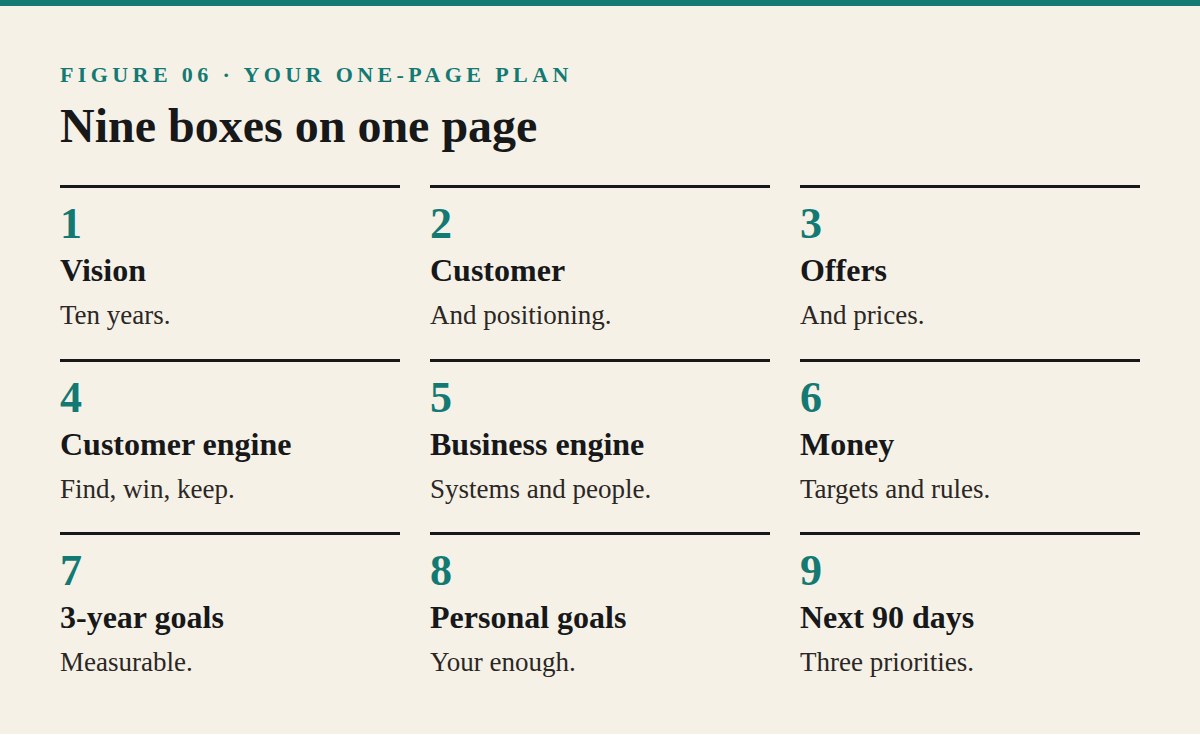
Throughout the collection, many issues have suggested writing something down: a vision, a positioning statement, a pricing review, a cash forecast, a three-year plan, an enough statement. A one-page business plan brings the most important of these together. It connects your long-term direction with your customers, operations, finances, personal goals and immediate priorities.
A single page is easier to remember, share and use than a long document.
Section one: vision and purpose
Write one or two sentences describing what your business will be in ten years and why it matters. Include who you serve and the impact you want to have.
Section two: customer and positioning
Describe your ideal customer, the problem you solve and what you are known for. Add your positioning statement and what you deliberately do not do.
Section three: offers and pricing
List your main offers, their prices and the outcome each delivers. Note which offers are most profitable and which need attention.
Section four: customer engine
Summarise how customers find you, how they buy and how you keep them: your main marketing channels, sales process, retention approach and referral sources.
Section five: business engine
Note the systems, people and tools that run the business, the key risks and how they are managed.
Section six: money
Record your key financial targets: revenue, gross margin, profit, cash reserve target, owner income and reinvestment rule.
List three to five goals for the next three years, each with a measure.
Section seven: three-year goals
List three to five goals for the next three years, each with a measure.
Section eight: personal goals
Include your definition of enough, your desired role, working hours, health and family priorities and personal financial goals.
Section nine: priorities for the next ninety days
Choose three priorities that will move the business towards its three-year goals, each with an owner and a measure.
Keep it current
Review the plan monthly against your priorities, update it quarterly and revise it fully during your annual strategy review.
A practical tool: the one-page template
Divide a page into nine boxes with the headings above. Write briefly in each, using phrases rather than paragraphs. If a box is difficult to complete, that difficulty is useful: it shows exactly which issue of the collection to revisit. Print the finished page and keep it where you will see it every week.
Questions to test your plan
Ask: Does every section support the vision? Do the three-year goals and ninety-day priorities connect clearly? Are the financial targets realistic? Do the personal goals fit the business plan, or conflict with it? Could a team member understand the plan in five minutes? A strong plan is clear, connected and honest.
Sharing the plan
Share the business sections of the plan with your team, so everyone understands where the business is going and how their work contributes. Keep the personal sections for yourself, your family and trusted advisers. A shared direction makes daily decisions easier for everyone.
Common mistakes
Founders often write long plans nobody reads, separate business and personal goals, set too many priorities, write plans and never review them or create plans disconnected from real numbers. Others avoid planning because it feels formal. A single, connected and regularly reviewed page turns ideas into direction.
An example in practice
A founder had read the collection over two years and filled notebooks with ideas but felt scattered. Using the one-page template, she connected her ten-year vision for a specialist bookkeeping practice with clear positioning, profitable offers, a referral-based customer engine, a cash reserve target, three-year goals and three priorities for the next quarter. For the first time, she said, every decision had a clear reference point.
Action · 07 of 08
Your Next 90 Days
Long-term plans are achieved ninety days at a time. Three priorities, weekly actions and steady review turn the plan into progress.
A plan becomes valuable only when it changes what happens each week. Ninety days is long enough to make meaningful progress and short enough to stay focused. Breaking long-term goals into ninety-day priorities, weekly actions and regular reviews is one of the most effective ways to turn ambition into results.
Choose three priorities
Select three priorities that will move the business most towards its three-year goals. Use your twelve-area assessment and the checks from the volume summaries. Choose the weakest areas with the greatest impact. Three priorities are enough; more usually means less progress on each.
Define success
For each priority, write what success will look like at the end of ninety days and how you will measure it. For example: "Average payment time reduced from forty-five to twenty-five days" or "Onboarding process documented and used for every new client."
Break priorities into weekly actions
List the actions needed to achieve each priority and spread them across the ninety days. Each week should include at least one action for each priority.
Assign owners
If you have a team, assign an owner to each priority. Ownership creates accountability and spreads the work.
Protect time
Schedule time in your calendar for priority work. Without protected time, urgent tasks will absorb the week.
Review weekly
Use your weekly founder review to check progress on each priority, complete the week's actions and plan the next. Weekly reviews keep priorities visible.
Which priorities should continue, change or be replaced?
Adjust when needed
If an action is not working, change it. The goal is the outcome, not the original plan.
Review at ninety days
At the end of the period, review results. What was achieved? What was learned? Which priorities should continue, change or be replaced? Then choose the next ninety-day priorities.
A practical tool: the ninety-day plan
Create a one-page plan with three columns, one per priority. In each column, write the priority, the success measure, the owner and the actions for months one, two and three. Below the columns, list your weekly review time and the date of the ninety-day review. Display the plan where you will see it every day.
Questions for each week
Ask in every weekly review: What progress did we make on each priority? What got in the way? What is the most important action for each priority next week? Do we need to adjust anything? What will we stop doing to make time? Short, consistent questions keep momentum.
Small steps, large results
Ninety days may seem short, but four cycles a year create twelve meaningful improvements. Over three years, that becomes thirty-six focused improvements to the business. Steady, repeated cycles of focus and review are how ordinary businesses become exceptional over time.
Common mistakes
Founders often choose too many priorities, set vague goals, fail to schedule priority work, skip weekly reviews or abandon priorities when urgent tasks arise. Others never review results at the end of the period. Focused priorities, weekly actions and regular review make steady progress almost inevitable.
An example in practice
A café owner chose three ninety-day priorities from her one-page plan: introduce deposits for catering orders, document the morning opening process and launch a loyalty programme. She scheduled two hours every Monday for priority work and reviewed progress each Friday. By the end of the quarter, all three were complete, cash flow had improved and opening shifts ran smoothly without her presence.
Celebrating each cycle
At the end of every ninety days, take a moment to recognise what has been achieved, with your team if you have one. Celebrating completed priorities builds momentum and makes the next cycle easier to begin with energy.
Closing · 08 of 08
Continuing the Journey
The collection ends here, but the work of building a business never does. Keep learning, reviewing and returning.
This is the final article of the Complete Collection. Over forty-eight issues, we have explored the whole journey of building a business: foundations, customers, systems, money, leadership, growth, wealth and the long view. No single reading can capture everything. The collection is designed to be returned to, again and again, as your business and your life evolve.
Return to the collection
Different stages bring different challenges. When you launch a new offer, revisit the foundations. When growth slows, revisit the customer engine. When you feel overwhelmed, revisit systems, time and leadership. When you think about the future, revisit growth, wealth and strategy. The right issue at the right moment can be more valuable than reading everything at once.
Keep the rhythm
The habits described throughout the collection create steady progress: weekly founder reviews, monthly profit reviews, quarterly priorities and annual strategy days. Rhythm matters more than intensity.
Keep learning
Markets, technology and customers will keep changing. Continue learning from customers, mentors, peers, books, courses and your own experience. Curiosity keeps founders adaptable.
Keep measuring
Return regularly to your twelve-area assessment and the checks from each volume. Measuring progress shows what has improved and what needs attention.
Keep it human
Behind every business are people: customers, employees, partners, families and the founder. The best businesses are built with care for all of them.
Remember your definition of enough, your health, your relationships and your purpose.
Keep your balance
Remember your definition of enough, your health, your relationships and your purpose. A business is a means to a good life, not a replacement for it.
Share what you learn
As your experience grows, help others. Mentoring, teaching and sharing lessons multiplies the value of everything you have learned.
Hustle in silence
The phrase that runs through this magazine is not about working endlessly or loudly. It is about doing the work consistently, building quietly and letting results speak. Lasting businesses are rarely built in a burst of noise. They are built steadily, through good decisions repeated over years.
A practical tool: the annual return
Each year, during your strategy review, repeat three exercises from this issue: the twelve-area assessment, the one-page business plan and the choice of your next ninety-day priorities. Compare the results with previous years. Over time, this annual return becomes a record of how far you and your business have come.
Questions to carry forward
Keep asking: Who do we serve, and how well? Is the business becoming stronger, not just busier? Are we profitable, resilient and prepared? Am I growing as a leader? Is the business supporting the life I want? These questions, asked regularly, will guide you long after the last page.
A final word
Thank you for reading Hustle Mag. Whether you began with Issue 001 or found the collection years into your journey, we hope it has offered clarity, encouragement and practical tools. Build something you are proud of. Look after the people around you, and yourself. And keep going.
Common mistakes
Readers often finish a collection and set it aside, return only during crises, stop the habits that created progress or forget to measure how far they have come. Others try to apply everything at once. Steady, selective and repeated use of the collection creates lasting results.
An example in practice
A founder who began reading Hustle Mag in the first year of her business returned to it each January during her strategy day. In early years, she focused on foundations and customers; later, on systems and leadership; eventually, on wealth and exit planning. A decade later, she described the collection as a companion that had grown alongside her business.
Before you close this edition
Your Action Plan
Your next 30 days
Week 1: Assess. Score your business on the twelve core areas of the playbook and identify the three weakest.
Week 2: Plan. Complete your one-page business plan, connecting vision, customers, systems, money and personal goals.
Week 3: Commit. Choose three priorities for the next ninety days, with weekly actions and measures.
Week 4: Begin the rhythm. Start a weekly review and schedule your quarterly and annual reviews.
Thank you for reading the Complete Collection
All forty-eight issues of Hustle Mag, in four volumes, are yours to return to whenever your business needs them.
hustleinfluence.com
HUSTLE MAGHustle in Silence.