
Cover Story · 01 of 08
The Startup Playbook: How to Turn an Idea Into a Real Business
From problem to first sale, the six decisions that separate a business from a hobby.
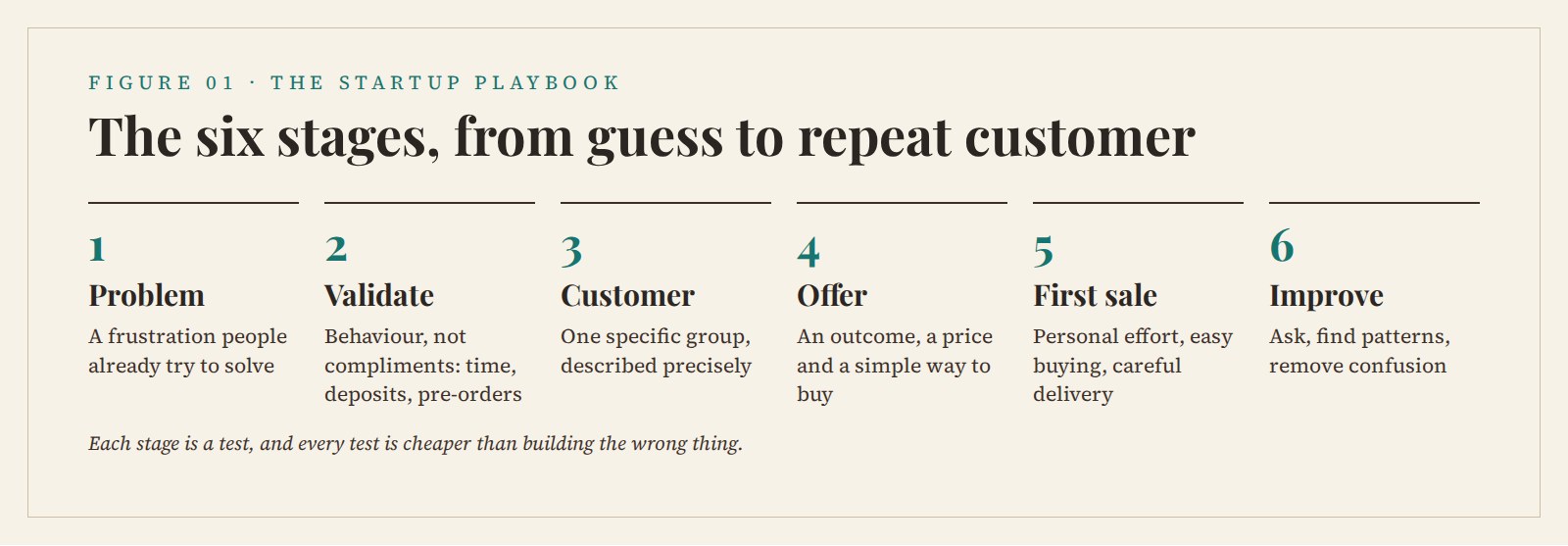
An idea is not a business. It is a guess. A business begins when that guess meets a real customer who is willing to exchange money for what you offer, and then does it again. Everything between the first thought and that repeated exchange is the work of turning a guess into evidence.
This playbook covers that work in six stages. None of them requires a large budget. All of them require honesty.
1. Start with a problem, not a product
The most common mistake new founders make is falling in love with a solution. They imagine an app, a product or a brand and then search for people who might want it. The order should be reversed. Begin with a problem that people already experience, already find frustrating and already try to solve.
A useful test is to ask: What are people doing about this today? If the answer is "nothing," the problem may not be painful enough. If the answer is "they use a clumsy workaround, pay for something they dislike or spend hours doing it by hand," you may have found something worth pursuing.
Consider a freelance bookkeeper who noticed that small restaurant owners kept their receipts in shoeboxes and paid accountants extra at year-end to sort them. The problem was obvious, frequent and already costing money. The business was a simple monthly service: collect receipts weekly, keep the books tidy and send a one-page summary. The idea was modest. The problem was real.
2. Validate demand before you build
Validation means collecting evidence that people want what you plan to offer. Compliments are not evidence. Friends who say "great idea" are being kind. Evidence is behaviour: people who give you time, information, a deposit or a pre-order.
Begin with conversations. Speak with ten to fifteen people who have the problem and ask about their recent experience. "Tell me about the last time this happened" produces far better answers than "Would you use a service that…?" Listen for how often the problem occurs, what it costs them and what they have already tried.
Then look for stronger signals. Would they join a waiting list? Pay a small deposit? Book a paid trial? Each step up the ladder of commitment tells you more than any survey.
3. Define a specific customer
"Everyone" is not a customer. A business that tries to serve everyone usually speaks to no one. Choose a specific group whose problem you understand well, and describe them precisely: who they are, what situation they are in, what they want and what stops them.
A precise description might read: independent café owners with one or two locations who post on social media inconsistently because they have no time. That sentence tells you where to find customers, what language to use and which offer will appeal. You can widen your market later. At the beginning, narrow is an advantage.
4. Test a simple offer
An offer is more than a product. It is a promise of an outcome, presented at a price, with a clear way to buy. Write it down in plain language before you build anything substantial:
- Who it is for: the specific customer.
- What it achieves: the result they care about.
- What is included: the concrete deliverables.
- The price and terms: what it costs and how they pay.
Then test it with the smallest possible version. A service can be sold before it is perfected. A product can be pre-sold with a clear delivery date. A course can begin as a live workshop. The goal is not to impress; it is to learn whether people will pay.
5. Make the first sale
The first sale changes everything because it proves that the exchange works. It rarely arrives through advertising. It usually comes from direct, personal effort: a conversation, a referral, a message to someone who told you about their problem two weeks ago.
Make buying easy. One clear price, one simple payment method and a prompt follow-up. Deliver more care than the customer expects, and pay close attention to everything that happens during delivery. Your first customers are also your best teachers.
6. Improve with feedback
After each sale, ask three questions: What nearly stopped you from buying? What was most valuable? What would you change? Write the answers down and look for patterns rather than reacting to every comment.
Improvement is not the same as adding features. Often the best change is removing confusion: a clearer description, a simpler onboarding step, a faster first result. Small, steady improvements based on real feedback compound into a business that customers recommend.
The takeaway
The path from idea to business is a series of tests, each one cheaper than building the wrong thing. This week, write down one problem you could solve, name the specific customer who has it and arrange three conversations with people in that group. Do not pitch. Listen. The business begins there.