
Opportunity · 02 of 08
Finding a Business Idea Worth Pursuing
Where good opportunities actually come from, and a simple way to judge them before you commit.
Good business ideas are rarely invented in a flash of inspiration. They are noticed. They hide in complaints, in clumsy workarounds, in skills people take for granted and in the small changes that reshape how customers live and buy. The founder's job is to look carefully and then judge honestly.
This article covers both halves of that job: where to look, and how to decide whether an idea deserves your time and money.
Listen for frustration
Every frustration is a potential market. Pay attention to what people complain about, especially when they complain repeatedly and with specifics. "I can never find a reliable plumber who answers the phone" is more useful than "plumbers are bad." The first sentence points to a service gap: reliability and responsiveness.
Online reviews are a rich source. Read the three-star reviews of popular products and services in a field that interests you. One-star reviews are often emotional; five-star reviews are often vague. Three-star reviews tend to say, "It's good, but…" and the sentence after "but" is frequently a business idea.
Start from your skills
Many durable businesses begin with a skill the founder already has. A graphic designer becomes a branding studio for local trades. A former retail manager becomes a consultant who helps small shops organise their stock. A fluent bilingual speaker becomes a specialist translator for a particular industry.
List the things people already ask you to help with, the problems you solve easily that others find difficult, and the work you have been paid for before. Skills reduce the cost of starting and improve the quality of what you deliver from the first day.
Look for gaps in existing markets
A market gap is a group of customers that existing businesses serve poorly. It might be a segment that is too small for large companies to notice, a location without a good option, or a price point between "cheap and unreliable" and "excellent but expensive."
Gaps often appear when you combine two things: a familiar service with an underserved audience. Fitness coaching is common. Fitness coaching for people returning to exercise after an injury is narrower, more specific and easier to market. Accounting is everywhere. Accounting for freelance creatives who are paid through several platforms solves a particular headache.
Notice changing needs
Customer needs change with technology, regulation, work patterns and habits. When many people start working from home, they need better home offices, new routines and different services. When a new platform becomes popular, businesses need help using it. When rules change, people need guidance to comply.
Ask: What has recently become easier, harder, cheaper or more important for a particular group? Change creates new problems, and new problems create openings for businesses that respond quickly and clearly.
Evaluate before you commit
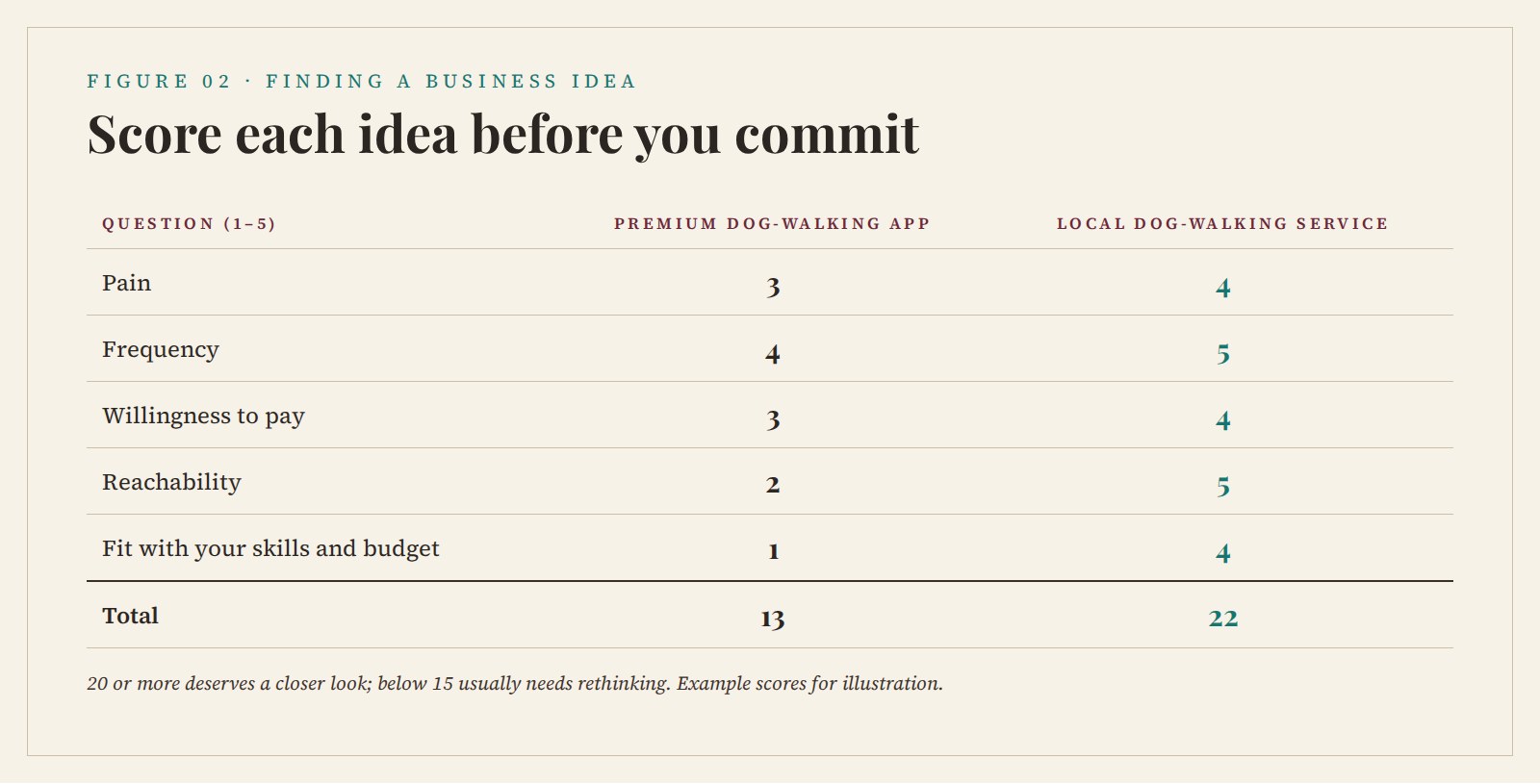
Once you have a few candidate ideas, resist the temptation to start building the most exciting one. Instead, score each idea on five questions, from 1 (weak) to 5 (strong):
- Pain: How much does this problem cost or frustrate the customer?
- Frequency: How often does it happen?
- Willingness to pay: Are people already spending money on solutions?
- Reachability: Can you easily find and contact these customers?
- Fit: Do your skills, budget and time suit this business?
An idea scoring 20 or more deserves a closer look. An idea scoring below 15 usually needs rethinking, however appealing it seems.
Consider two ideas. A premium dog-walking app scores high on excitement but low on reachability and fit for a founder with no technical skills and a small budget. A local dog-walking service with reliable scheduling and photo updates scores well on pain, frequency, willingness to pay and reachability. The second idea is less glamorous and far more likely to become a real business.
Warning signs
Some ideas look promising but carry hidden weaknesses. Be cautious when the main appeal is that a market is "hot" rather than that a specific problem is painful; when you cannot name ten real people who have the problem; when success depends entirely on a single platform, supplier or trend outside your control; or when the idea only works if large numbers of customers arrive immediately.
None of these signs automatically rules an idea out. Each one, however, is a question to answer with evidence before you invest serious time or money.
Run small tests
Scoring is a starting point, not a verdict. The next step is a small test that costs little and teaches a lot. Speak with potential customers, create a simple page that describes the offer and collects interest, or sell a limited version by hand. Set a clear goal before you begin, such as ten conversations, five people asking for a price or two paid trials.
If the test succeeds, you have earned the right to invest more. If it fails, you have saved months of effort. Both outcomes are progress.
The takeaway
Opportunities come from frustration, skill, market gaps and change, but only evidence tells you which ones are worth pursuing. Write down three ideas, score each on pain, frequency, willingness to pay, reachability and fit, and design one small test for the highest-scoring idea this week.