
Money · 03 of 08
Start Small: Building a Business on a Limited Budget
Lean thinking, honest priorities and the expenses that can wait.
A small budget is not a disadvantage to be overcome. Handled well, it is a discipline that protects founders from their most expensive mistakes: building too much, too early, for customers who have not yet proved they exist.
Starting lean does not mean starting cheaply in every respect. It means spending deliberately, in the right order, on the things that create evidence and revenue.
Think in experiments, not launches
The traditional picture of starting a business involves a grand launch: a finished website, a full product line, printed materials and an advertising budget. The lean approach replaces that picture with a series of experiments. Each experiment answers one question as cheaply and quickly as possible.
Will people in this neighbourhood pay for weekly meal preparation? You do not need a commercial kitchen to find out. You need a simple menu, a few willing customers and a clear price. Will small businesses pay for monthly social media content? You need a short offer document and a handful of conversations, not a full agency brand.
Every experiment should have a defined cost, a time limit and a clear measure of success.
Separate essential from optional
Before spending money, place each expense into one of three categories:
- Essential now: Without it, you cannot deliver or legally operate. Examples include basic tools of the trade, required registrations and a way to take payments.
- Useful soon: It would make work easier once you have customers. Examples include better software, a professionally designed logo or a nicer workspace.
- Optional: It feels like progress but does not create customers. Examples include elaborate branding packages, premium office space and stock you have not tested.
In the beginning, spend almost exclusively on the first category. Move items from "useful soon" into the budget only when revenue or a clear bottleneck justifies them.
Validate before you invest
The cheapest research is a conversation. The next cheapest is a pre-sale. Before you buy stock, sign a lease or commission a website, look for proof that customers want what you plan to offer.
A small clothing brand might sell a limited pre-order run before committing to a full production order. A consultant might sell three projects at an introductory rate before investing in a polished website. A course creator might run a live online workshop before recording a complete programme. In each case, the customer funds the next step.
Use simple tools
Many early businesses run perfectly well on simple, inexpensive tools: a spreadsheet for customers and finances, a free or low-cost website builder, a shared document for processes and a basic payment provider. Complex software can come later, when you understand your workflow well enough to know what you need.
A useful rule is to adopt a new tool only when you can name the specific problem it solves and the time or money it will save. Tools that promise to transform everything rarely fix a business that has not yet found its customers.
Prioritise spending that creates revenue
When money is limited, rank possible expenses by how directly they lead to sales. Improving your offer, reaching potential customers and delivering excellent work come first. Decoration comes later.
A bakery owner with a modest budget might choose better ovens over a premium shopfront design, because the ovens improve the product customers taste every day. A freelancer might invest in a professional microphone for client calls before a custom logo, because clear communication wins work.
Keep a simple monthly budget with three lines: money in, money out and what you learned. If an expense does not support delivery, sales or learning, question it.
Know your break-even point
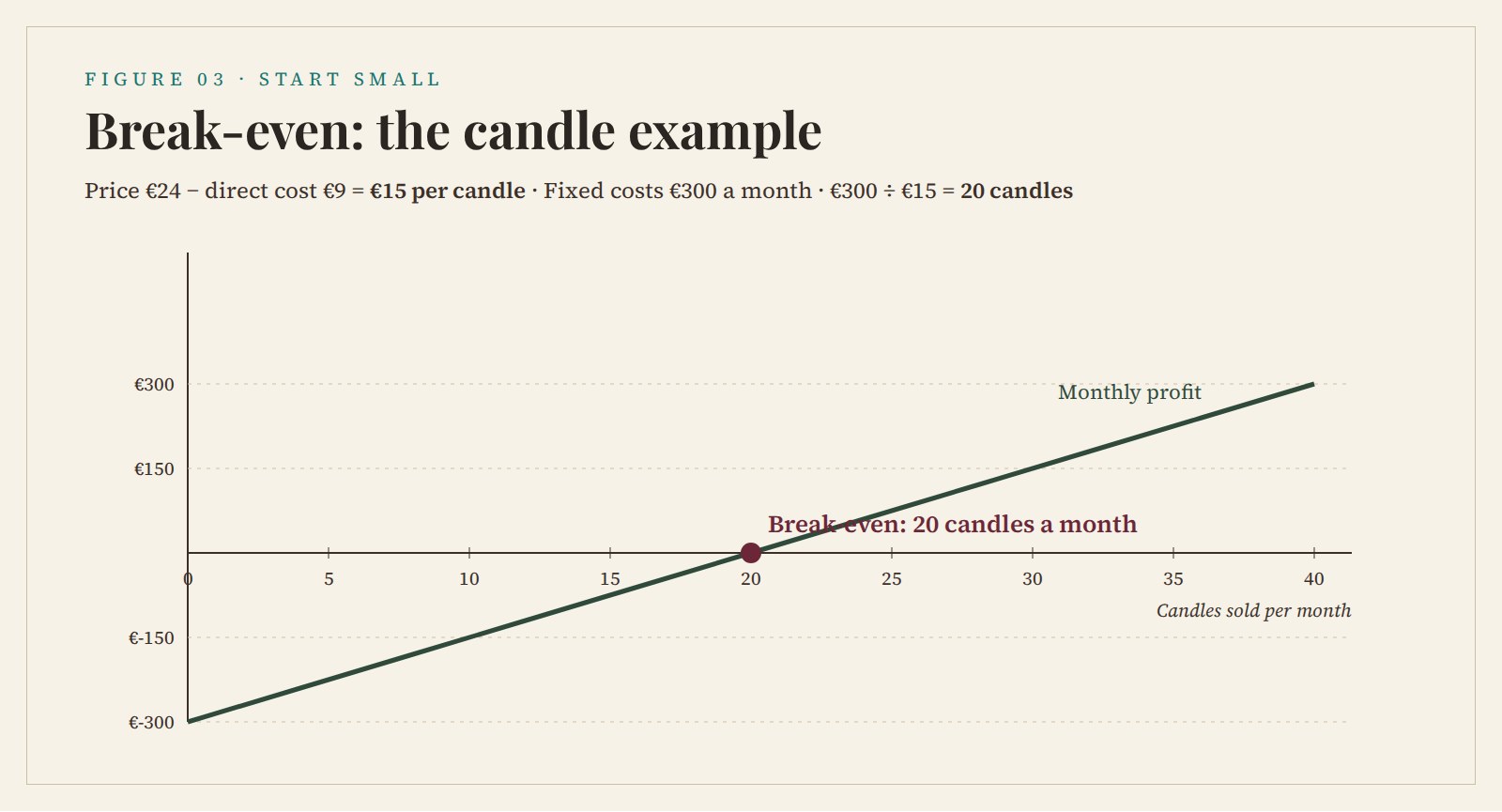
Every founder on a budget should know one number: how many sales it takes to cover monthly costs. The calculation is simple. Subtract the direct cost of each sale from its price to find what each sale contributes. Then divide your fixed monthly costs by that contribution.
Imagine a handmade candle business. Each candle sells for €24 and costs €9 in wax, jars, wicks and packaging, so each sale contributes €15. Fixed costs, including website, tools and a small market-stall fee, come to €300 a month. The business breaks even at 20 candles a month. Anything beyond that is profit; anything below it is a loss to be fixed.
Knowing this number turns vague worry into a clear target, and it shows instantly whether a new expense is worth the extra sales it requires.
Protect your runway
Your runway is the time you can keep going before money runs out. Protect it by keeping fixed costs low, avoiding long contracts early on and holding back a cash reserve for surprises. Monthly commitments are more dangerous than one-off purchases, because they continue whether or not customers arrive.
If possible, keep another income source while you test your business. Starting part-time is slower, but it allows you to make decisions based on evidence rather than fear.
The takeaway
A limited budget rewards clear thinking. List every expense you are planning, mark each as essential now, useful soon or optional, and delay everything that is not essential until a customer or a clear bottleneck justifies it.