
Strategy · 04 of 08
Business Models Explained: How Your Business Will Make Money
Six common models, what each demands of you, and how to choose the one that fits.
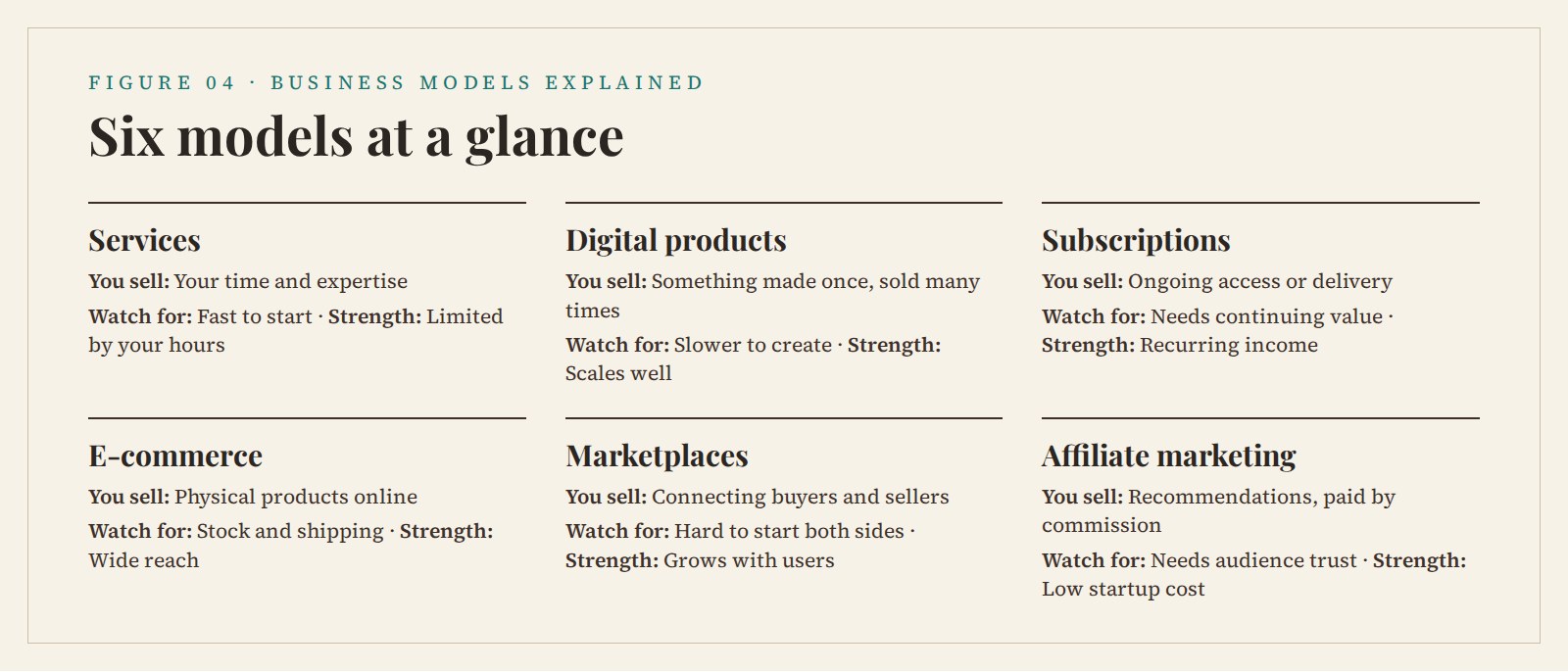
A business model is the logic of how a business creates value and earns money from it. Two businesses can serve the same customer with the same skills and still look entirely different because they choose different models. Choosing well early saves years of friction.
Here are six common models, what makes each work and what each asks of the founder.
Services
You sell your time, expertise or labour: design, consulting, cleaning, bookkeeping, coaching, marketing. Services are usually the fastest way to begin earning, because you can start with skills you already have and little upfront investment.
Strengths: quick to start, close contact with customers, high margins on skilled work. Challenges: income is limited by your hours, and growth often requires hiring.
A service business suits founders who want early revenue and deep customer knowledge. Many successful product companies began as services, learning exactly what customers needed before turning that knowledge into something scalable.
Digital products
You create something once and sell it many times: templates, guides, courses, software tools, design assets or music. Digital products can be delivered instantly and have very low costs per sale.
Strengths: scalable, no inventory, sales are not tied to your hours. Challenges: significant upfront creation time, and marketing becomes the main constraint.
Digital products work best when you understand a specific audience's problem well enough to package a clear solution.
Subscriptions
Customers pay regularly for ongoing access or delivery: software, memberships, boxes of products or recurring services. The attraction is predictable revenue that builds month after month.
Strengths: recurring income, easier planning, higher lifetime value per customer. Challenges: you must deliver continuing value, or customers cancel.
The key number in a subscription business is retention. Attracting new subscribers matters, but keeping them is what creates a stable business.
E-commerce
You sell physical products online, either products you make, buy wholesale, source from manufacturers or ship through third-party suppliers. E-commerce can reach customers far beyond your location.
Strengths: large potential market, tangible products, opportunities to build a brand. Challenges: inventory risk, shipping, returns, thinner margins and advertising costs.
Success depends on careful product selection, honest pricing that accounts for every cost, and excellent customer service.
Marketplaces
You connect buyers and sellers and earn a commission or fee on transactions: platforms for local tutors, freelance designers, rental equipment or handmade goods. Marketplaces can become very valuable once they reach scale.
Strengths: you do not hold inventory, and value grows as more people join. Challenges: you must attract both buyers and sellers at the same time, which is difficult at the start.
Marketplaces often begin by focusing on one narrow niche or location, where it is easier to build both sides.
Affiliate marketing
You recommend products or services made by others and earn a commission when people buy through your links. Affiliate businesses are usually built on content: reviews, comparisons, tutorials, newsletters or videos.
Strengths: no product creation, low startup costs, flexible schedule. Challenges: income depends on audience trust and traffic, and programmes can change their terms.
Honesty is the foundation. Clear disclosure, genuine recommendations and helpful content build the trust that affiliate income depends on.
One skill, three models
To see how much the model matters, consider a food photographer. As a service, she photographs menus for local restaurants and charges per shoot. As a digital product, she sells a pack of lighting presets and a short guide to phone food photography. As a subscription, she offers restaurants a monthly package: fresh photos of seasonal dishes, delivered every four weeks.
The skill is identical in each case. The customers, the marketing, the workload and the income pattern are completely different. The service brings cash quickly. The digital product earns while she sleeps but needs an audience first. The subscription offers stability but demands reliable monthly delivery. None is "best"; each suits a different founder at a different stage.
How to choose
Choose a model by answering four questions:
- What does the customer prefer? Some customers want a done-for-you service; others want to learn and do it themselves.
- What can you offer well today? Your skills and resources should match the model's demands.
- How much capital and time do you have? Services need little money; e-commerce and marketplaces often need more.
- What kind of business do you want to run? A service means client work; a digital product means creation and marketing; a subscription means continuous delivery.
Models can also be combined over time. A marketing consultant might start with services, create a template pack for clients who cannot afford a full engagement, and later launch a membership with monthly guidance. Each step builds on what came before.
The takeaway
The right model fits the customer, the offer and the founder at the same time. Write down two models that could suit your idea, list what each would require from you in time, money and skills, and choose the one you could start testing within thirty days.