
Planning · 05 of 08
The First Business Plan: A Practical Roadmap for Founders
Forget the forty-page document. Nine questions and a 90-day plan you will actually use.
The traditional business plan has an image problem. Many founders picture a long document full of projections, written to impress a bank and then forgotten in a drawer. That kind of plan has its place, but it is not what a new business needs first.
What a new business needs is a working roadmap: short enough to read in five minutes, specific enough to guide decisions and honest enough to change when evidence arrives. Here is a framework built around nine questions, followed by a 90-day execution plan.
The one-page plan
Answer each question in two or three sentences. If you cannot, that is useful information: it shows where your thinking needs work.
1. Target customer. Who exactly are you serving? Describe their situation, not just their demographics. "Freelance designers who struggle to find steady clients" is more useful than "people aged 25 to 40."
2. Problem. What specific problem do they have, and what does it cost them in time, money or stress?
3. Offer. What will you provide, and what outcome will the customer get? Name the concrete deliverables.
4. Positioning. Why should customers choose you instead of an alternative, including the option of doing nothing? State one clear reason.
5. Pricing. What will you charge, and why? Base the price on the value of the outcome and the cost of delivery, not only on what competitors charge.
6. Marketing channels. Where will you find your first customers? Choose one or two channels you can work on consistently.
7. Expenses. What will it cost to deliver and to operate each month? Separate one-off costs from recurring ones.
8. Revenue assumptions. How many customers do you expect, at what price, over what period? Write these as assumptions to test, not facts.
9. Key risks. What could stop this from working, and how will you find out early?
A one-page plan in practice
Here is how the first five answers might read for a small social media service. Customer: owners of independent cafés with one or two locations. Problem: they know they should post regularly but have no time, so their accounts look abandoned. Offer: twelve professionally written and designed posts a month, scheduled in advance, with one short monthly report. Positioning: specialised in cafés, with menu-based content ideas ready every season. Pricing: a fixed monthly fee, with a three-month minimum.
Five sentences, and the founder already knows where to find customers, what to say to them and what to deliver. That is the purpose of a first plan.
Writing realistic assumptions
The weakest part of most first plans is the revenue section. It is tempting to start with a target, such as €5,000 a month, and work backwards to whatever numbers make it possible. Reverse the process. Start with what you can actually do.
How many conversations can you hold each week? What share of them might reasonably turn into sales? How long does each delivery take? A consultant who can hold eight sales conversations a week and closes one in four will win about two clients a week, if each client can be served in the time available. Assumptions built from activity are easier to test and harder to fool yourself with.
Mark every assumption with the date by which you expect to know whether it holds. Your plan then becomes a list of questions with deadlines.
The first 90 days
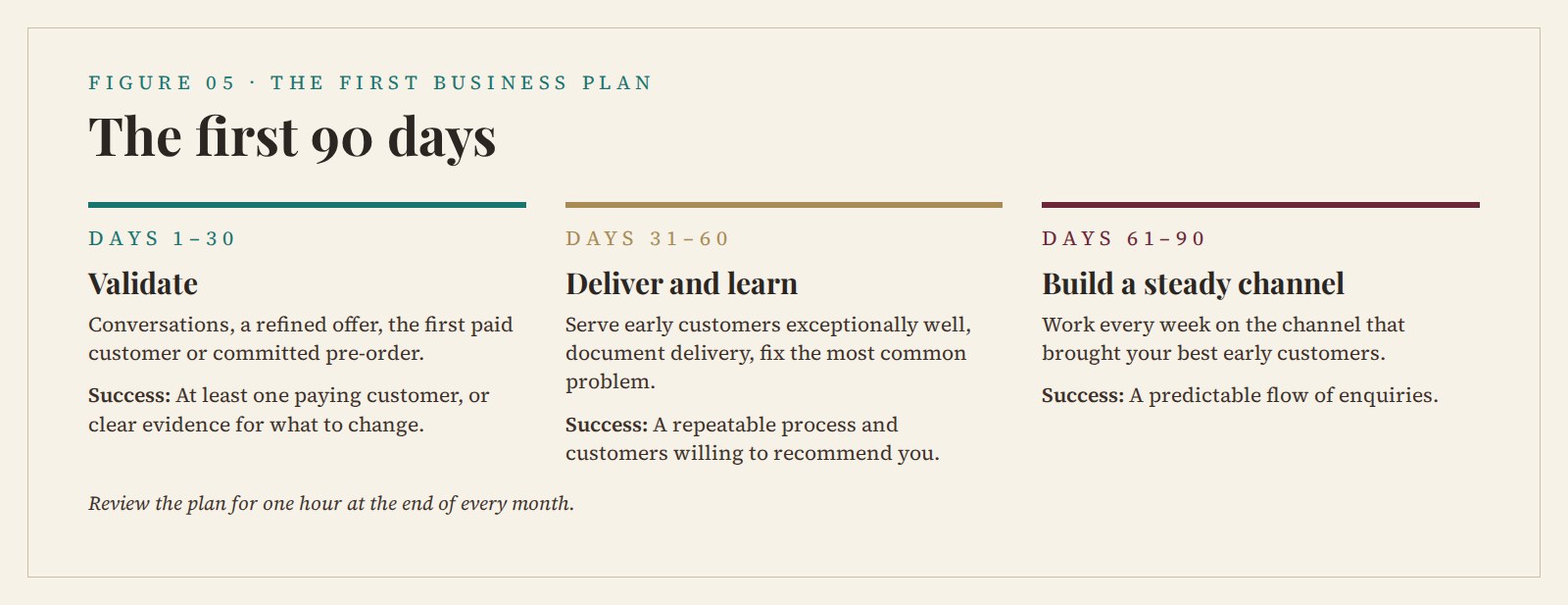
A plan is only useful if it turns into action. Divide the first three months into three focused phases.
Days 1–30: Validate. Hold conversations with potential customers, refine the problem and the offer, and aim for your first paid customer or committed pre-order. Success measure: at least one paying customer, or clear evidence for what to change.
Days 31–60: Deliver and learn. Serve your first customers exceptionally well. Document how you deliver the work so it can be repeated. Collect feedback and testimonials, and fix the most common problem. Success measure: a repeatable delivery process and satisfied customers willing to recommend you.
Days 61–90: Build a steady channel. Choose the marketing channel that produced your best early customers and work on it every week. Set a weekly activity target, such as a number of posts, outreach messages or partner conversations. Success measure: a predictable flow of enquiries.
Review the plan monthly
Set aside an hour at the end of each month. Compare what happened with what you assumed. Which assumptions held? Which were wrong? What will you change next month?
The plan is not a promise you failed to keep when reality differs. It is a tool for noticing the difference early. Founders who review their plans regularly make smaller mistakes and correct them faster.
When you need a longer plan
If you seek a bank loan, investment or a significant partnership, you may need a fuller document with financial statements, market analysis and detailed projections. The one-page plan is still the right foundation. A longer plan built on tested assumptions is far more convincing than one built on hope.
The takeaway
A good first plan is short, specific and constantly tested. This week, answer the nine questions on a single page, write your three most important assumptions with a deadline for each, and set one measurable goal for your first 30 days.