
Brand · 06 of 08
Branding Before Promotion: Building a Business People Remember
A brand is not a logo. It is the promise customers believe you will keep.
Many founders treat branding as decoration: a logo, a colour palette and a clever name, arranged before launch and admired on a screen. These elements matter, but they are the visible surface of something deeper. A brand is what people believe about your business, and what they expect when they choose you.
Promotion amplifies that belief. If the belief is unclear or weak, promotion simply spreads confusion faster. That is why branding comes first.
Start with positioning
Positioning is the place your business occupies in the customer's mind compared with the alternatives. It answers a simple question: Why this, rather than something else?
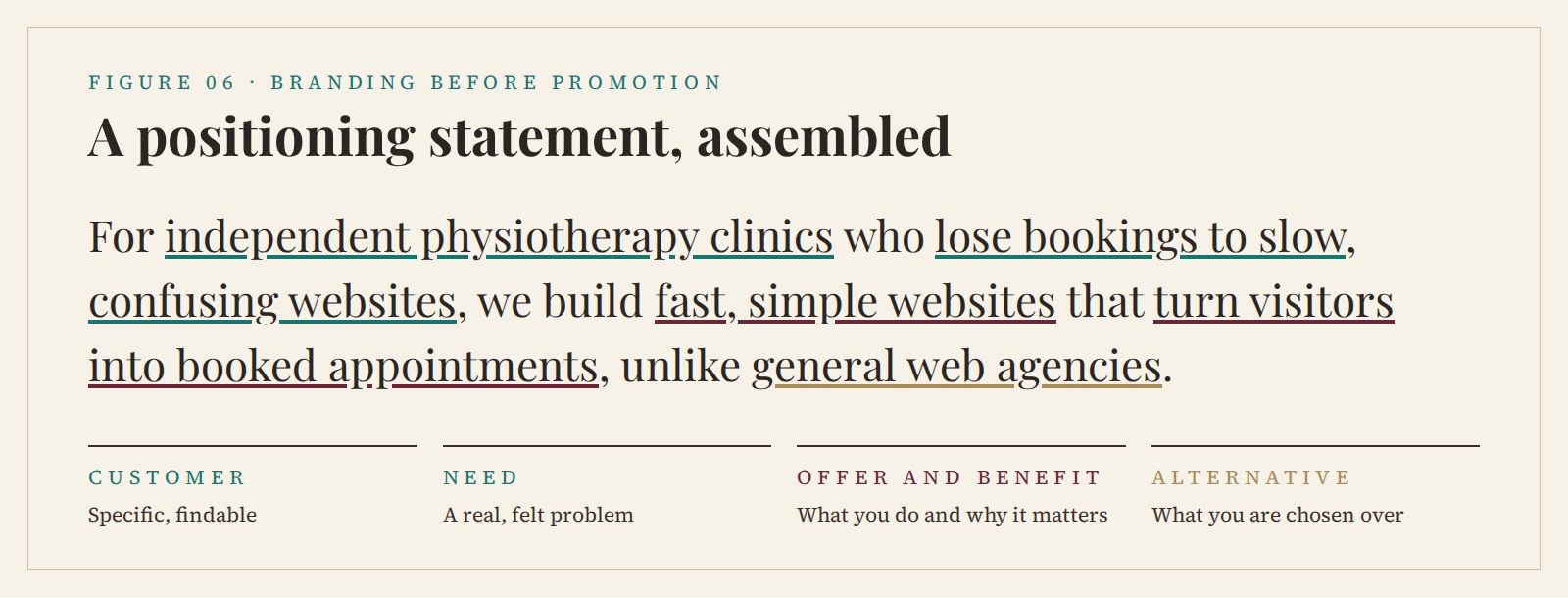
Strong positioning is specific. "A web designer" competes with thousands of others. "A web designer who builds fast, simple websites for independent physiotherapy clinics" stands apart instantly. The narrower statement makes marketing easier, referrals more natural and prices easier to defend.
A useful formula: For [specific customer] who [need or problem], we provide [offer] that [distinct benefit], unlike [alternative]. Write it plainly, even if you never publish the sentence. It will guide every decision that follows.
Make a brand promise you can keep
A brand promise is the experience customers can rely on every time. It might be speed, reliability, craftsmanship, clarity, warmth or expertise. It must be true, and it must be delivered consistently.
A small removals company might promise "on time, every time, with nothing broken." That promise shapes hiring, scheduling, packing materials and how complaints are handled. The promise is not a slogan to print on a van. It is a standard the whole business lives by.
Be careful not to promise everything. "Cheapest, fastest and highest quality" convinces no one. Choose what you will be known for, and accept what you will not.
Differentiate with substance
Differentiation means giving customers a real reason to choose you. The strongest reasons are rarely cosmetic. They come from a better process, deeper specialisation, a clearer guarantee, a more convenient experience or a particular point of view.
Ask your first customers why they chose you. Their answers often reveal your genuine differentiation more accurately than any brainstorming session. One accountant discovered that clients valued her plain-English monthly summaries more than anything else. She made those summaries the centre of her brand.
Stay consistent
Consistency builds recognition and trust. Customers should have a similar experience whether they visit your website, read an email, speak with you on the phone or receive your product.
Consistency covers your name and visual style, but also your tone of voice, response times, quality standards and the way you handle problems. A beautifully designed website followed by slow, careless replies damages a brand more than a plain website followed by excellent service.
Write down a few simple rules: how you describe what you do, how you sound, which colours and fonts you use, and how quickly you respond. Share them with anyone who helps you.
Visual identity: clear before clever
Your logo, colours and typography should be clear, appropriate for your customers and easy to use across your materials. A financial advisory firm and a children's party business should not look alike, because their customers expect different things.
At the beginning, a simple, well-executed identity is enough. A clean wordmark, two or three colours and one or two fonts used consistently will serve you better than an elaborate design you cannot maintain. Invest more once you understand your customers and your positioning.
Build credibility
New businesses lack history, so they must earn trust in other ways. Show real work and real results. Share specific testimonials with permission. Explain your process openly. Display clear contact details, honest prices and fair policies. Write useful content that demonstrates your expertise.
Every claim should be true and verifiable. Credibility built honestly grows over time. Credibility borrowed through exaggeration collapses at the first disappointed customer.
A brand in practice
Consider a small cleaning company that described itself as "professional cleaning services for homes and offices." Its website looked like dozens of others, and customers chose mainly on price.
After asking its best clients why they stayed, the owner noticed a pattern: busy parents valued the fact that the same trusted cleaner came every week and left a short note about anything unusual. The company repositioned itself as "the same trusted cleaner, every week, for busy families." It introduced the weekly note as a standard, featured its cleaners by first name and replaced generic stock photos with real ones.
Nothing about the cleaning changed. What changed was clarity. Enquiries became more relevant, cancellations fell and price discussions became shorter, because customers understood exactly what they were paying for.
The takeaway
Branding is the work of deciding what you stand for and then proving it consistently. Write your positioning statement and a one-sentence brand promise, ask three customers why they chose you, and adjust your website and messages so they communicate that real value clearly.