
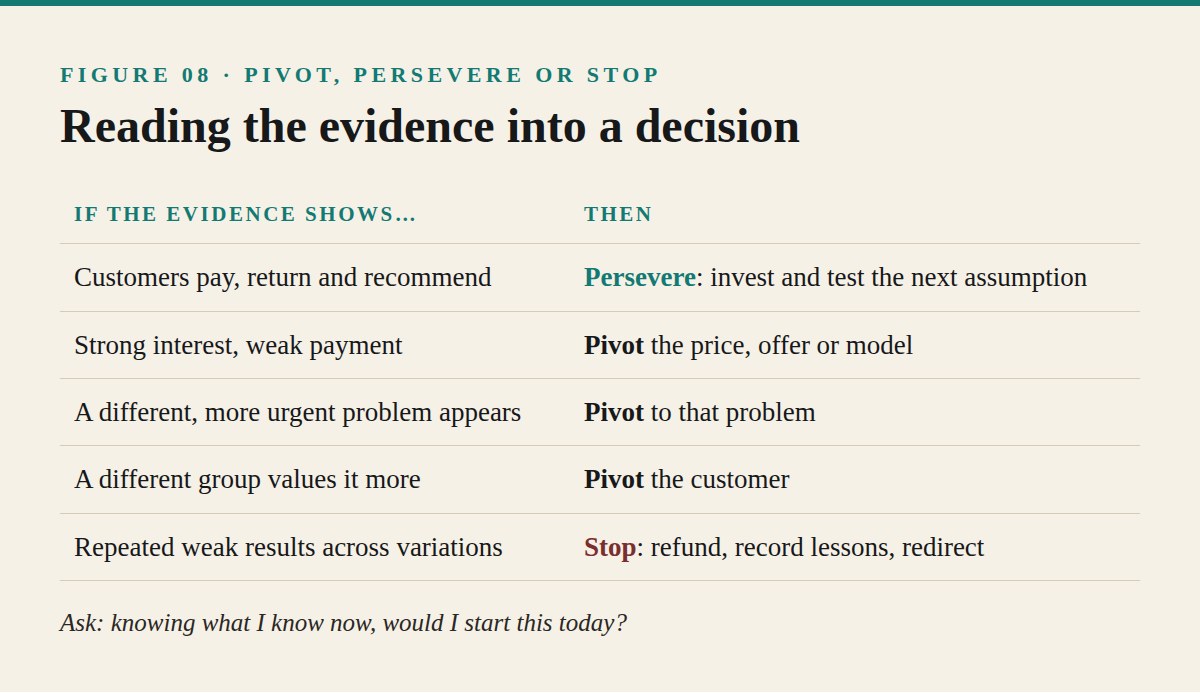
Validation is not an endless process of testing. Its purpose is to support decisions. After each meaningful round of evidence, a founder faces three options: persevere with the current direction, pivot to a different approach or stop and redirect time and money elsewhere.
None of these decisions is a failure. The real failure is avoiding the decision and continuing out of habit, hope or fear of admitting that the evidence points elsewhere.
Persevere when the evidence is strong
Persevering makes sense when your riskiest assumptions are being confirmed: customers pay, return and recommend, and the economics look viable. In this case, the next step is to invest more deliberately: improve delivery, strengthen marketing and test the next assumption, such as whether growth can be achieved affordably.
Perseverance should still be evidence-based. Continue testing as you grow, because new assumptions emerge at every stage.
Pivot when part of the idea works
A pivot is a significant change to one part of the idea while keeping what has been validated. Common pivots include:
- Customer pivot: the same solution for a different customer group that values it more.
- Problem pivot: the same customers, but a more important problem they need solved.
- Offer pivot: a different format, such as a service instead of software.
- Pricing pivot: a different business model or price structure.
- Channel pivot: a different way of reaching and selling to customers.
Pivots are most effective when based on specific evidence. If interviews repeatedly reveal a different, more urgent problem, that is a strong reason to change direction.
Stop when the evidence is clear
Stopping is the hardest decision, especially after investing time, money and emotion. Yet stopping an idea that the evidence does not support frees resources for something better. Many successful founders abandoned several ideas before finding one that worked.
Consider stopping if repeated tests across different audiences, messages and prices consistently fail to produce meaningful commitment, or if the economics cannot work even under optimistic assumptions.
The sunk cost trap is the tendency to continue investing because of what has already been spent.
Avoid the sunk cost trap
The sunk cost trap is the tendency to continue investing because of what has already been spent. Past investment cannot be recovered, and it should not determine future decisions. Ask instead: knowing what I know now, would I start this project today? If the answer is no, continuing is difficult to justify.
Set decision points in advance
Before starting a validation phase, define when you will make a decision and what evidence will guide it. For example: "After six weeks and fifty conversations, we will persevere if we have at least ten paying customers, pivot if interest is strong but conversion is weak, and stop if neither condition is met."
Predefined decision points reduce emotional pressure and prevent indefinite testing.
Stop well
If you decide to stop, do so responsibly. Refund any customers who paid for undelivered products, thank people who helped, document what you learned and share the lessons with others where appropriate. A well-managed ending protects your reputation and leaves relationships intact for your next venture.
Keep what you learned
Every validation effort produces valuable knowledge: customer insights, marketing skills, supplier contacts and a better understanding of what makes a business work. These assets carry forward into the next idea, which is often stronger because of the experience.
An example in practice
A team built a scheduling app for hair salons. After two months of tests, salon owners showed polite interest but few paid. In interviews, however, several mentioned the same frustration: clients who failed to turn up. The team pivoted to a simpler product focused on deposits and reminder messages for appointments. The same salon owners began paying within weeks, because the new offer solved a problem that cost them money every day.