
Meetings are often criticised as a waste of time, and many are. Yet well-run meetings can align priorities, solve problems quickly, make decisions and strengthen relationships. The problem is not meetings themselves, but meetings without purpose, preparation or outcomes.
Start with a clear purpose
Every meeting should have a reason to exist. Is it to make a decision, solve a problem, share important information, plan work or build relationships? If the purpose is unclear, the meeting may not be necessary.
Consider alternatives
Some meetings can be replaced with a short written update, a shared document or a quick message. Use meetings for discussions that benefit from real-time conversation.
Invite the right people
Invite only those who need to contribute or make decisions. Others can receive a summary afterwards. Smaller meetings are often faster and more productive.
Share an agenda
Prepare a short agenda listing topics, desired outcomes and time allocations. Share it in advance so participants can prepare.
Keep meetings short
Set a clear end time and respect it. Many meetings can be shortened from sixty minutes to thirty or even fifteen without losing value.
Stay focused
Guide the discussion towards the agenda and desired outcomes. If unrelated topics arise, record them for another conversation.
End with decisions and actions
Before the meeting ends, summarise decisions, actions, owners and deadlines. Share a brief written summary afterwards.
Review them regularly and ask whether each still has a clear purpose.
Review recurring meetings
Recurring meetings can continue long after they stop being useful. Review them regularly and ask whether each still has a clear purpose.
Protect meeting-free time
Consider grouping meetings on certain days or times, leaving other periods free for focused work.
A practical tool: the meeting card
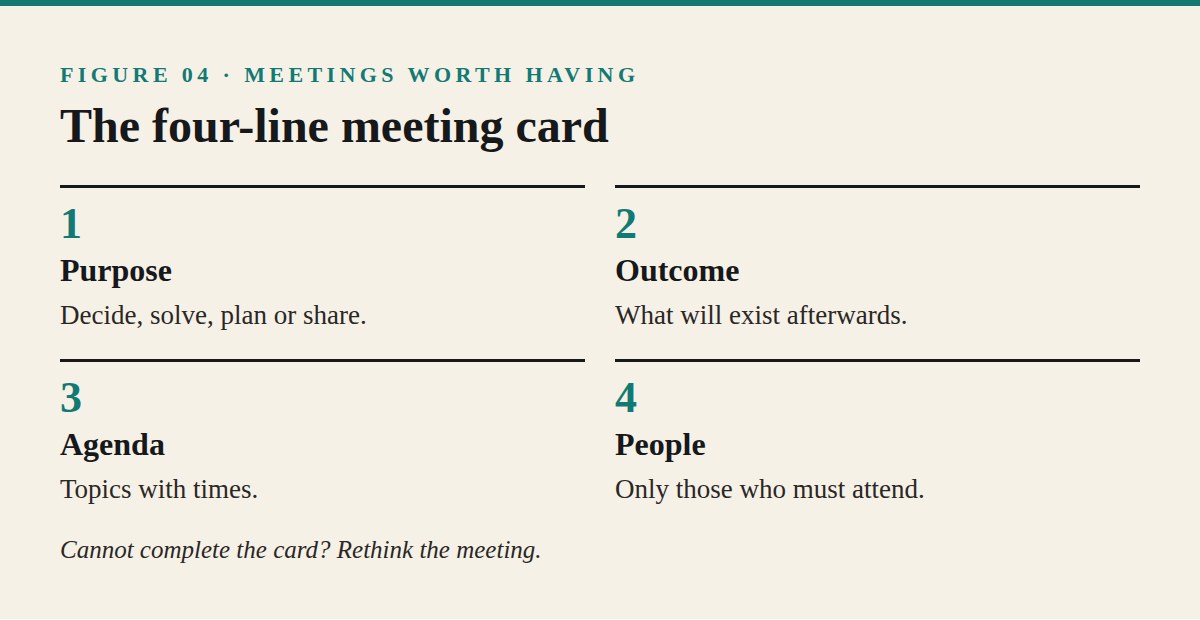
For every meeting you organise, write four lines in the invitation: purpose, desired outcome, agenda with times and who needs to attend. If you cannot complete the card, the meeting probably needs rethinking. Over time, the card becomes a habit that makes every meeting sharper.
Questions for recurring meetings
Every quarter, ask about each recurring meeting: What decisions has it produced recently? Could it be shorter or less frequent? Is everyone attending necessary? Could part of it be handled in writing? Would anyone miss it if it stopped? Cancelling or shortening one meeting can return hours each month.
Common mistakes
Businesses often schedule meetings without clear purposes, invite too many people, skip agendas, allow discussions to drift or end without decisions and actions. Others keep recurring meetings that no longer add value. Purposeful, focused meetings save far more time than they consume.
An example in practice
A small software company held a one-hour weekly meeting with the entire team, often spending most of the time on updates that could have been shared in writing. The founder replaced it with a short written update on Mondays and a thirty-minute meeting focused only on decisions and blockers. Meeting time halved, and team members reported feeling more informed and productive.
The founder's meeting load
Founders often attend far more meetings than necessary, simply because they are invited or feel they should be present. Review your calendar regularly and ask whether your presence changes the outcome. Delegating attendance, receiving written summaries or joining only for key decisions can free significant time.
One-to-one versus group meetings
Many topics are better handled one-to-one than in a group. Performance, personal concerns and detailed project questions rarely need the whole team. Moving these conversations out of group meetings shortens them and makes them more relevant for everyone who attends.
Ending meetings early
When a meeting achieves its purpose ahead of time, end it. Finishing early respects people's time, rewards good preparation and encourages focused discussion in future. A meeting does not need to fill its scheduled slot to be successful.