
Execution · 08 of 08
The Founder's Discipline: Turning Ambition Into Consistent Execution
Motivation starts the work. Systems, focus and honest reviews finish it.
Ambition is common. Execution is rare. Most people who dream of building a business have enough intelligence and energy to succeed. What separates those who do from those who drift is usually not talent but discipline: the ability to choose what matters, do it consistently and learn from what happens.
Discipline is often misunderstood as relentless willpower. In practice, it is better described as good design. Disciplined founders build simple systems that make the right work easier and the wrong work harder.
Choose fewer priorities
A new business offers endless possible tasks: improving the website, posting on every platform, refining the logo, researching tools, networking, learning new skills. Doing a little of everything feels productive and achieves little.
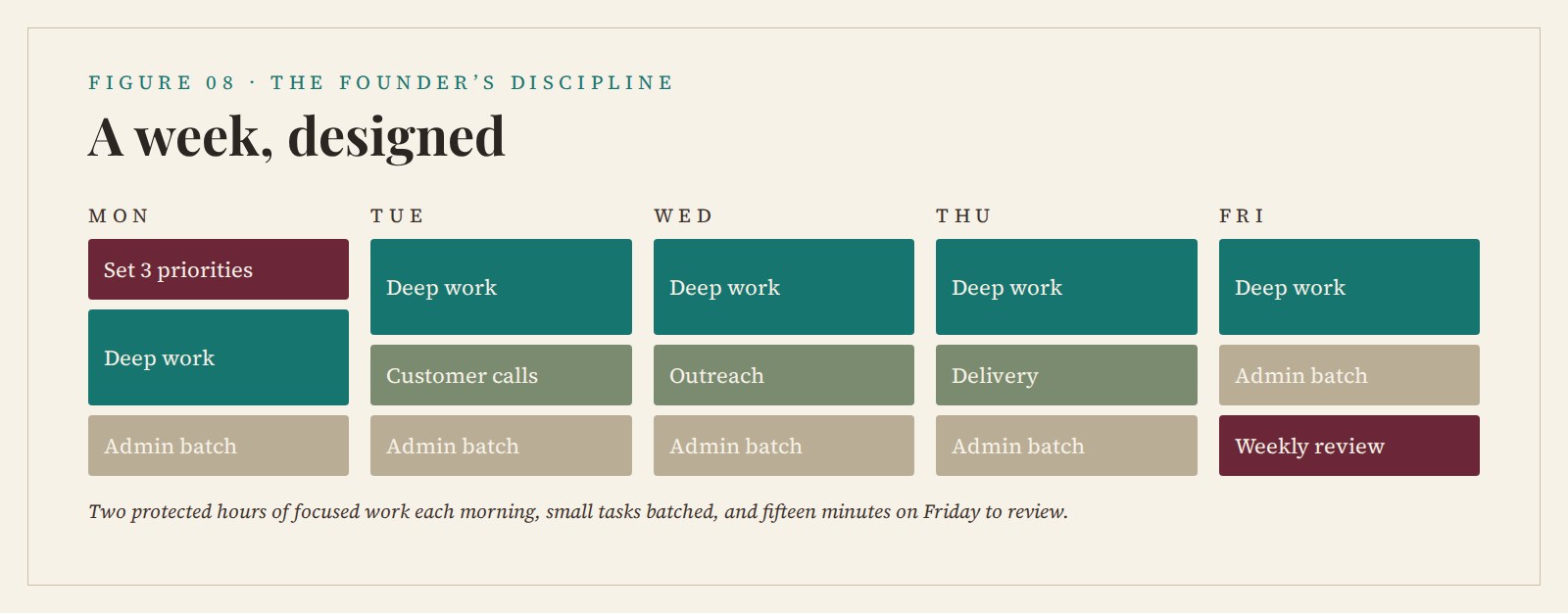
Each week, choose no more than three priorities that move the business forward. Early on, almost all of them should relate to customers: speaking with them, selling to them, delivering for them or improving what you offer. A useful question when choosing is: If I only achieved this one thing this week, would the business be meaningfully better?
Write your three priorities somewhere visible. When a new idea appears, write it on a separate list rather than starting it immediately. Most ideas look less urgent a week later.
Protect your focus
Deep, focused work is where most valuable progress happens: writing an offer, building a product, solving a difficult customer problem. It is also the work most easily interrupted.
Reserve blocks of time for focused work and protect them. Turn off notifications, close unrelated tabs and tell others when you are unavailable. Many founders find that two uninterrupted hours in the morning produce more than an entire day of scattered effort.
Group small administrative tasks, such as emails, invoices and messages, into one or two set times each day instead of handling them the moment they arrive.
Manage time realistically
Founders consistently overestimate what they can do in a day and underestimate what they can do in a year. Plan with this in mind. Leave space in your schedule for the unexpected, and break large goals into small, concrete next actions.
"Grow the business" is not a task. "Send five outreach messages to café owners" is. When your next action is clear and small, starting becomes easier, and starting is often the hardest part.
If you are building alongside a job or other responsibilities, be honest about your available hours. Five focused hours a week, used consistently on the right priorities, can build a real business over time.
Learn to say no
Every yes is also a no to something else. Opportunities will arrive that look attractive: a side project, a partnership outside your focus, a customer who wants something you do not really offer. Saying yes to all of them spreads your time thin and slows the core business.
Before accepting a new commitment, ask whether it supports your current priorities. If it does not, decline politely, or write it on your idea list for a later review. Founders who protect their focus often move faster precisely because they do fewer things.
Make decisions and move
Indecision is expensive. Founders often delay decisions while waiting for perfect information that never arrives. Most early decisions are reversible: a price can be changed, a message rewritten, a channel abandoned.
For reversible decisions, set a short deadline, gather the information you reasonably can and decide. Save extended deliberation for decisions that are costly or difficult to undo, such as long contracts, large purchases or partnerships. Then judge decisions by the quality of your reasoning at the time, not only by the outcome.
Track progress honestly
What gets measured gets attention. Choose a small number of indicators that reflect real progress: conversations held, offers sent, sales made, customers retained, revenue and costs. Record them weekly in a simple spreadsheet.
Track activities as well as results. Results often lag behind effort, especially at the start. If you held twenty sales conversations and made no sales, that is valuable information about your offer. If you held two conversations, the problem is activity, not the offer.
Learn from setbacks
Every founder faces rejection, mistakes and disappointing weeks. The difference lies in what happens next. Treat setbacks as information. After a lost sale or a failed experiment, ask: What happened? What did I learn? What will I do differently? Write the answers down.
Avoid two traps: blaming yourself entirely, and blaming circumstances entirely. The useful answer usually lies in between and points to something specific you can improve.
Build sustainable habits
A business is a long project. Habits that depend on exhaustion eventually fail. Protect sleep, take regular breaks and make time for people and interests outside work. Sustainable effort over years beats heroic effort over months.
End each week with a short review: what you achieved, what you learned, and your three priorities for the following week. This simple ritual turns scattered effort into steady direction.
The takeaway
Discipline is not a personality trait. It is a set of simple practices repeated until they become normal. Tonight, write your three priorities for the coming week, block two hours of focused time in your calendar, and schedule a fifteen-minute review at the end of the week.